

TL;DR
- MarketsandMarkets puts AI in agriculture on track to reach $4.7 billion by 2028, growing 23.1% a year.
- Vendor directories grew at a similar pace, and most rank firms by team size, rate, and review count. None of those show whether a firm has carried an agricultural model into production.
- Agritech founders, CTOs, and heads of data are choosing AI software partners with expertise to cover their agritech needs.
- This guide ranks the best agritech AI development firms based on named clients, production evidence, engagement model, and the terms that apply after launch.
- We explain how technical co-building differs from fixed-scope delivery, why only two firms here document systems running across repeated seasons, and where Intelliarts fits.
AI in agriculture was worth $1.7 billion in 2023 and is forecast to reach $4.7 billion by 2028, at 23.1% annual growth. The supplier market has widened accordingly, and public directories rank firms by headcount, hourly rate, and review volume. Those measures say little about whether a vendor has taken an agricultural model into production.
The best agritech AI development firms combine machine learning and data engineering with direct experience in agricultural systems: field data collection, remote sensing, IoT, and production deployment.
The comparison below scores nine of them against published project evidence, and sets out the selection work that sits on the buyer’s side.
How we selected the best agritech AI development firms
The Intelliarts experts compiled this selection of the best agritech AI development companies based on published project evidence. To stay objective, we used publicly verifiable facts and conclusions derived from them alone, regardless of whether any of Intelliarts’ experts had previously worked with any of the providers.
We reviewed case studies, technical documentation, and service pages from each vendor, scored eight criteria, and required at least one named agricultural client or a documented agricultural deployment.
| Criterion | Evidence we looked for | What a weak answer looks like |
|---|---|---|
| Agritech project experience | Named growers, cooperatives, or input companies as clients, with systems that ran through at least one full season | Agriculture listed among served industries, with case studies drawn from logistics or retail |
| AI and ML capabilities | Yield, disease, or anomaly models with a stated validation approach, such as leave-one-field-out or spatially blocked cross-validation | Accuracy figures from random k-fold splits, which inflate results when neighboring pixels share field conditions |
| Data engineering expertise | Named orchestration and storage stack, stated ingestion cadence, and integrations with agronomic sources like ISOXML exports or Climate FieldView | Claims of big data capability with no named sources, formats, or refresh frequency |
| Production deployment and MLOps | Drift monitoring tied to the crop calendar, retraining scheduled after harvest data lands, and a named owner post-launch | A model delivered as a notebook or container, with maintenance left to the client team |
| Remote sensing, IoT, geospatial | In-house cloud masking, atmospheric correction, and reprojection, plus store-and-forward buffering for LoRaWAN or NB-IoT devices | NDVI dashboards built on a third-party API, and mobile tools that assume live connectivity in the field |
| Technical co-building | Multi-year engagements, several parallel teams, named engineering leads, shared roadmap ownership | Fixed-scope delivery ending at handover, with discovery sold as a separate product |
| Post-launch support | Stated SLA terms, on-call arrangement, and maintenance scope covering seasonal peaks | Hourly retainer with no response commitment during planting or harvest |
| Quality of evidence | Client names, absolute numbers alongside percentages, and a reference call with the engineering lead | Percentage-only outcomes attributed to an unnamed client |
- Important note. Production deployment and evidence quality carried the most weight in our final ranking. A firm can have serious custom AI development capability and still not have much running on a farm. That’s why evidence-backed cases are prioritized.
From our work in the industry, data engineering criteria should sit high on this list. How much of a project goes into preparing data depends on what a company already holds, so no vendor can quote it upfront without having full information about infrastructure and the project.
What tells you something is whether they ask. Firms with agritech delivery behind them run a data readiness review before scoping, and they price the build once they have seen your sources.
The weighting above reflects where agritech projects actually spend time. Here’s one carbon farming case study by Intelliarts to demonstrate it plainly:
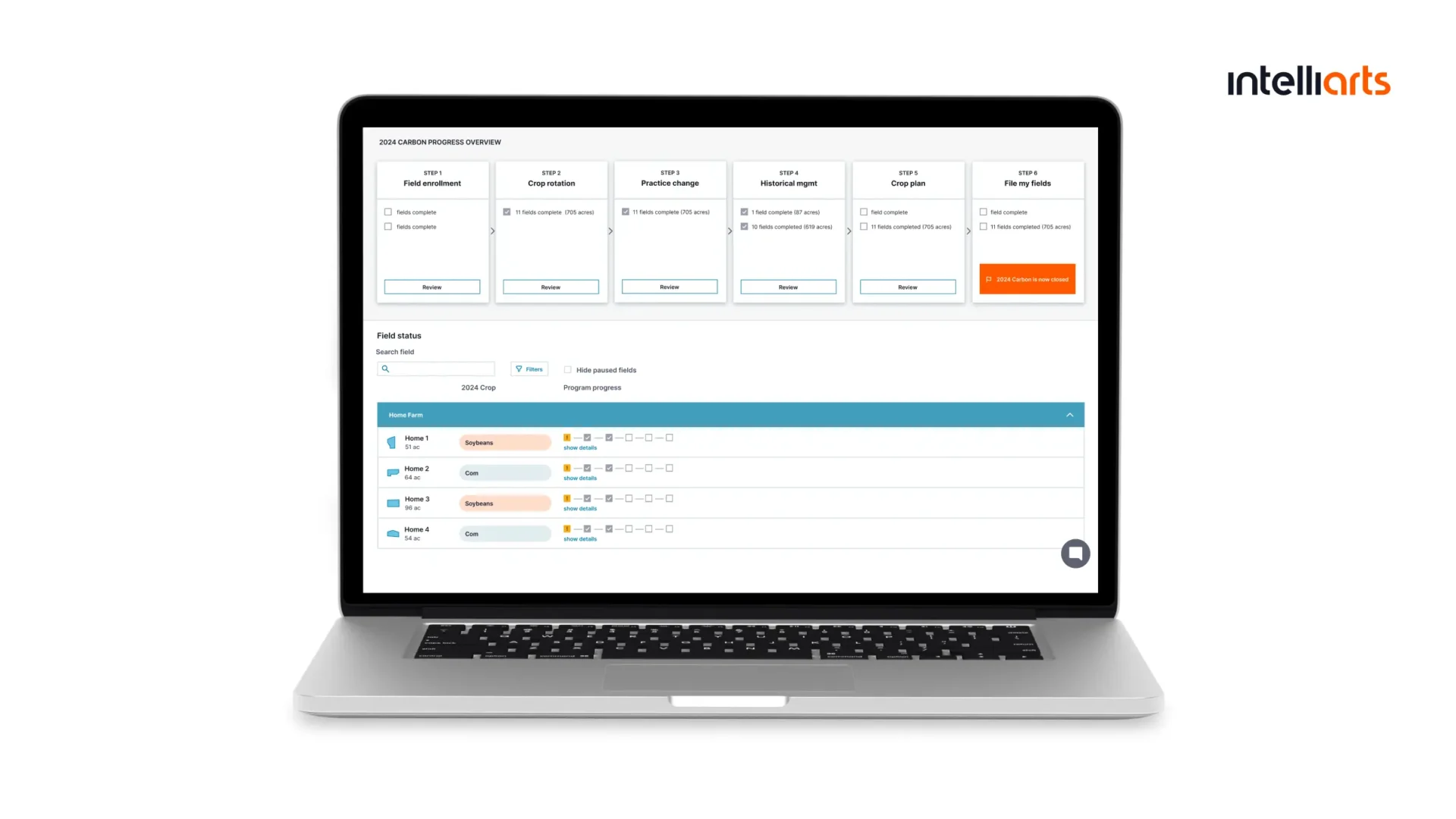
Challenge: The program required each grower to supply three to five years of historical field records. Manual entry ran up to eight hours per grower, submissions arrived incomplete, and enrollment drop-off was heavy.
Solution: Intelliarts rebuilt the intake around remote sensing and the client’s inference API, so crop type, planting dates, and field boundaries arrived pre-filled, and growers only reviewed them.
Results: Entry time fell from hours to minutes. Enrolled acreage reached 2.6 million, retention in one program held at 80%, and more than one million salable carbon credits were generated.
Model development was the smaller half of that engagement, which is the pattern worth checking in any vendor’s case studies. Read the full success story here.
Best agritech AI development firms at a glance
The best agritech AI development firms below are split into three groups: specialists with named farm clients, engineering firms carrying one strong agricultural project, and satellite analytics vendors that also take custom builds.
Read the evidence column first, since it separates delivery history from positioning.
| Company | Best for | Core agritech AI capabilities | Relevant project evidence | Engagement model |
|---|---|---|---|---|
| Intelliarts | Technical co-building and production AI | ML forecasting, remote sensing, agricultural data engineering, MLOps | Indigo Ag: land sampling redesign and automated field data intake, 2.6M+ acres enrolled, sensor losses under 4 per 1,000 | Long-term dedicated teams, product co-development |
| Intellias | Large-scale digital agriculture platforms | GIS, NDVI satellite analysis, IoT sensing, agrochemical risk scoring | Farm and crop management platforms running since 2018, vertical farm system with 60% energy savings; clients not named | Extended dedicated teams, digital innovation labs |
| Folio3 AgTech | Crop and livestock operations at scale | Computer vision for livestock, BI and analytics, ERP and traceability | Zoetis, Elanco, Vytelle, American Angus Association named; drone cattle counting at 98% accuracy | Fixed cost or time and materials, MVP scaling to platform |
| SEP | Agricultural equipment and embedded systems | Embedded telemetry, fleet data platforms, dealer systems | 15+ years with machinery OEMs, fleet data search time reduced by 99%; client under NDA | Embedded co-development inside client Scrum teams |
| Itransition | Enterprise AI integration | Computer vision, data engineering, BI | Plant pathology recognition built on ResNet-50 at 80% classification accuracy; client not named, proof of concept only | Full outsourcing, dedicated team, or team augmentation |
| EOS Data Analytics | Satellite crop monitoring and yield prediction | Remote sensing indices, crop classification, yield models on Random Forest and XGBoost, SAR for soil carbon | Agroxchange, Complete Farmer, AgriProve named; 165,000+ hectares monitored, onboarding cut from months to weeks | Subscription platform plus bespoke geospatial R&D |
| Geniusee | Agritech startups scaling IoT platforms | Satellite monitoring, weather modeling, IoT data pipelines, credit scoring | RealmFive: 40% lower data latency, 30% faster farm onboarding, 4x growth in device connections | Dedicated team or outstaffing, time and materials |
| Lemberg Solutions | Livestock computer vision and embedded devices | Edge CV on Jetson hardware, CNN model training, embedded firmware | Barkom: portable livestock weighing at 98% accuracy and 24x faster than manual; Inarix grain analysis app | Team extension or full-cycle fixed scope |
| Innowise | Field robotics and weed detection | Plant segmentation, stem detection, laser targeting | Autonomous weeding robots: 64% fertilizer savings, up to 100,000 weeds per hour; client under NDA | Dedicated ML teams, full project outsourcing |
Five of these firms publish agricultural client names: Intelliarts, Folio3 AgTech, EOS Data Analytics, Geniusee, and Lemberg Solutions. The other four work under NDA in agriculture, which means their outcome figures cannot be checked with a reference call before you sign.
That distinction matters more than portfolio size when you shortlist AI development companies for agriculture, and the sections below cover each firm in detail.
- Important note. These nine are not complete substitutes for one another. EOS Data Analytics sells a subscription monitoring platform with custom geospatial work attached, and Folio3 AgTech leads with its own products, such as AgriERP and Cattlytics.
Both hold a place on this list because they take custom engagements around those products, and buyers put them on the same shortlist as pure development vendors.
Firms like Intelliarts, Intellias, and Lemberg Solutions build to specification and hand over the code. Many programs need both: you license the imagery layer, then bring in a development partner such as Intelliarts to connect it to ERP and machine data and build models on top.
Maybe you would even need the implementation of precision farming using IoT alongside AI software. Decide which part of the stack you are buying before you shortlist vendors.
Need an AI development partner with experience in real-world agricultural systems?
Let’s discuss your agritech use case and find the right path to production.
Contact us
1. Intelliarts: Best for technical co-building and production AI
Intelliarts fits agritech companies that need machine learning running in production and want an engineering partner working next to their in-house team. Operating since 1999, the company builds agricultural data platforms, ML models, and field-facing software, and 90% of its clients return with new projects.
| Founded | 1999, offices in Lviv and Warsaw |
|---|---|
| Agritech focus | Field data collection, remote sensing, carbon program tooling, sensor management |
| Engagement | Dedicated teams with multi-season product ownership |
| Agritech projects | 1) Land sampling automation for Indigo Ag 2) field data automation for Indigo Ag 3) carbon program data intake for Indigo Ag 4) sensor inventory management system for a customer under NDA |
What we build for agriculture projects:
- Custom agritech software development and multi-season product co-development
- ML and predictive analytics, including forecasting on sparse field data
- Remote sensing and satellite imagery processing
- Agricultural data engineering, ETL and ELT pipelines, third-party data integration
- IoT and sensor integration across field and lab workflows
- Cloud infrastructure on AWS and Azure
Best fit. Companies with a product in market that needs data infrastructure, models, and monitoring running reliably, plus teams planning roadmaps across several seasons.
“An interesting thing is that sometimes we tend to continuously look at how often an agronomist overrides the model’s prediction. That frequency number is then correlated with our predictions for future renewal and retraining measures needed to be taken.” — Alexander Barinov, a Managing Partner at Intelliarts
Project example: land sampling automation for Indigo Ag

Challenge. Sampling ran on spreadsheets and manual handoffs. Samples went missing between field and lab, and the data quality feeding the carbon program suffered as a result.
Solution. Intelliarts redesigned the process around tablets, QR-coded sample tracking, and field sensors, with lab results syncing back into the analytics stack.
Results.
- Sensor losses reduced to fewer than 4 per 1,000
- Lab results available to data scientists without manual consolidation
- Five Intelliarts teams running the program in parallel at peak
Read the full success story here
From our engineering team. The demanding part of that project was not the analytics. Field crews work in dust, with gloves on, and often without signal, so sample tracking had to survive offline for hours and reconcile cleanly once a tablet reconnected.
We spent more time on sync logic and conflict handling than on the reporting layer. That ratio holds across most agritech builds we take on, and it is the part vendors underestimate at proposal stage.
Want to See How We Build Custom Agritech Systems?
Explore Intelliarts' agriculture engineering expertise, from field data collection to ML models in production.
Explore our services
2. Intellias: Best for large-scale digital agriculture platforms
Intellias suits enterprise agriculture platforms that need multi-country rollouts and sustained platform engineering. The firm has delivered agricultural projects since 2018 and employs around 3,000 engineers, which supports parallel workstreams that smaller agritech software development companies cannot staff.
Capabilities that matter for agriculture:
- GIS and geospatial mapping, including NDVI analysis of satellite imagery
- IoT sensing for greenhouses and vertical farms
- Risk scoring and heat maps for chemical runoff and leaching
- Farm management platform engineering and architecture work
Project example. A 12-person team has worked since 2018 on crop monitoring inside a farm management platform combining GIS, satellite imagery, and weather data. A separate vertical farming system built with image recognition and IoT climate control reports 60% energy savings.
Best fit. Large agribusinesses and platform owners that need several teams at once and multi-year platform ownership.
3. Folio3 AgTech: Best for crop and livestock solutions
Folio3 AgTech carries the deepest named-client roster here, built on two decades of agriculture work and 600+ delivered projects. The unit runs its own products alongside custom builds, with an advisory board drawn from pork production, animal health, and seed genetics.
Capabilities that matter for agriculture:
- Computer vision for livestock counting and monitoring
- ERP implementation on NetSuite and Dynamics 365, plus traceability software
- BI and self-service analytics on Power BI and Tableau
- Herd, feedlot, and seed certification workflows
Project example. Weaver Popcorn Hybrids went live on a grower ERP in five months and kept the project under $50,000, with manual Excel reporting reduced by 80% and daily tool adoption up 50%. Separately, drone-footage cattle counting for Australia’s second-largest beef producer is published at 99.9% accuracy.
Best fit. Livestock, animal health, and food supply businesses that need operational systems first, with AI solutions for agriculture applied to herd monitoring.
4. SEP: Best for agricultural equipment and embedded systems
SEP has built software for agricultural equipment manufacturers since 2011, working from Indiana as a 180-person employee-owned team. Founded in 1988 with 100% US delivery, it sits at the highest rate band among the agriculture software development firms here.
Capabilities that matter for agriculture:
- Embedded in-cab display and guidance software
- Machine-to-machine telemetry across large equipment fleets
- Fleet data platforms and dealer-facing systems
- Cloud migration for OEM data estates
Project example. An 8+ year partnership with a heavy farming machinery manufacturer covers embedded display software across a tractor generation. A separate web application reduced the time to search, analyze, and display data across tens of thousands of machines by 99%, and a fleet management build delivered 10x faster data calculations with dashboards localized in four languages.
What to check. SEP publishes no agricultural AI or ML project, and its machine learning case studies sit in aerospace, energy, and finance. Agricultural clients stay unnamed under OEM agreements, and engagements start at $100,000 with US-only rates.
Best fit. Equipment manufacturers and telematics providers that need embedded engineering and US-based delivery.
5. Itransition: Best for enterprise AI integration
Itransition brings 28 years of enterprise software work, 3,000+ professionals, and a strong industrial computer vision practice. Agriculture sits outside its listed verticals, so weigh it for integration depth against agriculture software development firms with domain history.
Capabilities that matter for agriculture:
- Image classification and defect detection with CNN architectures
- Data engineering, BI, and enterprise system integration
- Legacy modernization across ERP and CRM estates
- MLOps practice, evidenced outside agriculture
Project example. An image recognition proof of concept for plant pathology used ResNet-50 classifiers, with synthetic training data generated from 2,000 provided photos, reaching 80% correct pathology identification. The client demonstrated it to investors eight months after kickoff.
What to check. That proof of concept is the only agricultural delivery in the public portfolio, and the client is unnamed. Itransition’s agriculture pages describe work by third parties such as Blue River Technology and OneSoil, so read them as market commentary.
Best fit. Enterprises folding agricultural data into existing ERP and BI systems, where integration weighs more than agronomic modeling.
6. EOS Data Analytics: Best for satellite crop monitoring and yield prediction
EOS Data Analytics operates its own satellite analytics platform with 160 employees, including 55 in-house data scientists and GIS specialists. Founded in 2015 and headquartered in Menlo Park, it is the remote sensing specialist among these AI development companies for agriculture.
Capabilities that matter for agriculture:
- Vegetation index processing, including NDVI, NDRE, NDWI, and MSAVI
- Crop classification and field boundary detection
- Yield prediction using regression methods, Random Forest, XGBoost, and an adapted WOFOST crop model
- Radar and optical fusion for soil carbon measurement
Project example. AgriProve oversees more than 700 projects covering over 175,000 hectares and manages over 70% of all soil carbon projects registered in Australia’s ACCU Scheme. Working with EOSDA reduced its project onboarding from months to weeks.
What to check. Most wins are platform subscriptions or white-label deployments, and the published methodology list describes what EOSDA can apply, not what runs on every job. Their own cotton yield proof of concept used Random Forest alone, with WOFOST excluded.
Best fit. Teams that want imagery analytics running quickly and can build around a licensed platform.
Planning an AI project in agriculture?
Intelliarts can help you move from prototypes to production-ready solutions.
Let’s discuss
7. Geniusee: Best for agritech startups scaling IoT platforms
Among the agritech software development companies here, Geniusee is the one built around startup delivery, with 250+ specialists across Austin, Warsaw, Stockholm, and Kyiv.
Founded in 2017, the firm sells dedicated teams and outstaffing on time-and-materials terms.
Capabilities that matter for agriculture:
- Agricultural IoT data pipelines on AWS for soil moisture, rainfall, and tank sensors
- Satellite monitoring and weather modeling
- Mobile applications for field use
- Credit scoring models for smallholder financing
Project example. RealmFive rebuilt its data architecture with Geniusee and reports 40% lower latency, new farms onboarded 30% faster than originally projected, and four times the growth in device connections handled without performance loss. Its mobile app passed 50,000 downloads at a 4.5 rating.
What to check. The agritech portfolio holds two references. The 50% farmer income figure on the Ricult page describes Ricult’s own program results in Thailand before the engagement, and computer vision is not evidenced in either project.
Best fit. Funded agritech products scaling sensor networks and grower-facing apps.
8. Lemberg Solutions: Best for livestock computer vision and embedded devices
Lemberg Solutions builds agricultural hardware and edge AI with 200+ experts, working in agriculture since 2007. Five agriculture clients are named publicly, and the firm covers the device layer most agritech development partners leave to specialists.
Capabilities that matter for agriculture:
- CNN training for weight estimation and crop quality assessment
- Edge inference on NVIDIA Jetson with Intel RealSense depth sensing
- Embedded firmware, including GNSS correction modems
- Device interfaces on Raspberry Pi and Qt
Project example. Barkom’s portable weighing device measures pigs in motion using a model tested on almost 17TB of real farm data, returning weight in 8 to 10 seconds at 98% accuracy and cutting weighing time by a factor of 24. Inarix and AgriData Innovations followed with grain quality and germination analysis tools.
What to check. Evidenced AI is computer vision and edge inference, with no satellite, yield forecasting, or MLOps platform work. The Syngenta Group engagement on their site is Drupal website development and carries no AI component.
Best fit. Hardware-adjacent agritech, livestock analytics, and inference that runs on the device.
9. Innowise: Best for field robotics and weed detection
Innowise runs 3,500+ IT professionals from Warsaw and delivered one of the more demanding agricultural systems in this comparison. Robotics perception is the reason it earns a place.
Capabilities that matter for agriculture:
- Plant segmentation and stem detection networks
- Laser targeting control with millimeter-level range detection
- Computer vision pipelines on PyTorch, OpenCV, and MMSegmentation
- Robotics software and control integration
Project example. An autonomous weeding system built by six specialists over 14 months kills over 100k weeds per hour, with laser parameters tuned to determine range to 2 mm, and reports 64% fertilizer savings.
What to check. The client sits under NDA as a European producer of autonomous agricultural robots. Innowise’s agriculture industry page lists case studies drawn from HR, retail, healthcare, and travel, which makes its agricultural depth harder to assess than the robotics case alone suggests.
Best fit. Robotics and autonomous equipment builders that need perception models and control software inside a custom agritech software development program.
Which agritech AI development firms are best positioned as technical co-builders?
Among the best agritech AI development firms compared here, Intelliarts, Intellias, and SEP hold the strongest co-building records, each with multi-year engagements where their engineers worked inside the client’s own delivery structure.
The remaining providers in the list above offer mainly fixed-scope builds or platform subscriptions, which suit a defined deliverable and work less well for a product that keeps evolving.
A technical co-builder such as Intelliarts takes part in:
- Product discovery and data readiness assessment
- Architecture decisions and technology selection
- ML and data pipeline construction
- Integration with farm management systems, ERP, and machine data
- Deployment, monitoring, and retraining
- Roadmap planning across seasons
- Selection and negotiation of third-party data providers, e.g., imagery and weather APIs
- Data governance, residency, and grower data ownership terms
- Test automation and QA under field conditions, including hardware-in-the-loop
- Other engineering, software, and analytics-related services
| Firm | What the co-building record shows |
|---|---|
| Intelliarts | Three consecutive programs for the same agritech client, covering land sampling, field data automation, and carbon program intake. Five teams ran in parallel at peak; discovery and data readiness are handled in-house before scoping, and partnerships average past four years with 90% of clients returning |
| Intellias | A 12-person team on one client's farm management platform since 2018, having initiated its test automation and architecture work |
| SEP | Engineers embedded in the client's global and regional Scrum teams with on-site support, one OEM relationship over the past eight years |
Intelliarts, as a long-term agritech development partner, offers agritech AI development, Intelligent forecasting, and precision agriculture among our other services. We have dedicated teams as well as engineering leads available for reference calls before you commit.
Have an agritech AI idea but need the right technical partner to bring it into production?
Get in touch with the Intelliarts team
Which firms have built production-grade ML pipelines for precision agriculture?
Intelliarts and EOS Data Analytics show the clearest documented evidence of machine learning pipelines running in production on farms, followed by Innowise and Lemberg Solutions, whose models run at the edge on robots and field devices.
The remaining firms publish deployed software without models, models without deployment, or agriculture without either.
Production-grade ML pipelines are those that ingest, process, deploy, monitor, and retrain on their own schedule with field conditions taken into consideration. The respective scope of service is shown in Intelliarts’ data engineering page.
What a vendor should be able to provide across the full cycle in case of a production-grade ML pipeline:
- Automated data ingestion from imagery, sensors, and third-party providers
- Data processing, validation, and reconciliation
- Model deployment into the systems people use daily
- Monitoring for drift and data quality
- Retraining on a defined schedule or trigger
- Integration with farm management platforms, ERP, and machine data
- Scalability across acreage, devices, and seasons
- Error handling when a feed, sensor, or API stops responding
Programs tied to carbon credits or sustainability reporting add even more requirements. Here’s what an Intelliarts expert has to say about that:
“Carbon and compliance put reproducibility into the spotlight. You might ask: why? Well, just imagine you have to rebuild a 2023 prediction with legacy code and outdated imagery, years later.” — Marta Kufalska, an Agritech Solution Expert at Intelliarts
And here’s our list of evidence on documented agricultural ML in production per agritech provider in the blog:
| Firm | Documented agricultural ML in production |
|---|---|
| Intelliarts | ETL and ELT pipelines with medallion architecture, near real-time ingestion of external agronomic data, integration with an inference service pre-filling grower records |
| EOS Data Analytics | Continuous satellite ingestion, index processing, crop classification, and yield models serving paying customers |
| Innowise | Real-time plant segmentation and stem detection running on autonomous weeding machines in European fields |
| Lemberg Solutions | CNN inference on NVIDIA Jetson devices used in daily livestock weighing, trained on almost 17TB of farm data |
| Folio3 AgTech | Computer vision counting cattle from drone footage for a large beef producer |
| Intellias | NDVI analysis and image recognition inside client farm platforms since 2018 |
| Geniusee | IoT ingestion holding four times growth in device connections without performance loss |
| Itransition | Plant pathology classification reaching 80% accuracy |
| SEP | Fleet telemetry platforms across hundreds of thousands of machines |
Across the best agritech AI development firms reviewed here, the stage least often evidenced is retraining and drift monitoring, which is the stage that decides whether a yield forecasting model holds up in season two as well as it did in season one.
Intelliarts and EOS Data Analytics are the only two with documented systems running through repeated seasons.
Interested in exploring how ML engineers at Intelliarts handle data pipeline projects? Read how we built a big data pipeline on an actual case in another blog post.
What should you compare beyond team size and price?
Compare production evidence, the seniority mix behind the rate, and the terms covering monitoring and retraining. Agricultural technology consulting firms will advise on the roadmap, and these checks apply to whoever writes the code afterwards.
Team size and rate say what a month costs. They say nothing about the second season, when accuracy drifts, and the original team has rotated off.
The checklist below sets out what to compare additionally, with indications of what exactly to look for and practical examples based on Intelliarts:
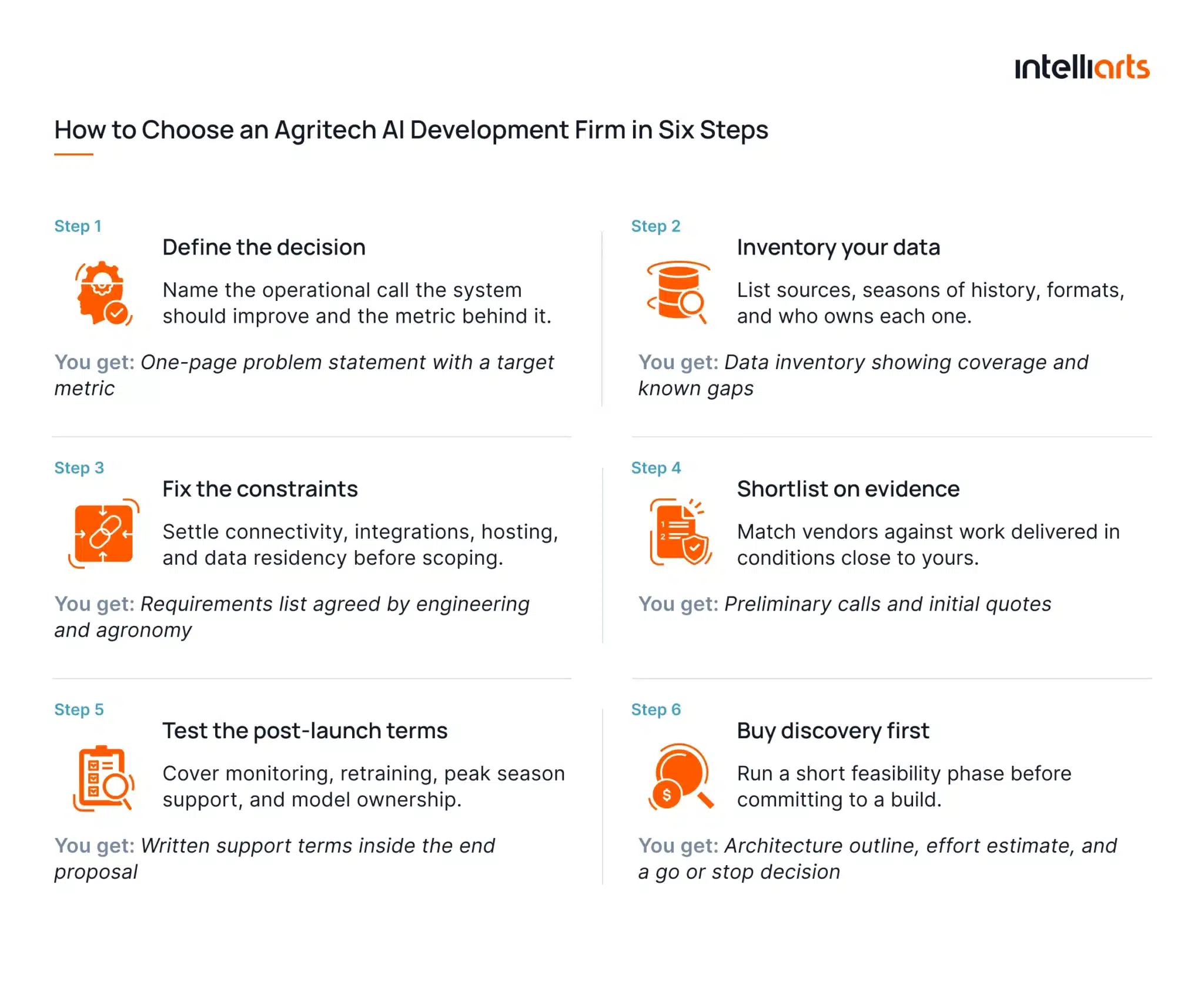
You check an agritech development firm’s past project references by getting the engineer who ran the delivery onto the call, then matching what they describe against the published case study. NDA coverage is standard in agriculture, so the real question is whether any client will speak to the work at all.
From the work of Intelliarts experts in the industry, an engineer who has shipped a field data system already knows harvest, laboratory assessment, seasonality, and other farming-related aspects. Intelliarts can staff agritech programs with engineers who have shipped field data and remote sensing systems and therefore can offer the best expertise for your project.
Having a proper tech stack can also be crucial for an agriculture project. Take a look at top precision agriculture tools that you or your trusted vendor might be using in another one of our blog posts.
How to choose the right agritech AI development firm
Start with the decision the system should improve, confirm your data can support it, and compare the best agritech AI development firms only after those two are settled.
Projects that stall usually run the sequence backwards, with an agriculture AI development company selected before anyone has inventoried the field records the models would need.
The steps below run from problem definition to a signed discovery phase, with the artifact each one should leave behind:
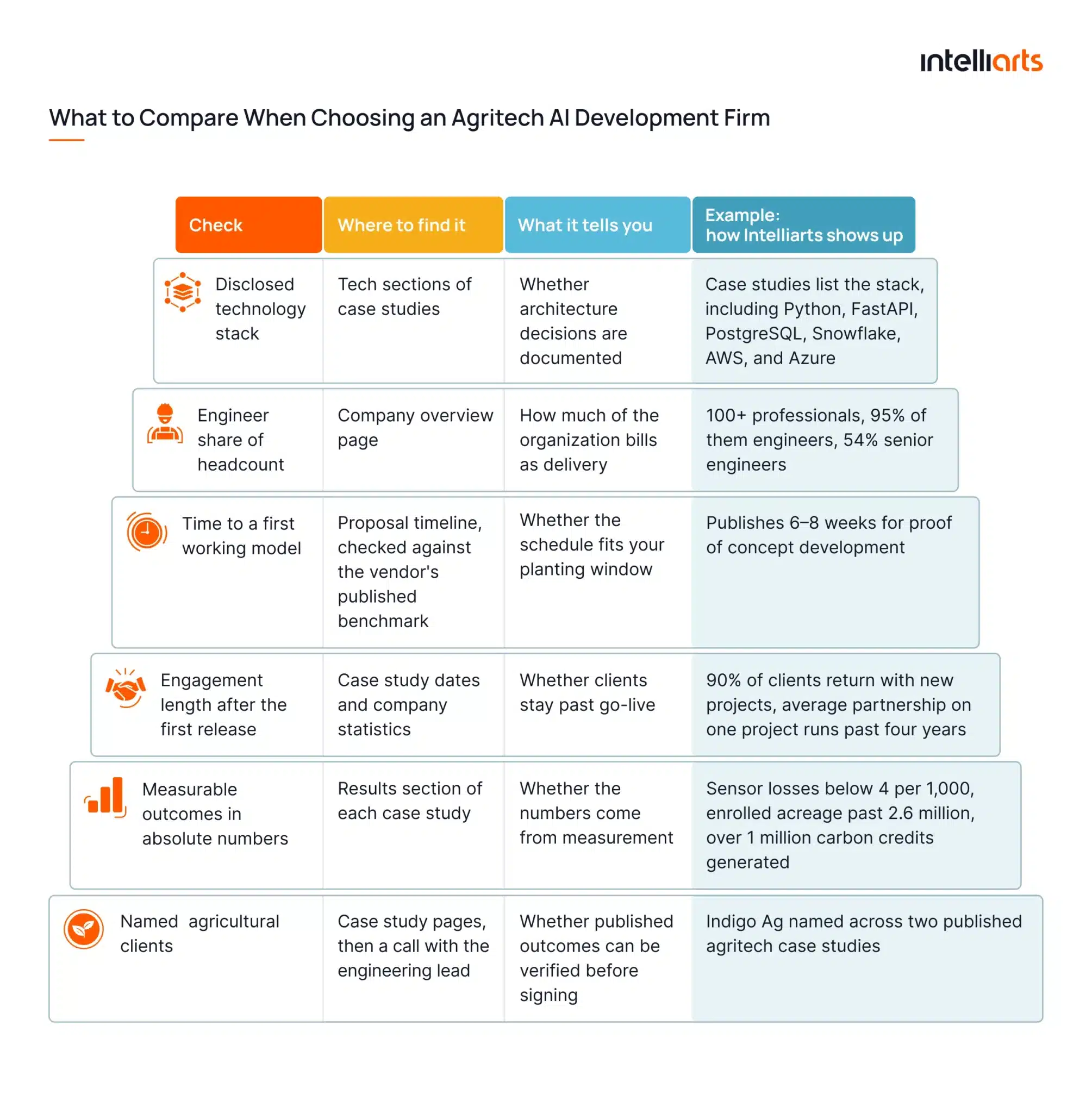
Discovery is the cheapest place to find out that three seasons of records are missing or that a satellite feed cannot cover your region in June.
Intelliarts usually opens agritech engagements with a data readiness review and an architecture outline for that reason, so the estimate reflects the sources you hold today.
For companies that need an assessment beforehand or struggle to evaluate their project viability, we offer both advice during a free discovery call as well as paid technical consultation for more in-depth matters.
Find more information on how to choose an agritech company in this article.
Which agritech AI development firm should you choose?
Choosing among the best agritech AI development firms comes down to evidence you can verify: named clients, models that survived more than one season, and written terms covering the period after launch.
Platform vendors, ERP specialists, and engineering partners all appear on this list, and they cater to varying project needs.
Intelliarts fits companies looking for a long-term technical co-builder across agricultural data, ML, and software development. We have more than 27 years of experience delivering software services for international customers from different domains, including agriculture. 90% customer return rate and in-house expertise, allowing us to deliver development of any complexity.
Looking to explore more ways of utilizing AI in your business? Read 10 AI in agriculture use cases covering crop monitoring, forecasting, and computer vision.
Entrust us with your agritech AI project
We will evaluate your project, conduct a strategy session, and provide an accurate quote. End-to-end, business-focused assistance.
Contact us
FAQ
What are the best agritech AI development firms in 2026?
The best agritech AI development firms in 2026 pair machine learning depth with agricultural domain knowledge. Intelliarts, Intellias, Folio3 AgTech, SEP, and Itransition lead in documented work with field data, remote sensing, and production deployment.
Which agritech AI firms can act as technical co-builders?
Technical co-builders take part in discovery, architecture, ML pipelines, and long-term product work. Intelliarts and Intellias fit this model most closely among agritech AI development companies, since both staff dedicated teams that work alongside in-house engineering for years.
Which firms build production-grade ML pipelines for precision agriculture?
Production-grade means automated ingestion, monitoring, retraining, and error handling in one running system. Intelliarts, Intellias, and Itransition publish evidence of deployed pipelines, which matters when you compare AI development companies for agriculture on engineering maturity.





![Top MLOps Tools in 2026 and Their ROI [Based on Real Projects]](https://intelliarts.com/wp-content/uploads/2026/08/ChatGPT-Image-23-июн.-2026-г.-11_16_54-1.webp)