
Smart sensors help manage water waste, soil loss, and livestock tracking. Set to reach $7.27 billion in market value, they’ll soon be a must-have for every farm.
Agriculture feeds the world and supports local economies, but it also feels the full weight of modern times. Cities expand, pollution rises, soil loses quality, and water becomes harder to manage. If you work in this space, you know traditional farming doesn’t stretch as far as it used to, so it might be time for a change.
Analysts at Fortune Business Insights project the agriculture sensors market to reach $7.27 billion by 2034, making it one of the most in-demand technologies in the field. Smart sensors cover a number of tasks, from temperature monitoring to tracking livestock, painting a full picture of your farm’s health.
Here, we’ll list the main types of agricultural sensors, explain what each does best, and show how to use them for maximum impact, both for your business and for the planet.
What are the sensors used in smart agriculture?
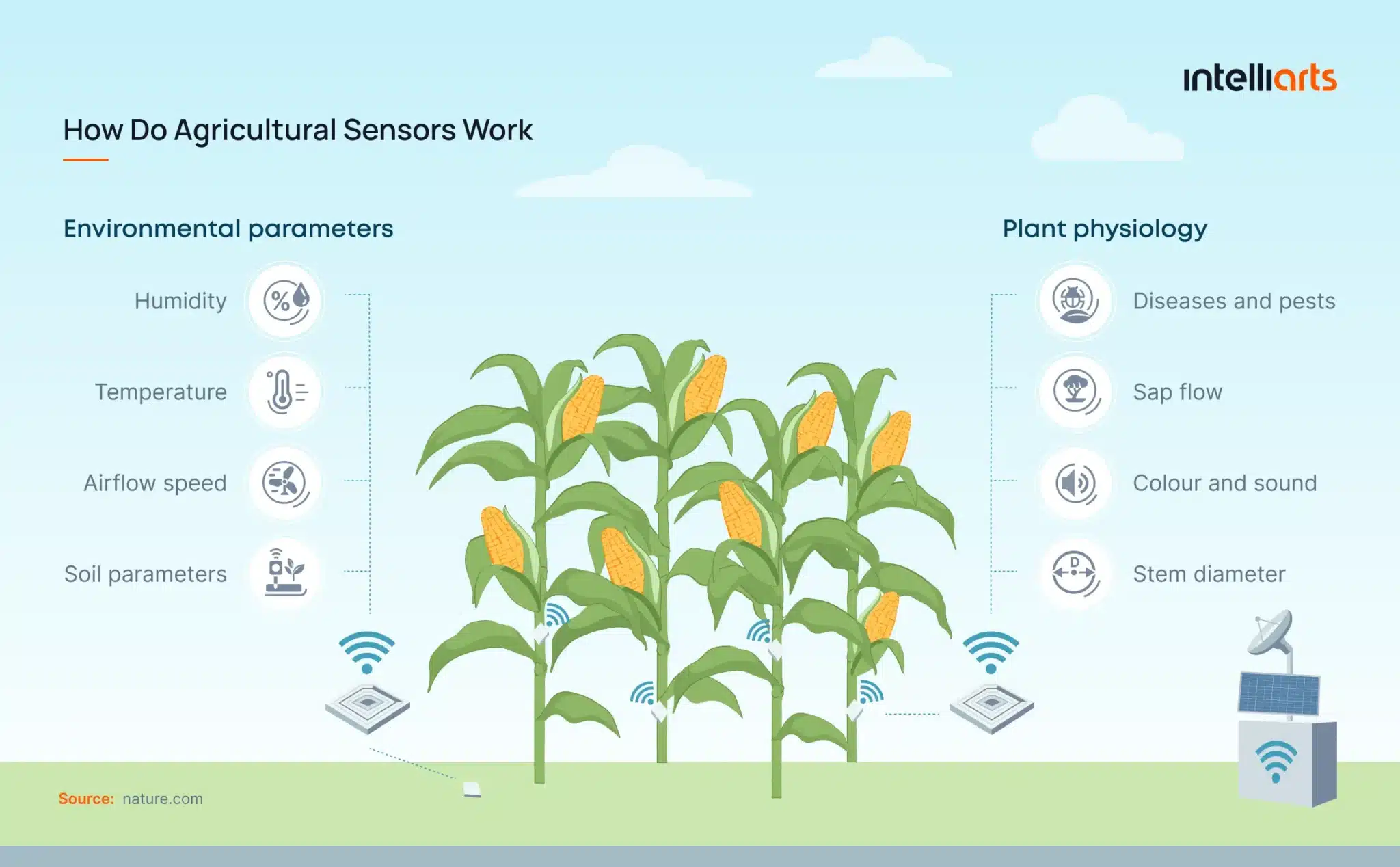
Agricultural sensors are devices that collect information from your farm environment and send it to become actionable data. They can track soil moisture, humidity, light levels, crop health, etc.
Basically, sensors are the eyes and ears of modern farming. They react to physical or chemical changes, such as a change in soil moisture, and convert that into an electrical signal or data.
The real value of agricultural sensors is about turning data into automated decisions. When sensor networks connect directly with irrigation, fertilization, or analytics systems, farms move from observation to real-time optimization.
– Martha Kufalska, Agritech Solution Expert @Intelliarts
In some cases, sensors are only for monitoring. In others, they can trigger an action like watering a crop when the soil is too dry.
Why invest in smart sensors?
Climate change creates difficult conditions for farmers. Droughts, heavy rain, and extreme temperatures interfere with planning and schedules, while demand for food rises every second. Clearly, the farmers of today must adapt to these changes.
Agricultural sensors help detect stress, prevent losses, and make smarter choices. When you get direct information about the state of your farm, you don’t have to rely on visual checks alone and can base decisions on measurements.
- Studies show that sensors and precision farming practices increase crop yields by 10-20%, and in some cases even more.
- Sensors also reduce waste. IoT networks cut fertilizer use by 50% and water use by 30%, not affecting yields.
Over time, small savings become tangible. Many farms reach a positive ROI (return on investment) within 2-5 years after installing sensor-based systems thanks to lower input costs and higher productivity.
For example, in one Intelliarts project with agritech company Indigo Ag, our engineers integrated sensor data and automated pipelines for processing field records such as seed types, locations, and irrigation data. The solution reduced manual data entry from around 8 hours to just 1–2 minutes, allowing agronomists to focus on analysis rather than administrative tasks. The latter had a significant ROI impact as a result.
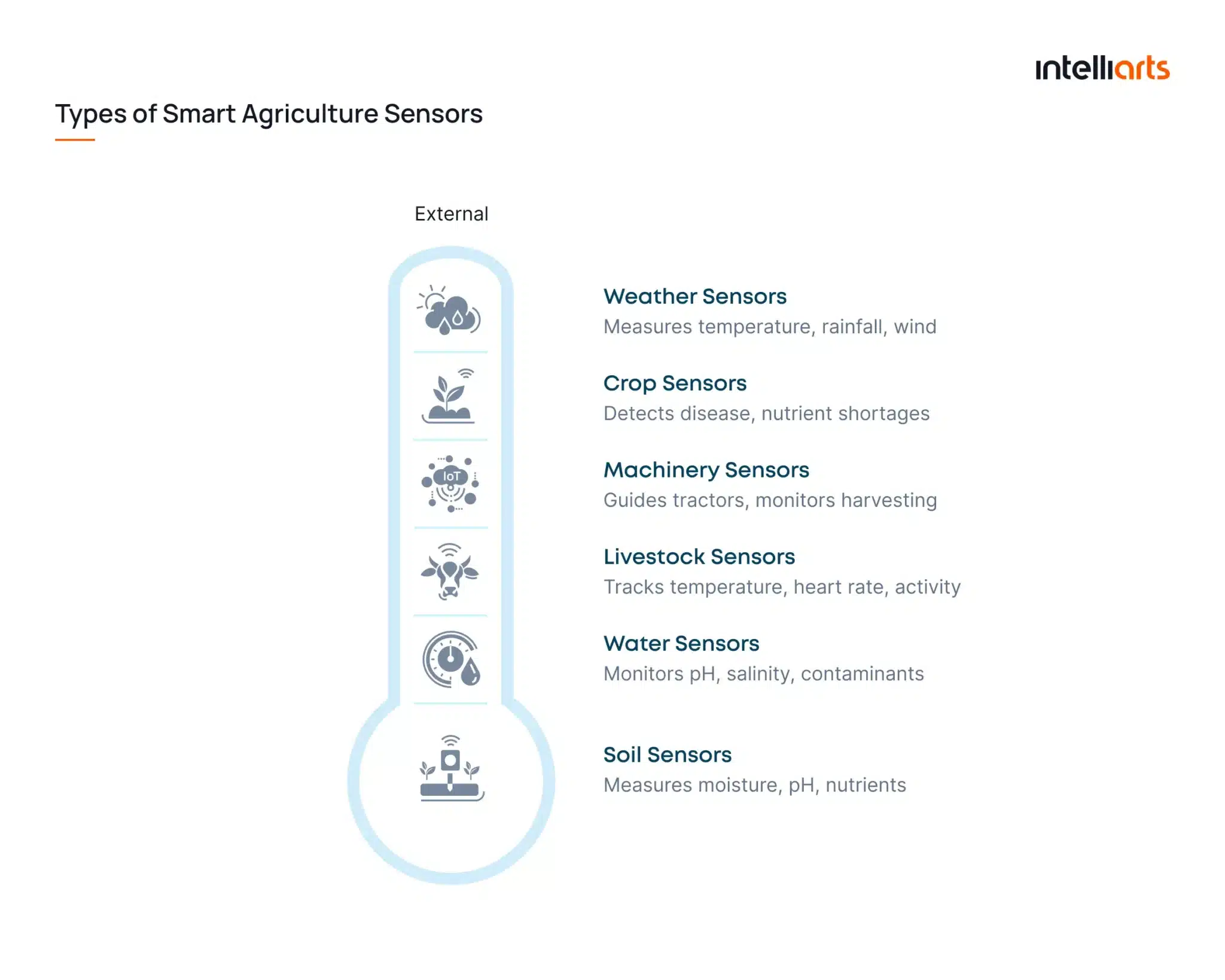
Types of smart agriculture sensors
Agriculture sensors cover a range of tasks, yet the most effective use of IoT is an interconnected network that spans all areas of your operation. Let’s break down the most common sensor types one by one.
Soil and nutrient sensors
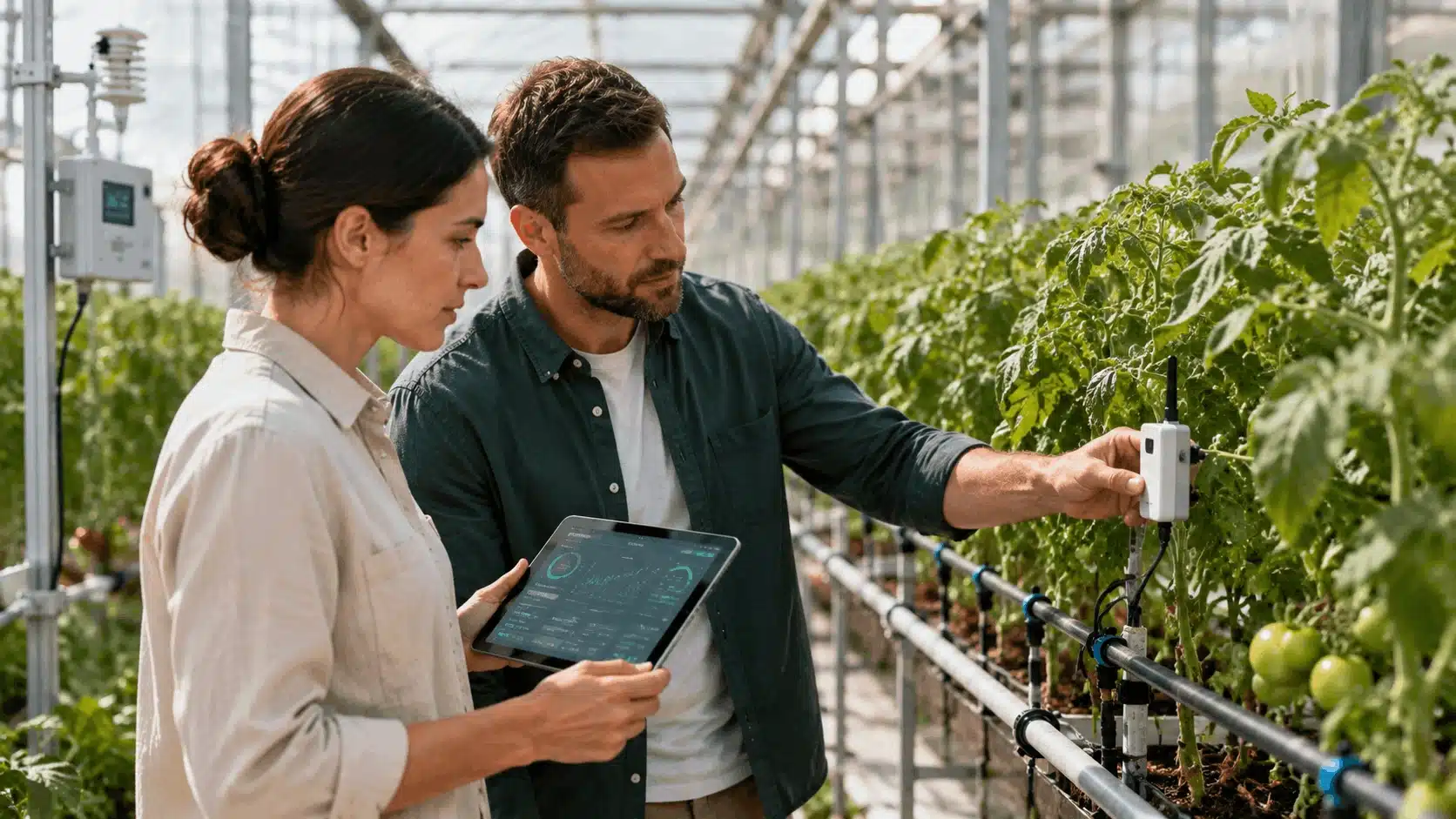
Roots and leaves achieve balanced water flow only when soil moisture is optimal, and the same goes for sustenance. Sensors measure moisture, temperature, pH, and nutrient levels.
How it works:
- Moisture sensors are placed in the soil to measure how much water is present at different depths.
- pH and nutrient sensors check the soil’s chemical makeup, including nitrogen, phosphorus, potassium, and acidity.
- All this data goes to a dashboard or irrigation system so you can adjust watering and fertilizing in real time.
Benefits: You water only when needed, waste less fertilizer, and provide crops with better growing conditions.
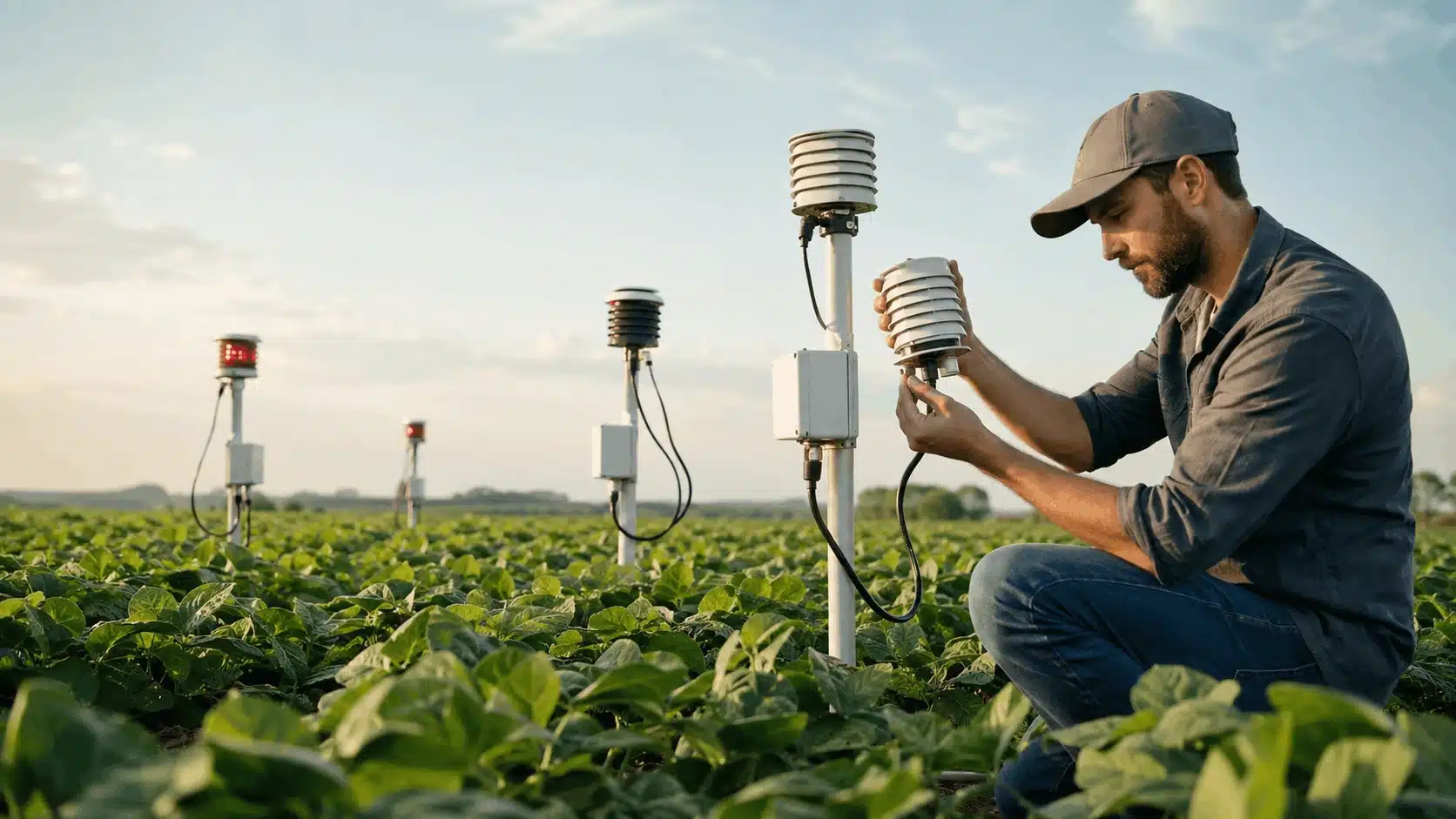
Weather and climate sensors
Farms that use real-time weather data make better decisions about when to plant or protect crops. Studies of precision farming show crop yields can be 20% higher when using weather sensors.
How it works:
- Temperature sensors use electronic thermometers and hygrometers.
- Rainfall sensors collect precipitation data with tipping buckets or optical sensors.
- Wind sensors measure speed and direction.
- Data is transmitted for alerts and scheduling.
Local microclimates can vary significantly even within the same farm. Weather sensors placed across fields provide localized data that helps farmers schedule spraying, planting, and harvesting far more accurately than relying on regional forecasts.
– Martha Kufalska, Agritech Solution Expert @Intelliarts
Benefits: Better timing for planting, spraying, and harvesting, and lower risk of weather damage.
Crop health and imaging sensors
Crop disease often starts before visible signs. By the time you notice yellow leaves, the damage might already be done. Imaging sensors catch the small changes and gather data for targeted treatments.
How it works:
- NDVI (Normalized Difference Vegetation Index) sensors measure red and near-infrared light reflected by plant canopies, indicating plant health, chlorophyll content, and biomass.
- Multispectral and hyperspectral cameras capture images in different wavelengths.
- AI or machine learning analyzes data to find signs of pests, diseases, or nutrient shortages.
Benefits: Earlier detection of problems, fewer crop losses, and better field planning.
Learn more about farm equipment imaging in today’s agricultural businesses.
Livestock monitoring sensors
Health issues in animals are harder to notice in large herds. A single cow that eats less can trigger a disease spread, which is why livestock sensors monitor activity and feeding habits 24/7.
How it works:
- Wearable sensors track temperature, heart rate, and movement.
- RFID (Radio Frequency Identification) tags and GPS collars show location and activity.
- The data is sent to farm software that flags unusual behavior.
Benefits: Faster response to illness and better-planned feeding and grazing.
Water quality sensors
Water monitoring tools give you lab results instantly, no waiting. Sensor-driven irrigation systems have been shown to improve yields by 8–20 % and help save water at the same time.
How it works:
- Sensors measure pH, salinity, oxygen levels, turbidity, and contaminants.
- The results go to a dashboard or irrigation system.
Benefits: Safer water use, lower risk of stress on crops and livestock, and better water control.
Automated machinery sensors
IoT tech and smart sensors in tractors and harvesters can save $5,000-$15,000 per machine per year just from better fuel use, fewer overlaps, and less downtime.
Automation also improves how farms manage operational data across large agricultural environments. In one Intelliarts case study, integrating sensor-driven data pipelines and automated workflows helped our agritech partner scale its internal data infrastructure, contributing to 260% operational growth while maintaining reliable data processing across multiple farming locations.
How it works:
- GPS systems guide tractors and planters for accurate field work.
- Load sensors monitor harvesting machines to prevent overload.
- Drones with cameras scan fields for crop health and field mapping.
- Data integrates with farm management systems to automate operations.
Benefits: Reduce manual labor, save resources, and improve farm efficiency.
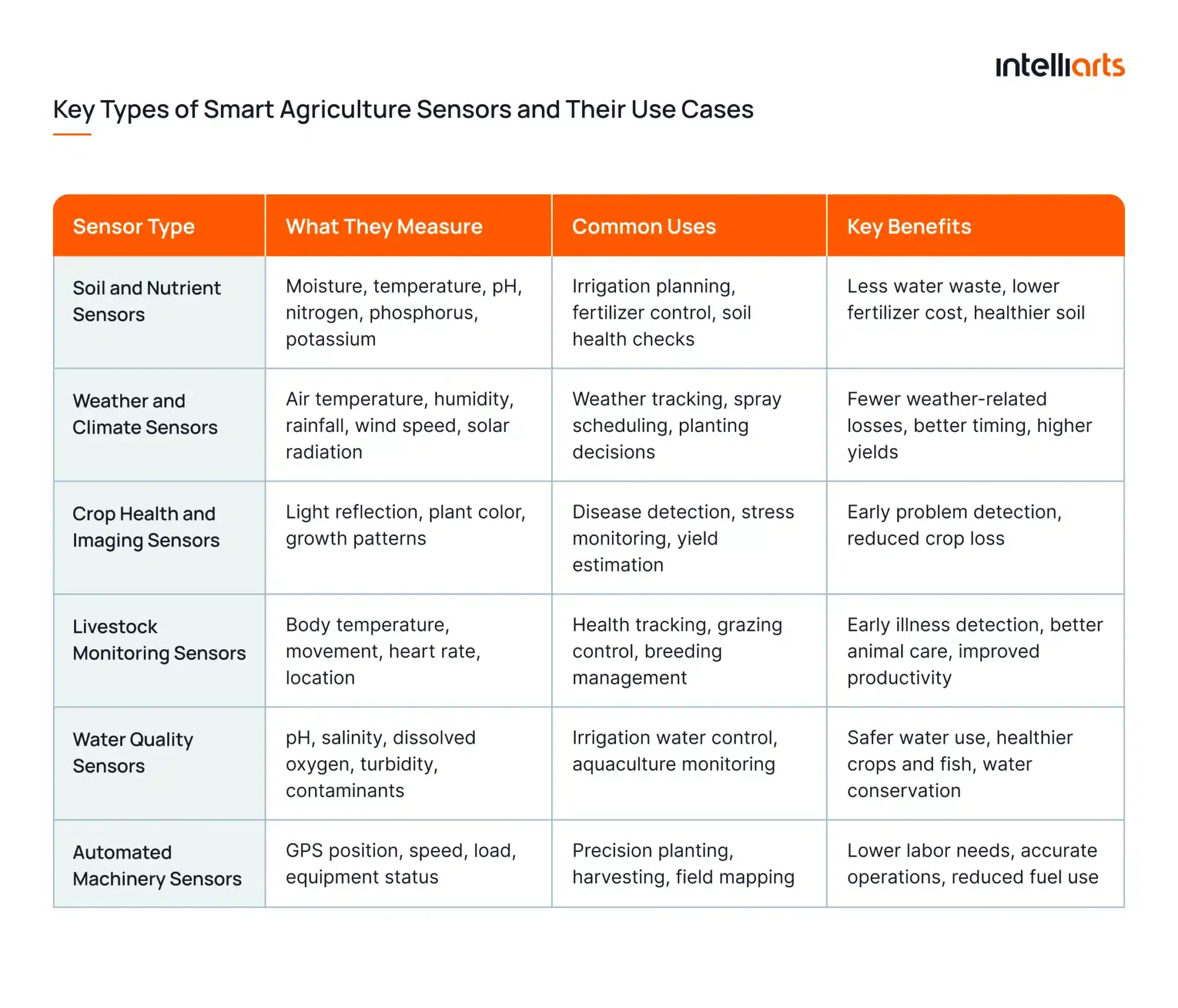
For your convenience, here’s a short summary of the topic in a table with key sensor types, use cases, and benefits:
Final thoughts
With the weather getting less predictable and food demand going up, guessing is a risky game. Sensor-based farming is what keeps your farm steady, productive, and able to last for the long run.
Smart farm sensors track soil, weather, crops, animals, water, and equipment, and when they work together, you get a full picture of what’s really going on in your fields. You can see problems before they appear, and stop wasting fertilizer and water.
However, sensors alone are only part of the equation. To unlock their full value, farms need robust software platforms that collect, analyze, and transform raw sensor data into actionable insights. With 25+ years of experience in software engineering, Intelliarts helps agribusinesses turn agricultural data into practical solutions. If you’re looking for a partner with exclusive expertise, 90% retention rate, and lasting quality as a core value, contact us to schedule a consultation.
FAQ
What are the different types of smart sensors?
Smart agriculture sensors collect environmental and operational data to support precision farming. The most common types include soil and nutrient sensors, weather and climate sensors, crop health and imaging sensors, livestock monitoring sensors, water quality sensors, and machinery sensors.
What are the 4 modern farming methods?
Modern agriculture increasingly relies on technology-driven practices. Among its widely adopted farming methods, there is precision farming, also known as precision agriculture, which stands for using sensors, GPS, and analytics to optimize crop inputs and field management. Hydroponics and vertical farming refers to growing plants without soil in controlled indoor environments. Smart farming or IoT-based agriculture integrates sensors, automation, and real-time monitoring systems. Finally, sustainable and regenerative farming include practices focused on improving soil health and reducing environmental impact.
What are the 4 types of IoT?
IoT systems are typically grouped into four main categories: consumer IoT, commercial IoT, Industrial IoT (IIoT), and agricultural IoT (Agri-IoT). Consumer IoT relates to smart home devices such as thermostats, wearables, and appliances. Commercial IoT includes smart systems used in offices, retail, and healthcare. IIoT refers to connected machines and sensors used in manufacturing and infrastructure. Finally, Agri-IoT refers to sensor networks and automation technologies used in farming operations.