
TL;DR
- Food and Agriculture Organization (FAO) puts agriculture’s share at 72% of total freshwater withdrawals.
- By 2050, agriculture may need to produce 50% more food, feed, and fibre than in 2012, alongside 25% more freshwater. That pressure explains the business case for the Internet of Things (IoT).
- Co-ops, agritech startups, large growers, and farms need solutions for better control over field conditions, greenhouse climate, and other aspects.
- This guide walks through the main IoT applications in smart agriculture, including precision irrigation, weather monitoring, livestock tracking, greenhouse automation, and remote asset monitoring.
- It also explains the typical costs behind implementation, from sensors and software to integrations, maintenance, and analytics.
- We also explain why raw sensor data only pays off when paired with analytics and AI (forecasting, optimization, anomaly detection), which is where Intelliarts comes in.
What do we mean by “IoT in Smart Agriculture”?
IoT in smart agriculture is a network of connected sensors, agriculture IoT devices, platforms, and applications for monitoring and automating farm operations.
It covers the following and multiple other aspects:
- Soil moisture
- Weather
- Livestock health
- Greenhouse conditions
- Irrigation infrastructure
- Equipment status
- Remote assets.
Farm teams use this data to see what is happening across facilities and, correspondingly, trigger decision-making and actions. Less manual labor involvement is prioritized here.
Operational scope: The same model can support a focused irrigation pilot or a multi-site agriculture operation.
In field crops, the priority may be soil moisture, weather, and pump control. In greenhouses, it may be climate, CO₂, light, and irrigation control. In livestock operations, it may be animal movement, location, and health indicators.
Architecture breakdown:
- Field layer: Sensors, gateways, and controllers collect data from crops, soil, livestock, equipment, and farm infrastructure.
- Connectivity and platform layer: Cellular, LPWAN, satellite, or mixed networks move field data into IoT platforms and storage systems.
- Application and analytics layer: Dashboards, alerts, mobile apps, and AI/ML models help teams use that data for decisions.
These layers help farms connect physical conditions with decisions around irrigation, yield, livestock health, equipment use, and resource planning. That is the software foundation behind IoT in smart farming.
Turn raw field data into action
We embed data pipelines, analytics, and ML models into smart agriculture IoT solutions.
Explore our services
Top IoT applications, benefits, and cost ranges
Use cases are the best place to start when evaluating IoT in smart agriculture and smart farming technology solutions. They help estimate hardware needs and ROI, and understand the benefits of each approach.
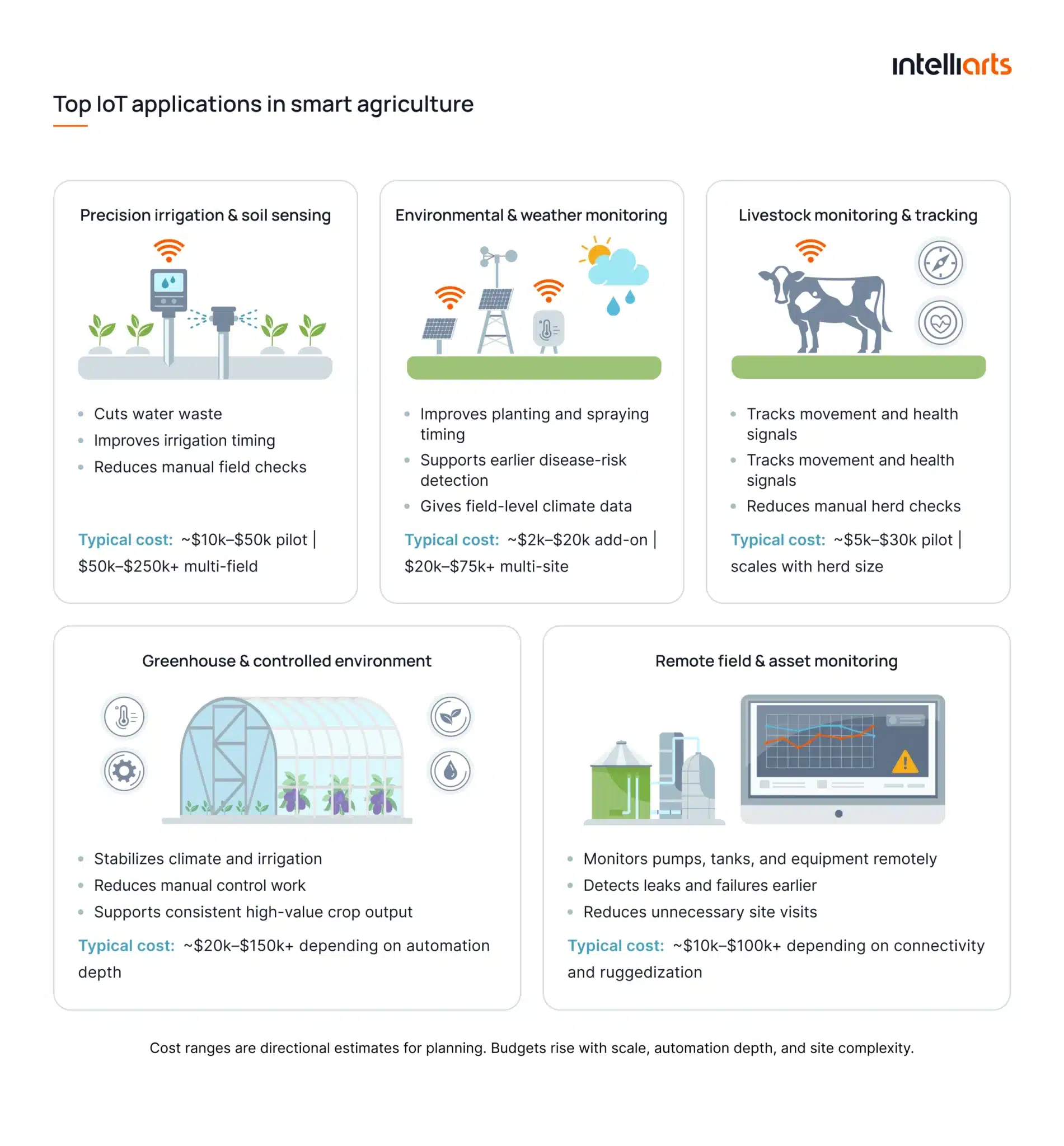
See the table below for a general use cases overview:
| IoT application | Main benefits | Typical cost range* |
|---|---|---|
| Precision irrigation & soil sensing | 1) Cuts water waste through zone-level irrigation. 2) Improves timing based on soil and weather data. 3) Reduces manual field checks. | ~$10k–$50k for a focused pilot; $50k–$250k+ for larger multi-field deployments. |
| Environmental & weather monitoring | 1) Improves timing for planting, spraying, and harvesting. 2) Supports earlier disease and pest risk detection. 3) Gives teams field-level climate data instead of regional estimates. | ~$2k–$20k when added to an existing setup; $20k–$75k+ for dense multi-site monitoring. |
| Livestock monitoring & tracking | 1) Tracks movement, location, and health signals. 2) Helps detect illness, stress, or missed events earlier. 3) Reduces labor spent on manual herd checks. | ~$5k–$30k for a small herd pilot; larger programs scale with per-animal devices and platform fees. |
| Greenhouse & controlled environment | 1) Stabilizes climate, irrigation, light, CO₂, and ventilation. 2) Reduces manual climate control work. 3) Supports more consistent production for high-value crops. | ~$20k–$150k+ depending on greenhouse size, actuator coverage, and automation depth. |
| Remote field & asset monitoring | 1) Monitors pumps, tanks, reservoirs, and equipment remotely. 2) Helps detect leaks, failures, and abnormal usage earlier. 3) Reduces unnecessary site visits. | ~$10k–$100k+ depending on connectivity, power setup, rugged hardware, and asset count. |
Important note. Cost ranges are directional estimates for planning purposes. Lower budgets usually fit narrow pilots with limited coverage. Larger budgets are required when the system spans multiple sites, controls physical equipment, or necessitates custom integrations.
Application #1: Precision irrigation and soil monitoring
Smart irrigation systems use soil, weather, and crop data to control when, where, and how much water crops receive. Soil moisture sensors measure field conditions, while weather data helps estimate rainfall, evapotranspiration, and near-term water demand.
When a smart watering system is connected to pumps or valves, it can automate irrigation by field zone. A basic setup may only show moisture levels and send alerts. A more advanced system can trigger irrigation events and adjust watering based on crop needs.
A 2025 smart irrigation review analyzed 150 publications and selected 110 for synthesis. It describes precision irrigation systems around soil data, plant water status, weather data, remote sensing, and automated control.
Real-world benefits
For precision agriculture IoT, the main benefits usually come from lower water use, fewer manual checks, and more stable crop conditions.
- Water savings: A 2025 Scientific Reports field study reported 35.2% water savings from an IoT-based irrigation system.
- Yield improvement: The same study reported 12.05% higher crop yield compared with conventional ETc-based drip irrigation.
- Labor reduction: Remote monitoring can reduce field visits because teams can check moisture, system status, and alerts from a dashboard.
These gains are strongest when the farm already faces high water costs, uneven soil conditions, or frequent manual inspections.
Cost drivers & typical ranges
Cost depends on sensor coverage, connectivity, automation depth, and integration work. Business Insider highlights rural connectivity, high costs, and the need for clearer analytics as adoption barriers for farm IoT in smart agriculture.
Main cost components include soil moisture, salinity, and temperature sensors; gateways and connectivity; pump and valve controllers; platform software; and system integration.
- Basic setup: The cost of IoT in agriculture often starts around $10k for a focused IoT in smart agriculture pilot.
- Larger deployment: Multi-field systems can take months and reach much higher budgets.
- ROI window: Some implementations report payback in 3–12 months through water, input, and labor savings.
Where AI/ML adds extra value
AI/ML and data science offer benefits when irrigation planning has to predict demand before crop stress appears. Models can combine sensor history, weather forecasts, crop type, growth stage, and irrigation records to estimate when each field zone will need water.
Intelliarts can support agritech teams beyond dashboards. With custom machine learning solutions and agriculture software development, we help design agriculture-focused data pipelines and ML models.
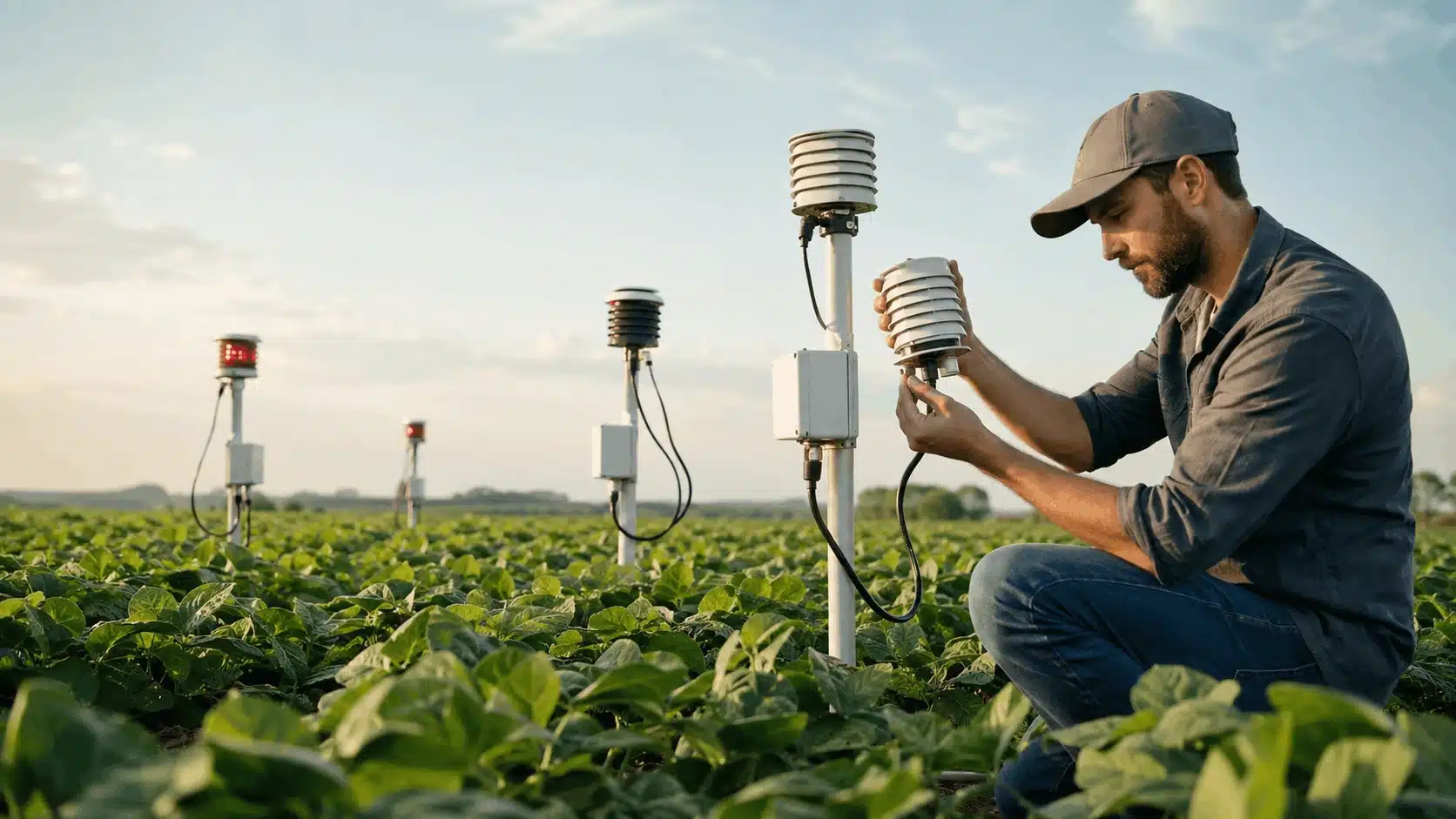
Application #2: Environmental and weather monitoring
Environmental and weather monitoring uses weather stations and IoT sensors in agriculture to track local growing conditions across the farm. These systems measure temperature, humidity, rainfall, solar radiation, wind, and microclimate differences between fields or production zones.
The reason to install them locally is simple: regional weather data can be too broad for precision decisions. A University of Arizona Cooperative Extension guide notes that weather data is most reliable within about 6 miles for local applications such as precision farming. For large-scale weather patterns, the useful radius may be closer to 60 miles.
Installation also affects data quality. The same guide recommends placing stations away from obstacles by at least 10 times the obstacle height. It also gives practical mounting ranges: 1.3–2.0 m for temperature and humidity sensors, 1.0 m for rain gauges, and 2.0–3.0 m for anemometers.
Real-world benefits
The main value comes from better timing. With local weather and microclimate data, teams can plan field operations around actual conditions, not broad regional averages.
A 2025 Sensors review on IoT-enabled agrometeorological stations connects these systems with better irrigation scheduling, yield support, and weather-risk mitigation.
- Planting and harvesting: Teams can time work around temperature, rainfall, wind, and field-access conditions.
- Spraying: More precise weather data helps avoid poor spray windows caused by wind, rain, or unsuitable humidity.
- Disease and pest risk: Earlier detection of high-risk conditions can support more targeted treatment decisions.
This also improves planning beyond the field. More reliable local data helps agribusiness teams align operations with expected crop quality, harvest timing, and market demand.
Costs and integration notes
Costs depend on how much precision the farm needs and how the data will be used. A basic station for local visibility has a different budget profile than a research-grade or smart station connected to decision-support software.
- Weather stations: University of Arizona examples range from $188 to $20,800, depending on sensor quality, connectivity, and system grade.
- Data loggers: Listed examples range from $69 to $2,290.
- Individual sensors: Listed sensor prices range from $47 to $1,800.
- Service plans: Published examples range from $25 to $449, usually tied to cloud access, data transmission, or platform services.
- Maintenance: Research-grade systems can require scheduled calibration, while smart stations may reduce manual work through remote access and alerts.
Environmental monitoring is often deployed alongside soil sensing, irrigation, or crop analytics. In those cases, adding weather stations may be a smaller part of the total budget than integration with agronomic tools, pest-risk models, or farm management software.
Application #3: Livestock monitoring and smart herd management
Livestock monitoring IoT is one of the clearest examples of IoT in smart agriculture because connected tags, collars, boluses, cameras, or barn sensors track animals in real time.
These systems can monitor location, movement, rumination, feeding behavior, temperature, activity level, and other health indicators. The data is sent to a central platform for alerts and analytics.
In larger herds, this gives farmers animal-level visibility that manual observation cannot maintain consistently. The same logic also applies to free-range livestock, where location tracking helps reduce losses and missed events.
Real-world benefits
The strongest benefit is earlier intervention. A 2025 review of wearable collar technologies for dairy cows found that collar-based systems support real-time monitoring of health, behavior, and productivity.
- Earlier illness and stress detection: Activity, rumination, and movement changes can flag animals that need attention.
- Better welfare management: Continuous monitoring helps teams respond before minor issues become severe.
- Lower manual workload: Staff spend less time checking every animal and more time acting on alerts.
In dairy operations, smart herd management can also support heat detection, reproductive planning, and milk-quality control. The effect is strongest when alerts are connected to clear farm workflows.
Cost considerations
Costs scale mainly with herd size because many systems use per-animal hardware. A small pilot may need only tags, collars, a gateway, and a basic dashboard. Larger farms often need more devices, barn coverage, integrations, and staff training.
- Per-animal devices: Tags, collars, or boluses usually drive the core hardware cost.
- Connectivity: Barn systems may use Wi-Fi or gateways, while pasture-based herds may need LoRaWAN, cellular, or satellite.
- Platform fees: Many monitoring tools include recurring software or analytics subscriptions.
- Installation and support: Costs rise when devices must integrate with milking systems, herd management software, or veterinary workflows.
A 2025 Frontiers article on precision dairy farming notes that high technology costs remain a major adoption barrier, especially for smaller farms.
ROI usually comes from fewer animal losses, lower veterinary costs, improved reproductive performance, and reduced labor in monitoring and herding.
Explore more about precision farming using IoT in another blog post by Intelliarts.
Application #4: Smart greenhouses and controlled environments
Greenhouse automation uses IoT sensors and automated controls to manage the growing environment inside a greenhouse. They monitor temperature, humidity, CO₂, light, soil or substrate moisture, and irrigation status, then adjust connected systems when conditions move outside target ranges.
The automation layer can control heating, cooling, ventilation, lighting, shading, fertigation, and irrigation. In simple setups, growers receive alerts and make changes manually. In more advanced environments, control systems adjust climate and water delivery automatically.
This level of control is especially useful for high-value crops, year-round production, and regions where outdoor growing conditions are unstable.
Real-world benefits
The main benefit is production stability. A 2025 Nature article on controlled environment agriculture notes that CEA protects crops from climate uncertainty and can deliver much higher productivity than open-field agriculture.
- Year-round production: Controlled environments reduce dependence on seasonal weather and outdoor growing windows.
- Faster growth: Highly optimized greenhouse and vertical farming environments can report up to 40% faster growth when lighting, nutrients, temperature, and humidity are tightly managed.
- Lower water use: Some controlled systems report up to 90% less water usage, especially when hydroponic or recirculating irrigation is used.
- Lower manual workload: Automation reduces repeated climate checks and manual adjustments.
These results depend heavily on crop type, greenhouse design, and operating discipline. A low-tech greenhouse and a sensor-driven controlled environment will not produce the same outcomes.
Cost and complexity
Smart greenhouses are usually more capital-intensive than basic field IoT because they control the production environment, not only monitor it. The budget is shaped by the greenhouse structure, automation depth, energy profile, and integration with existing systems.
- Automation scope: Basic monitoring may cover climate alerts only. Higher-cost systems add actuators for heating, cooling, ventilation, lighting, irrigation, and CO₂ control.
- Energy exposure: A 2025 MDPI review notes that CEA operations face large initial investment, high energy costs, and over-engineering risks.
- Market maturity: Fortune Business Insights valued the smart greenhouse market at $6.77 billion in 2025, with projected growth to $27.17 billion by 2034.
- Integration work: Costs rise when controls must connect to ERP systems, farm management software, crop analytics, or remote monitoring dashboards.
The ROI case is strongest for high-value crops and intensive production models. These operations can justify higher upfront costs when automation improves yield consistency, resource use, and labor efficiency.
Application #5: Remote field and asset monitoring
“A connected farming system should naturally result in reduced uncertainty. If it’s operated only as a hub for readings, the project has missed its purpose.” — Marta Kufalska, Agritech Digital Solution Expert at Intelliarts
Remote field and asset monitoring uses IoT sensors, gateways, and cellular or satellite connectivity to support connected farming solutions beyond reliable network coverage. These systems monitor fields, pumps, reservoirs, tanks, irrigation lines, equipment, and storage areas that are costly to inspect manually.
The data can include water levels, pump status, pressure, flow, soil conditions, weather, equipment location, or abnormal usage patterns. The goal is early visibility: teams can detect leaks, failures, and other issues before they affect crops or operations.
Real-world benefits
Remote monitoring reduces the need for physical site visits and helps teams detect failures earlier. This matters most when fields are spread across large areas or when equipment is hard to reach quickly.
A practical example is an Intelliarts project that focused on automating field data collection for Indigo.
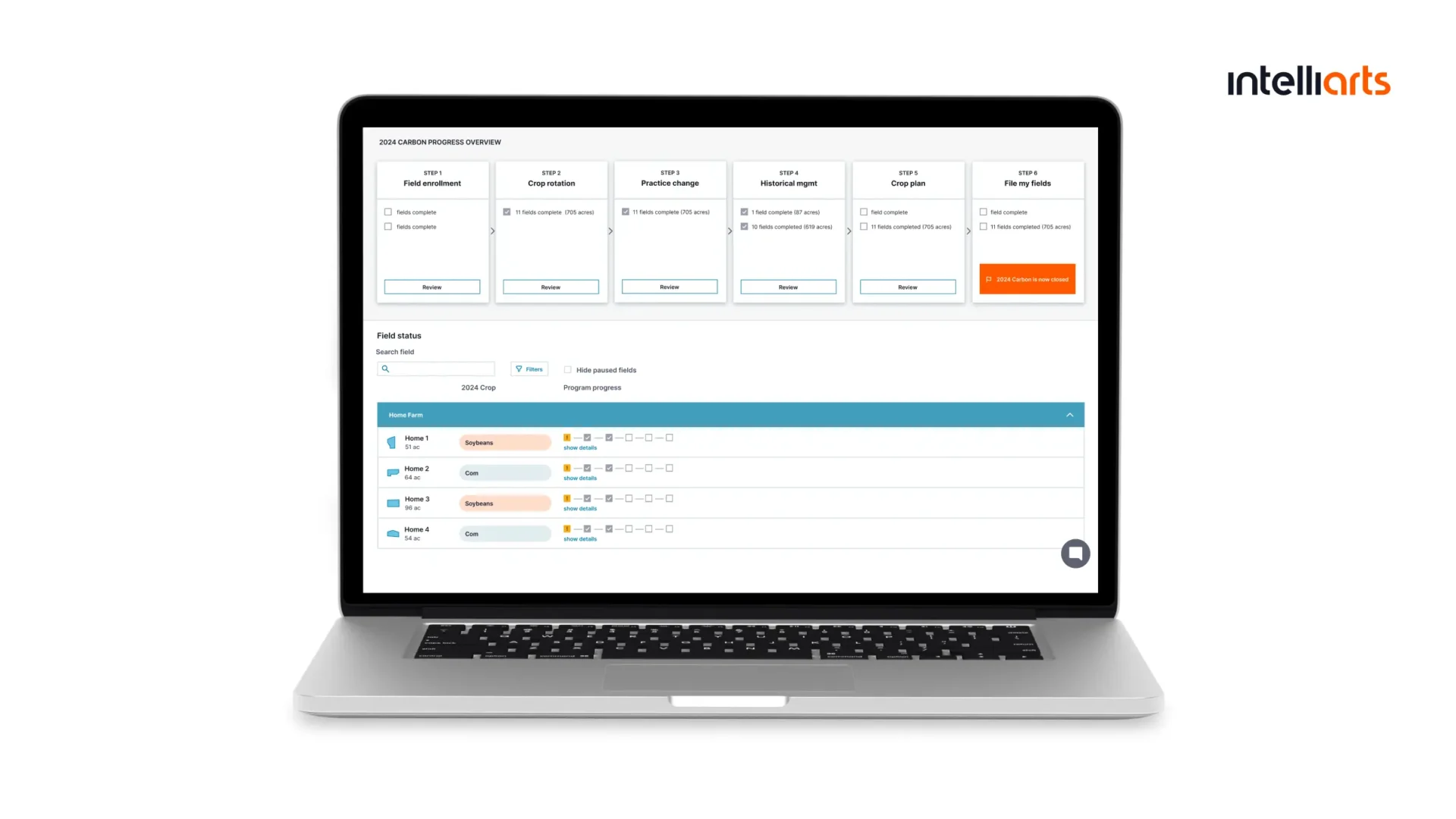
- Challenge: Indigo needed to scale carbon-farming enrollment, but growers had to provide 3–5 years of field records. Manual collection was slow, incomplete, and hard to verify.
- Solution: Intelliarts used remote sensing, machine learning, and Indigo’s Best Guess API to pre-fill crop types, planting dates, and field boundaries, reducing manual data entry.
- Results: The solution cut data entry from weeks to minutes, finalized 3M acres, converted 55% of new acres, and reactivated 900,000 acres.
For remote asset monitoring, the main insight is that data becomes useful when it reduces manual work and gives teams a reliable operating picture across dispersed sites.
Costs and connectivity choices
Remote projects often cost more because of coverage and reliability requirements. The sensor itself may be simple, but the system still needs stable power, durable hardware, and dependable connectivity.
- Connectivity choice: Cellular works when coverage is stable. LPWAN can support low-power sensor networks. Satellite is often used when terrestrial networks are weak or unavailable.
- Power setup: Remote assets may need solar panels, batteries, or low-power devices that can run for long periods without service.
- Hardware durability: Devices may need weatherproofing, dust protection, secure mounting, and resistance to heat, cold, moisture, or vibration.
- Integration scope: Costs rise when alerts, maps, maintenance workflows, or farm management systems need to work together.
In many remote projects, connectivity and robustness drive cost more than sensors themselves. A reliable alert from a remote pump can be more valuable than a larger set of sensors that cannot transmit data consistently.
Need to understand which IoT approach fits your farming operations?
Talk to our AgriTech experts
Benefits of IoT in smart agriculture beyond the hype
IoT agriculture ROI is easier to judge when benefits are grouped by business pressure point. For most farms, connected data has to prove itself in three places: margin, resource use, and operational control.
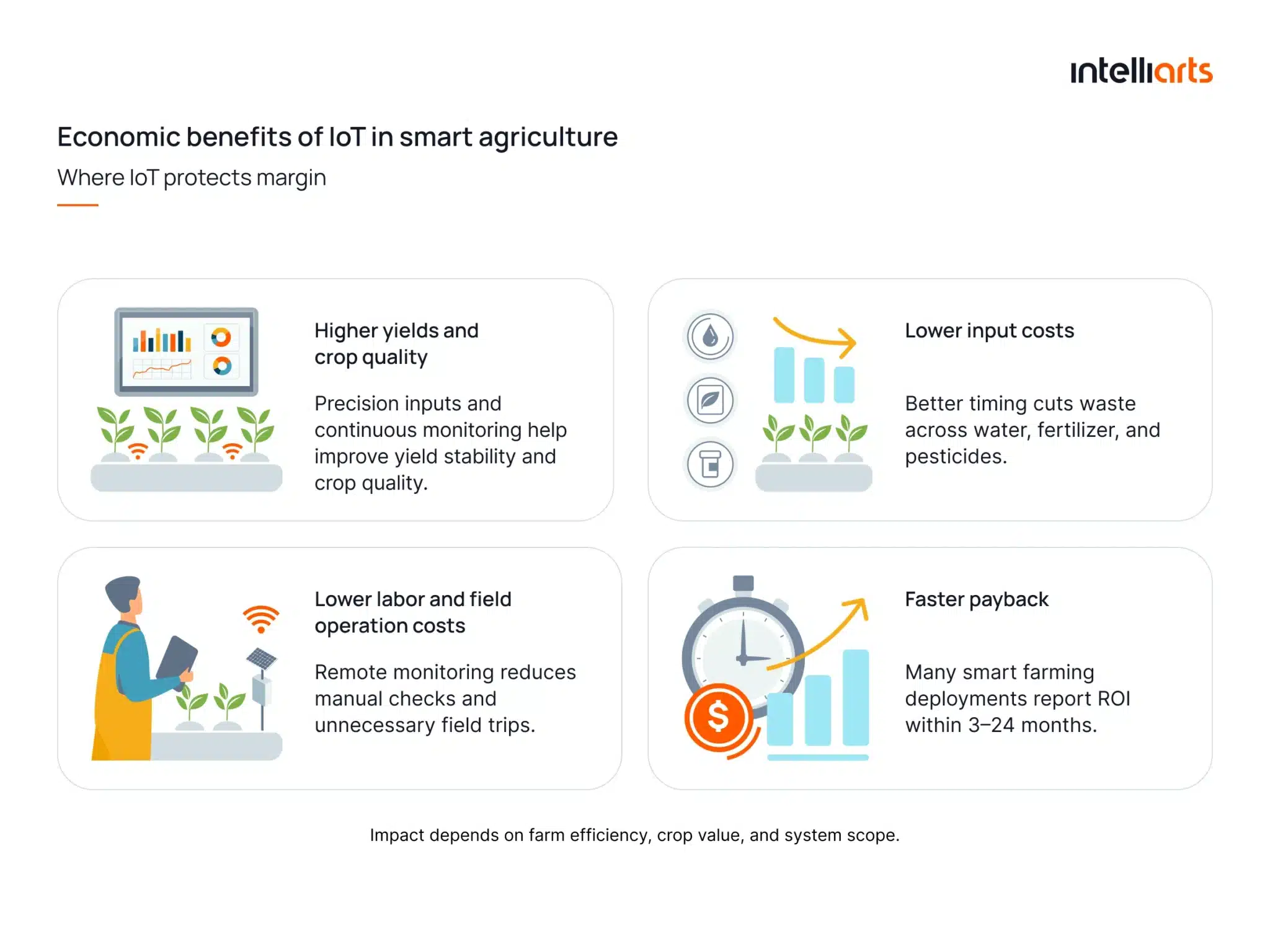
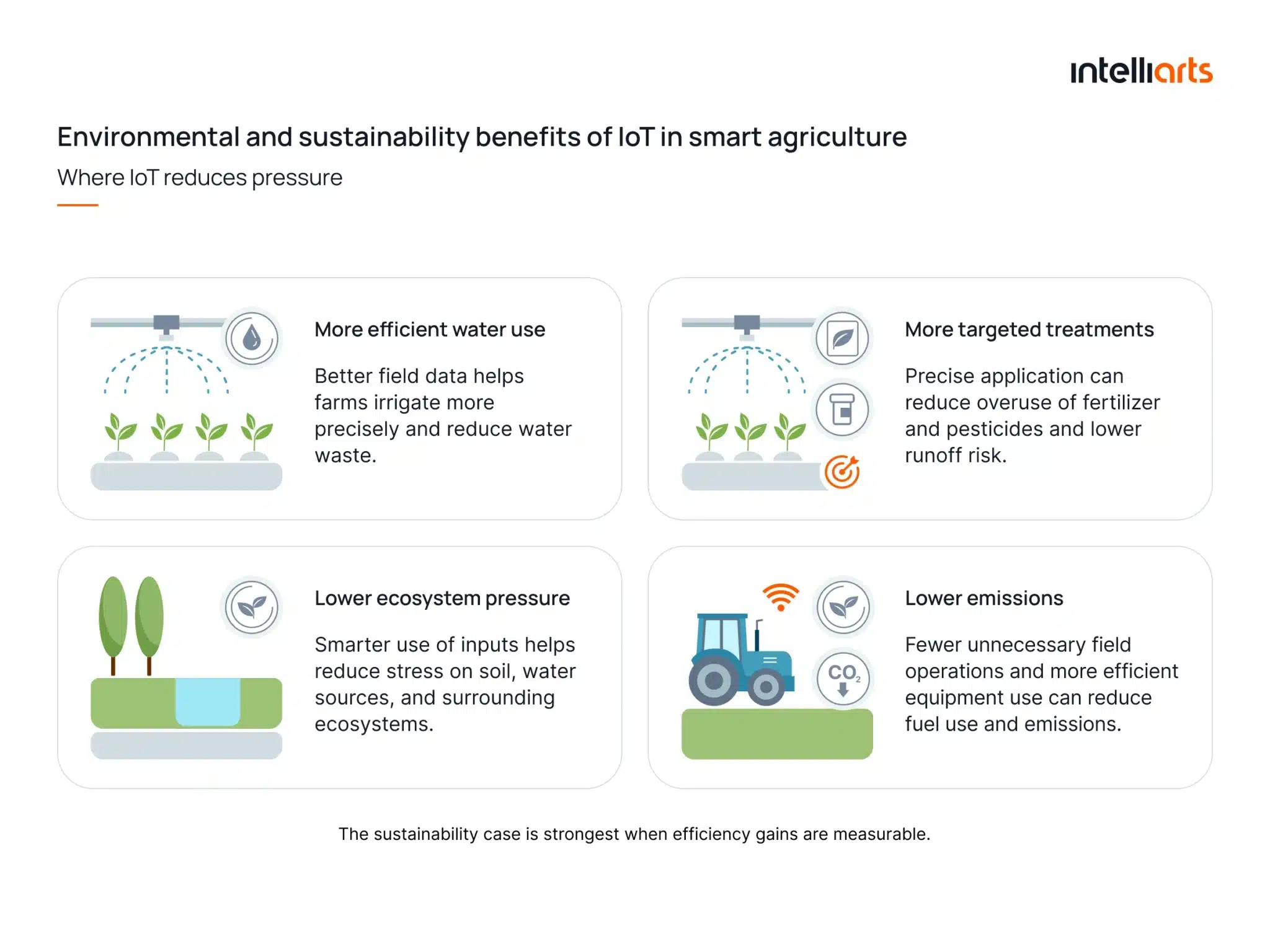
See what three layers of value-adding benefits of agriculture automation solutions comprise, with infographics provided for each:
Economic benefits
This is the ROI layer. Precision inputs and continuous monitoring can improve yields, protect crop quality, and reduce waste across water, fertiliser, pesticides, labour, and field operations.
In many implementations of IoT in smart agriculture, payback appears within 3–24 months, depending on farm efficiency and system scope.
Environmental and sustainability benefits
This is the resource-efficiency layer. Better field data helps farms apply water and treatments more precisely, which can reduce ecosystem pressure, runoff risk, and unnecessary machinery use.
The sustainability case is strongest when efficiency gains are easily measurable, so they can be reported to stakeholders and acted upon.
Operational and strategic benefits
This is the control layer. IoT gives teams earlier visibility into field conditions, equipment status, livestock signals, and climate risks. That supports faster decisions, stronger risk management, more reliable crop quality, and better supply planning.

Explore the importance of farm record-keeping in agriculture in another one of our blog posts.
Cost breakdown: What drives the cost of IoT in smart agriculture?
Costs are driven by scale, connectivity, hardware quality, and integration complexity. The number of sensors matters, but it rarely explains the full budget.
Before estimating the cost of IoT in agriculture, teams should separate three questions:
- Coverage: How many fields, assets, greenhouses, or herds need monitoring?
- Control depth: Will the system only report data, or also automate pumps, valves, ventilation, and other equipment?
- Data use: Will teams need basic dashboards, or smart farming IoT data solutions with analytics, alerts, integrations, and decision-support workflows?
Cost component What it includes Why it affects budget
Hardware Sensors, gateways, controllers, actuators, mounting equipment, weather stations, and power units. Costs rise with accuracy, coverage density, ruggedization, and automation depth.
A University of Arizona guide lists weather stations from $188 to $20,800, data loggers from $69 to $2,290, sensors from $47 to $1,800, and service plans from $25 to $449.
Connectivity Cellular, LPWAN, satellite, data transmission, gateways, repeaters, and network management. Remote coverage can become expensive. A 2025 LPWAN, 5G, and hybrid connectivity study found that hybrid models can reduce connectivity costs by up to 30% while improving reliability.
Software IoT platforms, dashboards, alerts, analytics, data storage, licenses, and user access. Costs rise when connected farming solutions need custom dashboards, predictive alerts, agronomic logic, or role-based workflows.
Integration and setup Engineering, installation, calibration, device configuration, field testing, and staff training. Integration costs grow when agriculture automation solutions must connect with irrigation systems, ERP tools, farm platforms, or decision-support software.
Ongoing operations Maintenance, calibration, battery replacement, device support, connectivity fees, and platform updates. Long-term cost depends on device reliability, service frequency, and how critical the system is for daily farm operations.
For planning, the budget can be read at three levels:
- Focused pilot: Basic IoT-based precision farming solutions often start around $10k when the scope is narrow and the use case is clear.
- Expanded deployment: Costs rise when the system covers several fields, assets, or production sites.
- Advanced system: Budgets grow further when the project includes automation, analytics, custom integrations, and long-term support.
Here at Intelliarts, we usually start with a practical estimate of what the farm needs from a technology standpoint to improve, as per business objectives.
We strongly suggest starting with a small-scale pilot solution, and usually do so before proceeding with complete development and integration of any greenhouse automation or agriculture-related solutions.
Have an IoT in agriculture idea and need a cost breakdown?
Start with a strategy session with Intelliarts experts to discuss your project.
Contact us
How to decide where to start with IoT in smart agriculture
A good IoT in smart agriculture starting point is usually a narrow use case with visible cost pressure. That can be irrigation waste, manual field checks, unstable greenhouse conditions, missed livestock events, or equipment failures in remote areas.

A popular example is sensor-based irrigation operations. In one Intelliarts sensor management case, the team built software that centralized sensor tracking, improved QA/QC, and supported irrigation practices at scale.
The project helped the customer move toward 260% operational scaling and reduce water use per acre by 10 times compared with the prior year.
Here are some of the actions we implemented in the early project stated in the mentioned success story, and some other relevant IoT in smart agriculture cases:
- Quantify the loss first. The use case should already have a measurable cost: water overuse, crop loss, labor hours, downtime, failed inspections, or missed livestock events. Irrigation is often a strong starting point because agriculture accounts for more than 70% of global freshwater withdrawals.
- Set a minimum improvement target. A pilot needs a number to beat: 10–20% lower water use, fewer manual checks, or stable yield with lower input use. Recent IoT irrigation research reported 35.2% water saving and 12.05% yield improvement.
- Check whether the signal can be measured. The project needs a reliable physical signal: soil moisture, pump pressure, flow rate, tank level, animal movement, CO₂, humidity, or equipment status. Weak or delayed signals produce noise.
- Match data frequency to the decision. Daily irrigation, greenhouse climate control, pump-failure alerts, and seasonal yield reporting need different refresh rates. This affects sensor choice, battery life, connectivity, and platform cost.
- Validate connectivity before scaling. Remote fields may need LoRaWAN, cellular, satellite, or hybrid networks. A 2025 LPWAN/5G study found that hybrid models can cut connectivity costs by up to 30% while improving reliability.
- Define the control point. The pilot should connect data to a specific action: open a valve, inspect a pump, adjust ventilation, or check an animal. If no action changes, the system is only reporting.
- Use scale metrics early. In the Intelliarts sensor management case, centralized sensor management supported 260% operational scaling and helped reduce water use per acre by 10 times.
“The messy part is usually reconciliation. Field boundaries, crop records, weather feeds, sensor IDs, and equipment logs all need to be both established with business purpose and well-aligned technically to provide accurate readings and analytics.” — Marta Kufalska, Agritech Digital Solution Expert at Intelliarts
A practical roadmap looks like this:
- Pick one measurable loss.
- Choose the physical signal.
- Set the improvement target.
- Validate sensors and connectivity.
- Run the pilot.
- Compare before and after.
- Fix data gaps.
- Expand if the workflow works.
- Add analytics or AI.
The right first IoT use case is where the farm can measure the loss, trust the signal, act on the alert, and prove improvement with numbers.
How Intelliarts fits: From IoT data to smart decisions

Intelliarts brings 27 years of software engineering experience to agritech, with work across farm automation, IoT monitoring, predictive analytics, data engineering, and ML systems.
For agritech companies building precision agriculture solutions, Intelliarts can help design that layer end-to-end: cloud architecture, data pipelines, API integrations, analytics logic, ML models, and user-facing decision tools.
Our ML practice has delivered 90 large projects, with 40% senior-level engineers and typical PoC timelines of 6–8 weeks.
- IoT data architecture and integration
Field devices generate moisture readings, weather events, equipment status, GPS points, livestock signals, and actuator logs. Intelliarts helps ingest, normalize, validate, store, and expose this data through APIs.
- Relevant expertise: IoT solutions development and data engineering consulting.
- Analytics and ML pipelines
IoT data can support irrigation prediction, yield forecasting, pest-risk signals, equipment anomaly detection, and resource optimization. These models need aligned timestamps, sensor metadata, field boundaries, crop stage, weather context, and retraining logic.
- Relevant expertise: custom machine learning solutions and agriculture software development.
- Decision support tools
Raw readings need a workflow. A moisture alert should map to an irrigation zone. A pump anomaly should map to an inspection task. A greenhouse warning should show which control action is available.
Intelliarts has built this kind of operational layer in IoT products before. In the Xeros IoT platform case, the team developed dashboards, reports, user roles, status monitoring, downtime tracking, and error visibility for connected equipment.
Conclusion
IoT in smart agriculture pays off when connected data changes a real farm decision. That may start with irrigation, greenhouse climate, livestock monitoring, or remote equipment, but the pattern is the same: collect a trustworthy signal, connect it to the right workflow, and measure the result.
With the right architecture, analytics, and ML layer, agritech teams can move from sensor visibility to forecasts, alerts, and optimization that support daily operations.
The Intelliarts team has more than 26 years of experience delivering tailored AI / ML / RAG solutions for different domains, including smart agriculture. We provide services to businesses worldwide and are proud to have 90% of customer return rate.
With our business-oriented approach and in-house expertise, we are ready, willing, and able to contribute to your best IoT in agriculture project.
FAQ
What are the most common IoT applications in smart agriculture today?
The most common IoT applications in smart agriculture are precision irrigation, soil and weather monitoring, livestock tracking, greenhouse automation, and remote asset monitoring. Most teams start with one measurable use case, then expand once sensor data proves operational value.
How much does it typically cost to start with IoT in smart agriculture?
Basic IoT in smart agriculture pilots often start around $10,000 when they include sensors, a gateway, connectivity, and a simple dashboard. Costs rise with field coverage, actuators, rugged hardware, integrations, and analytics requirements.
What kind of ROI can farmers expect from IoT-based precision farming?
ROI depends on the use case, but precision agriculture IoT can pay back within 3–24 months when water, fertilizer, labor, or crop-loss costs are high. The strongest returns usually come from decisions made daily, not seasonal reporting.