
TL;DR
- A RAG demo can be built in days, but a production RAG needs retrieval, access control, evaluation, and monitoring.
- Most failures start before generation: weak ingestion, poor chunking, missing metadata, or outdated sources.
- A stronger LLM cannot fix retrieval if the system misses the right source, version, or context.
- Enterprise RAG should be measured by workflow outcomes: resolution time, citation accuracy, adoption, latency, and cost per query.
- Long-term ownership matters: RAG needs re-indexing, feedback review, evaluation updates, and continuous optimization.
Enterprise AI has moved fast, but measurable value still lags behind adoption. According to McKinsey’s 2025 State of AI report, only 39% of respondents attribute any Earnings Before Interest and Taxes (EBIT) impact to AI, and most of them report an impact below 5%.
Gartner points to the same production gap: at least 30% of gen AI projects are expected to be abandoned after proof of concept because of poor data quality, inadequate risk controls, rising costs, or unclear business value. RAG development often fails for these exact reasons.
This article breaks down the mistakes that make RAG demos look promising but keep enterprise systems from becoming reliable, secure, and useful in daily workflows.
Building a RAG application? Avoid costly mistakes and get expert guidance.
Talk to our AI team
Why RAG development is so easy to start and so easy to get wrong
A basic RAG prototype is quick to build. Basically, with some knowledge, a team can connect an LLM API to a vector store, load a small document set, and produce a working demo in a few days.
That speed often creates false confidence. Early results look strong because the data is clean, the questions are expected, and the scope is narrow.
The gap becomes clear after rollout, because in practice, users ask vague, incomplete, and context-heavy questions while documents exist in multiple versions. Moreover, access rules differ across teams, regions, and functions.
See how prototype RAG and production-ready RAG compare against each other in the table below:
| Dimension | Prototype RAG | Production RAG |
|---|---|---|
| Goal | Show that the concept works | Support a business workflow |
| Data | Small, curated, and clean | Large, fragmented, and constantly changing |
| Access | Few or no permission rules | Role-based access and compliance controls |
| Performance | Limited concern for latency or cost | Clear targets for speed, scale, and cost per query |
| Control | Manual review during demos | Monitoring, tracing, and repeatable evaluation |
Given all that, if retrieval is weak, the system may return outdated or irrelevant context. At the end of the day, due to an inherited lack of observability in simple RAG prototypes, devs cannot see why the response generation fails or where the delay comes from.
Quick refresher: what enterprise-grade RAG development involves
Enterprise-grade RAG is an architecture for producing source-grounded outputs over controlled business knowledge. It combines retrieval across enterprise data with an LLM, so the model works from approved evidence instead of relying on pretraining or broad prompt context.
Core layers of enterprise RAG include:
- Ingestion: Source selection, parsing quality, chunking strategy, metadata, embeddings, and refresh logic
- Retrieval: Hybrid search, filtering, reranking, source priority, and access control
- Generation: Prompt orchestration, citations, tools or agents, guardrails, and fallback behavior
- Evaluation and monitoring: Relevance, groundedness, drift, latency, cost, feedback, and error traces
Based on what the Intelliarts team observed, the architecture only works when these layers are designed around enterprise constraints. On top of that, security rules must apply before content reaches the model. More than that, there are AI compliance requirements, such as the EU AI Act’s provisions, that define, among many others:
- Logging and retention rules
- Data residency requirements
- Audit trails
- Access control policies
- PII and sensitive data handling
- Regulatory reporting
As for software integrations, they are used to place RAG inside the systems where workflows reside. For example, integrations with ticketing, CRM, BI, document management, or internal knowledge platforms are typically used.
Most RAG mistakes come from shortcutting one layer and expecting another layer to compensate. From Intelliarts experience, in lots of instances, better prompts are used to fix weak ingestion and poor data quality.
Or, a higher-performing model is used to compensate for improper retrieval. None of these and similar measures show acceptable results. That’s why every single layer, process, and choice must be to the point in RAG development. 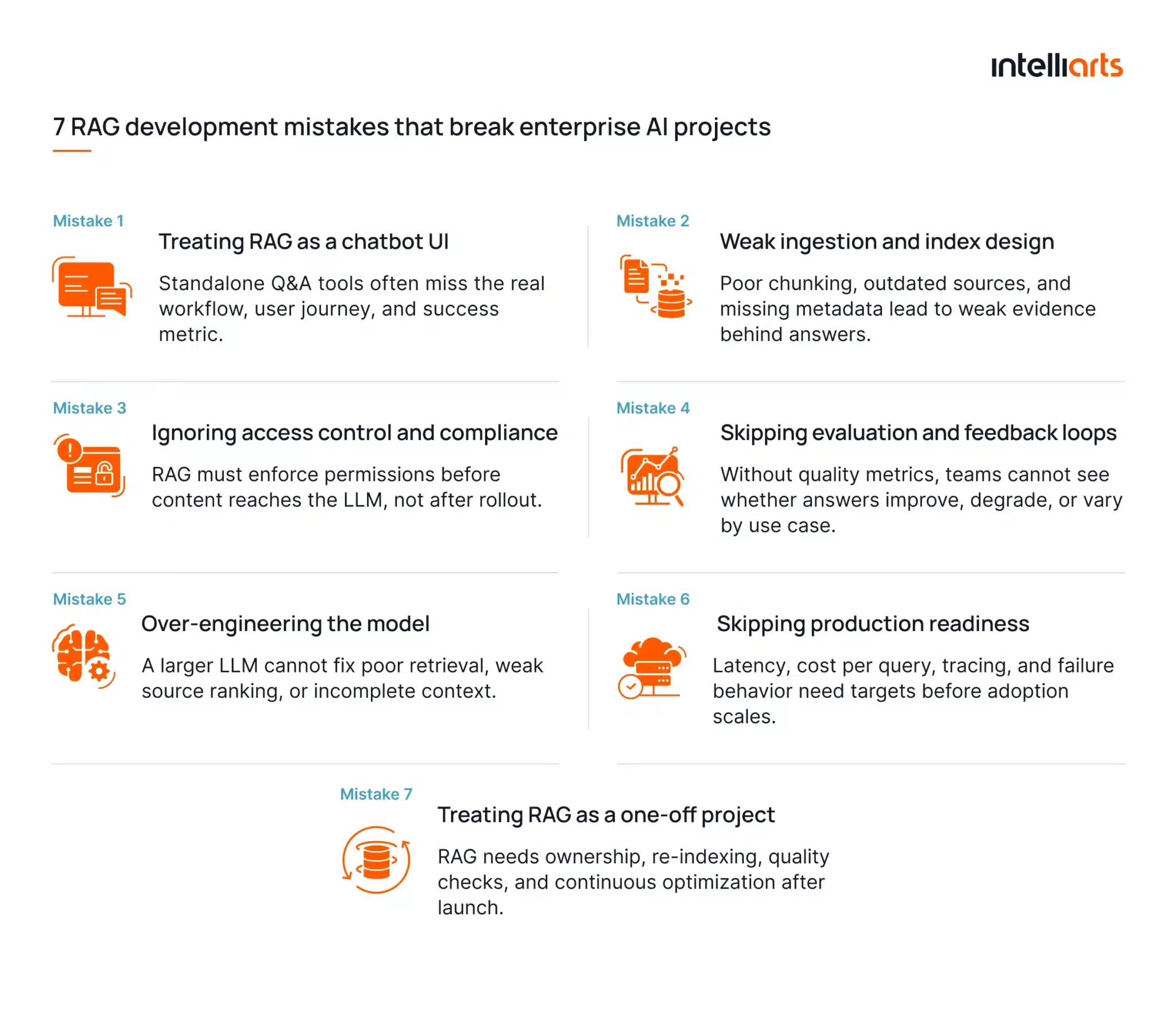
Explore how RAG works in great detail in another technical blog post by Intelliarts.
Mistake #1: Treating RAG as a chatbot UI
When auditing an AI project, our ML experts confirmed that this issue is usually a result of having a narrow interface decision as the core of a broader product strategy.
Why it happens
Many enterprise RAG projects start as a Q&A layer on top of internal documents. Yet a chatbot interface does not define the workflow, user intent, or business value behind the system.
Another part of the problem is anchoring on the demo before they define where the feature belongs, what task it should improve, and which metric will prove success.
How it shows up in production
When RAG is designed around the capability to provide basically any response, users get broad answers that are hard to verify or act on. As a result, chatbot-first RAG usually breaks down when:
- Users receive generic answers that do not support a clear decision
- The system does not fit ticket handling, reporting, review, or approval workflows
- ROI cannot be measured because the app is not tied to task-level metrics
- Adoption drops because employees need to leave their daily tools
How to fix it
Design RAG as a capability inside a real workflow. For each feature, define the target user, workflow step, expected output, and measurement.
When it comes to, for example, support, this may include resolution time, escalation rate, and answer acceptance. For compliance, it may include review time, citation accuracy, and rejected responses.
As Intelliarts experts often emphasize, RAG works better when it is embedded into tools employees already use, such as CRM, wiki, ticketing, BI, or document management systems.
Mistake #2: Poor data ingestion, chunking, and index design
Poor ingestion weakens RAG at the evidence layer. Once outdated, duplicated, or poorly structured content enters the index, the system can produce fluent answers that are difficult to trust, audit, or operationalize.
Why it happens
Teams index enterprise content before defining source authority, freshness, hierarchy, and required metadata. As a result, regional, outdated, or customer-specific documents may compete in retrieval as if they were equally valid.
Chunking can damage meaning, too. A rule may lose its exception, a table may lose its explanation, and a section may lose the heading that defines its scope.
How it shows up in production
The RAG application retrieves context that looks relevant but is wrong for the business case.
Common production symptoms include:
- Outdated, duplicated, or low-trust sources appearing in generated answers
- Tables, PDFs, and long-form documents losing context during parsing or chunking
- Regional policies, product versions, or legal clauses being mixed
- Similar queries returning different sources because ranking logic is unstable
- Slow retrieval caused by broad indexes with weak filtering and poor metadata coverage
How to fix it
Intelliarts recommends starting with a source audit: what should be indexed, who owns it, how often it changes, which version is authoritative, and which content should be excluded.
Then, define chunking and metadata rules before scaling. Chunks should preserve sections, definitions, exceptions, tables, and references when the answer depends on their relationship. Metadata should cover owner, date, version, jurisdiction, product, customer segment, source type, and priority.
Before rollout, validate retrieval with real user queries. Check whether the right sources appear in the top results, whether filters improve precision, and whether the retrieved context is strong enough for the LLM to answer without filling gaps.
“When we audit a RAG system, we start with the retrieved context. If the correct source is missing from the top results, prompt tuning will only make the failure harder to see.” — Andrii Shutka, DS Engineer and MLOps at Intelliarts.
Mistake #3: Ignoring access control, security, and compliance
Security gaps in RAG usually start when retrieval is designed without the same access rules that govern enterprise systems.
Why it happens
Early RAG prototypes often run on public data, test files, or internal documents that all pilot users can access. This makes the system look safe until it connects to real knowledge bases, where permissions vary by role, region, department, contract, and legal status.
The main risk is assuming that access control can be added later. In production, the retriever must know which documents, fields, and records each user is allowed to see before context reaches the LLM.
How it shows up in production
Security reviews may block rollout because the application cannot prove who can access what. Even worse, users may receive answers based on documents from another department, customer account, region, or restricted project.
Common production symptoms include:
- Users seeing content outside their role, region, or business unit
- Sensitive documents entering prompts without proper permission checks
- Legal or compliance teams requiring manual approval for wider rollout
- Audit teams unable to trace which source was used in an answer
- Data residency, retention, or logging rules being handled after launch
- RAG endpoints missing the same testing applied to other enterprise APIs
How to fix it
Build access control into the retrieval layer from the start. Index security metadata with every document and enforce permissions at query time, including document-level and field-level restrictions where needed.
RAG development should also account for data residency, logging, retention, audit trails, and incident response. Security and compliance teams need to be involved before the pilot expands, not after risks appear in review.
For production systems, add threat modeling, permission testing, and penetration testing for RAG endpoints. The goal is to make every retrieved source traceable, allowed for the user, and compliant with the organization’s governance rules.
Explore our work in cybersecurity. Read the case study.
Mistake #4: Under-investing in evaluation, metrics, and feedback loops
Oftentimes, a RAG system may look strong in selected examples, but the team has no reliable way to prove whether answer quality improves, degrades, or varies across use cases.
Why it happens
Intelliarts team noted that the problem almost always lies in a weak quality baseline. For example, one stakeholder may care about completeness, another about concise answers, and another about source accuracy.
The problem is the missing definition of a good answer. A legal assistant, support copilot, and internal knowledge search tool should not use the same evaluation criteria.
Each application needs its own thresholds for relevance, groundedness, completeness, safety, tone, and citation quality.
How it shows up in production
Quality debates become anecdotal. Users report that answers are “wrong” or “not useful,” but the team cannot see whether the issue comes from retrieval, prompting, model behavior, or source quality.
Common production symptoms include:
- No trendline for answer quality over time
- Prompt or model changes causing silent performance drops
- High-confidence answers with weak or missing citations
- Good answers for common questions but poor results for edge cases
- User feedback staying in support tickets instead of improving the system
- Declining adoption after a small number of unreliable answers
How to fix it
The Intelliarts team recommends building an evaluation loop with curated test sets, human review, offline tests, online metrics, and A/B experiments. The test set should include common questions, edge cases, ambiguous prompts, and cases where the system should refuse to answer.
Feedback also needs to become part of the RAG development services process. Capture thumbs up or down, comments, corrected answers, and failed searches in the UI. Then use that data to improve retrieval, prompts, source quality, and evaluation criteria.
Mistake #5: Over-engineering the model, under-engineering retrieval
In many failed RAG systems, the generation layer receives poor context, and the team keeps tuning everything around it.
Why it happens
The assumption is that a stronger LLM will resolve ambiguity, fill missing context, and work around noisy sources.
However, from Intelliarts experience, that approach hides the real failure point and makes detecting the source of degradation increasingly more difficult. If the right documents are not retrieved for core queries, the model is forced to reason from incomplete or incorrect evidence. A better generation may improve fluency, but it will not make the answer more reliable.
How it shows up in production
The system becomes more complex while quality stays inconsistent. Teams add longer prompts, reranking steps, chains, or agents to compensate for weak retrieval, which increases latency and cost without solving the root problem.
Common production symptoms include:
- Correct answers depending on prompt wording rather than stable retrieval
- Complex chains added to fix issues that start in the index
- Higher infrastructure cost with little improvement in answer quality
- Slow response times caused by too many model calls or retrieval steps
- Difficult debugging because failures can come from retrieval, prompting, tools, or generation
- Teams changing models before checking whether the right sources were retrieved
How to fix it
Use a retrieval-first approach in the ML development process. For priority use cases, test whether the right documents appear in the top results before changing prompts, models, or agents.
Once baseline retrieval is stable, add advanced RAG development patterns only where they solve a clear problem. Query rewriting can help with vague user input. Multi-step retrieval can support questions that require several sources. Structured retrieval can work better for tables, knowledge graphs, product catalogs, or compliance rules.
Looking for a trusted partner with RAG expertise?
The Intelliarts team specializes in RAG solutions that drive business efficiency
Request white paper
Mistake #6: Skipping production readiness: latency, cost, and observability
RAG fails in production when teams do not define how fast, how expensive, and how traceable each answer should be before users start relying on it.
Why it happens
Unfortunately, the Intelliarts team has seen that teams responsible for prototyping usually don’t test operating limits well. They may check whether the response is useful, but not how many retrieval calls, model calls, tokens, tools, and retries it takes to produce that response.
That creates a blind spot. A flow that feels acceptable in a demo can become too slow or expensive when used across support, compliance, sales, or internal knowledge workflows.
How it shows up in production
The system starts creating operational friction when the following factors are noticeable:
- Slow responses that push users back to search, wiki, or manual review
- Cost spikes caused by large context windows, repeated retrieval, or unnecessary model calls
- No visibility into which documents were retrieved for each answer
- No tracing across retrieval, prompts, tools, model responses, and errors
- Teams unable to separate model latency from retrieval latency
- Quality issues that cannot be reproduced because the logs are incomplete
How to fix it
Define production targets before rollout. Each use case should have limits for response time, cost per query, availability, and acceptable failure behavior. Then tune the system against those limits.
Adjust the number of retrieved documents, index type, reranking strategy, model choice, context size, and tool usage. Add caching or response reuse where repeated questions are common.
Observability should cover the full RAG pipeline: user query, retrieved sources, filters applied, prompt version, model response, latency, cost, errors, and user feedback.
Mistake #7: Treating RAG development as a one-off project instead of an ongoing service
What we’re hearing from customers is that RAG quality decays when software ownership ends shortly after the launch. That’s because data changes, users change, and retrieval logic needs continuous support and maintenance to stay reliable even with the same LLMs.
Not to mention that switching to new AI models can drastically undermine the workflow if left unvalidated and unadjusted for.
Why it happens
Many RAG initiatives are funded as one-time builds. The team delivers a pilot or production release, but no one owns the backlog for re-indexing, evaluation, prompt updates, source quality, or user feedback. This creates a maintenance gap.
“I keep emphasizing that any RAG system needs ownership after launch. Re-indexing rules, feedback reviews, evaluation updates, and source-quality checks are only part of the maintenance process, but they play a major role in whether answer quality stays consistent or declines over time.” — Alexander Barinov, a managing partner at Intelliarts.
How it shows up in production
The system becomes less useful over time if:
- New documents are missing from the index
- Outdated sources continue appearing in answers
- Retrieval settings no longer match how users search
- Prompts stay unchanged after workflows evolve
- Feedback is collected, but not turned into improvements
- No team is accountable for quality, cost, adoption, or roadmap decisions
How to fix it
Position RAG as an operating capability with clear ownership. Assign a product owner, technical owner, quality process, and backlog for ongoing RAG development services.
The operating model should include regular re-indexing, data quality checks, evaluation cycles, model reviews, prompt updates, and UX improvements. Usage data and user feedback should feed directly into this roadmap.
At Intelliarts, long-term RAG work is typically structured in stages: initial build, production stabilization, and continuous optimization. This keeps the system aligned with changing data, workflows, and business priorities after the first release.
Need assistance with a complicated RAG project?
Intelliarts team provides consultation and end-to-end AI, ML, and RAG development.
Contact us
The most common RAG mistakes, symptoms, and how to fix them
The seven mistakes above explain why enterprise RAG projects fail at the architecture, governance, and operating model level. You can note that these were mostly strategy and management-layer challenges.
The table below goes one layer deeper and shows measurable technical defects teams can check during a production RAG audit.
| RAG failure pattern | What is it | Technical solution |
|---|---|---|
| Low top-k precision | Correct source missing from top 3–5 chunks | Build 100–300 golden queries. Track recall@5, precision@5, MRR. Tune reranking, filters, and source weights. |
| Weak metadata coverage | Critical fields missing from indexed records | Require 90–95%+ coverage for owner, version, date, region, product, access group, and source priority. Quarantine incomplete records. |
| Poor chunk boundaries | Rules, exceptions, tables, or headings split apart | Test 20–50 docs per source type. Compare 3–5 chunking strategies. Preserve section IDs, page numbers, and parent-child links. |
| Unstable query normalization | Same intent returns different sources | Test 5–10 query variants per priority question. Add rewriting, acronym expansion, synonym mapping, and intent labels. |
| No confidence threshold | System answers with weak evidence | Set minimum retrieval score, source count, freshness limit, and contradiction checks. Route low-confidence cases to refusal or human review. |
| Uncontrolled context size | Prompts grow without quality gain | Cap chunks, deduplicate context, rerank before prompt assembly. Track tokens per answer, P95 latency, and cost per query. |
| Broken citation mapping | Users cannot verify answer claims | Store chunk ID, document ID, page, section, timestamp, and version. Flag uncited claims during evaluation. |
| Stale index refresh | New or updated docs missing from answers | Set refresh SLAs by source type: same day for policies, weekly for stable docs. Add failed-ingestion alerts. |
| No feedback dataset | User feedback does not improve the system | Store ratings, failed searches, rejected answers, and corrections. Review weekly and add repeat failures to the test set. |
Use this table as an audit checklist for production RAG. Keep in mind that when multiple patterns are discovered, the issue is usually not the LLM itself, but the retrieval pipeline, data controls, or operating process around it.
How Intelliarts approaches enterprise RAG development services

Here at Intelliarts, we treat RAG as a complex data and product architecture matter and never let our developments result in an LLM implementation risk for customers afterwards.
The work starts with the use case, the decision the system should support, and the evidence needed to support that decision. Only then does the team design retrieval, generation, evaluation, and monitoring around enterprise constraints.
A typical engagement follows four stages:
- Discovery and data audit: Define the target workflow, users, source systems, access rules, data quality issues, and success metrics.
- Pilot with clear KPIs: Build a focused RAG application for one workflow and validate retrieval quality, answer accuracy, latency, and adoption.
- Scaling: Add security controls, permission-aware retrieval, observability, cost limits, fallback behavior, and integration with existing systems.
- Ongoing optimization: Re-index sources, review failed queries, update prompts, monitor drift, and improve UX as usage patterns change.
Success story #1: RAG-enabled data-extraction chatbot
This approach can be observed in Intelliarts’ data extraction chatbot development using the ChatGPT case. Our team built an information retrieval system over an internal knowledge base, added RAG for source-grounded answers, routed tabular queries separately, and included references so users could verify the output.
The result was a reduction in search and analysis time from hours to minutes.

ML pipeline for the Data Extraction Chatbot
Success story #2: GPT solution for contract analysis
Another relevant example is Intelliarts’ GPT-driven solution for contract analysis. The system helps analyze and compare delivery contract discounts, which makes it a good example of AI tied to a defined business decision instead of an open-ended chat interface.
Intelliarts helps you advance from a working demo or an MVP and scale your RAG project to an enterprise-level system. As a result, you obtain a solution for daily use in production that offers accurate retrieval, controlled access, traceable answers, acceptable latency, and continuous improvement after launch.

How LLMs can convert tables into one format
Final take
RAG development fails when teams treat retrieval, governance, evaluation, and operations as secondary work. The core lesson is simple: production RAG depends on the evidence base around the model.
Reliable systems need clean ingestion and permission-aware retrieval as well as measurable answer quality, cost, and latency controls, and continuous ownership after launch. Use the mistakes above as an audit checklist for existing initiatives or as a planning framework for new RAG applications built for real enterprise use.
The Intelliarts team is a trusted software development agency specializing in AI, ML, and RAG development. We have 26+ years of experience delivering tailored solutions to businesses worldwide and are proud of our 90%+ customer return rate. Should you need technology consultation, end-to-end development, or any other assistance, don’t hesitate to reach out.
Looking for expert opinion on your RAG project?
Let AI/ML specialists at Intelliarts provide any advisory or development assistance
Reach out
FAQ
What is RAG development in enterprise AI?
RAG development is the process of building AI applications that retrieve information from trusted enterprise sources before generating an answer. Instead of relying only on a model’s memory, a RAG system connects the LLM to internal documents, databases, policies, or knowledge bases, making responses more grounded and useful.
What are the most common mistakes in RAG development?
The most common mistakes include treating RAG as a simple chatbot, loading poorly structured data into a vector store, ignoring access control, and skipping evaluation. Many teams also overfocus on the model while underinvesting in retrieval quality, production readiness, monitoring, and long-term ownership.
How do RAG development services help avoid RAG application failures?
RAG development services help teams design the full system, not only the prototype. This includes data audits, ingestion pipelines, retrieval architecture, security rules, evaluation metrics, and production monitoring. Experienced teams can also spot weak assumptions early, before they turn into unreliable answers, poor adoption, or compliance risks.