

TL;DR
- MLOps tools should be evaluated by ROI levers: time-to-production, failure rate, operating cost, governance, and manual effort.
- MLflow and W&B help standardize experiment tracking, model versions, and release decisions.
- Kubeflow, Airflow, and Flyte support repeatable pipelines, validation, retraining, and production handoff.
- SageMaker, Vertex AI, and Azure ML fit teams already committed to one cloud.
- Evidently and Arize help detect drift, production issues, and model degradation earlier.
- This article maps tools to MLOps layers and real ROI patterns, including Intelliarts engagements.
AI adoption has outpaced MLOps maturity. McKinsey’s 2025 State of AI report says 88% of organizations use AI in at least one business function, yet only about one-third are scaling AI across the enterprise. In the 2025–2026 DataTalks.Club ML and MLOps survey, only 33% reported standardized deployment and monitoring.
For enterprise teams, the bottleneck is usually the launch and ownership of the model after the release. This is where the suite of Machine Learning Operations (MLOps) software solutions can come in handy.
In this article, we compare the top MLOps tools in 2026 and explain where they create measurable ROI across experiment management, pipelines, deployment, monitoring, and governance, based on Intelliarts’ project experience.
What problems do MLOps tools solve?
MLOps tools help teams improve upon a model that performs well in a controlled experiment to make it reliable, traceable, monitored, and easier to improve in production.
For business owners, the absence of MLOps is a delayed ROI from ML investments. For engineering teams, it shows up as inconsistent deployments, unclear ownership, and growing maintenance costs.
A successful experiment may be impossible to reproduce months later or in a different environment due to broken handoffs across data, engineering, infrastructure, and business teams.
Wrong feature versions, differences between AI models, and a multitude of other factors add up to the overall complexity of the issue. To aid with all the above-mentioned, a practical MLOps stack usually covers five core layers:
- Data and artifact versioning: Keeps datasets, features, model files, and training artifacts traceable. This helps teams avoid inconsistent results and supports audit readiness.
- Experiment tracking and model registry: Records parameters, metrics, runs, and approved model versions. This reduces duplicated experiments and makes model promotion easier.
- Orchestration and pipelines: Turns training, validation, and retraining into repeatable workflows. This improves release speed and reduces manual handovers.
- Serving and deployment: Packages models for production and manages scaling, rollback, and environment consistency. This lowers deployment risk.
- Monitoring, drift, and governance: Tracks model quality, latency, data drift, and compliance signals. This helps teams detect failures before they affect users or revenue.
So, from Intelliarts’ experience, the value of investing in the MLOps stack and the effort results in producing a more reliable operating model. This leads directly to fewer failed audits, faster model releases, lower operating costs, and, respectively, high ROI overall.
Need help turning ML experiments into production systems?
Schedule a consultation to discuss your architecture, requirements, and strategy.
Contact us
How we selected the “top” MLOps tools for this article
To make this proposed suite of MLOps tools useful, Intelliarts experts grounded our selection based on their relevance to production ML environments and other factors specified below.
Our goal was to highlight technologies that help companies transition from isolated ML experiments or small-scale pilots to well-governed systems. Drawing on Intelliarts’ engineering experience, we evaluated each tool against the following criteria:
- Operational maturity: We assessed how well each MLOps tool supports the transition from experimentation to production. The focus was on reproducibility, controlled deployment, and the ability to keep models stable after release.
- Enterprise decision risk: Priority went to MLOps tools that reduce risks tied to delayed launches, model degradation, and unclear ownership. These are the problems that usually turn ML initiatives into expensive maintenance work.
- Architecture fit: Each tool was assessed in the context where it usually performs best. This includes cloud-native environments, Kubernetes-based platforms, regulated data ecosystems, and hybrid enterprise stacks.
- Implementation trade-offs: Intelliarts experts considered the adoption cost behind each tool. A strong platform still needs the right skills, governance model, and internal standards to produce ROI.
- Proof of value: The final selection favored MLOps tools with visible ROI patterns in production projects and public case studies. The strongest signals were faster releases, better traceability, and fewer issues after deployment.
Important note: In this article, “top” does not mean every tool is the best choice for every team and business scenario. It rather reflects that a particular tech stack choice would suit common enterprise scenarios where MLOps investments are needed.
“Managed MLOps work best when the cloud strategy is already clear. It’s important to pre-plan usage to both avoid vendor lock-in and maximize impact.” — Andrii Shutka, an experienced data engineer and DevOps/MLOps at Intelliarts.
Tool landscape at a glance: 2026 MLOps stack
The 2026 MLOps landscape is expanding because AI adoption is moving faster than most organizations can mature in regard to their AI integration. McKinsey reports that 88% of organizations use AI in at least one business function, yet only about one-third are scaling AI programs.
MLOps maturity is still uneven. In a 2025–2026 DataTalks.Club survey, only 33% of respondents reported standardized deployment and monitoring.
That explains why tooling decisions now revolve around architecture fit, automation depth, governance needs, and ownership. Now, let’s move on to the application of MLOps technology in actual business scenarios:
Which MLOps tools show up most in real projects?
Across production projects, MLOps tools usually fall into a few stable categories, which basically revolve around either orchestration, deployment, monitoring, versioning, or experiment tracking. Altogether, these comprise the main MLOps implementations.
Here’s the list of unified MLOps and data platforms distributed across their usability layers:
| MLOps layer | Representative tools in 2026 | Where they usually create value |
|---|---|---|
| Data and artifact versioning | DVC, lakeFS, Delta Lake | Reproducible training data, traceable artifacts, and fewer inconsistencies between experiments and production |
| Feature store and feature management | Feast, Tecton, Vertex AI Feature Store, SageMaker Feature Store | Consistent feature logic across training and inference, especially for real-time and regulated ML systems |
| Experiment tracking and model registry | MLflow, Weights & Biases, Neptune | Controlled model comparison, versioned runs, and clearer promotion from experiment to approved model |
| Pipelines and orchestration | Kubeflow, Vertex AI Pipelines, SageMaker Pipelines, Azure ML, Airflow, Prefect, Flyte | Repeatable training, validation, retraining, and deployment workflows |
| Serving and deployment | SageMaker, Vertex AI, Azure ML, custom Kubernetes stacks with KServe, Seldon, or BentoML | Safer releases, scalable inference, rollback control, and better environment consistency |
| Monitoring and drift | Evidently AI, Arize, Fiddler, WhyLabs, SageMaker Model Monitor, Vertex AI Model Monitoring | Earlier detection of model degradation, drift, latency issues, and governance risks |
| LLMOps, evaluation, and observability | W&B Weave, MLflow for LLMs, Arize Phoenix, LangSmith, Ragas | Tracing, evaluation, prompt/version control, latency tracking, and quality checks for LLM applications |
It’s safe to claim that stronger MLOps implementation usually comes from choosing a suite of tools that fit the company’s goals perfectly.
This is where Intelliarts helps you make an optimal choice and build a great stack. We define a set of MLOps tools per layer and align them with the company’s architecture to both reap the MLOps advantages and avoid having an unworkable stack.

Comparison table: Top MLOps tools and where they shine
As specified above, the right MLOps tool choice is the one that fits the company’s cloud, skills, delivery model, and risk profile.
In Intelliarts’ practice, direct ROI usually appears in areas teams can measure quickly: reduced manual work, fewer repeated handovers, less rework, faster release cycles, and lower compliance effort. Indirect ROI builds over time through more reliable ML systems, better customer experience, and stronger business performance.
The table below compares flagship MLOps tools by their core role, typical users, ROI levers, and relevant Intelliarts project patterns.
| Tool | Category | Typical users | Strengths / ROI levers | Notable Intelliarts’ project examples |
|---|---|---|---|---|
| MLflow | Experiment tracking and model registry | Data scientists, ML engineers, platform teams | Improves reproducibility, model comparison, and promotion control. ROI comes from less duplicated work and faster approval cycles. | Custom predictive modeling platform for real estate: Intelliarts built an ML solution that processed 8 TB of data, trained 2,000+ models, and supported 153 models in production. |
| Weights & Biases | Experiment tracking, model management, LLM evaluation | Data science teams, research teams, LLM teams | Supports fast experiment comparison, collaboration, and LLM evaluation. ROI comes from faster iteration and clearer quality signals. | Custom GPT-driven contract analysis PoC: Intelliarts validated an LLM-based solution using OCR and multiple LLM technologies. |
| Kubeflow | ML pipelines and Kubernetes-based deployment | ML engineers, MLOps engineers, platform teams | Helps Kubernetes-heavy teams standardize ML workflows. ROI depends on platform maturity and strong ownership. | Client-anonymous project under NDA: Intelliarts helped standardize recurring training, validation, and deployment steps for sensor-based prediction models. |
| AWS SageMaker | Managed cloud MLOps platform | AWS teams, enterprise cloud teams, ML engineers | Shortens setup for AWS-first teams and reduces infrastructure maintenance. ROI comes from smoother model lifecycle control. | Custom equipment failure prediction platform for manufacturing: Intelliarts used AWS SageMaker in an AI-powered failure prediction solution that reached 90%+ accuracy and helped reduce maintenance costs by 5%. |
| GCP Vertex AI | Managed cloud MLOps platform | GCP teams, data platform teams, enterprise ML teams | Fits teams already built around Google Cloud. ROI comes from integrated pipelines, managed deployment, and simpler handoff between data science and engineering. | Client-anonymous project under NDA: Intelliarts supported a forecasting system that needed managed pipelines, monitored endpoints, and cleaner engineering handoff. |
| Azure ML | Managed cloud MLOps platform | Microsoft ecosystem teams, enterprise IT, regulated organizations | Fits companies standardized on Azure and Microsoft governance. ROI comes from stronger lifecycle control and deployment governance. | Client-anonymous project under NDA: Intelliarts supported an enterprise ML initiative that needed traceability, deployment control, and Azure DevOps alignment. |
| Evidently AI | Model monitoring and drift detection | ML engineers, data scientists, MLOps teams | Tracks drift, model quality, and production behavior without heavy observability overhead. ROI comes from earlier issue detection. | Custom hydraulic degradation prediction system: Intelliarts built ML models with 98% accuracy and API endpoints for monitoring and retraining decisions. |
| Arize AI | ML observability and production monitoring | MLOps teams, platform teams, regulated AI teams | Adds deeper visibility into deployed models and root-cause analysis. ROI comes from lower incident impact and stronger governance. | Custom fleet maintenance error detection system: Intelliarts built an ML-driven error detection system that helped save an estimated $30,000–$40,000 monthly. |
Explore the entire Intelliarts’ portfolio page to learn more about our projects and customers, as well as the expertise we can offer for your business.
How to measure ROI of MLOps tools in real projects
MLOps ROI is calculated from the financial value created by the stack, compared with implementation and operating costs.
Intelliarts team reminds you that some metrics can be converted directly into money, such as saved engineering hours or reduced compliance effort. Others work as supporting indicators, showing whether the stack improves release speed, reliability, and production control.
See the five key ROI dimensions plus one final MLOps project ROI formula in the infographics below:
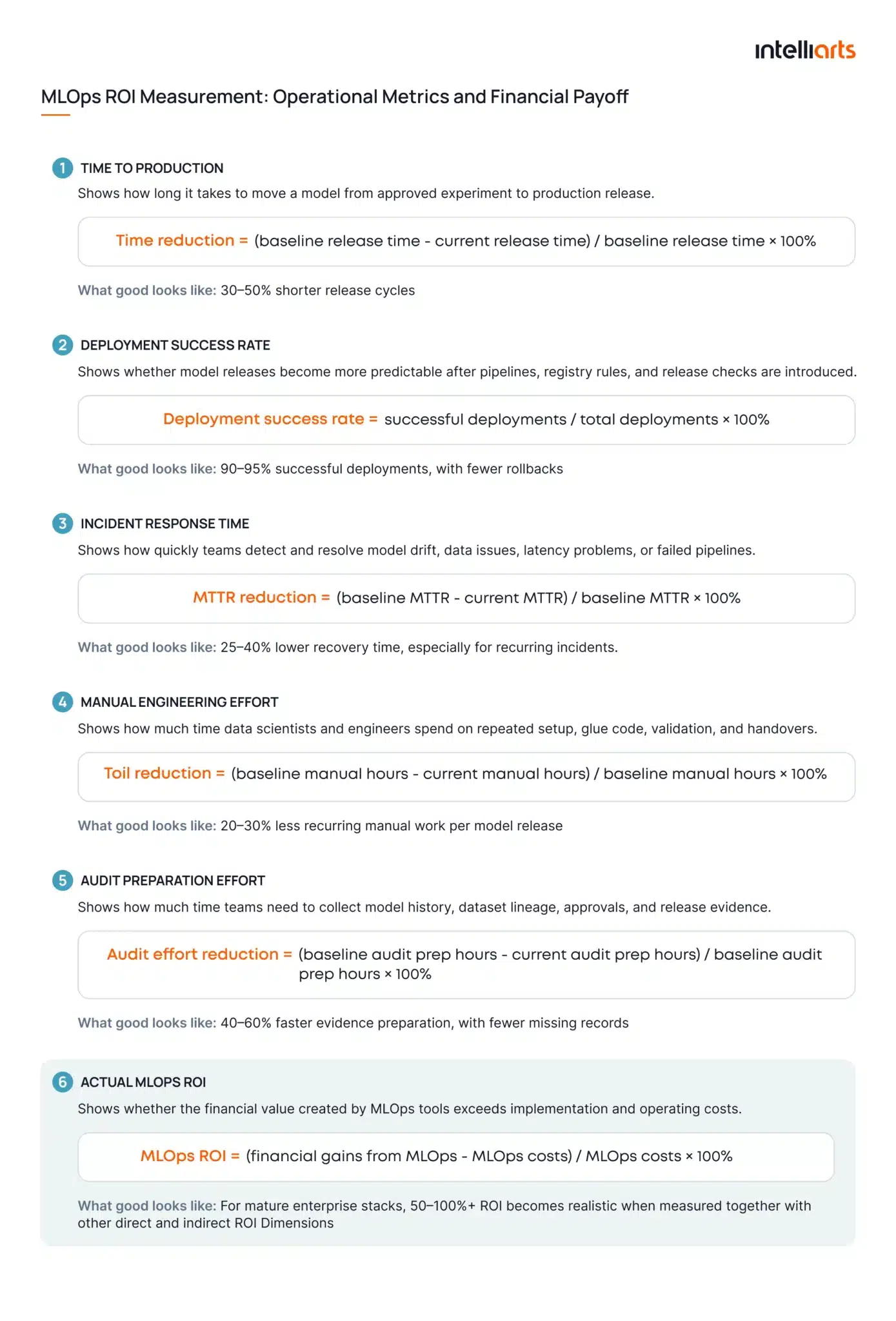
Important note: Before introducing an MLOps tool, teams should capture a baseline for the workflow it targets. For example:
- MLflow can be measured against experiment reproducibility and approval time.
- SageMaker Pipelines can be measured against deployment lead time, failed runs, and manual release steps.
From our engineering team (callout): A quick example of the impact of MLOps for enterprise comes from a manufacturing engagement under NDA. In that case, model release time dropped from about six weeks to ten days after introducing MLflow and a lightweight CI/CD pipeline. That is roughly a 76% reduction, or about 32 days saved per release cycle, mainly by standardizing model artifacts and replacing manual deployment scripts.
Tool deep dives: What they do and where they pay back
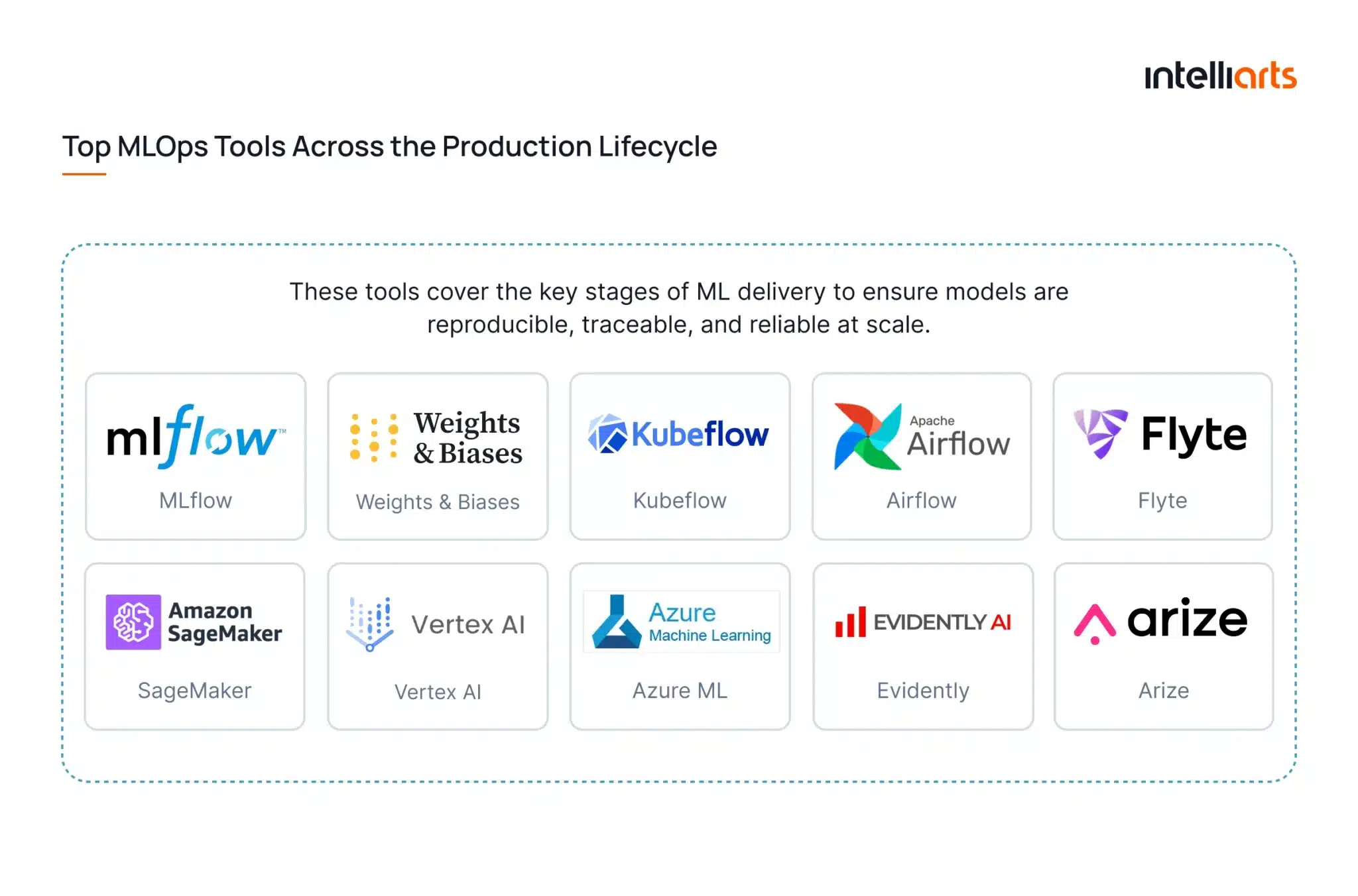
Tool comparisons are definitely helpful when each category is tied to a specific operating problem. To make sure of that, the sections below look at the MLOps tools that usually shape production stacks and explain where they create measurable value.
MLflow & W&B: Are experiment tracking tools worth the overhead?
Business problem
Experiment tracking becomes worth the overhead when model decisions can no longer rely on notebooks, spreadsheets, or informal team memory. The cost shows up during release: teams lose time proving which run produced the selected model, which data and parameters supported it, and whether the result can be reproduced.
What these MLOps tools do
MLflow and Weights & Biases work as development MLOps solutions for controlled model experimentation. They give data science and engineering teams a shared system for recording experiments, comparing model versions, and preparing selected candidates for release.
- Track model runs, parameters, metrics, and artifacts.
- Store approved models in a searchable registry.
- Compare experiments without rebuilding results manually.
- Connect model versions to CI/CD and release workflows.
- Support LLM evaluation, prompt testing, and quality checks, especially in W&B.
Why they pay back
- Reduce repeated experiments caused by lost metrics or unclear run history.
- Shorten release preparation by making model versions and artifacts explicit.
- Improve rollback decisions because previous model versions stay traceable.
- Speed up onboarding by giving new engineers a clear experiment history.
- Support audit and governance work without manual evidence collection.
MLflow usually fits cloud, hybrid, and Kubernetes-based stacks because it can connect with CI/CD, object storage, Airflow, Kubeflow, or managed pipelines. W&B is more useful when experiment visibility, team collaboration, and LLM evaluation matter more than owning every part of the tracking layer.
Real project lens
Years ago, one Intelliarts partner under NDA had a manufacturing ML workflow where the bottleneck was release readiness, specifically. In a nutshell, every candidate model required manual checks across the feature schema and deployment configuration, which resulted in a critical overhead over time, as was evaluated by stakeholders.
Eventually, the partner resorted to a pilot workflow with MLflow, achieved through machine learning operations services provided by Intelliarts. This tool is used as the registry layer, and approved runs are connected to a lightweight CI/CD flow, resulting in more consistent release packaging. When scaled, this helped cut several days from each model iteration cycle.
Kubeflow, Airflow, Flyte: Managing ML pipelines at scale
Business problem
Pipeline orchestration becomes critical when retraining stops being occasional work. Multiple models, changing data sources, validation rules, and release schedules quickly expose the limits of notebook-only workflows and manual cron jobs.
The cost usually appears in missed retraining, inconsistent pipeline runs, wasted compute, and weak visibility into where the workflow failed.
What these MLOps tools do
Kubeflow, Airflow, and Flyte are orchestration MLOps solutions for repeatable ML workflows. They structure the steps between data preparation and production release, so teams can run, test, schedule, and inspect pipelines with more control.
- Define training and validation workflows as DAGs or reusable components.
- Schedule retraining based on time, data availability, or business triggers.
- Track pipeline runs, dependencies, failures, and execution history.
- Reuse workflow logic across models, teams, or regions.
- Connect ML jobs with Kubernetes, cloud services, and CI/CD workflows.
Why they pay back
- Reduce manual coordination between data science, data engineering, and platform teams.
- Make retraining easier to rerun when data drifts or business rules change.
- Lower release risk by testing pipeline steps before production deployment.
- Improve compute usage through scheduling and controlled execution.
- Give teams clearer failure points when a pipeline breaks.
Architecture notes
Kubeflow fits teams that already have Kubernetes maturity and want stronger ownership of ML workflows. Airflow works well when ML pipelines need to connect with broader data engineering workflows. Flyte is a strong fit for typed, reusable workflows where pipeline reliability matters across many model runs.
Real project lens
A quick example is Spotify Engineering rebuilding its forecasting infrastructure for weekly and on-demand runs across 180+ markets. The workflow split data QA, training, tuning, checks, and visualization into controlled components, reducing heavy tuning processes from several months on one machine to a few hours.
SageMaker, Vertex AI, Azure ML: When does a managed platform make sense?
Business problem
Managed MLOps platforms make sense when the bottleneck is platform assembly. Building tracking, pipelines, deployment, monitoring, access control, and governance from separate components can take months before the first model reaches production.
For cloud-first companies, that delay often costs more than platform fees. The team spends too much time wiring infrastructure and too little time improving models, data quality, and release performance.
What these MLOps tools do
SageMaker, Vertex AI, and Azure ML are cloud-native MLOps platforms. They package core model lifecycle capabilities into one managed environment, so teams can train, evaluate, deploy, monitor, and govern models without building every layer themselves.
- Manage training jobs, model versions, endpoints, and deployments.
- Connect ML workflows with cloud storage, identity, security, and logging.
- Support managed pipelines for validation, retraining, and release steps.
- Provide monitoring features for model quality, drift, and runtime behavior.
- Reduce custom infrastructure work for teams already committed to one cloud.
Why they pay back
- Shorten the path to production for teams already on AWS, Google Cloud, or Azure.
- Reduce platform maintenance work for ML engineers.
- Improve integration with existing data lakes, IAM, logging, and CI/CD.
- Make governance easier through cloud-native access control and audit trails.
- Help small teams run production ML without owning a full custom platform.
The strongest fit is a company already standardized on one hyperscaler. SageMaker works best in AWS-heavy environments, Vertex AI in Google Cloud data stacks, and Azure ML in Microsoft-centered enterprise ecosystems. The trade-off is lock-in. Managed platforms simplify delivery, but they also shape how teams package models, govern access, and monitor behavior.
Real project lens
Google Cloud’s Cainz case shows where managed MLOps platforms pay back. The retailer used Vertex AI for demand forecasting across 209 stores, replacing a forecasting setup that struggled with seasonal products and short-term sales trends. The platform helped Cainz train large datasets more efficiently and reduce preprocessing time to 50 minutes regardless of store count.
Important note: In Intelliarts’ practice, native MLOps platforms are great for shortening delivery, mainly when the client is already invested in one cloud. The decision becomes weaker when the client needs strong multi-cloud portability or expects to customize every layer of the ML lifecycle.
Looking for software engineering assistance from an expert AI/MLOps service provider? Don’t hesitate to reach out.
Monitoring & drift tools (Evidently, Arize, Fiddler, etc.): Are they overkill?
Business problem
Monitoring becomes necessary when a model can fail without a visible system error. The endpoint still responds, but prediction quality drops because user behavior changes, input data shifts, labels arrive late, or an upstream integration starts sending different values.
For business teams, this can show up as bad recommendations, weaker risk scores, lower conversion, or missed anomalies. For engineering teams, the problem is harder: logs may confirm that the service is alive, while the model is already making worse decisions.
What these MLOps tools do
Evidently, Arize, Fiddler, and similar MLOps monitoring tools add observability after deployment. They track how inputs, predictions, performance, latency, and drift signals change in production.
- Compare production data against reference datasets.
- Detect data drift, concept drift, and prediction shifts.
- Monitor latency, errors, and model quality signals.
- Alert teams when behavior crosses defined thresholds.
- Support root-cause analysis through dashboards and explainability views.
Why they pay back
- Detect silent model degradation before users or revenue are affected.
- Shorten the incident investigation by showing where the behavior changed.
- Reduce unnecessary retraining by separating noise from meaningful drift.
- Support governance with production evidence and model behavior history.
- Improve SLA confidence for ML systems tied to customer-facing workflows.
Evidently is often useful for teams that want flexible open-source monitoring and custom drift checks. Arize and Fiddler fit teams that need deeper observability, explainability, and governance workflows across many production models.
Real project lens
Carnegie Mellon’s Software Engineering Institute tested drift monitoring on a DNS data exfiltration case. When adversarial behavior changed, the classifier’s performance dropped, but drift detection triggered retraining and restored strong post-drift performance. The case shows how MLOps monitoring tools can help teams detect behavior changes, separate real degradation from noise, and decide when retraining is justified.
Scenario matrix: Which MLOps tools fit which use cases?
Tool choice should follow the operating model. A small AWS-first team, a GCP-based enterprise, and a hybrid manufacturer do not need the same MLOps stack, even when they solve similar ML problems.
The matrix below shows practical starting points. Each setup can be expanded, but the first goal is to cover the critical layers without creating platform overhead.
| Scenario | Recommended core MLOps tools | Rationale |
|---|---|---|
| Startup with 1–2 key models, all in AWS | SageMaker, SageMaker Pipelines, SageMaker Model Monitor, S3, GitHub Actions | A managed AWS stack keeps the setup lean. The team gets training, deployment, monitoring, and basic automation without building a custom platform too early. |
| Mid-size enterprise on GCP with a data science team | Vertex AI, Vertex AI Pipelines, BigQuery, MLflow or W&B, Vertex AI Model Monitoring | Vertex AI fits teams already using Google Cloud for data and analytics. MLflow or W&B can add stronger experiment control when several data scientists work in parallel. |
| On-prem or hybrid manufacturing, Kubernetes-heavy | Kubeflow, MLflow, DVC or lakeFS, KServe or Seldon, Evidently AI | This setup gives more control over infrastructure, data location, and deployment patterns. It fits industrial environments where cloud-only platforms may create integration or compliance limits. |
| Regulated finance with strong audit needs | MLflow, Azure ML, or SageMaker, Fiddler or Arize, feature store, CI/CD with approval gates | The stack should prioritize traceability, model approval history, access control, and production monitoring. Audit readiness matters as much as deployment speed. |
| LLM-heavy stack with RAG and agents | W&B Weave, MLflow for LLMs, LangSmith, Arize Phoenix, Ragas, vector database monitoring | LLM systems need evaluation, tracing, prompt/version control, latency tracking, and retrieval quality checks. Standard MLOps monitoring is usually not enough for RAG and agent workflows. |
What Intelliarts experts suggest is sticking to simple patterns. So, lighter teams should start with managed platforms and a small tracking layer.
Larger or regulated teams that need stronger governance and ownership, as well as are potentially users of high-risk products as per the EU AI Act and other regulations, should have stronger control over model releases.
A focused pilot has always been the safest way to prove the usefulness of planned technology implementation. If a better ROI is confirmed, then it’s time to strategize for scaling.” — Volodymyr Mudryi, a DS/ML engineer at Intelliarts
Common anti-patterns when adopting MLOps tools
We do not get tired of reminding that MLOps can’t be a paid add-on to a software platform. It should be a systematic approach in place instead, to actually achieve the desired ROI.
The infographics below specify some of the most common anti-patterns in using MLOps tools:
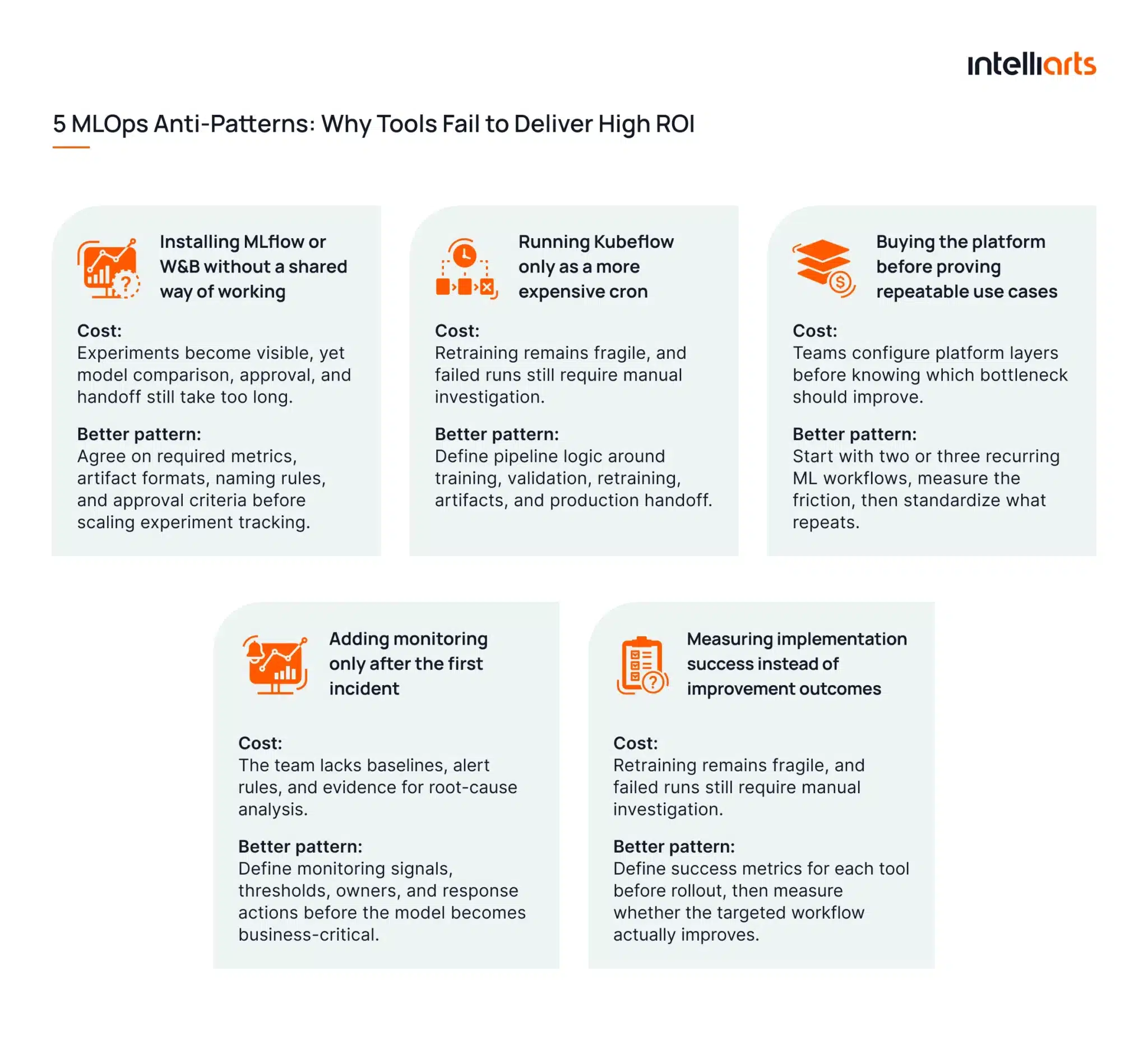
Intelliarts experts strongly suggest keeping the first rollout narrow. For this, just choose the most complicated workflow and define the operating rules around it. Then you should measure whether the tool actually reduces release time, rework, incident response, compliance effort, or any other central parameter.
How Intelliarts approaches MLOps tooling and ROI
Intelliarts approaches MLOps tooling using a business-oriented approach in the first place. The same tool stack will work in different scenarios because each one has a different release rhythm, risk profile, and governance load.
Here’s a very brief methodology that we would base end-to-end MLOps solutions around, with adjustments for every particular business situation:
- The methodology starts with evaluating the lifecycle of the current AI model in place, if there is any. Intelliarts maps where delivery slows down or becomes unreliable. Metrics like experiment handoff, release time, retraining delays, incident response, and others will define what the MLOps stack needs to improve.
- The next step is a minimal, opinionated toolset for the client’s environment. Cloud-first teams may benefit from SageMaker, Vertex AI, or Azure ML. Hybrid or regulated teams may need more control over registries, pipelines, monitoring, and deployment gates.
- ROI is validated through a focused pilot. Before-and-after metrics show whether the stack reduces manual work, release delays, production risk, or compliance effort before the MLOps ecosystem expands.
Important note: An actual project scope with clear steps tailored for your business will be provided as part of the consultation and project quote.
For more information on Intelliarts’ expertise and service offerings, visit our data science consulting and data engineering consulting website pages.
Final take
It’s generally accepted that there’s no universal best MLOps tool. All options available create value in different operating models and, by and large, serve different workflows. The strongest ROI comes from matching MLOps tools to clear production problems: release delays, manual handoffs, drift, failed deployments, and audit pressure. Start with measurable pain, choose a focused stack, prove value on a pilot, and expand only when the workflow improves.
With more than 26 years of experience delivering AI and MLOps services to businesses worldwide, Intelliarts offers our unmatched expertise and experience to serve your business needs.
We are proud to have a 90% customer return rate and 92% of our senior engineers are in-house. Our specialists can both consult you on business matters and help with any development and engineering needs to help you achieve optimal ROI for your best project.
FAQ
What are the must-have MLOps tools for a small data team?
A small data team usually needs MLOps tools for experiment tracking, model registry, deployment automation, and basic monitoring. Start with MLflow, Git-based versioning, CI/CD, and lightweight model monitoring tools before expanding into full end-to-end MLOps solutions.
How do I choose between MLflow and Weights & Biases?
Choose MLflow when your team needs an open, flexible experiment tracking and model registry layer that fits many stacks. Choose Weights & Biases when collaboration, experiment comparison, and LLMOps workflows matter more. Both can support a scalable MLOps architecture.
Is Kubeflow worth the complexity for a mid-size company?
Kubeflow makes sense when a mid-size company already runs Kubernetes and needs repeatable ML pipelines across several models. If the team lacks platform engineering capacity, a managed MLOps software platform may deliver faster ROI with less maintenance overhead.