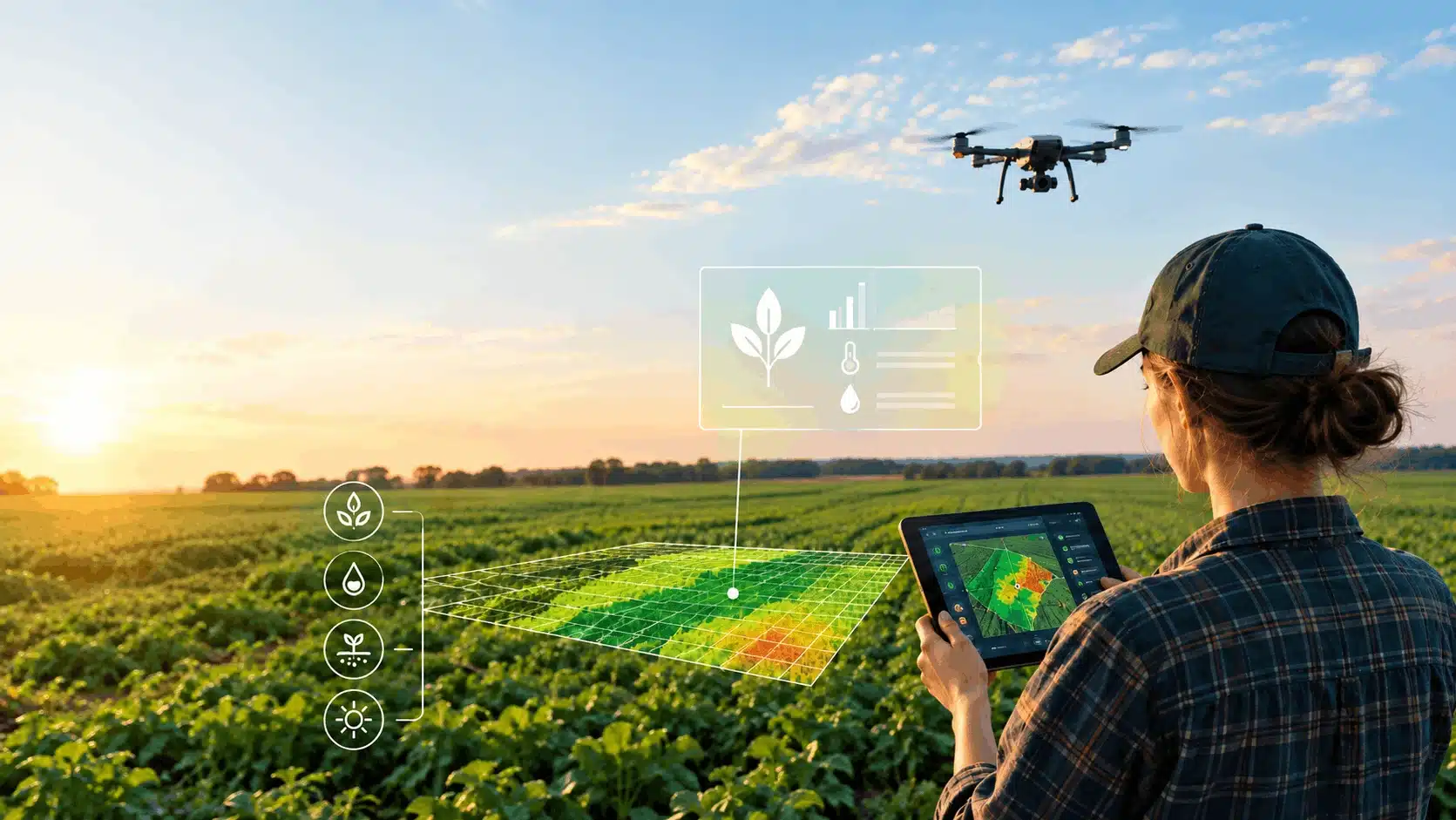

Agritech buyers are under pressure to make software decisions more carefully. The OECD-FAO Agricultural Outlook 2025-2034 projects global agricultural and fish production to grow by 14% by 2034, mainly through productivity gains. Meanwhile, the World Bank’s 2025 report on AI in agrifood systems maps 60 AI use cases across the agrifood value chain.
Still, the usage of additional technology software doesn’t automatically translate into better farming outcomes like extra yield. Based on Intelliarts’ expertise with agriculture businesses, software has to account for field data, hardware constraints, weak connectivity, and seasonal validation for a solid chance of having a good ROI.
That is why choosing an agritech software development partner requires more than checking portfolios or rates. The questions below will help you clarify whether a vendor can handle the real operating conditions behind your product.
Why agritech software development is a different beast
An agritech product, even a digital one, gets tested under specific conditions in a field. It’s something that can hardly be replicated during QA.
A platform can look convincing during a vendor call, then fail when it has to process delayed sensor readings, weak connectivity, inconsistent machinery records, or crop-specific workflows.
The main risks usually appear in several areas:
- Field usability: Farmers and agronomists may use the app under bright sun, with gloves, dirty hands, older devices, or limited time between field tasks.
- Data reliability: Soil sensors, satellite images, weather feeds, machinery records, and manual notes can be incomplete, delayed, or inconsistent across locations.
- Local agronomic context: Growth predictions may fail if the model does not account for soil type, drainage, field history, crop variety, or microclimate.
- Seasonal validation: A yield model, irrigation feature, or disease-risk alert may need a planting or harvest cycle before the team can prove value.
- Connectivity limits: Field teams often work with weak internet, so the product needs offline workflows, local caching, and delayed-sync logic.
- Traceability pressure: Agrifood companies may need proof of input use, product origin, sustainability metrics, or supplier activity.
Vendor selection should therefore extend beyond software expertise. Practical experience and actual agritech and renewable energy cases are high-priority consideration factors.
A strong agritech app development company covers, among others, these agritech-related concerns early:
- Where does the data come from, and how often does it fail?
- Which soil, crop, and climate factors affect the recommendation?
- Can users read and operate the product under field conditions?
- What happens when the device goes offline?
- Which decisions must be supported during this season?
- How will the team prove that the product improved planning, yield, waste, or compliance?
This mindset is what eventually helps clients avoid overbuilt dashboards, unreliable predictions, and a bunch of other errors.
What to look for in an agritech app development company
Before you compare prices or team size, check whether the vendor can handle the core delivery dimensions of an agritech product. Using our expertise with agriculture projects, the Intelliarts team drafted the approximate scope of dimensions in the infographic below to help:
| Layer | Evaluation focus | What it proves |
|---|---|---|
| 1. Agriculture logic | Crop models, farm workflows, machinery use, livestock operations, supply chain roles | The team understands how agricultural decisions are made |
| 2. Data foundation | Sensor data, satellite imagery, weather feeds, soil records, machinery data, manual field notes | The product can rely on realistic data, not ideal assumptions |
| 3. ML readiness | Yield forecasting, disease detection, irrigation optimization, model monitoring, seasonal retraining | Prediction features can stay useful across seasons and regions |
| 4. Field usability | Offline use, delayed sync, weak connectivity, sunlight-readable screens, fast field input | Farmers and agronomists can use the product outside office conditions |
| 5. Delivery model | Discovery, data audit, PoC, pilot, architecture, MLOps, post-launch roadmap | The vendor can reduce risk before full-scale development |
| 6. Scale potential | Multiple crops, regions, farms, devices, partners, and reporting requirements | The architecture can grow without expensive rework |
After you check the delivery dimensions, use the Experience, Expertise, Authoritativeness, and Trustworthiness (EEAT) framework to judge whether the vendor’s claims are credible:
- Experience: Look for proof that the company has worked with real agritech use cases, not only adjacent software projects.
- Expertise: Check whether the team can explain the logic behind the solution. For agritech, this may include soil data quality, crop models, model drift, seasonal validation, sensor calibration, offline sync, and explainable ML outputs.
- Authoritativeness: Look for evidence that the company shares knowledge beyond sales calls. This can include detailed case studies, technical articles, conference talks, research work, or open-source contributions related to agritech, data engineering, IoT, or ML.
- Trustworthiness: Pay attention to how the vendor talks about risks. A credible partner will discuss missing data, weak connectivity, hardware limits, adoption barriers, and pilot constraints before promising a full roadmap.
Important note: EEAT is an additional proof layer when choosing a provider. It doesn’t uncover whether a provider has sufficient technical feasibility for your particular project. However, it indicates whether an agritech software solutions and consulting partner is actually reliable and trustworthy.
Keeping all that in mind, let’s proceed with questions used to clarify one or another such aspect.
Looking for a strategy session with industry experts?
The Intelliarts team will guide you through any agritech project’s complexities.
Request technology consulting
10 questions to ask before you sign with an agritech software development partner
Before committing to any contractual agreements, you naturally have a session with a representative of a shortlisted agritech software company. That’s the best time to have any of your potential concerns or business needs addressed before a provider would quote you, and you make a final decision.
Important note: Normally, you don’t force a representative to answer every and each question in real life. The right call would be to evaluate what aspects had been covered through the website material of prior conversations first.
Then, just ask the remaining questions in text. Request a meeting with a dedicated specialist if necessary to address some technical matters. The goal is to achieve mutual understanding rather than to examine a representative using the rigid list of questions.
Based on Intelliarts’ experience, here are the questions we are often asked by clients, as well as the questions we would ask ourselves if we were in their place.

Question 1 – What real agritech experience can you show beyond generic case studies?
When shortlisting your potential vendors, a strong dev portfolio is naturally one of the main criteria. But ask for the details behind specific cases that fit your project conditions, if applicable.
As detailed above, in agritech software development, a case study matters more if it shows how the vendor handled agricultural constraints: crop variability, adoption of software, seasonal timing, region-specific considerations, and so on.
Don’t hesitate to ask what data the team used, who worked with the product, and where it was tested.
A strong answer should cover:
- The agricultural use case, such as farm planning, irrigation, livestock monitoring, crop scouting, or agrifood logistics
- The field context, including offline use, sunlight-readable screens, hardware limits, or on-farm rollout
- The measurable result, such as better forecast accuracy, reduced waste, faster inspections, or improved planning
The best vendors will also explain what went wrong. Real agritech projects often face missing sensor data, weak adoption, delayed integrations, or ML models that need adjustment after the first season.
Red flags: Vague experience, agriculture stock images, AI claims without data context, and case studies with no seasonality, no pilot results, and no clear business metric.
Question 2 – How deep is your domain knowledge in agriculture and food supply chains?
A good vendor should understand who uses the product and how decisions move across the agricultural value chain. Ask a chosen agritech software development company about growers, agronomists, farm managers, machine operators, input suppliers, processors, distributors, or downstream buyers.
Domain knowledge matters because agriculture has too many context-specific workflows. Row crops, horticulture, greenhouse operations, livestock, and agrifood logistics all need different product logic. A greenhouse platform may depend on climate control and controlled inputs. An open-field solution has to deal with weather volatility, soil variation, machinery routes, and limited connectivity.
A strong answer should mention:
- Domain experts, agronomists, or data scientists with agritech experience involved in discovery
- Clear understanding of crop types, farm workflows, supply chain roles, and regional requirements
- Ability to explain how product features change for growers, cooperatives, input suppliers, or buyers
Red flags: The vendor uses generic software terms rather than those specific to software in agritech. For example, they don’t articulate the difference between greenhouse and open-field workflows, or B2B input planning and downstream buyer needs.
“We note that our customers’ concerns primarily revolve around business goals and adoptions. Naturally, we put a lot of effort into discussing these aspects, especially when communicating with stakeholders.” — Alexander Barinov, a managing partner at Intelliarts.
Question 3 – How do you approach data, sensors, and integrations in agritech projects?
A lot of agritech products depend on data that is messy before it reaches the application layer. Weather APIs, satellite images, soil sensors, machinery records, gateways, telemetry, and manual notes often arrive in different formats and update at different speeds. Some data may be missing for hours, while other sources may need calibration before they become useful.
Ask the vendor how they design for this reality. A strong agritech app development company should explain how they validate incoming data, handle gaps, and manage delayed sync. They should also prevent weak data from producing misleading recommendations.
Look for experience with:
- Hardware integrations, such as sensors, gateways, telemetry devices, and field equipment
- External data sources, such as OEM APIs, satellite imagery, weather providers, and farm management systems
- Data architecture that can handle noisy, sparse, delayed, or region-specific data
It may happen that soil moisture readings need calibration in the field. Alternatively, satellite data may be blocked by cloud cover. Machinery data may arrive with inconsistent timestamps. A reliable partner should explain how the system behaves when data is incomplete, not only when every source works.
Red flags: Treating sensors as input sources only, skipping data quality checks, or ignoring offline use. Having no strategy for missing readings, delayed syncing, or unreliable field connectivity.
Explore satellite remote sensing and predictive analytics in agriculture in another one of our articles for additional insights.
Question 4 – What is your track record with agritech software solutions and consulting, not just coding?
In our experience, many agritech businesses start with an actual business problem or an objective without a clear specification at this stage. For example, they might be looking for ways to reduce water waste, improve yield forecasting, automate field reporting, or enforce traceability across suppliers through software.
This is where agritech software development and consulting services become even more valuable. The team of a selected partner should test assumptions, review data availability, assess ML feasibility, and define what a useful pilot should prove. Without that step, the project may move fast, but build features that cannot be supported by real field data.
A strong answer should include:
- Workshop-based discovery or product discovery sprints
- Data audits, ML feasibility checks, or architecture reviews
- PoC and pilot planning with clear success metrics
- Examples where the vendor refined the scope after data review or early field feedback
For example, you, as an agriculture organizaiton, may want a full yield prediction platform, but the available historical data may only support a narrower planning tool at first. A good partner should say that early, explain the trade-off, and propose a staged roadmap.
Red flags: Fixed long-term scope before discovery, or no willingness to challenge assumptions. In agritech, weak early assumptions can cost more than delayed development because the next validation window may be months away.
Question 5 – How do you handle seasonality, field conditions, and offline use in product design?
Agritech products have to match the agricultural calendar. A feature released after planting, spraying, irrigation planning, or harvest may miss the moment when it can create value. Because of this, release planning should follow seasonal priorities, not only sprint capacity.
Field conditions also shape product design. A worker may use the app under direct sunlight, with gloves, dirty hands, a poor signal, or limited time between tasks. Dense dashboards, long forms, and always-online workflows can reduce adoption even when the backend works well. These concerns naturally should be discussed with a selected agritech app development company and addressed.
A strong vendor should explain how they design for:
- Offline-first mobile workflows and local caching
- Delayed sync with conflict handling and clear status indicators
- Sunlight-readable screens, fast input, and simple field actions
- Seasonal release planning tied to planting, growing, harvest, or inspection windows
Ask what happens when connectivity drops during a field inspection or when data sync happens several hours later. The answer should include product behavior, user notifications, and data recovery logic.
Red flags: Include proposals based on constant internet access, office-style UX, or no distinction between field workers and office users. A capable agritech software development partner should know that field adoption depends on small practical details.
“To me, field adoption has always been one of the most interestings matters about agritech projects. Demands are ranging from readability under direct sunlight and offline sync to embedded, custom analytics with AI-powered, real-time forecasting. The impact of software is fascinating.” — Yurii Bondarenko, Software Engineer at Intelliarts

Question 6 – How do you manage data quality, ML models, and explainability for agritech use cases?
Prediction features can support better decisions only when the data behind them is reliable. Yield forecasting, disease-risk alerts, irrigation recommendations, and crop growth models depend on soil type, weather patterns, crop variety, field history, and farming practices.
Ask how the vendor checks data before it reaches the model. A serious agritech software development partner should address matters like missing values, outliers, delayed updates, inconsistent sensor readings, and seasonal retraining.
A strong answer should cover:
- Data versioning, so the team knows which datasets trained each model
- Model monitoring after new seasonal data arrives
- Retraining plans based on crop cycles, regions, and field feedback
- Farmer-friendly explanations for recommendations and risk alerts
- Validation against real field outcomes across more than one season
Explainability matters because farmers and agronomists need to trust the output before they act on it. A disease-risk alert should show signals like humidity, temperature, crop stage, or recent observations. A yield forecast should show assumptions or confidence levels, especially when soil quality may affect accuracy. The scope of agritech software solutions and consulting should cover that.
Red flags: “AI-powered” claims without data-quality checks, no model drift monitoring, no retraining plan, and no explanation of how predictions will be validated in real field conditions. A credible vendor should explain how the model behaves when data changes between seasons.
Explore AI use cases in agriculture in great detail in another blog post by Intelliarts.
Question 7 – What is your approach to security, compliance, and data ownership in agritech?
Farm and supply chain data can expose commercially sensitive information. It may reveal yield performance, field locations, input use, livestock health, supplier relationships, production volumes, or sustainability metrics. When the product serves cooperatives, processors, or marketplaces, access control becomes even more important.
Ask who owns the data, who can access it, and how the system separates information between farms, partners, and tenants. A reliable vendor should answer this before development starts, especially when several value-chain actors use the same platform.
A strong answer should cover:
- Data ownership and usage clauses in the project scope
- Role-based access for growers, agronomists, managers, suppliers, and buyers
- Multi-tenant data separation for cooperatives, platforms, or marketplace models
- Audit logs for critical actions and data changes
- Data residency, retention, and regional privacy requirements
Based on Intelliarts’ experience working with agricultural organizations, the scope of compliance is entirely dependent on the actual use case. Lots of AI usages in agriculture are still considered low or medium-risk if not involved with production processes. However, a traceability platform may still need reliable records for product origin and supplier activity. A sustainability reporting tool may need documented input, use, resource consumption, or emissions-related data.
Red flags: Vague answers related to cybersecurity options, no access model for different agricultural roles, no audit logs, no data residency discussion, and unclear data ownership. A credible agritech app development company should treat data rights as a product requirement from discovery.
Question 8 – How Will We Collaborate Day‑to‑Day (Team Setup, Communication, On‑Farm Presence)
One thing we’ve consistently observed is that agritech projects usually involve more stakeholders than a standard software build. One product may need input from growers, agronomists, farm managers, data scientists, hardware partners, operations teams, and executives. Without a clear collaboration model, field context gets lost before it reaches the backlog.
Ask who will be involved from the vendor side. The answer should go beyond the project manager and developers. For data-heavy or ML-based products, you may need a data engineer, ML engineer, QA specialist, solution architect, and someone who can translate domain feedback into product decisions.
A strong answer should cover:
- Team setup with clear roles, such as PM, tech lead, domain expert, data engineer, ML engineer, and QA
- Demo cadence tied to product decisions and field feedback
- Communication channels for data issues, integration blockers, and user feedback
- Discovery sessions with real users, such as agronomists, operators, or farm managers
- Willingness to visit farms, processing sites, or pilot locations when needed
Collaboration with an agritech software solutions and consulting partner should also take into account seasonal aspects related to agriculture. During planting, harvest, or inspections, users may have limited time for long workshops. Here at Intelliarts, we firmly believe that a good partner adapts feedback loops to the agricultural calendar.
Red flags: Purely ticket-driven work, no domain expert on the vendor side, no direct access to field users, and demos that show screens without discussing real operating feedback.
Question 9 – How do you estimate, price, and de-risk agritech software development projects?
Agritech projects often start with unknowns. The client may not know whether the data is complete enough, whether farmers will adopt the workflow, or whether hardware integrations will behave consistently in the field. Because of this, detailed long-term fixed quotes before discovery should raise concern.
A safer approach breaks the project into stages. Discovery defines the business goal, users, data sources, and constraints. A PoC tests technical feasibility. A pilot checks whether the product works in real operations. After that, full-scale development becomes easier to estimate.
A strong answer should cover:
- A phased plan, such as discovery, PoC, pilot, and scale
- Clear outcomes and go/no-go criteria for each phase
- Transparent pricing, such as time and materials with caps or fixed scope for limited phases
- Risk assumptions around data availability, hardware, adoption, and seasonality
- A process for scope changes after pilot feedback
For example, a vendor may recommend testing one crop, region, or farm group before expanding the platform. That can reduce the risk of building a large product around weak assumptions.
Red flags: Fixed multi-year scope before data review, no PoC or pilot phase, no risk assumptions, and no criteria for stopping or changing direction. A mature agritech software development partner should price the work around evidence.
Looking to discuss your agritech project?
Here at Intelliarts, we have expertise and experience for any of your requests.
Contact us
Question 10 – What Happens After Go‑Live: Support, Iteration, and Long‑Term Roadmap?
Go-live is where agritech products start producing the most useful evidence. Field users reveal slow workflows, integrations expose data gaps, and models show whether they can handle new regions, seasons, or crop conditions. The post-launch plan matters because the first release rarely captures every field constraint.
Ask what support looks like after deployment. A strong partner should explain how issues are monitored, how incidents are prioritized, and how field feedback enters the roadmap. For ML-based products, they should also explain how model performance will be reviewed as new data arrives.
A solid answer should cover:
- Support SLAs and escalation paths for critical issues
- Monitoring for integrations, data pipelines, sync failures, and model performance
- Issue response during high-pressure seasonal windows
- Backlog management based on field evidence and user feedback
- Roadmap planning for new crops, regions, integrations, or reporting needs
Seasonality should remain part of the roadmap. A feature needed before harvest cannot wait for a generic quarterly planning cycle. A reporting module tied to compliance deadlines needs the same timing discipline.
Red flags: No clear support model, ad hoc change requests only, no monitoring plan, no roadmap process, and no seasonal planning after launch. A credible agritech software development and consulting partner should help the product improve across seasons, regions, and user groups.
Comparison table: types of agritech software development partners
When it comes to agritech software development, you have an array of partners to choose from. You should be aware that specialization and technical feasibility may vary. Some focus on app delivery, some on hardware, and some on ML.
For products with field data, integrations, seasonal validation, and scaling needs. You can see a general comparison across the main types of agritech software development companies that are offering corresponding services in the table below:
| Type of partner | Main strength | Limitations | Best for |
|---|---|---|---|
| Agritech software solutions and consulting firm (like Intelliarts) | Most comprehensive option. Covers discovery, data audit, architecture, PoC planning, product development, integrations, MLOps, and post-launch iteration. Connects business goals with field data, hardware, seasonality, and scalability. | Requires deeper client involvement during discovery, data review, and pilot planning. May be too structured for small feature-only tasks. | Complex agritech platforms, ML products, smart irrigation, yield forecasting, traceability, IoT ecosystems, and products with unvalidated scope. |
| Agritech app development company | Brings agriculture context and understand common product patterns for growers, agronomists, cooperatives, or processors. | Often focused on web or mobile delivery. May lack depth in data engineering, ML feasibility, hardware integration, or strategic consulting. | Farm management apps, crop scouting tools, livestock monitoring apps, agrifood logistics systems, and MVPs with validated requirements. |
| Generic custom dev agency | Flexible implementation capacity for standard web, mobile, admin, or marketplace features. Can be cost-effective when domain risk is low. | Limited agritech context. May miss seasonality, field UX, offline use, sensor reliability, data ownership, and agricultural decision logic. | Internal tools, simple portals, admin panels, basic marketplaces, and non-critical features. |
| IoT hardware vendor or sensor provider | Deep knowledge of devices, telemetry, installation, calibration, and field hardware behavior. | Usually tied to its own hardware ecosystem. May lack full product strategy, UX, data architecture, ML, or platform delivery. | Sensor-driven monitoring, equipment connectivity, livestock tracking, smart irrigation hardware, and field telemetry projects. |
| Data science or ML consultancy | Strong for forecasting, optimization, computer vision, anomaly detection, and early model feasibility. | Often focused on models, not full product delivery. May not cover field UX, integrations, platform architecture, support, or roadmap execution. | Yield prediction, disease detection, satellite imagery analysis, recommendation engines, and ML feasibility studies. |
The first option, which is a consulting and all-in-one agritech software development company, fits best when the project needs both strategic validation and delivery.
Other partners can work well for narrower tasks, but they usually cover one product layer: the app, hardware, model, or implementation. Intelliarts’ experts have repeatedly observed that for agritech products that need to work in field conditions and scale over time, a narrow focus can leave critical gaps.
How Intelliarts thinks about agritech software solutions and consulting

Here at Intelliarts, we approach agritech projects as a sequence of validation steps framed around specified business objectives. We discuss potential risks like incomplete data, unavailable model inputs, weak field adoption, etc., early, and only then proceed.
- The starting point is a clear product hypothesis: the team defines what the solution should improve and how that improvement will be measured.
- The next step is a data audit: the team checks what data already exists, where it comes from, how often it updates, who owns it, and which gaps may affect the product logic.
Combining agritech software development with data and ML consulting is our specialization. Here are some of the measures we take to ensure that no expensive rework will be needed:
- Starting with one crop, region, or decision workflow before scaling the product
- Testing whether satellite, weather, soil, or machinery data is reliable enough for recommendations
- Designing fallback logic for missing sensor readings or delayed sync
- Checking whether an ML model can explain its output in a way agronomists and farmers can trust
- Planning MLOps early, so models can be monitored and retrained after new seasonal data arrives
As a strong agritech software development and consulting firm, Intelliarts leverages digital technology, hardware, adoption, and compliance aspects to help reach business goals.
Some of our agritech success stories demonstrating our expertise and experience include:
- Case example 1: Sensor inventory management for agritech operations
In a sensor inventory management project, Intelliarts helped an agritech company replace fragmented tracking across spreadsheets, QR codes, dashboards, and SQL queries. The system centralized sensor lifecycle management across 2,000 sensors and 500+ fields, improving field updates, QA/QC checks, and operational scalability.
- Case example 2: Data automation for Indigo Ag’s Carbon program
In a data automation project for Indigo Ag, Intelliarts automated agricultural data collection for carbon credit workflows. Our team built third-party integrations and ETL/ELT pipelines to reduce manual entry from up to 8 hours to several minutes while improving data consistency.
Final take
Choosing an agritech software development partner comes down to proof, not promises. The right team should understand field conditions, data quality, hardware limits, seasonal validation, ML risks, and agricultural workflows.
Use these questions to clarify how an agritech software solutions and consulting vendor works, where their expertise is strongest, and whether their approach fits your roadmap. For complex products, prioritize partners that combine consulting, engineering, data, and long-term product thinking.
Agritech software development is one of the main niches for the Intelliarts team. We combine high-tech, as well as AI and ML practices, to provide the best solutions for sustainable agriculture for businesses worldwide. With 92% senior developers in-house and a 90% customer return rate, we are well-equipped to contribute to your best project with all our knowledge and experience.
Ready to build custom agritech software?
We develop scalable AI, IoT, GIS, and data platforms that solve real agricultural challenges.
Schedule a consultation
FAQ
1. What is agritech software development?
Agritech software development is the creation of digital tools for agriculture, food production, and farm operations. It can include farm management platforms, IoT monitoring, yield prediction, supply chain systems, and mobile apps for field teams. Strong solutions account for seasonality, connectivity limits, and real farm workflows.
2. How do I choose an agritech app development company?
Choose an agritech app development company by checking its real agriculture experience, data and ML capabilities, integration skills, and understanding of field conditions. Look for case studies, clear discovery methods, and practical knowledge of sensors, weather data, machinery, and farm users.
3. What should be included in agritech software solutions and consulting services?
Agritech software solutions and consulting should cover product discovery, data audit, architecture design, PoC planning, agritech software development, integrations, QA, and post-launch support. For data-heavy products, it should also include ML feasibility, model monitoring, explainability, and roadmap planning based on pilot results.