

TL;DR
- API-first LLM development is usually the fastest path for pilots, early copilots, and low-risk GenAI features.
- Custom LLM development becomes more relevant when cost, data control, latency, compliance, or product differentiation begin to affect the business case.
- Fully custom models are rarely the first step. Most enterprise teams benefit more from RAG, fine-tuning, model routing, or self-hosted deployment.
- Based on Intelliarts’ project experience, the strongest strategy is often hybrid: validate fast, then add ownership where it improves long-term value.
Many enterprise GenAI pilots start with OpenAI, Anthropic, or other LLM APIs because they are fast to test and easy to connect. AI adoption has moved into core operations, as the Stanford AI Index 2025 reports that 78% of organizations used AI in 2024, up from 55% in 2023.
As usage grows, so do questions about APIs, token spending, data residency, vendor dependence, latency, and compliance. For CTOs and VP Engineering, desired outcomes of custom LLM development and corresponding concerns are largely defined by the level of ownership the company needs across models, data, infrastructure, and governance.
This article explains how to compare LLM APIs with custom large language model development across cost, control, security, and delivery speed. It also shows how to structure a build-or-buy decision for enterprise use cases.
Have an AI project in mind, but unsure which path to take?
Let’s discuss your options together
Why is “custom LLM vs API” a strategic question?
API-first GenAI works well for pilots. Teams can test copilots, chat interfaces, and document workflows without building model infrastructure.
The problem starts when pilots move into production. Then API access becomes an architecture decision: cost, vendor dependence, data control, latency, and compliance all matter.
Three factors are pushing leaders to revisit the build-or-buy LLM decision:
- Open-source LLMs are becoming more practical. The Stanford AI Index 2025 points to rapid progress in model performance, tooling, and AI adoption, which gives enterprises more options beyond standard APIs.
- AI regulation is getting stricter. The EU AI Act’s general-purpose AI rules started applying on August 2, 2025, increasing pressure around transparency, documentation, and risk controls.
- LLMs are moving into core workflows. McKinsey’s 2025 State of AI survey says organizations are redesigning workflows as they deploy GenAI and assigning senior leaders to AI governance.
APIs are still useful for speed, variable workloads, and advanced capabilities that are hard to operate internally. Custom LLM development starts to matter when the use case needs more control over cost, data, behavior, or integration.
Before comparing both paths, leaders need to define what custom LLM development services actually cover. That’s something the Intelliarts expert more often than not helps to define before the beginning of new projects or throughout technology consultation sessions.
What does custom LLM development mean?
Development of a custom LLM for enterprise applications is a spectrum of technical approaches to create, adapt, deploy, and operate LLM capabilities for a specific business case.
At the lightest level, a company may still rely on external APIs but add custom prompts, retrieval, evaluation, and workflow logic around them. At the deeper end, it may fine-tune a proprietary or open-source model, host it privately, or continue pre-training a model on domain-specific data. Here are four main approaches aggregated:
| Approach | What it means | When it fits |
|---|---|---|
| API-only | External LLM APIs with no model ownership | Fast pilots, low-risk workflows, uncertain demand |
| Proprietary model customization | Provider-hosted fine-tuning or configuration | Use cases that need more consistent behavior, but not full infrastructure ownership |
| Open-source model adaptation | Fine-tuning, RAG, or deployment of models like Llama or Mistral in your cloud | Sensitive data, higher volume, stronger control requirements |
| Heavy pre-training or training from scratch | Building or further training a model on large proprietary datasets | Rare cases with unique data, strong budgets, and clear long-term value |
- Important explanation: As you can see, even for enterprises, “custom LLM” does not mean building a GPT-scale model from zero. It usually means choosing the right foundation model, or, at the very maximum, selecting an algorithm, which may be an LLM or another AI-based one, to create an incredibly niche model. For example, Intelliarts did this with a two-model computer vision solution for car damage detection.
So, the Intelliarts team can confidently state that the goal for almost every single AI, ML, and LLM project is adapting an existing model to the particular business task. Usually, it’s related to integrating it with enterprise data and making it up and running with proper MLOps.
Just a few of the backend layers underneath the model’s UI/UX include:
- Model serving layer
- Inference API
- Request routing and orchestration
- Data and vector database connections
- Authentication and access control
- Monitoring, logging, and tracing
- Guardrails, fallback, and retry logic
Another important note here is that “build vs buy” is not a rigid decision in this scenario with LLM implementation services. The scale tips depending on how much ownership the company needs across the model, data, infrastructure, and governance layers.
Searching for an AI and LLM software partner?
Entrust the Intelliarts team with all your project development needs.
Reach out
Custom LLM development vs using LLM APIs
You probably already concluded that APIs keep more responsibility on the provider side, while custom LLM development moves more responsibility to the enterprise team or its engineering partner. While this is a generalization, such a statement is mainly correct.
See how a custom LLM for enterprise applications compares to fulfilling the same business objective using LLM APIs integrations:
| Criteria | Using LLM APIs | Custom LLM development |
|---|---|---|
| Launch speed | Fast setup for pilots, proofs of concept, and first product releases | Longer setup because the team needs architecture, data pipelines, deployment, and evaluation |
| Upfront cost | Lower initial spend, usually based on API usage and integration work | Higher initial spend across engineering, infrastructure, security, and MLOps |
| Cost at scale | Simple at first, but less predictable when token volume, user count, or workflow coverage grows | Easier to optimize for stable, high-volume workloads once infrastructure is in place |
| Data control | Depends on provider terms, deployment model, retention policy, and enterprise controls | Stronger control over where data is processed, stored, logged, and audited |
| Model control | Limited to prompting, provider settings, and available fine-tuning options | Broader control through model selection, RAG, fine-tuning, routing, evaluation, and guardrails |
| Compliance | Suitable when the provider’s controls match the risk level of the use case | Stronger fit for strict data residency, auditability, and sector-specific governance |
| Performance | Strong general-purpose capability with minimal maintenance | Can be tuned for domain vocabulary, repeatable tasks, latency, and cost per request |
| Vendor exposure | Higher exposure to pricing changes, model updates, rate limits, and usage policies | Lower exposure if the architecture supports open-source LLMs, private hosting, or multi-model routing |
| Operations | Provider handles model serving, scaling, and most infrastructure concerns | Enterprise owns more backend work: serving, monitoring, access control, retries, and updates |
| Strongest use cases | Early experiments, variable workloads, general assistants, multimodal features | Regulated workflows, high-volume automation, domain copilots, large document pipelines |
Based on what the Intelliarts team observes, for early-stage use cases, LLM APIs and fine-tuned procedures usually keep delivery simple yet sufficient at a small scale and within a limited scope of usage. They also let teams compare model quality before making deeper infrastructure decisions or committing to a full-scale custom LLM development process.
However, for mature workloads, the shift toward LLM TCO (total cost of ownership) that would prioritize control and operational readiness is reasonable. That is where enterprise LLM development is already both an engineering and a business task, with full responsibility across the entire technology solution on the owner’s side.
Evaluation framework: 6 questions to decide, build, or buy
Before choosing between APIs, custom LLM development process, or a hybrid setup, teams need to pressure-test each use case against business and technical constraints. These six questions help narrow the decision before architecture, budget, and delivery planning begin.
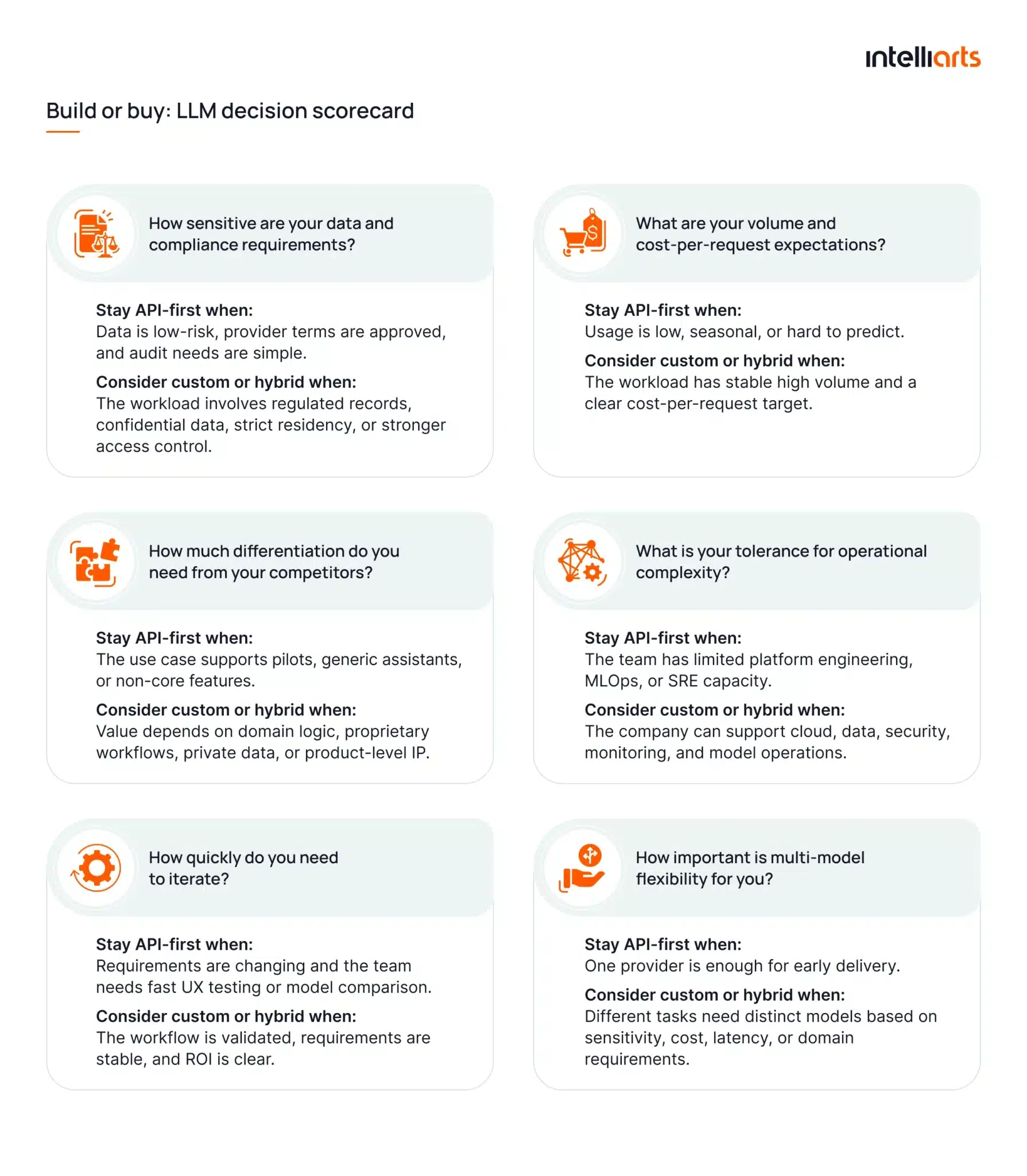
How sensitive are your data and compliance requirements?
Sensitivity is the first hard filter. If the system will process regulated records, confidential contracts, claims, medical notes, internal IP, or government data, the choice often shifts toward custom LLM development and, respectively, VPC-hosted, self-hosted, or tightly controlled architectures.
APIs can still work when the provider’s enterprise terms, retention policy, regional processing, and audit options match the risk profile. For enterprise teams, the key question is whether the full data flow can pass legal, LLM security, compliance, and procurement review.
For enterprise teams, this question usually comes down to three checks:
- Processing boundary: where prompts, retrieved context, logs, and outputs are processed.
- Control boundary: who can access the data, model outputs, audit trails, and configuration.
- Regulatory boundary: which data residency, retention, explainability, or sector-specific rules apply.
From Intelliarts’ experience, this filter narrows the architecture early. A marketing content assistant may stay API-based. A claims review, underwriting, legal analysis, or healthcare workflow usually needs a stronger ownership model.
What are your volume and cost-per-request expectations?
High-volume workloads can make custom LLM development services more attractive. Low-volume, seasonal, or experimental use cases usually stay cheaper and easier with APIs.
The rough breakeven point appears when monthly API invoices become higher than the cost of running infrastructure, maintaining the model stack, and supporting production operations. This threshold depends on token volume, context size, latency needs, and workload predictability.
For enterprise teams, LLM TCO should account for:
- Inference cost: API usage, GPU infrastructure, hosting, or managed deployment fees.
- Engineering cost: integration, model updates, backend maintenance, and incident response.
- Quality cost: evaluation sets, regression testing, guardrails, and human review.
- Monitoring cost: usage tracking, latency checks, output quality review, and cost controls.
A support copilot used by thousands of agents can justify a custom or self-hosted setup once request patterns become stable. A small assistant used by one department may remain API-based for years because infrastructure ownership adds more cost than value.
As a custom LLM development company, we can confirm that in such digital projects, the stronger signal is repeatable volume with clear quality requirements and a predictable cost-per-request target.
“To craft an enterprise LLM system that would cater to business objectives, we build around workflows, permissions, evaluation, and feedback loops. Of course, model choice matters, but the infrastructure, data transformation, and integrations deliver the key value that stakeholders can observe.”
— Alexander Barinov, a managing partner at Intelliarts.
How much differentiation do you need from your competitors?
If the LLM feature is part of your competitive edge, API access alone may not be enough. The same model can power many similar tools, so defensibility usually comes from what the company builds around it.
For enterprise products, differentiation often comes from the following sources:
- Proprietary workflows: the way the system supports domain-specific decisions, approvals, reviews, or exceptions.
- Private data: historical records, expert knowledge, user behavior, internal policies, or product-specific context.
- Integration depth: how well the LLM connects to permissions, business systems, data sources, and operational logic.
This is where the custom LLM development process gives teams more control. An insurance copilot can reflect claims handling rules. A legal research assistant can follow a firm’s review standards. An industrial analytics product can connect model outputs to equipment data, maintenance history, and risk thresholds.
The timing still matters. If users have not validated the workflow yet, building custom LLMs can lock the team into expensive assumptions. APIs, especially those based on open-source LLMs, are often better for proving demand first. Once the feature becomes strategic, custom models can support stronger IP, more consistent behavior, and deeper product differentiation.
Learn about our ML solution for lead scoring in insurance. Read the case study.
How quickly do you need to iterate?
APIs are usually the better fit when requirements are still changing. They let teams test prompts, workflows, UX, and model behavior before committing to deeper architecture choices.
A practical path often looks like this:
- Prototype with APIs: launch the first version quickly and compare model quality across realistic tasks.
- Validate value: measure adoption, output quality, cost per task, and failure patterns.
- Segment use cases: separate experimental, long-tail, sensitive, and repeatable workloads.
- Build selectively: move stable, high-ROI workloads into the custom LLM development process when the business case is clear.
This phased approach reduces the risk of overbuilding too early. It also helps teams build long-term capability around the workloads that deserve more control, instead of treating every GenAI feature as a custom infrastructure project from day one.
What is your tolerance for operational complexity?
Custom LLM development requires more than model integration. The team also needs MLOps, SRE, security, and support capacity to keep the system reliable after launch.
API-first is safer when the organization cannot yet own that operational load. Custom LLM application development firms handle much of the model serving, scaling, updates, and infrastructure resilience.
For a custom or self-hosted setup, the main operational questions are:
- Scaling: Can the system handle usage spikes without breaking latency targets?
- Observability: Can the team trace failed answers, slow requests, retrieval issues, and cost anomalies?
- Model updates: Can changes be tested before they affect production quality?
- Incident response: Who owns failures when outputs are wrong, unsafe, delayed, or unavailable?
- Security operations: Can the team manage access, audit logs, secrets, and data exposure risks?
In Intelliarts’ projects, we sometimes see companies underestimate the long-term cost of owning the LLM stack. The initial build may look manageable, while monitoring, regression testing, updates, and support become the real workload, which we typically help to optimize.
If the team already has strong platform engineering practices, custom LLMs can be realistic. If that maturity is missing, APIs can reduce operational risk while the use case matures.
Want a clearer picture of LLM costs?
Download our 2026 LLM cost guide to explore pricing trends and hidden costs.
Get your copy
How important is multi-model flexibility for you?
We’ve found that multi-model flexibility matters when the product may need different models for critically distinct tasks, like code testing vs customer support. One workflow may need a GPT-class model, another may need an open-source LLM, and a third may need a domain-specific model with stricter deployment rules.
The custom LLM development architecture should avoid hardwiring the product to one provider. A model routing layer gives teams a pluggable backend for API models, custom models, and self-hosted deployments.
This helps teams control switching costs in three ways:
- Provider changes: replace or add vendors without rebuilding the product layer.
- Use-case optimization: choose cheaper, faster, or more accurate models for specific workloads.
- Risk management: keep sensitive requests on controlled backends while sending lower-risk tasks to external APIs.
This flexibility becomes more important as the scope of self-hosted LLMs grows. Without it, every model change can turn into a product, backend, and compliance update at the same time.
Important tip: These questions, taken together, are useful because they force teams to evaluate each use case separately. A low-risk assistant may stay on APIs, while a regulated document workflow may require more ownership from day one.
Once leaders see these differences clearly, the build-or-buy discussion becomes less abstract and easier to connect to architecture, budget, and delivery priorities.
API-first strategy: When “buy” is the right answer
API-first is the right answer when the team needs speed, low upfront investment, and access to strong general-purpose models. It works best when data sensitivity is manageable and expected usage does not yet justify deeper model ownership.
In which scenarios do LLM APIs make the most sense?
One thing the Intelliarts experts consistently observed is that LLM APIs are usually the best starting point when the use case still needs validation. Teams can launch faster, compare model quality, and avoid early infrastructure decisions.
Common examples include:
- Prototyping new AI features or pilots. APIs help teams test copilots, search assistants, summarization tools, or document workflows before making larger architecture commitments. These use cases are usually exploratory, so speed and flexibility matter more than infrastructure ownership.
- Customer-facing chatbots and copilots without highly sensitive data. This approach works when the provider’s security controls match the risk level of the use case. It is a good fit for product guidance, FAQ support, onboarding flows, or other interactions that do not require strict control over private records.
- Low-to-medium scale internal assistants across departments. Teams can support HR, sales, operations, or engineering workflows without building a dedicated model stack. These assistants usually handle routine knowledge access, drafting, summarization, or workflow support across a manageable number of users.
- Specialized, semi-internal AI assistants. Such solutions may include limited-functionality bots that help users access specific, usually technical features of a vendor’s platform. Lots of other applications are possible, yet they are limited to the main platform or website functionalities and are incapable of providing answers to customer queries.
For these scenarios, LLM integration services, or simply put, buying model access, keep the focus on workflow design, user adoption, and business validation. That is often more valuable than investing too early in a custom LLM development process.
What are the hidden risks of an API-only approach?
An API-only setup can become limiting when a pilot turns into a production dependency. The risks usually appear around cost, control, and compliance, for example, as per the above-mentioned EU AI Act.
Key risks include:
- Vendor pricing changes. A workload that looks affordable during testing can become expensive as token volume, user count, or document size grows.
- Tighter rate limits or usage policies. Provider-side limits can affect reliability, regional availability, or supported use cases.
- Regulatory shifts. New data residency, audit, or AI governance requirements may force teams to control more of the data flow.
- Model changes. Providers may update, deprecate, or replace models, which can affect output quality, latency, pricing, or prompt behavior in production.
- Limited control over optimization. API-only setups give teams less room to tune infrastructure, inference cost, latency, and behavior for repeatable domain-specific workloads.
These risks can be managed without abandoning APIs. A practical API-first architecture should include an API abstraction layer, basic multi-vendor testing, clear data-sharing rules, and an exit plan for workloads that may later need an enterprise LLM strategy and development.
Custom LLM development: When “build” starts to pay off
An easy answer here, based on Intelliarts’ expertise, is that when building starts to make sense, API-based delivery becomes too expensive, restrictive, or risky for a specific workload. This usually happens when the use case has high volume, high business value, or strict data requirements. Let’s elaborate on these considerations:
Which use cases justify custom LLMs?
Custom LLM development is easier to justify when the model supports one or more of the core workflows already, rather than being a supporting functionality.
Common product examples of generative AI model development include:
- Domain-specialized copilots for regulated industries. Financial, healthcare, legal, or insurance teams may need assistants who understand domain language and internal policies. These copilots may support analysts, claims teams, compliance officers, or customer support agents while keeping sensitive data inside approved environments.
- Large-scale document processing pipelines. A company may process contracts, claims, invoices, tickets, or reports at a volume where API costs become harder to predict. Custom models can help classify documents, extract fields, flag exceptions, or route cases to the right team.
- Products where the LLM is central IP. If the model experience is part of the product’s competitive value, generic API behavior may limit differentiation. This can apply to legal research tools, industry copilots, AI analytics products, or domain-specific knowledge platforms.
- Repeatable classification or extraction workflows. With custom LLM development services, stable, high-volume tasks can often benefit from a smaller optimized model. This works especially well when the task does not need broad general reasoning, such as ticket tagging, intent detection, entity extraction, or compliance triage.
- Private knowledge assistants for enterprise teams. Some companies need assistants who work with internal documentation, policies, engineering tickets, or customer records. In this case, the main value comes from secure retrieval, access control, and reliable answers inside the company’s own context.
- AI workflows with strict latency or uptime needs. Some production systems cannot depend only on external provider availability or changing rate limits. A custom setup can give engineering teams more control over inference speed, fallback logic, and service-level requirements.
These use cases do not always require training from scratch. In most cases, enterprise LLM development starts with an existing model and adds the right data, infrastructure, evaluation, and governance around it.
“Just to prevent any possible confusion. For one, a claims assistant, a legal review tool, and a marketing copilot can all use LLMs. It still doesn’t mean that they should share the same software architecture or even AI model by default.” — DS/ML Engineer at Intelliarts.
What does a realistic custom LLM stack look like?
A realistic stack usually combines open-source LLMs, RAG systems, fine-tuning where needed, and production-grade MLOps. In practice, LLM software development services cover the backend, data, monitoring, evaluation, and governance layers that make the model usable in production.
That stack usually includes:
#1. A model decision. The team chooses whether the workload needs an API model, a fine-tuned provider model, an adapted open-source model, or a self‑hosted LLM to control inference location, latency, data exposure, and model behavior.
- Stack elements: Model provider, fine-tuning setup, open-source model deployment, or private inference endpoint.
#2. A data path. The system needs a controlled way to pull approved data from documents, databases, tickets, policies, or product systems without exposing more context than the model needs.
- Stack elements: CRM, ERP, DMS, ticketing system, knowledge base, database, or data warehouse connectors.
#3. A runtime layer. The product needs a backend that routes requests between the application, data layer, and model while managing context, retries, latency, and usage.
- Stack elements: Model gateway, inference API, request router, prompt/context builder, cache, retry logic, and fallback route.
#4. A quality control loop. Teams need a way to catch wrong, irrelevant, unsafe, or expensive answers before model or prompt changes affect production quality.
- Stack elements: Evaluation dataset, golden questions, answer scoring, regression tests, hallucination checks, and human review queue.
#5. A governance layer. The company needs rules and controls for regulated or sensitive workflows, including access, retention, auditability, approvals, and policy enforcement.
- Stack elements: SSO, RBAC, audit logs, PII detection, data retention rules, approval flows, and usage policies.
Custom LLM development pays off when the workload is stable enough to optimize and important enough to own. Otherwise, APIs may still be the more efficient choice.
If you are looking for a technical explanation of how enterprise solutions for LLMs work, specifically RAG architecture and best practices, take a look at another of our blog posts.
Hybrid LLM strategies: Best of both worlds
A hybrid LLM strategy works when processes need different model paths. In practice, this means splitting workloads by purpose:
- APIs when flexibility, model breadth, or fast iteration matter most.
- Custom LLMs, when control, cost predictability, data boundaries, or repeatable quality matter more.
The infographic below shows how this routing logic works in practice.
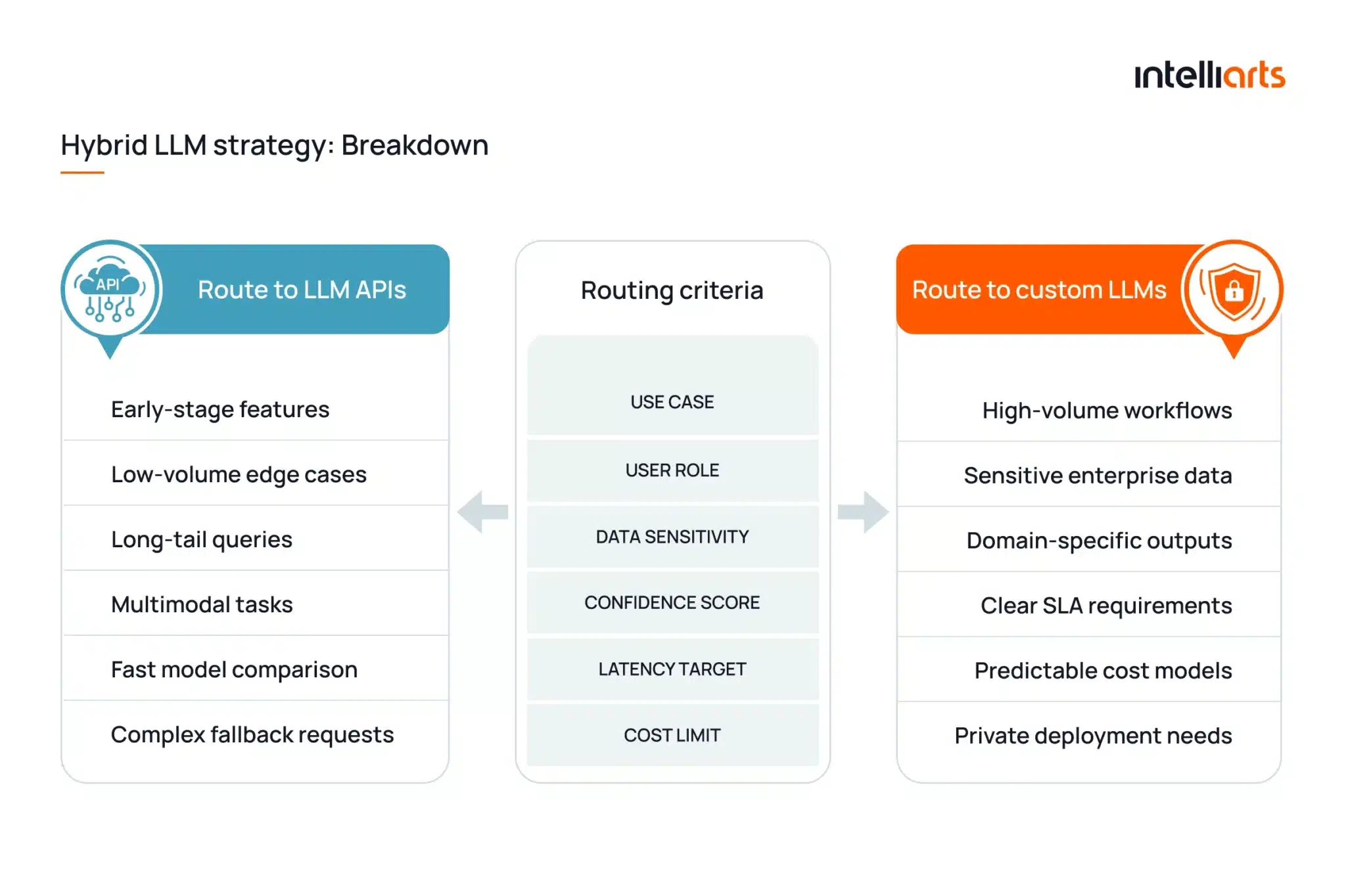
At the end of the day, hybrid strategies work best when each workload is matched to the model path that fits its risk, cost, and performance profile.
Decision matrix: Example scenarios mapped to LLM strategy
Use this matrix to map each use case to the right delivery path. The goal is to compare demand certainty, data sensitivity, workload volume, and ownership needs without overengineering the first decision.
| Scenario | Recommended approach | Rationale |
|---|---|---|
| New product prototype with uncertain demand | API-first | Fast validation matters more than infrastructure ownership. |
| Customer-facing chatbot with low-risk data | API-first | LLM APIs work well when data exposure is limited, and requirements are still broad. |
| Internal assistant for one department | API-first | Limited usage rarely justifies a dedicated model stack. |
| Internal support assistant for 500 agents | Hybrid | Start with APIs and RAG, then move repeated tasks to custom infrastructure if usage stabilizes. |
| Regulated document review, such as contracts or claims | Custom or VPC-hosted LLM | Sensitive data needs stronger control over access, logs, and processing. |
| High-volume classification pipeline | Custom LLM | Stable repeated tasks can improve LLM TCO with an optimized model. |
| Enterprise knowledge assistant over internal documents | Hybrid or RAG-first | Retrieval quality, permissions, and source control matter more than the model alone. |
| Domain-specific copilot for a regulated industry | Custom LLM development | Domain rules, internal policies, and repeatable logic require deeper control. |
| Marketing copy generation for multiple brands | API-first or hybrid | APIs support variation, while RAG can add brand rules and approval context. |
| Multimodal analysis with image, audio, or video | API-first | External providers usually offer faster access to advanced multimodal capabilities. |
| Existing API-based workload with rising spend | Hybrid migration | Keep APIs for complex cases and move stable tasks to controlled infrastructure. |
The matrix should be revisited as usage grows. A use case can start API-first, move to hybrid, and justify custom ownership once value, volume, and risk become clear.

How Intelliarts helps enterprises navigate the build or buy LLM decision
Intelliarts, as a provider of custom LLM development services, helps enterprises with their build-or-buy LLM question based on the investment decision tied to value, risk, and long-term ownership factors. The work starts with business priorities: which workflows create measurable value, which data can be used safely, and which risks would block production adoption.
Our expertise combines AI/ML engineering, data engineering, enterprise software development, LLM development, and RAG system integration.
While it’s hard to specify exact project stages before discussing business needs, our general LLM development, with or without API-based integrations, is usually shaped around four phases:
- Use case discovery. We define the workflows that can benefit from LLMs, the users involved, the data they need, and the business metrics that will prove value. The result is a prioritized set of use cases with clear constraints.
- Build-or-buy modelling. We compare LLM APIs, RAG, fine-tuning, self-hosted models, and hybrid options against cost, latency, risk, security, and maintenance needs. The result is a practical enterprise LLM strategy, with LLM TCO and risk assumptions visible before implementation starts.
- Pilot implementation. We build a focused proof of value with real workflows, integrations, and evaluation criteria. The result is measurable evidence on output quality, cost per request, user adoption, and failure patterns.
- Production scale-up. We add monitoring, guardrails, evaluation pipelines, cost controls, and reliability practices. The result is an LLM architecture that can support broader enterprise use without losing control over quality or operations.
This gives leadership a clearer roadmap before major engineering investment begins. Teams can validate GenAI ideas quickly, keep early delivery lean, and move deeper ownership only into workloads where it improves cost, reliability, security, or product differentiation.
With Intelliarts’ LLM development services and RAG development services, enterprises can plan, build, and scale LLM systems with the right balance of speed and control.
Conclusion
Build or buy is a portfolio decision. LLM APIs are useful for pilots, variable demand, multimodal workloads, and low-risk assistants. Custom LLM development becomes more relevant when workloads are stable, sensitive, expensive at scale, or tied to product differentiation.
The middle ground is often a hybrid enterprise LLM strategy with model routing, where each request goes to the backend that fits its risk, cost, latency, and quality needs.
Whether you lean more toward custom or API-based development, you need a trusted custom LLM development company specializing in AI/ML development. With more than 26 years of experience delivering software solutions and 90% customer return rate, the Intelliarts team is ready, willing, and able to contribute to your best project.
FAQ
What is custom LLM development in practice?
Custom LLM development is the process of adapting LLM capabilities to a specific business context. It can include RAG, fine-tuning, prompt architecture, model routing, private deployment, evaluation, monitoring, and guardrails. In rare cases, it may also include continued pre-training or training a model from scratch.
When should an enterprise move from LLM APIs to custom models?
An enterprise should consider moving beyond standard LLM APIs when generic outputs, vendor limits, data exposure, latency, or usage costs start constraining the product. The next step does not always mean full model ownership. It may begin with RAG, fine-tuning, open-source LLMs, or a hybrid architecture.
Can we mix custom LLMs and third-party APIs in one architecture?
Yes. Many enterprises use third-party APIs for experimentation, complex reasoning, or multimodal tasks, while custom LLM components handle sensitive, high-volume, or domain-specific workflows. A hybrid setup works best with model routing, shared evaluation, access controls, and clear rules for which data each model can process.






![Top MLOps Tools in 2026 and Their ROI [Based on Real Projects]](https://intelliarts.com/wp-content/uploads/2026/08/ChatGPT-Image-23-июн.-2026-г.-11_16_54-1.webp)