
TL;DR
- Companies searching for the best RAG development companies often see the same claims: secure AI, scalable architecture, enterprise-grade delivery, and polished demos.
- In RAG projects, those claims are not enough. Weak retrieval design, poor source handling, shallow evaluation, and unclear ownership can stay hidden until production.
- Strong vendors should prove how they handle retrieval quality, enterprise data sources, permissions, answer grounding, workflow integration, and post-launch monitoring.
- We explain how to compare RAG development companies using practical criteria that show whether a partner can move from a prototype to a reliable enterprise RAG.
Enterprise AI adoption continues to grow. According to McKinsey’s State of AI 2026 report, 44% of organizations are now scaling AI enterprise-wide, up from 38% in 2025. Yet moving from proof of concept to production remains a challenge.
Gartner reported in January 2026 that at least 50% of GenAI projects were abandoned after proof of concept by the end of 2025, citing poor data quality, inadequate risk controls, rising costs, and unclear business value. For companies investing in RAG solutions, these findings make vendor evaluation particularly important.
This guide explains how to evaluate RAG development companies from a technical standpoint. It covers production-ready RAG architecture, technical signals to verify, vendor comparison criteria, and red flags. If approached properly, these guidelines should help you find the perfect-fit retrieval-augmented generation services for your project.
Why choosing a RAG partner is harder than choosing a generic AI vendor
It’s easy to notice that RAG projects look deceptively mature in demos. But you should always keep in mind that production success depends on metrics that the demo rarely proves, like retrieval precision or source data quality.
- The big idea: It’s easy to demonstrate a seemingly polished assistant created using simple and fast methods. But much harder to show engineering discipline and domain expertise needed for enterprise RAG development.
At the end of the day, this has made vendor selection increasingly difficult over the past few years. Here are three practical reasons for such market conditions:
- Generic LLM experience gets rebranded as RAG expertise. Many vendors prove RAG capability on clean, limited datasets, then generalize that result to enterprise use. That doesn’t cover actual buyers’ concerns that often revolve around weak metadata, access restrictions, and retrieval failures under real operating conditions. LLM expertise still matters, which is why Intelliarts also provides large language model development services.
- Buyers over-focus on the model layer. RAG development companies may lead with model choice, UX, or speed to pilot. Yet, a mature RAG implementation partner starts with knowledge architecture and solution logic that should be shaped around business objectives.
- Case studies hide the hard parts. Public examples often highlight adoption or efficiency, while hiding failed queries and stale indexes, as well as escalation paths.
At a very basic level, a credible RAG implementation partner should be able to elaborate on ways in which they can make the end system retrieve the right evidence and keep performance stable after launch.
Weak RAG development companies stay near the demo layer, i.e., model choice and general experience, supporting that with unverified claims, while AI vendors have a set of prebuilt solutions that may or may not work for your particular business scenario.
- Important note: The Intelliarts team explains the general logic behind choosing the vendor and some common situations with different RAG development companies you might be facing. This does not automatically justify labeling one vendor as trustworthy and another as untrustworthy.
Looking for a RAG partner that thinks beyond the demo?
Contact us to learn more
What makes a good enterprise RAG system?
Any enterprise RAG system should be evaluated by how it behaves under real operating conditions. As per the Garbage-in-Garbage-Out (GIGO) rule, the following issues contribute to poor performance:
- Incomplete sources
- Conflicting documents
- Restricted repositories
- Stale records
From a technology perspective, a RAG solution may malfunction due to the combination of the following:
- Poor chunking strategy
- Weak embedding model fit
- No re-ranking layer
- Poor query expansion or query rewriting
- Context windows filled with low-value passages
- No confidence scoring or fallback logic
- High latency under real user load
- No retrieval evaluation dataset
- No regression testing after index or prompt changes
As you can conclude, a bad RAG system is a mix of data- and technology-related issues in place. As for a good solution, the best RAG development companies make sure to have these essential RAG building blocks included in the architecture:
- Ingestion and structuring of enterprise data. This is the process of processing raw enterprise content to yield searchable, governed knowledge assets.
- Source types: PDFs, wikis, tickets, tables, CRM records
- Parsing quality: Layout, tables, images, metadata
- Content controls: Duplicates, outdated files, conflicting sources
- Refresh logic: Sync frequency, re-indexing rules
- Retrieval quality. Also referred to as the system’s ability to find the most relevant and authorized evidence for each user query.
- Search methods: Keyword, dense, hybrid
- Ranking logic: Relevance, freshness, source priority
- Filters: Metadata, user role, document type
- Metrics: Recall, precision, top-k accuracy, failed queries
- Grounded generation with traceable evidence. Grounded generation is how the system turns retrieved evidence into an answer that users can verify.
- Citations: Source links, passage-level references
- Answer boundaries: Answer, qualify, or refuse
- Evidence fit: No unsupported claims
- Signals: Confidence, missing evidence, conflicting sources
- Observability, evaluation, and governance. This is the operating layer that keeps RAG quality measurable and controlled after launch.
- Logs: Queries, retrieved sources, user feedback
- Evaluation: Test sets, regression checks, hallucination review
- Governance: Access audits, source ownership, update rules
- Monitoring: Drift, stale content, quality drops
The Intelliarts team reminds you that in RAG projects, quality usually improves less from changing the model and more from fixing architecture in the first place and retrieval practices in the second place.
Interested in exploring more about data pipelines and retrieval best practices? Read how Intelliarts built a big data pipeline in another one of our blog posts.
How we define the best RAG development companies
In this guide, “best” is a criteria-based definition. It describes the capabilities a RAG implementation partner should prove before an enterprise buyer commits to a project: retrieval depth, architecture maturity, evaluation discipline, workflow fit, and post-launch ownership.
This logic is consistent with how production AI systems are assessed by technical sources. Intelliarts’ experience in providing RAG services is complemented by the guidelines available at the following sources
- NIST AI RMF for risk and governance context.
- Microsoft Azure guidance to check on grounding data design as an architectural concern.
- Google Vertex AI and NVIDIA NeMo help separate RAG evaluation into retrieval quality and generation quality.
What strong evidence looks like:
- Production RAG depth: Document parsing, chunking, embeddings, hybrid retrieval, re-ranking, grounding, monitoring, and optimization.
- Enterprise architecture thinking: Clear answers on permissions, metadata, data residency, auditability, integrations, deployment options, and access boundaries.
- Evaluation discipline: Separate measurement of retrieval quality and answer quality, not only demo feedback or user satisfaction.
- Workflow-specific value: A business process improved by RAG, such as support resolution, compliance review, sales enablement, engineering knowledge search, or internal research.
- Rollout logic: Discovery, pilot scope, quality gates, production rollout, monitoring, re-indexing, governance review, and ownership transfer.
What weakens the credibility:
- Generic “enterprise-grade AI” claims with no retrieval methodology
- Chatbot screenshots without architecture or evaluation details
- Model-choice discussions that ignore source ranking and evidence quality
- Case studies with outcomes but no constraints, metrics, or failure handling
- Proofs of concept with no monitoring, SLA, or post-launch owner
The next section turns this methodology into eight concrete criteria for enterprise AI partner selection.
Looking for custom RAG development from an experienced vendor?
Request RAG services
The 8 criteria to evaluate RAG development companies
Ever found yourself struggling to distinguish between providers and therefore make the final decision? While budget, legal, and other constraints require additional considerations, there are aspects by which you can assess technical capability and general reliability of any vendor, and move from there.
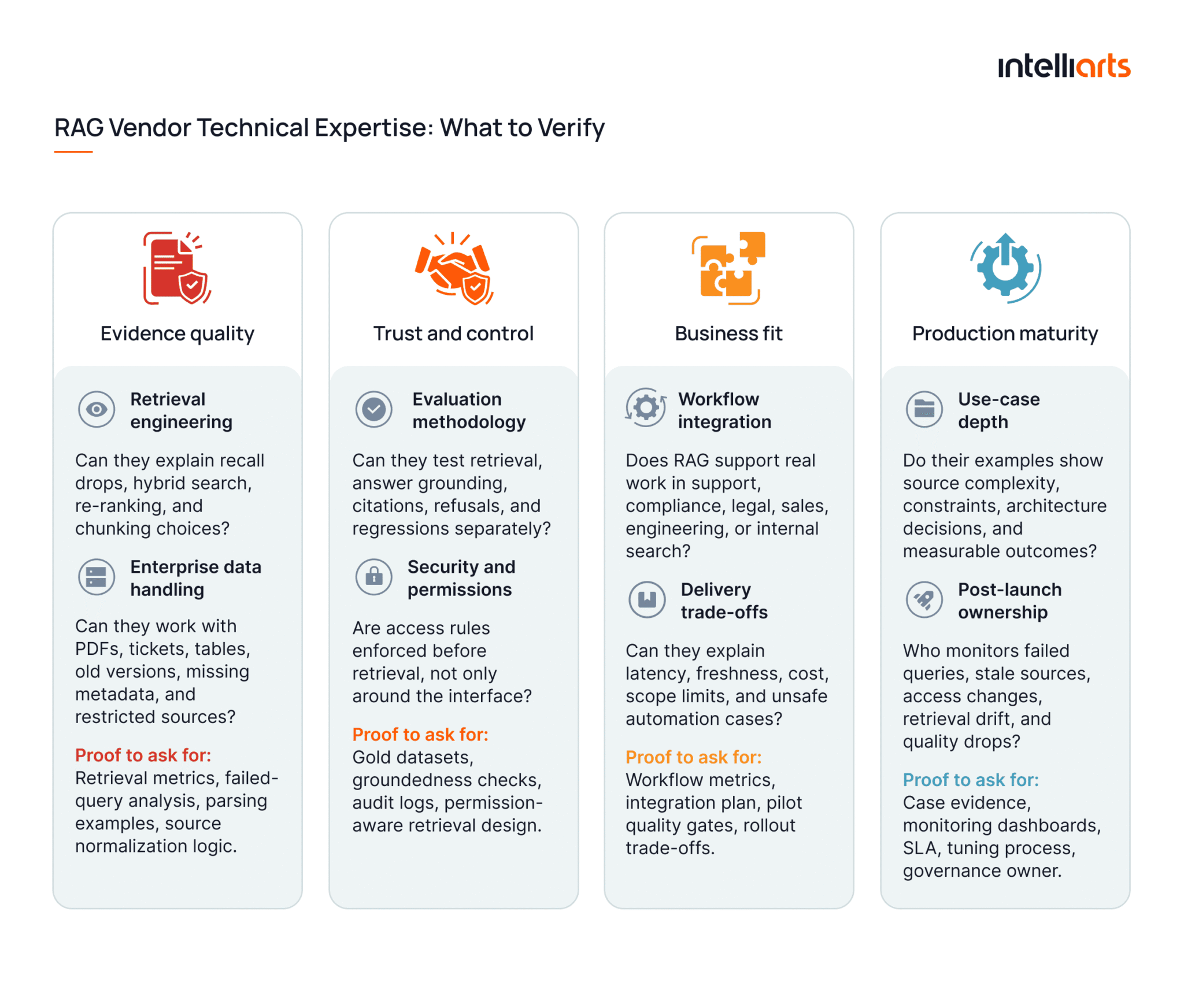
Ask yourself the following, and reach out to your vendor if any information is lacking or is unclear:
1. Do they understand retrieval engineering, not just LLM prompting?
Look first at how the vendor reasons about retrieval failure. A good sign is a team that can explain where recall drops, why keyword search may beat embeddings, and how chunking changes for tables, policies, procedures, or support tickets.
In enterprise RAG development, the model works only with the evidence retrieval it gives. Poor retrieval turns even a strong model into a confident summarizer of the wrong context.
Signals to look for:
- Clear use of Recall@k, Precision@k, MRR, nDCG, and failed-query rate
- Practical comparison of dense, keyword, hybrid search, and re-ranking
- Chunking choices tied to document structure rather than default rulesets
2. Can they handle complex enterprise data sources?
Look at the data conditions behind the vendor’s examples. Many RAG demos run on clean markdown, help center pages, or a small set of curated PDFs.
Best RAG development companies for enterprises deal with fragmented repositories, scanned files, tables, version conflicts, missing metadata, and permissioned systems. In RAG solution development, weak source handling later appears as irrelevant retrieval, broken citations, and unstable answers.
Signals to look for:
- Source normalization across PDFs, wikis, tickets, records, and technical documents
- Parsing strategy for tables, diagrams, layouts, and long manuals
- Governance rules for duplicates, stale files, conflicting versions, and source ownership
Take a look at Intelliarts’ data engineering consulting services to find out how our team handles normalization, pipelines, governance support in custom RAG development, and more.
3. Do they have a clear evaluation methodology?
Pay attention to how quickly the conversation moves from “the demo works” to measurable quality. In RAG vendor evaluation, a credible team separates retrieval quality, answer quality, citation quality, and hallucination risk.
User feedback matters, but it cannot replace benchmark queries, gold datasets, and regression checks. In enterprise RAG development, quality needs a testable baseline before rollout.
Signals to look for:
- Offline tests using benchmark questions and expected source passages
- Online monitoring for failed queries, low-confidence answers, and user corrections
- Metrics beyond satisfaction, including groundedness, faithfulness, and citation accuracy
4. How mature are they on security, permissions, and compliance?
Security maturity shows in pipeline design, not in a single “we are compliant” statement. Enterprise RAG solutions often need document-level, row-level, or role-based access before retrieval happens.
Late permission checks can still expose restricted context to the model or logs. This becomes critical in finance, healthcare, legal, and industrial environments, where auditability matters as much as answer quality.
Signals to look for:
- Permission-aware indexing and retrieval, not only UI-level access control
- Data residency, private deployment, encryption, and retention options
- Audit logs for queries, retrieved sources, access decisions, and answer history
“We pay close attention to the boring parts of RAG because those are usually where production quality lives: parsing, indexing, ranking, logging, and regression tests.” — Volodymyr Mudryi, former DS/ML Engineer at Intelliarts
5. Can they integrate RAG into workflows, not just build a chatbot?
The best use cases rarely end at a chat window. Enterprise generative AI solutions create more value when RAG supports a real decision point: a support case, compliance review, sales response, engineering ticket, or legal workflow.
Generic “ask your docs” interfaces can help, but in the case of reliable AI chatbot development services, ROI usually comes from embedding answers where workflows are already well-established.
Signals to look for:
- Experience connecting RAG to CRMs, support tools, BI systems, portals, or case workflows
- Outputs that trigger approvals, drafts, recommendations, or next-step actions
- RAG development services tied to workflow metrics, not only usage numbers
6. Do they show realistic delivery thinking and trade-offs?
Good delivery thinking sounds specific, sometimes inconvenient. A strong RAG consulting company will discuss latency, content freshness, indexing cost, permission complexity, and cases where automation is unsafe.
Weak proposals often promise fully accurate answers or imply that RAG removes hallucination risk. In practice, enterprise RAG development needs staged rollout and quality gates.
Signals to look for:
- Pilot scope tied to clear success metrics and failure thresholds
- Honest trade-offs around latency, cost, freshness, coverage, and accuracy
- Rollout plan covering discovery, evaluation, production, monitoring, and optimization
7. Do they have relevant case studies or at least use-case depth?
A logo wall proves little without a delivery context. Look for stories that explain the business problem, data environment, architecture choices, constraints, and measurable results.
Strong RAG development experts can speak concretely even when NDAs limit client names. The useful signal is not industry similarity alone, but how the team reasoned through trade-offs.
Signals to look for:
- Use cases with source complexity, workflow context, and success metrics
- Discussion of constraints, failed assumptions, and lessons learned
- Anonymized examples that still show architecture, delivery path, and business outcome
Here’s an AI-powered data extraction chatbot case study by Intelliarts as a reference for a relevant portfolio:
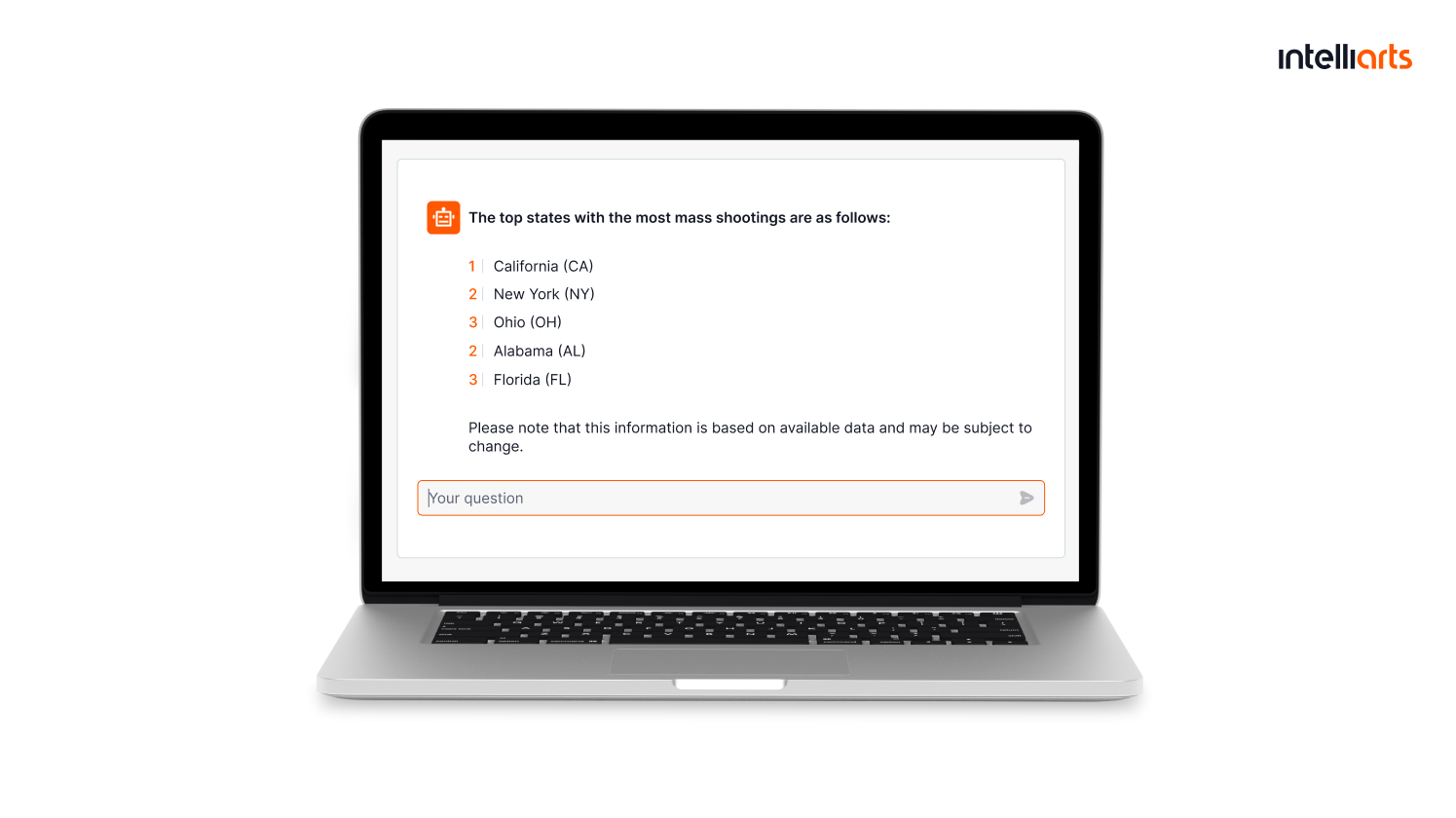
- Challenge: The NGO needed faster access to a growing gun safety knowledge base with mixed textual and tabular data.
- Solution: Intelliarts built a GPT-4 chatbot with RAG, vector search, table processing, embedding routing, references, and topic restrictions.
- Results: Search and information analysis dropped from hours to minutes, helping employees save operational time and make faster research-based decisions.
Have any questions? Don’t hesitate to reach out via our direct contact form, and we’ll get back to you shortly.
8. What happens after launch?
RAG quality changes when documents change, users expand, prompts evolve, and business rules move. A RAG service provider needs a post-launch model for monitoring, re-indexing, evaluation, and governance.
Without it, enterprise RAG solutions degrade quietly: sources become stale, retrieval patterns drift, and unsupported answers become harder to trace.
Signals to look for:
- Observability dashboards for queries, retrieved passages, answer quality, and feedback
- Tuning process for prompts, retrieval rules, indexes, and ranking logic
- Clear SLA, support model, ownership transfer, and governance review schedule
Vendor scorecard: a practical way to compare RAG development companies
Before assigning scores, collect evidence from both public sources and direct interactions with RAG development companies. After all, it’s hard to argue that RAG vendor evaluation should not rely on website claims alone.
Aggregate inputs in these main ways:
- Review platforms and directories: Ratings, client reviews, project size, industry fit, seniority, repeated complaints.
- Public proof check: Case studies, technical blogs, webinars, GitHub, architecture notes, team expertise.
- Qualification call: Use case, target users, workflows, data sources, expected ROI.
- Technical workshop: Retrieval design, chunking, ranking, evaluation, architecture trade-offs.
- Security review: Permissions, data residency, audit logs, deployment limits, compliance risks.
- Sample-data assessment: Parsing quality, metadata handling, access rules, source conflicts, retrieval failures.
- Pilot scoping: Success metrics, quality gates, timeline, ownership, post-launch support.
Once these inputs are gathered, use the scorecard below to compare each RAG implementation partner against the same delivery-risk criteria.
Criteria Why it matters Example questions to ask Impact estimation
Retrieval engineering depth Weak retrieval gives the model wrong or incomplete evidence. How do you measure Recall@k and Precision@k? When would you use hybrid search over vector search? High
Evaluation methodology Without evaluation, quality depends on demo impressions. Do you use gold datasets or benchmark queries? How do you test retrieval, answers, citations, and regressions separately? High
Security and compliance Poor access control can expose restricted content or block procurement. Are permissions enforced before retrieval? What audit logs cover queries, sources, and answers? High
Data integration capability Complex sources often decide whether enterprise RAG is feasible. How do you parse PDFs, tables, tickets, and structured records? How do you handle stale, duplicate, or conflicting sources? High
Metadata and access modeling Weak metadata limits filtering, ranking, personalization, and permission logic. Which metadata fields are required before indexing? How do user roles affect retrieved results? Medium
Workflow fit Standalone chat can work technically but fail to create ROI. Where will RAG outputs appear in daily work? Which workflow metric should improve after rollout? Medium
Observability and monitoring RAG quality degrades as data, usage, and prompts change. What dashboards track retrieval and answer quality? How are failed queries and low-confidence answers reviewed? Medium
Post-launch ownership No owner means tuning, re-indexing, and governance updates may stall. Who owns retrieval quality after launch? What SLA covers incidents, re-indexing, and support? Medium
Latency and cost control Slow or costly systems lose adoption and become hard to scale. What latency target do you design for? How do you balance model cost, retrieval depth, and answer quality? Medium
Delivery maturity Weak planning can turn a pilot into an unclear or delayed rollout. What quality gates must the pilot pass? Which trade-offs affect scope, timeline, and rollout? Medium
Public proof and reviews Reviews help filter vendors but do not prove technical delivery. What do clients mention repeatedly? Are complaints about seniority, delivery, or communication recurring? Low
Demo polish A clean demo can hide weak retrieval, security, or evaluation practices. Does the demo use real enterprise-like data? Can the same flow work with permissions and messy documents? Low
Intelliarts team strongly suggests not averaging out major gaps after scoring. High-impact aspects need proof or mitigation, Medium-impact issues should shape pilot checks, and repeated Low-impact signals may still reveal a pattern.
Ready to build a production-grade RAG solution?
From architecture to optimization, Intelliarts delivers end-to-end RAG development.
Schedule a meeting
Red Flags That Signal Hype Instead of Real RAG Capability
Probably, any business owner or C-level executive who has been dealing with vendor selection has a story or two to tell about the whole process and complexities.
We aggregated some of them into one abstract scenario that is totally based on actual situations. This should help you figure out when something goes wrong.
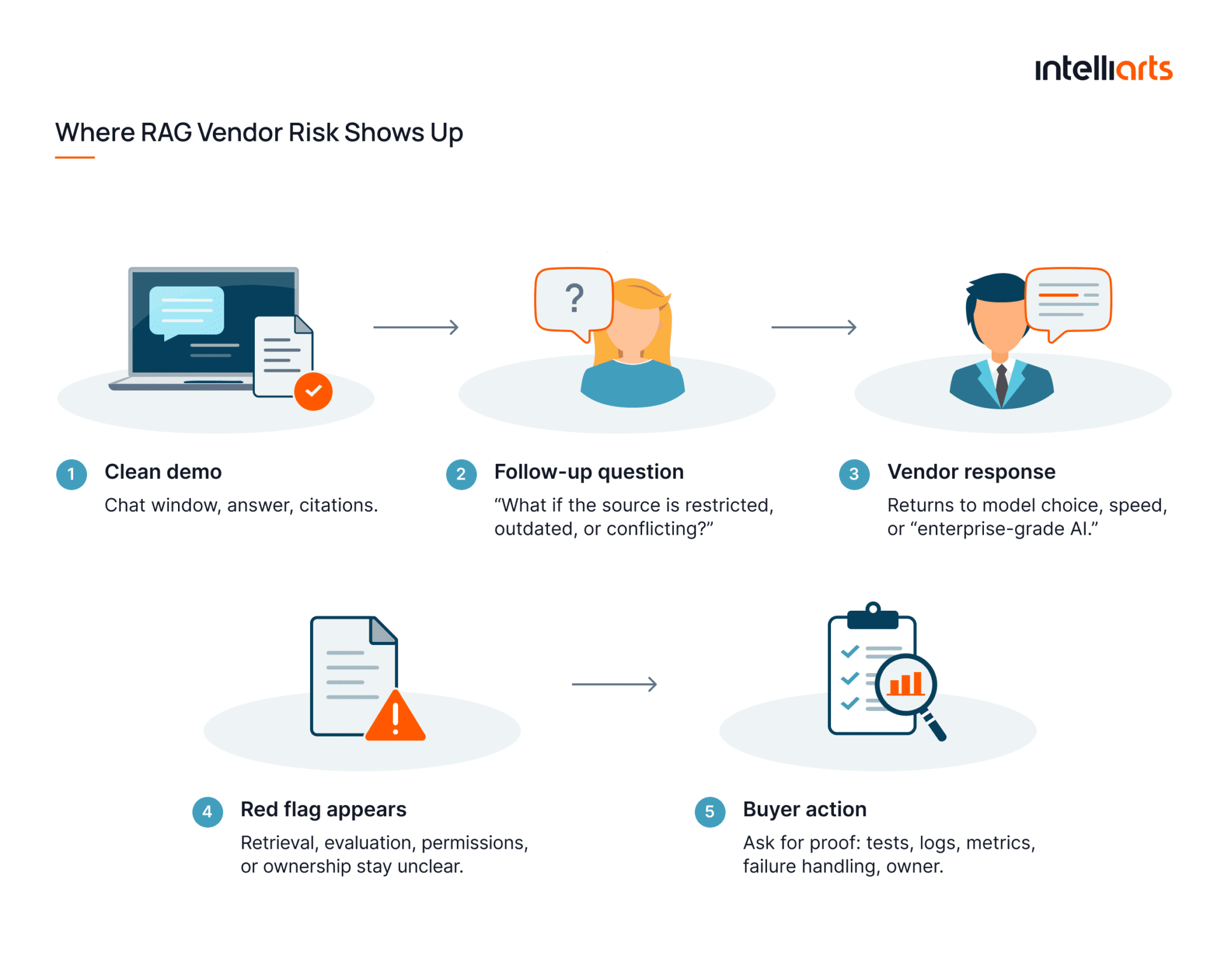
Picture the first vendor call. The demo looks clean, but everything starts falling apart when technical or grounded questions are asked:
#1 They talk only about the LLM, not retrieval
The first red flag appears when the discussion keeps circling back to the model layer. The conversation slides back to model choice, context windows, speed of delivery, or “enterprise-grade AI” language. The harder questions stay unresolved: how evidence is selected, ranked, filtered, and tested before generation.
#2 They claim RAG “eliminates hallucinations”
The second warning sign comes when accuracy is presented as already solved. The pitch sounds reassuring, but the explanation stops at “grounded answers.” A credible answer would cover unsupported-claim detection, citation review, refusal logic, and regression checks after source or prompt changes.
#3 They have no answer for evaluation or evidence traceability
The gap becomes sharper when quality cannot be explained in measurable terms. The demo may look useful, yet quality remains undefined. There is no clear method for testing retrieval accuracy, answer support, citation reliability, or performance changes after the knowledge base evolves.
#4 They cannot explain permissions, monitoring, or ownership boundaries
Then the buyer asks about access rules and production ownership. When those boundaries stay vague, security turns into a platform-level promise. The missing detail is where permissions affect retrieval, what logs exist, who reviews failures, and who owns tuning after launch.
#5 Their case studies focus on chat UI screenshots, not system outcomes
The final signal often appears in proof materials. When proof materials stop at screenshots, the evidence stops at the interface. Useful proof would show source complexity, workflow impact, architecture choices, constraints, measurable results, and production edge cases.
The practical test is to move from the demo to failure handling. Ask what breaks, how detection works, who owns the fix, and which evidence proves the answer can be trusted. A credible RAG implementation partner should make those answers concrete before the pilot starts.
We believe this scenario is well-relatable to many. If you are looking to partner with one of the most reliable RAG development companies that never let anything similar happen, consider Intelliarts.
How Intelliarts approaches enterprise RAG projects
Intelliarts approaches enterprise RAG projects as architecture work first. The goal is not to ship another chat interface, but to design a retrieval layer that can handle business data, permissions, workflow context, and measurable quality expectations.
That usually starts with the knowledge environment: what sources exist, how reliable they are, which users can access them, and where the final answer will be used. From there, Intelliarts maps the RAG pipeline around ingestion, chunking, retrieval, ranking, grounding, evaluation, integration, and monitoring.
“A useful RAG system is a useful add-on to any in-house procedure, from simple workflow to high-level decision-making. For us, that starts with how decisions are made inside the organization.
For a RAG implementation partner like ourselves, that means dealing more often with the complexities of business challenges and figuring out how to automate solving them. Technology is rarely the blocker.” — Alexander Barinov, managing partner at Intelliarts
Here is how Intelliarts covers enterprise RAG projects across strategy, architecture, implementation, and delivery validation:
- We architect enterprise-grade RAG systems: Intelliarts’ RAG development services cover RAG strategy, custom pipeline development, enterprise search, performance optimization, and system evaluation.
- We build retrieval systems for complex knowledge bases: The AI-powered data extraction chatbot case shows how a RAG-based information retrieval system reduced search and analysis time from hours to minutes.
- We create AI workflows for document-heavy operations: The GPT-driven contract analysis case shows how OCR, LLMs, and data processing can support complex contract comparison workflows.
- We integrate RAG into business workflows: Intelliarts connects RAG outputs to the tools and processes where decisions happen, such as internal portals, document workflows, support operations, and review systems.
- We define quality gates for rollout: The team helps test retrieval accuracy, monitor answer grounding, evaluate system behavior, and move from pilot to production with clear ownership.
- Our main value-adding offering: Create and integrate a business-centered RAG solution end-to-end, using niche-specific knowledge and industry-leading expertise.
Conclusion
Choosing between the best RAG development companies means looking past demos and checking how each vendor handles retrieval, enterprise data, evaluation, security, workflow fit, and post-launch ownership. Strong partners can explain trade-offs, prove technical maturity, and connect architecture decisions to business outcomes.
The best choice is a RAG implementation partner that can build a governed knowledge system, keep it measurable, and support it after rollout.
Here at Intelliarts, we have more than 26 years of experience delivering AI / ML / RAG solutions to businesses worldwide. From technical consultations and retrieval systems to complex chatbot-based solutions for enterprises in regulated industries and more, we have successfully provided all of that and more. Should you need any RAG or software development assistance, don’t hesitate to reach out.
Specialized RAG expertise and extensive end-to-end project delivery experience
Contact us
FAQ
What should I look for in RAG development companies?
Look for companies that can explain retrieval design, data ingestion, permissions, evaluation, and post-launch monitoring in practical terms. A strong partner should connect technical choices to business outcomes, show relevant delivery experience, and discuss trade-offs without hiding behind generic AI promises.
How is a RAG partner different from a general AI consulting company?
A RAG consulting company focuses on retrieval quality, source handling, evidence traceability, and system evaluation. A general AI vendor may help with strategy or prototypes, but RAG needs deeper work with enterprise data, permissions, ranking, monitoring, and workflow integration.
What questions should I ask a RAG vendor before signing?
Ask about their RAG vendor evaluation approach, retrieval metrics, data source experience, security model, hallucination controls, and rollout process. You should also ask how they build test datasets, measure answer quality, handle changing content, and transfer ownership after launch.