
Global EV adoption is accelerating, with electric vehicles comprising more than 20% of all new car sales globally. At the same time, the EV charging infrastructure market is expected to grow at a CAGR above 25% through 2030.
A modern energy management system (EMS) and fleet charging software enable control over charging decisions. As fleets scale, electric fleet charging optimization directly affects cost, uptime, and operational stability. Measurable improvements here are of high value for fleet operators, logistics companies, public transport operators, delivery fleets, and other companies involved.
This post delves into the reasons for implementing EV fleet charging management. It also outlines seven key tips for optimizing EV fleet charging at both technological and organizational levels. The guide further shows what an optimized fleet charging workflow looks like and highlights common business mistakes companies may make.
What is electric fleet charging optimization and why is it critical?
Electric fleet charging optimization is the strategic coordination of charging schedules, energy usage, and infrastructure as a unified system. The ultimate goals of EV charging optimization are to minimize costs and ensure that vehicles are used in a time-effective manner.
If you’re wondering why EV fleet charging optimization can be tricky, here are some of the common challenges:
- Coordination of charging across large and diverse fleets
- Limited charging windows between vehicle shifts
- Integration with route planning and duty schedules
- Different battery levels and charging needs across vehicles
- Scaling infrastructure as the fleet grows
- Fragmented visibility across chargers, vehicles, and energy systems
And here are some of the charging-related factors that impact operational costs:
- Utility tariff structure
- Peak demand level
- Time-of-use electricity rates
- Number of vehicles charging at the same time
- Charger power output
- Total depot energy consumption
- Session duration
- Local grid capacity limits
Core capabilities of fleet energy management include intelligent scheduling, continuous monitoring, and real-time adjustments. These functions are supported by analytics, which, in turn, provide visibility into usage patterns. The final outcome is informed charging decisions to drive further optimization actions.
Learn more about cost-effective EV charging optimization practices in another blog post by Intelliarts.
The following sections will elaborate on the tips, best practices, and technologies to optimize your electric fleet charging.
Tip #1 – How can smart charging reduce energy costs?
Without coordination, fleets often charge during peak tariff windows, increasing both energy costs and exposure to demand charges. Smart charging introduces controlled, data-driven behavior that keeps costs predictable while maintaining fleet readiness.
Approaches to cut EV charging costs through smart charging:
#1 Time-of-use optimization
Electric vehicle fleet charging schedules are shifted to off-peak tariff periods, often overnight. Non-critical sessions are delayed automatically, reducing the average cost per kWh.
- Estimated impact: ~10-30% reduction in energy costs, depending on tariff spread.
#2 Demand response integration
Charging load is reduced or paused during grid stress events based on utility signals. This avoids expensive peak usage and unlocks incentive payments.
- Estimated impact: ~5-15% additional savings through avoided peak pricing and incentives based on the above mentioned SceinceDirect research and supporting materials.
#3 Dynamic load balancing
Power is distributed across vehicles based on real-time capacity limits. This prevents simultaneous high-load charging and stabilizes total site demand. Load balancing is a core component of any advanced EV fleet charging infrastructure.
- Estimated impact: ~10-25% reduction in demand-related costs based on the above mentioned SceinceDirect research and supporting materials.
#4 Charging prioritization by operations
Vehicles are charged based on departure schedules and battery levels. Only critical vehicles receive early charging, while others are deferred.
- Estimated impact: ~5-12% efficiency gain through better charger utilization and reduced overlap.
From Intelliarts experience supported by publicly available data and research, combining these smart charging strategies leads to 20-40% overall cost reduction for fleet charging operations.
Additional savings include avoiding infrastructure upgrades and improved energy efficiency. In optimized cases, studies show even greater reductions when tariff-aware scheduling and load control are applied together.
Cutting energy costs: Success story by Intelliarts
Challenge: The customer is an EV charging platform provider expanding into fleet management. They needed a solution that could support different charging scenarios, including depot, on-route, and at-home charging, while keeping costs under control.
Solution: Intelliarts built an EV fleet management solution with a clear focus on lowering costs and improving day-to-day efficiency. Vehicles that need to leave sooner get priority, while others are scheduled later, which helps avoid unnecessary overlap and wasted energy. On top of that, the system adds smart energy control through power limits and load balancing.
Results: The solution keeps demand under control and prevents expensive spikes. It also tracks at-home charging and calculates costs based on actual electricity rates. In practice, this means lower energy bills, better use of charging infrastructure, and more predictable fleet operations.
Explore EV fleet charging case study.
Tip #2 – Why is load balancing essential for depot charging?
Load balancing is the process of distributing available electrical power across multiple chargers. This technology is what allows businesses to keep total demand within site limits and still ensure that vehicles get charged.
As a C-level manager or a business owner, you might be concerned with the following:
- Grid overload. When multiple vehicles start charging at full power, total demand can exceed the site’s capacity within minutes. This can trigger shutdowns, slow down all sessions, or lead to penalties for exceeding contracted limits, directly impacting operations.
- Expensive infrastructure upgrades. Without load balancing, growing demand often leads to costly grid upgrades or new equipment. In many cases, the issue comes from inefficient power distribution rather than actual capacity shortages.
The table below shows distinctions between having a dynamic load balancing vs having static or even no set load balancing rules at all: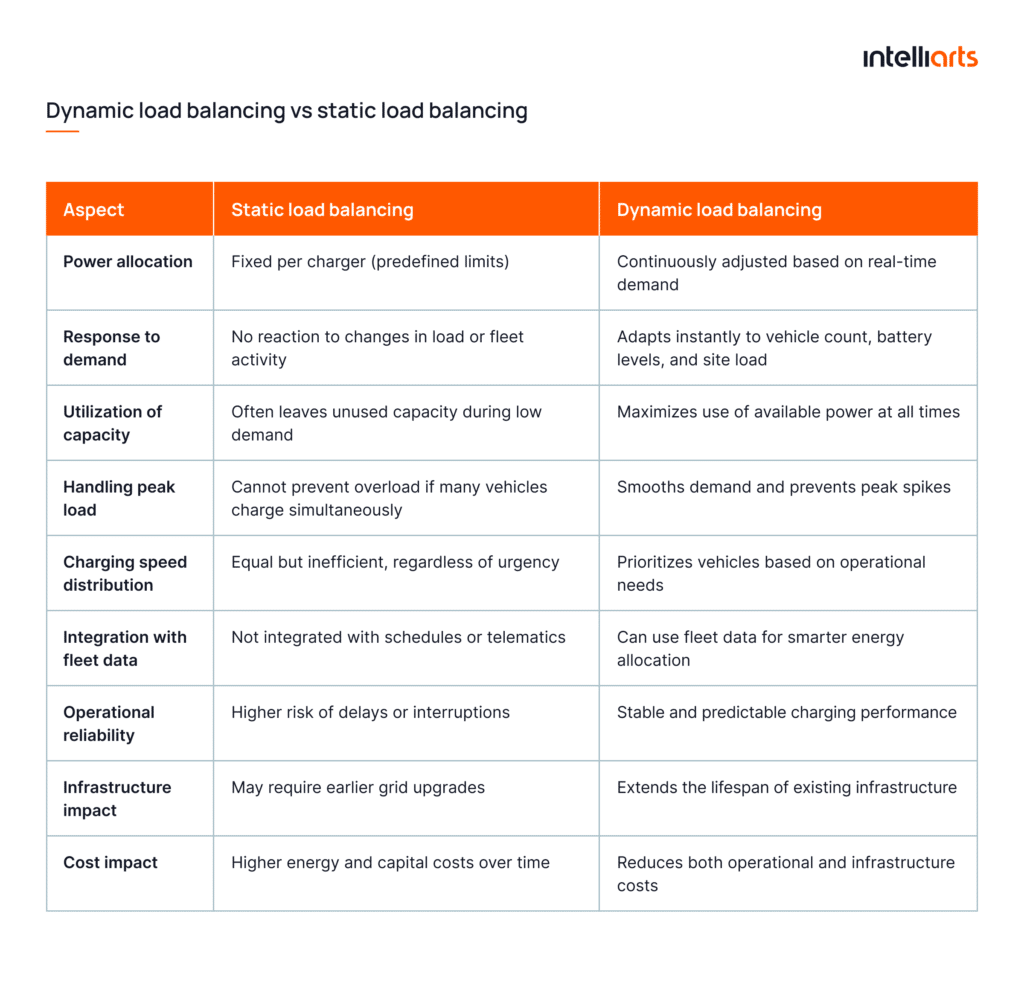
Tip #3 – How does charging scheduling improve fleet availability?
Here at Intelliarts, when providing technology consulting, our experts often note that poor fleet availability is actually a cause of uncoordinated charging rather than a lack of infrastructure.
A lack of optimization in that regard leads to critical vehicles not being ready, while low-priority ones occupy chargers without urgency. Charging scheduling helps to manage charging sessions with consideration of the following factors:
- Actual vehicle usage
- Departure times
- Operational priorities
- Battery state of charge
- Charger availability
That’s how you optimize the system for charging the priority vehicles first. Adhering to additional fleet management trends may also notably help.
Core scheduling approaches in EV fleet management include:
- Route-based scheduling. Charging follows planned routes and departure times. Vehicles with earlier shifts are charged first, while others are scheduled later to avoid overlap.
- Priority-based charging. Vehicles are ranked by battery level, next trip, or importance. Power is allocated to ensure critical vehicles are not delayed.
- Integration with telematics systems. Telematics data provides real-time insights into location and battery status. Charging plans adjust dynamically to reduce idle time and improve accuracy.
Improvements to be expected:
- Higher fleet availability at departure times
- Reduced charging conflicts at depots
- More efficient use of the charging infrastructure
- Better alignment between operations and energy consumption
In practice, charging scheduling becomes a key component of EV fleet optimization, ensuring vehicles are charged based on real business needs rather than static rules.
Discover more about EV fleet management in another blog post by Intelliarts.
Tip #4 – How can fleet charging software improve visibility?
Without a unified system, data for all electric fleet charging operations is often split across chargers, vehicles, and external tools. This makes it difficult to track charging status, identify inefficiencies, or respond quickly to issues. As fleets scale, this lack of visibility leads to higher costs and operational blind spots.
Key capabilities that improve visibility:
- Centralized dashboard. All charging operations are displayed in one interface.
- Real-time monitoring. The system tracks charging activity as it happens.
- Charging analytics. Historical and real-time data are used to identify patterns in energy usage, peak demand, and charger utilization.
How visibility supports better decisions:
- Faster identification of operational issues
- Clear understanding of energy usage across the fleet
- Better planning of schedules and electric vehicle fleet charging infrastructure
- Improved control over fleet charging costs
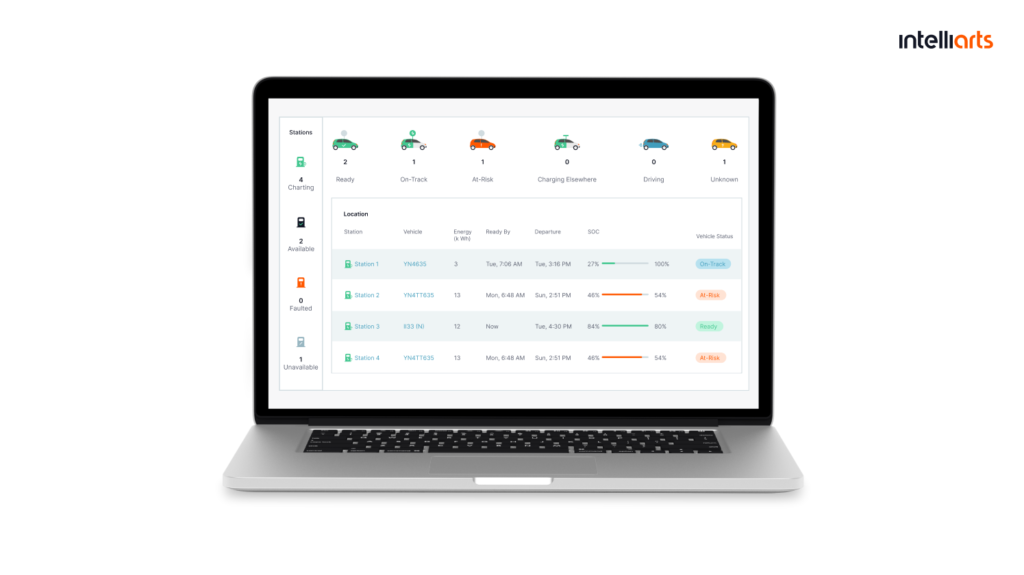
See the example of an optimization dashboard in the diagram below:
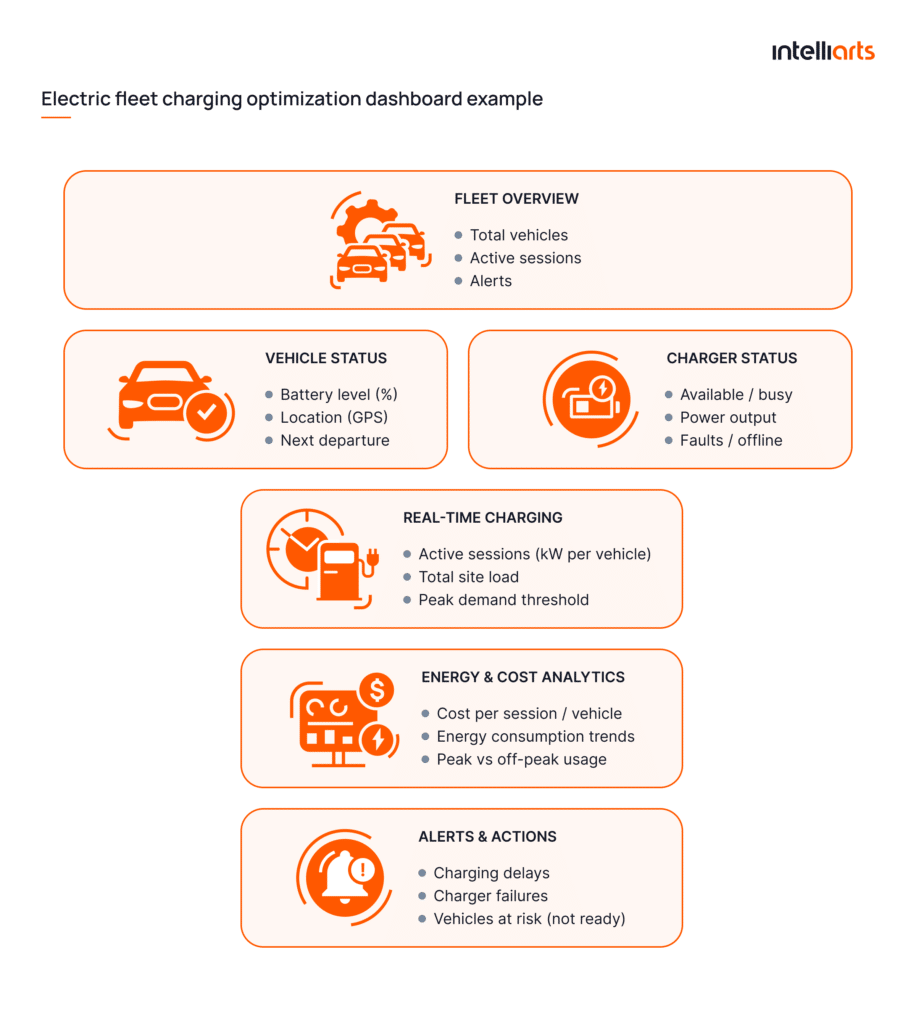
While being more of a general approach for an actual optimization dashboard, this diagram combines vehicle data, charging status, and energy usage in one place. Great for fast validation of detecting bottlenecks for improving cost control and planning further.
Tip #5 – How can telematics and route planning support charging efficiency?
Charging efficiency becomes harder to maintain when vehicle usage, routes, and energy needs change throughout the day.
Here are two main issues related to charging efficiency:
- Unpredictable usage. Vehicle schedules often change during the day. Without real-time data, charging plans become inaccurate, leading to undercharged vehicles or unnecessary early charging.
- Range anxiety in a fleet context. For fleet operators, this is not just about one vehicle. If battery levels are not tracked accurately, there is a risk that vehicles will not complete planned routes, affecting service reliability.
Telematics and route planning support charging efficiency by providing both real-time and predictive inputs for charging decisions. They are based on the following factors:
- Battery level
- Location
- Recent energy consumption
- Planned route distance
- Next departure time
- Charging history and patterns
Route planning adds context by linking charging to trip distance and departure timing, so energy is allocated based on actual needs rather than estimates.
This works through integration between the fleet management system and charging software. Such a level of coordination is increasingly expected from modern EV charging fleet services and advanced fleet platforms.
In early stages, fleet charging looks manageable. Once the number of vehicles grows and return times start overlapping, energy demand becomes concentrated within a very short window, and that’s where both costs and coordination issues start to surface. — Jurij Aulikh, an eMobility Software Engineer at Intelliarts
Tip #6 – How do you minimize peak demand charges?
Peak demand charges are minimized by controlling site load, so short-term spikes do not define your billing level. In depot charging, this usually means managing how many vehicles charge at high power at the same time.
Core peak demand management methods include:
#1. Peak shaving. Caps total site load by reducing charging power when demand approaches a threshold.
Formulas: Peak Demand = max (total site load, kW)
Cost = Peak Demand × Demand Rate ($/kW) → Lower peak = lower cost
#2. Battery storage integration. Supplies stored energy during peak periods to reduce grid draw.
Formula: Grid Load = Total Load − Battery Output → Reduces billed peak demand
Expert advice by Intelliarts: Battery storage can be complemented by emerging approaches such as Vehicle-to-Grid (V2G), where EVs act as distributed energy assets and feed power back to the grid during peak demand periods. V2G technology, when implemented properly, further reduces grid load and demand charges.
#3. Smart algorithms. Adjust charging timing and power based on demand, tariffs, and fleet priorities.
Formula (conceptual): Optimized Load(t) = Σ charging powerᵢ(t) ≤ Demand Limit → Keeps total load under cost threshold
Peak demand cost comparison across charging strategies is provided in the infographic below:
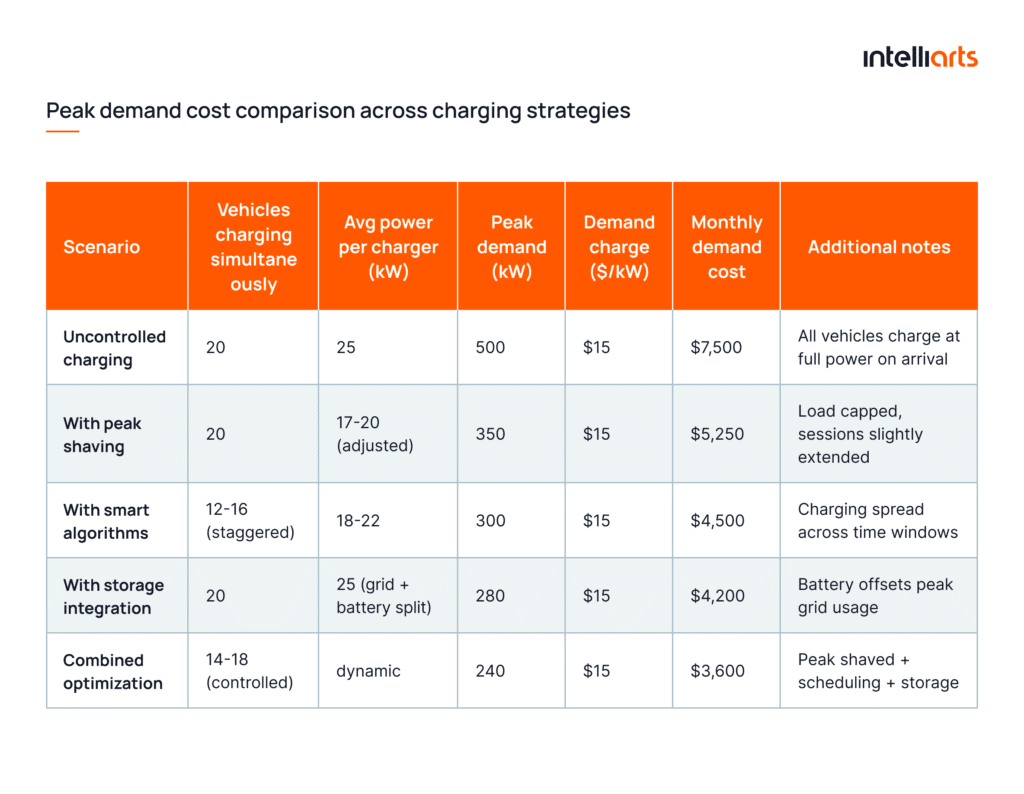
Note: The values shown are illustrative estimates based on typical EV fleet charging scenarios. Actual rates and resulting costs vary for every business situation.
Tip #7 – When should you consider custom fleet charging software?
Custom fleet charging software becomes relevant when standard tools no longer support the scale, complexity, or control required for your operations. Experience of Intelliarts engineers shows that this usually happens when the charging logic becomes too complex because of operational constraints or when the following scenarios are applicable:
- Multi-depot operations. Coordinating load, reporting, and charging policies across locations becomes difficult without centralized and flexible control.
- Complex integrations. When data needs to sync in real time, standard platforms often fall short or require workarounds.
- Scalability beyond standard workflows. More advanced logic is needed to manage prioritization, energy distribution, and cost control at scale.
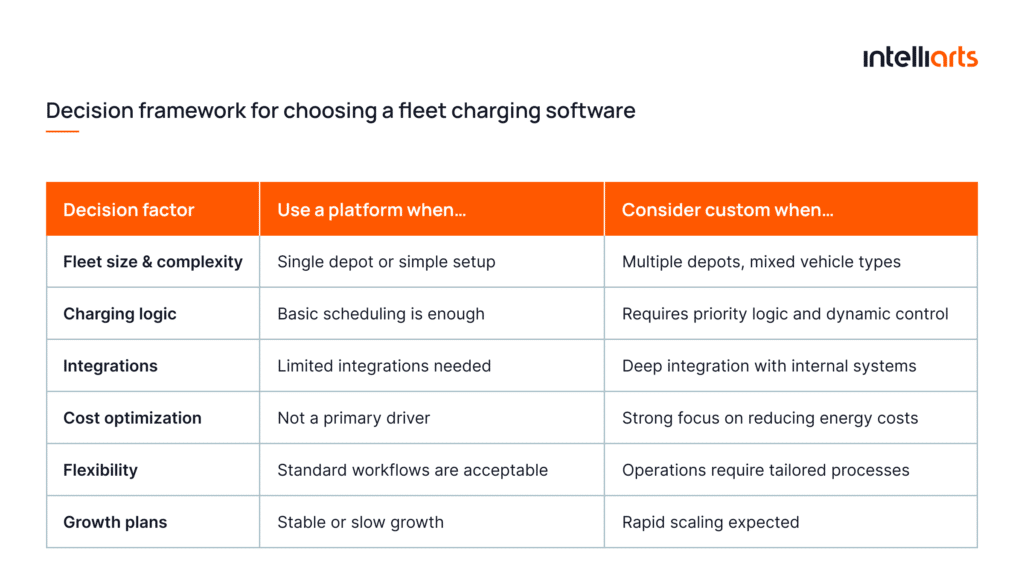
See the general decision framework in the table below:
Still not sure how to approach the decision?
Through our many success stories, Intelliarts found out that the platform approach works well enough at the earliest stages of EV businesses. As operations expand, limitations appear in control, integration, and optimization. At that point, transitioning to custom fleet charging software starts appearing as a cost-effective and nearly critical strategic investment.
Should you need technical consultation or assistance, don’t hesitate to reach out to Intelliarts and request our EV software development services. We will guide you through the decision based on your business context and help implement your best project.
What does an optimized fleet charging workflow look like?
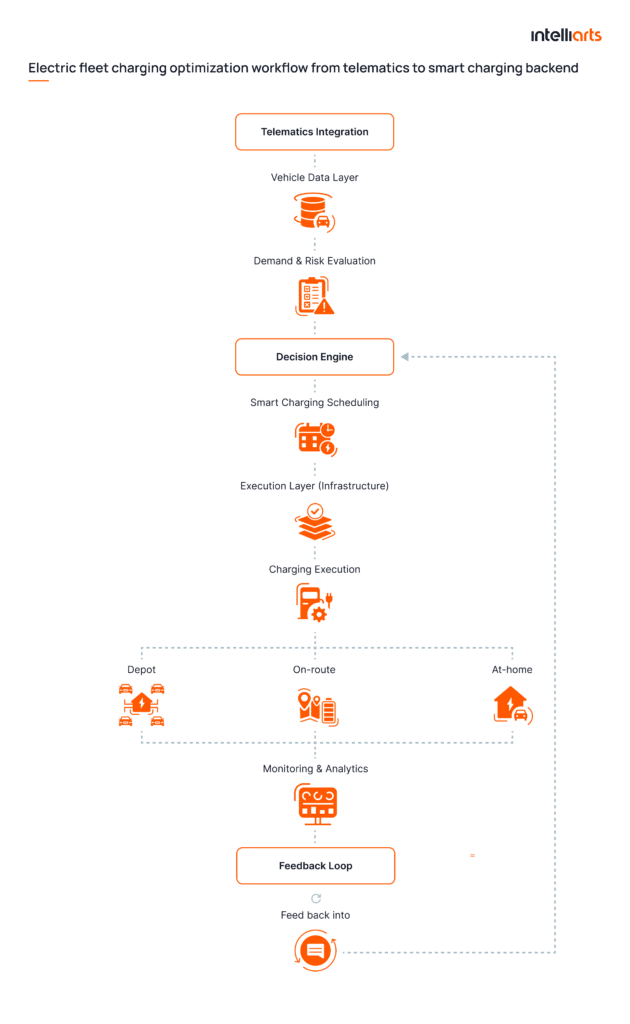
An optimized EV fleet charging workflow ensures that every charging decision is predictable, justified, and aligned with operations. The system should be capable of coordinating vehicle data, charging logic, and infrastructure in a way that supports both cost control and fleet readiness.
Adding more chargers increases theoretical capacity, but it doesn’t improve how efficiently that capacity is used. Without coordination, utilization remains uneven, and costs stay high. — Ihor Rudnyk, an eMobility Tech Specialist at Intelliarts
Key characteristics of an optimized workflow:
- Charging reflects actual fleet operations. Vehicles with earlier departures or longer routes naturally move to the front of the queue. Others are scheduled later, which keeps energy usage aligned with real demand and avoids unnecessary overlap.
- Vehicle data is continuously collected via telematics. Charging decisions rely on live inputs such as battery level, location, route assignment, and energy consumption. This keeps electric fleet charging aligned with actual vehicle usage throughout the day.
- Charging demand is forecasted per vehicle. Energy requirements are calculated based on planned routes and departure times. Each vehicle has a defined charging target and deadline, which reduces both undercharging risk and unnecessary energy use.
- Smart algorithms schedule charging sessions. A scheduling engine assigns when each vehicle should charge and at what power level. Priorities, tariffs, and site constraints are taken into account to avoid uncontrolled or simultaneous charging.
- Load is balanced across available chargers. Power is distributed in real time to keep total site demand within limits. This stabilizes energy usage, prevents overload, and reduces peak demand charges across the EV fleet charging infrastructure.
- Performance is monitored and continuously adjusted. Charging analytics track how sessions are executed, including energy usage and charger utilization. This feedback is used to refine scheduling and improve efficiency over time.
The infographic below shows the end-to-end electric fleet charging workflow, from telematics data to optimized charging execution.
It explains how fleet charging software and an energy management system turn vehicle data into scheduling and load balancing decisions. It also represents a continuous optimization loop where charging analytics improve future EV fleet charging performance and costs. Work for fleet management for public transport as well as for private vehicle fleets.
Common mistakes in fleet charging optimization
Sometimes inefficiency is hidden in fairly avoidable operational and system-level mistakes. Here are some of the most common issues the Intelliarts team has seen companies make in electric fleet charging:
- Ignoring tariff structures
- Overprovisioning infrastructure
- Lack of integration between systems
- Manual scheduling
- No real-time analytics
- No load balancing across chargers
- Charging all vehicles at arrival time (no staggering)
- No prioritization based on operations
- Poor visibility into charger utilization
- Ignoring peak demand thresholds
- No alignment between routes and charging plans
While detecting and fixing every bottleneck may be unrealistic, it is definitely worth pursuing excellence. After all, every bit of optimization results in potential financial gains.
Optimizing EV fleet charging requires specialized expertise
The Intelliarts team handles EV fleet charging projects of any complexity.
Talk to our experts
Final take
EV fleet charging optimization depends on how charging decisions are structured and executed. A scalable EV charging software architecture connects data, decision logic, and execution into a continuous system. As fleets grow, the ability to monitor, adjust, and optimize charging operations supports efficiency, cost control, reliability, and long-term scalability.
Intelliarts, as a trusted provider of software development services, has substantial expertise in EV solutions, with over 80 large projects successfully completed. We are also proud to maintain a 90% customer return rate and have 92% senior-level engineers on our team. Let our experts contribute to your electric fleet charging development with all our experience and industry-leading practices.
FAQ
What is the best way to optimize EV fleet charging costs?
Smart charging is the most effective approach. It shifts charging to lower-cost periods while keeping vehicles operationally ready. This allows fleets to align energy use with tariffs and reduce overall charging expenses without disrupting daily operations.
How does load balancing work in fleet depots?
Load balancing distributes available power across chargers in real time. It ensures that energy demand stays within grid limits while multiple vehicles charge simultaneously, improving infrastructure efficiency and avoiding costly upgrades.
Do I need custom fleet charging software?
Custom solutions are typically needed at scale or with complex operations. Fleet charging software provides centralized control and aligns charging processes with business workflows, offering better flexibility and long-term efficiency compared to standard tools.