
TL;DR
- Dynamic load management distributes available site capacity across active EV chargers in real time.
- It helps prevent overloads by keeping charging demand within grid, transformer, and site limits.
- The system reduces peak-load pressure by adjusting charger output when demand or tariffs change.
- Effective load management depends on software logic, charger telemetry, backend control, and OCPP smart charging.
- Rule-based allocation is usually the starting point, while AI and ML can improve forecasting and optimization.
- For CPOs, fleets, and public hubs, dynamic load management is essential for scaling EV infrastructure without unnecessary grid upgrades.
In 2025, nearly 1.8 million public charging points were added globally, and the number of fast or ultra-fast chargers reached 2.2 million. Higher-power sites create a harder constraint: grid connection capacity has to be shared between chargers, buildings, tariffs, and user demand. Dynamic load management solves this control problem by deciding how much power each charger can safely receive at any moment.
This guide introduces dynamic load management in EVs, shows how the technology works, and outlines the benefits of using it in business. Besides, it highlights challenges and limitations as well as brings real-world use cases.
What is dynamic load management in EV charging?
Dynamic load management is a system that allocates available electrical capacity across multiple EV chargers in real time based on live demand, site limits, and operational priorities.
In EV charging, the available power at a site is naturally limited. A fleet depot or a public charging hub may have more chargers than the grid connection can support at full power at the same time. Dynamic load management solves this by controlling how much power each charger receives at any given moment.
So, the core purpose of dynamic EV charging energy management can be defined as follows:
Keep total site consumption within safe capacity limits while distributing power efficiently and helping operators expand charging infrastructure without unnecessary grid upgrades.
A load management system for EV infrastructure usually provides three core capabilities:
- Monitoring: Tracks site load, charger activity, vehicle demand, and available electrical capacity.
- Allocation: Distributes power between active chargers based on technical limits and priority rules.
- Optimization: Adjusts charging behavior to improve energy use, reduce peak demand, and support network uptime.
Dynamic load management differs from static load management because it responds to real-time conditions instead of relying on fixed charger limits. The following sections will explain this distinction in more detail and show where each approach fits.
Looking for OCPP and OCPI assistance?
Intelliarts team can provide you with a full spectrum of EV interoperability services
Request OCPP/ OCPI development
Why is load management critical for EV charging networks?
Based on Intelliarts’ consulting sessions with EV companies, the limiting factor is often usable power capacity. A typical scenario is when a site has enough parking spaces and installed EVSE units, yet still fails to support full-speed charging when demand rises. Therefore:
Load management, as a technology that orchestrates charging, is critical because it controls how that limited capacity is used across active sessions.
See how load management technology is a must-have for high-performing EV charging networks in the infographics below:

How does dynamic load management work?
Dynamic load management works as a closed-loop control process. The system monitors site conditions, analyzes charging demand, calculates safe power limits, sends commands to chargers, and keeps adjusting allocation as new data comes in.
Here are the common stages that comprise the load management process:
1. Real-time monitoring
Load management starts with live data collection to uncover how much power the site can safely use before it can define available EV charging capacity.
This monitoring layer usually tracks:
- Grid or utility capacity: the site’s contracted or technical power limit
- Building load: non-EV consumption from HVAC, lighting, elevators, or equipment
- Site meter data: real-time total load across the location
- Charger status: charger availability, energy use, session state, and faults
The key output is the available charging capacity. This is not the same as the site’s maximum grid connection.
2. Demand analysis
Once available capacity is known, the system evaluates charging demand. It checks which chargers are active, which vehicles are requesting power, and which sessions should receive priority.
Demand analysis may include:
- Active charging sessions
- Pending charging requests
- Charger power ratings
- Vehicle charging capability
- User or fleet priorities
- Schedules, tariff windows, and business rules
This step prevents every session from being standardized by default.
3. Power allocation
The allocation engine calculates how much power each charger should receive, or, in proper terminology, per-charger power limits.
In a simple setup, this can be as simple as dividing available power across active chargers. In a more advanced setup, the algorithm can account for the following constraints to allow for customized per-charger power limits:
- Site capacity limit
- Charger ratings
- Priority rules
- Tariff windows
- Minimum charging thresholds
- Electrical safety limits
The output is a set of charging limits or schedules for each charger. These limits define how much power each EVSE unit can draw without pushing the site beyond safe capacity.
“Static limits often hide unused capacity. We have seen quite a few cases where chargers stay restricted while the site has available power that could be reassigned to active sessions.” — Ihor Rudnyk, eMobility Tech Specialist at Intelliarts
4. Charger-level control
After the allocation engine calculates limits, the EV charging backend or Charging Station Management System (CSMS) sends them to chargers. In most scalable EV charging platforms, this is handled through Open Charge Point Protocol (OCPP) smart charging. OCPP allows the backend to send charging profiles, current limits, schedules, and status requests to compatible chargers.
You may discover more about OCPP and other EV protocols in another blog post by Intelliarts.
At this stage, the calculated limits are enforced for each charger separately.
Important note. The main risk is execution mismatch. Intelliarts’ experience with integrating load management software shows that some chargers, especially those from different suppliers, when combined in the same network, apply profiles differently.
This can result in delayed responses or connection errors during the enforcement of charging limits. That’s why it’s recommended to account for validation logic, retries, and fallback limits in the backend.
5. Continuous optimization
After the enforcement of limits, chargers keep sending telemetry back to the backend. This data is then used as input for stages 1 and 2 to re-evaluate allocation in real-time.
Re-optimization can be triggered by:
- A new vehicle plugging in
- A vehicle unplugging
- A change in building load
- A tariff update
- A charger status change
- A charging session reaching its target
- A fault or communication issue
This closed loop is what makes the process dynamic, as reflected in the name of the technology.
See the diagram indicating the main stages of the dynamic load management process, as well as the flow of data below:

Static vs dynamic load management: What’s the difference?
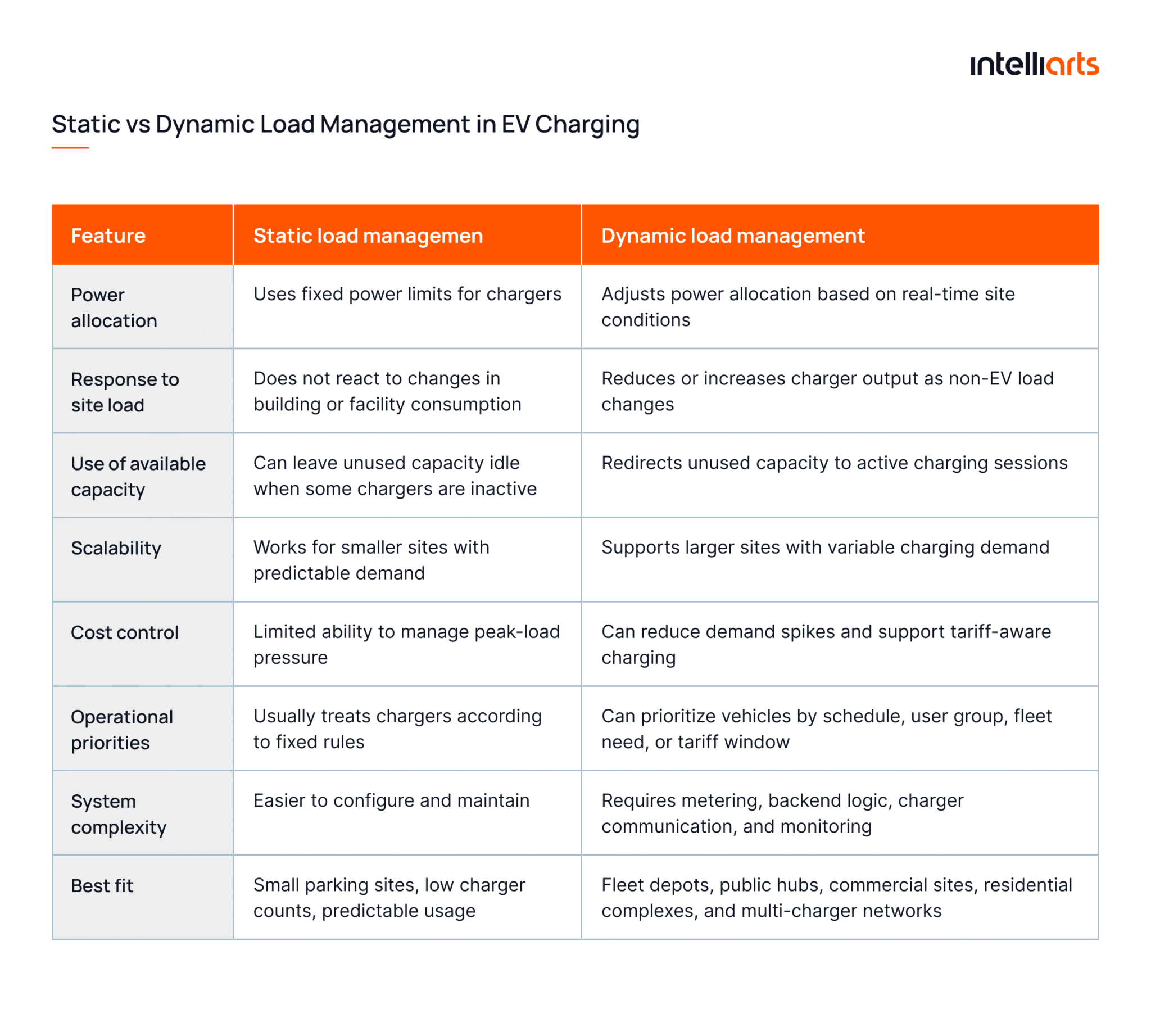
Static load management is a fixed-capacity control method where each charger, charger group, or site zone receives a predefined power limit.
The limit is usually configured during installation and does not change automatically based on live building consumption, charger utilization, or grid conditions. This approach can work when the site has predictable demand and a small number of chargers.
However, it becomes inefficient when usage varies. If several chargers are idle, their reserved capacity may remain unused. If many vehicles plug in at once, the system may reduce charging speed too broadly because it cannot recalculate allocation based on live demand.
The table below compares both approaches from an infrastructure, cost, and operational perspective.
What algorithms and technologies power dynamic load management?
Dynamic load management depends on two layers: the decision logic that calculates power limits and the technical infrastructure that enforces those limits at the charger level. In practice, most systems combine rule-based allocation, OCPP smart charging, Energy Management System (EMS) integrations, and, in advanced cases, AI or machine learning models.
#1. Rule-based allocation
Rule-based allocation is the most common starting point for dynamic load management. It uses predefined operating rules to distribute already available EV charging capacity across active chargers.
Common rule types include:
- Equal sharing: all active chargers receive the same power limit.
- Priority-based sharing: selected users, vehicles, or fleets receive more power.
- Minimum threshold rules: each active session receives enough current to continue charging.
- Departure-based rules: vehicles with earlier departure times receive higher priority.
- Tariff-based rules: charging power is reduced during expensive peak periods.
For equal sharing, the allocation logic can be expressed as:
Power per active charger = Available EV charging capacity ÷ Number of active charging sessions
For priority-based allocation, the system applies weights instead of splitting capacity evenly:
Allocated power = Available EV charging capacity × Session priority weight
Control power across your entire charging network
Dynamic load management solutions for scalable EV infrastructure
Contact us
#2. OCPP smart charging
OCPP smart charging is the communication layer that allows the backend to control charger output. Without this layer, the allocation algorithm may calculate limits, but the system cannot reliably enforce them across chargers.
Through OCPP, the CSMS can send charging profiles, schedules, and current limits to compatible chargers. These commands define how much power a charger can draw during a specific time window or operating condition.
In a typical setup, the process looks like this:
- The backend calculates a charger limit.
- The CSMS sends a charging profile through OCPP.
- The charger applies the limit locally.
- The charger reports status and meter values back to the backend.
- The backend updates the profile when site conditions change.
The technical challenge is consistency. Different charger models and firmware versions may interpret profiles differently, so the backend needs validation logic, retries, and fallback rules.
#3. EMS and grid system integrations
An Energy Management System gives the load management system access to wider site energy data. This is especially important when EV charging competes with building consumption, solar generation, battery storage, or industrial equipment.
Typical EMS inputs include:
- Real-time building load
- Grid connection limit
- Transformer or panel load
- Solar generation
- Battery storage status
- Demand response signals
- Energy tariff data
A practical control formula can be:
Available EV charging capacity = Grid import limit + Usable on-site energy − Current building load − Safety reserve
#4. Power allocation algorithms
More advanced systems use allocation algorithms that balance technical limits with business goals. These algorithms do more than split power evenly. They decide which sessions should receive more energy based on constraints, priorities, and expected demand.
The algorithm may optimize for:
- Maximum charger utilization
- Lower peak demand
- Guaranteed fleet readiness
- Lower energy cost
- Phase balance
- Fair distribution across users
- Reduced waiting time
A fleet depot, for example, may allocate more power to vehicles with earlier route schedules. A public hub may prioritize fairness and session stability. A commercial site may reduce output during peak tariff periods and increase it when energy is cheaper.
A simplified priority-based formula can look like this:
Session priority score = Departure urgency + Required energy + User priority − Tariff penalty
#5. AI and machine learning optimization
AI and machine learning may be regarded as optional layers. However, they are usually utilized nevertheless. Here at Intelliarts, we utilize optimization when the customer has collected or is going to collect enough historical data to implement predictive control.
Common AI/ML use cases include:
- Forecasting charging demand by hour, site, or user group
- Predicting fleet energy needs before route departure
- Estimating peak-load risk
- Optimizing charging against dynamic tariffs
- Detecting abnormal charger behavior
- Recommending better charger schedules
Explore time series ML, which is exactly the method used for purposes of such optimization, in another one of our blog posts.
Yet, AI should not replace deterministic safety rules. Site capacity limits, electrical protection logic, and minimum charger thresholds should remain rule-based. ML works best as an optimization layer above those hard constraints.
See the formulas conveniently gathered in a single infographic below:

What are the benefits of dynamic load management?
Dynamic load management shows its value when charger utilization grows, and site capacity becomes a constraint. For operators, the positives are tied to infrastructure cost, uptime, and the ability to serve more vehicles without overloading the site. These value-adding benefits include the following:
- Keeping total charging demand within safe grid, transformer, and site limits.
- Reduced need for early grid, cabling, or switchgear upgrades.
- Unused capacity moved from idle chargers to active charging sessions.
- Support for more chargers within the same electrical connection.
- Lowered charging load during utility, tariff, or demand-response events.
- Reduced failed sessions caused by overloads, breaker trips, or unstable power.
- Prioritized fleet vehicles by departure time, route schedule, or required energy.
- Reduced demand spikes that can increase electricity bills.
- More predictable charging performance during high-demand periods.
- Support for infrastructure growth and delaying large grid upgrades.
Explore the cost-effectiveness of EV charging optimization and other advantages of having proper dynamic load management in another one of our blog posts.
What are the challenges and limitations?
“An interesting approach to the cost-efficiency problem is to treat charging capacity as inventory. When power sits reserved for an idle charger while an active session is delayed, the platform is wasting something the operator could have sold.” — Alexander Barinov, a Managing Partner at Intelliarts.
Dynamic load management only works well when site data, charger behavior, and control logic stay aligned. The main limitations come from delays, inconsistent hardware behavior, and rules that must fit both technical and business priorities.
- Integration complexity
Dynamic load management connects the Charging Station Management System, meters, chargers, and sometimes an Energy Management System. The risk is mismatched data timing: one system may show current site load, while another still reports older charger data.
Solution: A reliable setup depends on clear data ownership, update frequency, and fallback logic for each integration.
- Real-time data accuracy
The system calculates limits from live site load and charger telemetry. If this data is delayed or inaccurate, the site may underuse capacity or move too close to its electrical limit.
Solution: Timestamped telemetry, validation rules, and a safety reserve help protect the site from short spikes and delayed readings.
- Charger compatibility
Open Charge Point Protocol support does not guarantee that every charger applies limits in the same way. Firmware, reconnect behavior, and current-limit handling can differ between models.
Solution: Charger compatibility planning should cover profile handling, response delays, reconnect cases, and fallback behavior before large-scale rollout.
- Priority logic conflicts
Fleet readiness, fair distribution, and peak-cost reduction can compete. A system that optimizes for tariff savings may still delay a vehicle that needs to leave soon.
Solution: The control model should separate hard safety limits from business priorities, then rank those priorities clearly.
- Regulatory and utility constraints
Grid rules, tariffs, demand-response programs, and reporting needs vary by market and utility. This can make one standard configuration unsuitable for every site.
Solution: Local grid and tariff rules work best as site-level configuration inside the load management system.
- Failure handling
If meter data, backend control, or charger connectivity fails, the site still needs safe operating limits. Poor fallback logic can either overload the site or charge too much.
Solution: Conservative fallback limits keep charging predictably until real-time control is restored.
Important note: The best mitigation strategy for most companies is rarely a particular fix. Instead, an array of targeted changes and best practices should be applied. Oftentimes, it’s best to partner with a trusted EV software development company like Intelliarts for comprehensive assistance.
Make every charging site easier to manage
Software for monitoring, energy allocation, and multi-site EV network control
Request EV development
How to implement dynamic load management in your EV charging system?
Dynamic load management implementation can be approached just like any other development. Yet, it has some specificities to account for, especially in terms of site power limits, charger communication protocols, and business requirements behind the EV infrastructure modification.
The infographic below shows the implementation flow from capacity assessment to live optimization, with the main technical factors that make this process specific to EV charging systems.

Real-world use cases of dynamic load management
Dynamic load management is most useful where charging demand changes faster than electrical capacity can be expanded. In practice, this usually means sites with shared power limits, predictable peak periods, or many vehicles connected at the same time.
Let’s get through exactly such use cases to see how the technology is applied in practice and what governmental initiatives support dynamic load management for EVs:
- Public charging hubs
Public charging hubs need to balance high utilization, grid limits, and driver experience because many vehicles can arrive within the same peak window. Dynamic load management helps distribute available power across active sessions to keep the site within its connection limit.
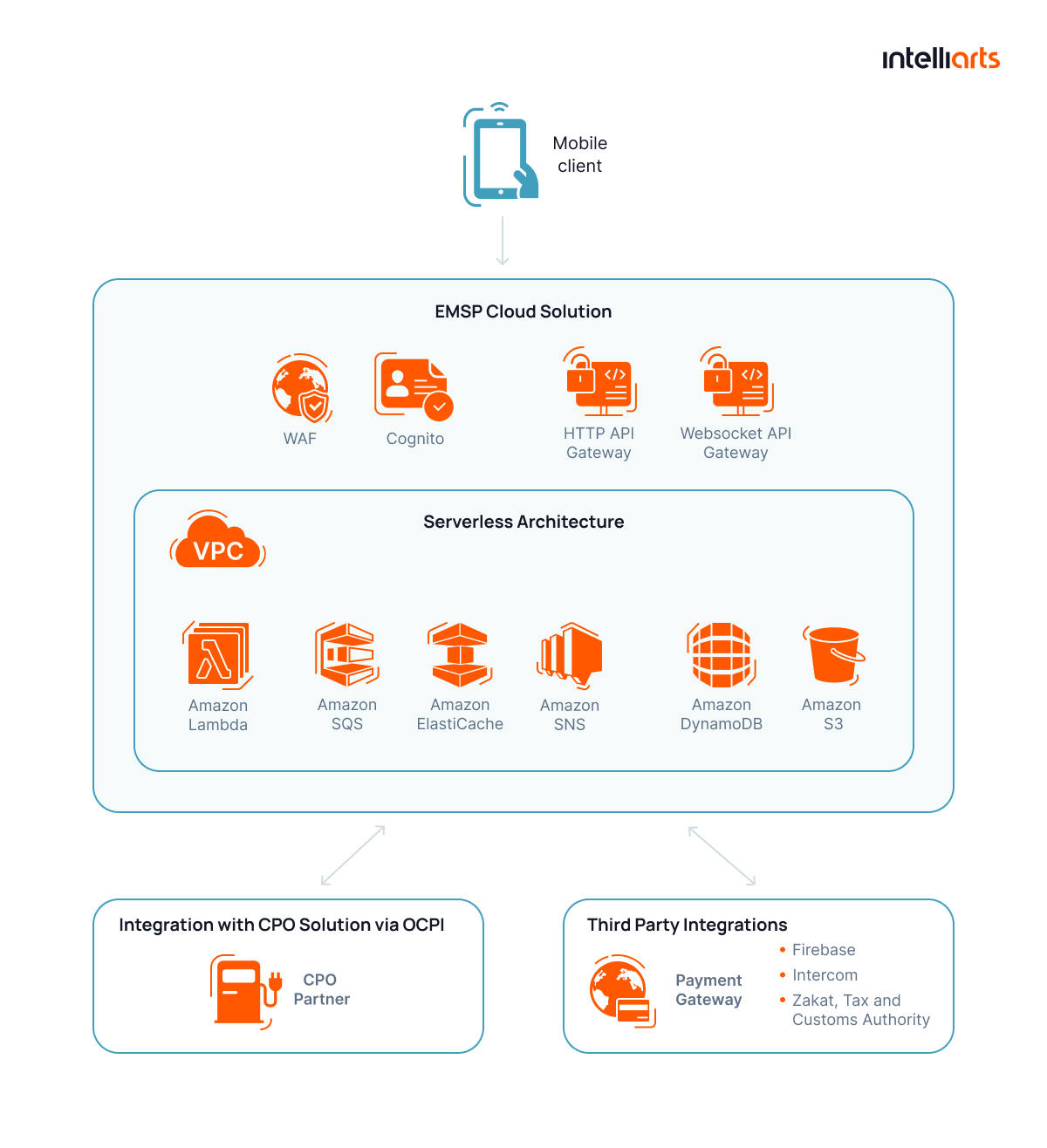
A practical example of this load management application is Intelliarts’ work with EVIQ, a company building a nationwide fast-charging network in Saudi Arabia. The EV management software platform Intelliarts developed supports station monitoring, charger lifecycle management, and charger onboarding/offboarding.
As a result, EVIQ received the core components of a fully functional EV station management platform in six months, supported tens of thousands of active app users, and achieved strong app ratings of 4.1 on Android and 4.8 on iOS. The serverless architecture also helps the network scale without major infrastructure investments as EVIQ expands across Saudi Arabia.
Explore Intelliarts’ portfolio
- Commercial parking
In office parking, retail parking, and paid parking facilities, EV charging competes with building load. Dynamic load management helps keep charging available during business hours without sizing the electrical system for every charger running at full power. The
Alternative Fuels Data Center explains how utilities can support infrastructure planning through power availability and capacity analysis and reduce grid impact through managed charging.
- Fleet depots
Fleet depots need vehicles ready by a specific departure window, so load management is tied to schedules and operational priority. The U.S. Department of Energy describes managed EV charging for federal fleets as a way to reduce installation costs, avoid peak pricing or demand charges, and help vehicles receive the energy they need.
- Residential complexes
In multifamily housing, the main constraint is shared electrical capacity across many residents and parking spaces. Dynamic load management helps distribute charging load without assigning full dedicated capacity to every EV space. The U.S. Department of Energy’s Multifamily EV-Ready Checklist reflects this logic: EVSE serving multiple spaces may use lower nameplate charging capacity per space when supported by an energy management system.
Why choose Intelliarts for EV charging software development?

For successful dynamic load management, developers need to understand how EV charging platforms behave under site constraints. Therefore, hands-on, specialized expertise is required.
At Intelliarts, we approach EV charging software and load management with regard to energy and infrastructure specificities and core business objectives. Our work in smart energy management systems is closely connected to this challenge because dynamic load management depends on live energy data, charging demand forecasts, and site-level control rules.
Our team also brings relevant experience in smart grid software development, where power usage optimization, dynamic limits, monitoring, and demand-side flexibility are core parts of the system logic. This matters for CPOs, fleet operators, and infrastructure companies that need charging software to work within grid constraints.
For dynamic load management projects, Intelliarts can help with:
- Designing cloud, local, or hybrid load management architecture.
- Building smart charging logic for charging profiles, current limits, and schedules.
- Integrating chargers, meters, Energy Management Systems, fleet tools, and billing platforms.
- Developing custom allocation algorithms for site limits, tariff windows, user priorities, and fleet schedules.
- Planning fallback behavior for connection loss, delayed telemetry, and charger-specific execution issues.
This experience also connects to our broader work in renewable energy software development, where EV fleet management, charging schedules, load needs, and route optimization often intersect. This means that we have the expertise and knowledge to drive an EV charging project with load management end-to-end without any third-party providers required.
Don’t hesitate to explore our software engineering services on our website.
Final take
Dynamic load management helps EV charging operators control limited site capacity without sacrificing reliability or expansion plans. It connects real-time monitoring, demand analysis, allocation logic, OCPP-based charger control, and continuous optimization into one operating model.
For CPOs, fleets, public hubs, and residential sites, this means safer power distribution, better use of existing infrastructure, and a more practical path to scaling charging networks.
The Intelliarts team has more than 26 years of experience delivering custom software solutions, including EV charging platforms and dynamic load management integrations. We can create software from scratch or add necessary development on top of an existing platform. With more than half of our senior staff engineers in-house and 90% of our customers, we are ready, willing, and able to contribute to your best project.
FAQ
What is dynamic load management in EV charging?
Dynamic load management EV charging means distributing available electrical capacity across chargers in real time. The system tracks site limits, charger demand, and vehicle needs, then adjusts power output to prevent overloads and keep charging sessions stable.
How is dynamic load management different from static load management?
Static systems assign fixed power limits to chargers. EV load balancing adjusts allocation based on live demand, available capacity, and operational rules. This makes it more suitable for sites with changing usage patterns, such as depots or public hubs.
Why does dynamic load management matter for CPOs?
For CPOs, EV charging energy management helps avoid grid upgrades, reduce peak demand costs, and support more chargers within existing electrical capacity. It also improves uptime because the system reacts before local infrastructure reaches unsafe load levels.