
TL;DR
- EV charging regulations work through two lenses: a transport lens (coverage, reliability, payment) and an energy lens (timing, flexibility, control). Most markets combine both.
- The UK made home chargers smart by default and regulates public charging mainly through consumer protection rules.
- From March 2028, companies that remotely control energy smart appliances in Great Britain, such as EV chargers, heat pumps and home batteries, will need a load control licence.
- The EU harmonised public charging under AFIR, but energy-side rules are still set country by country.
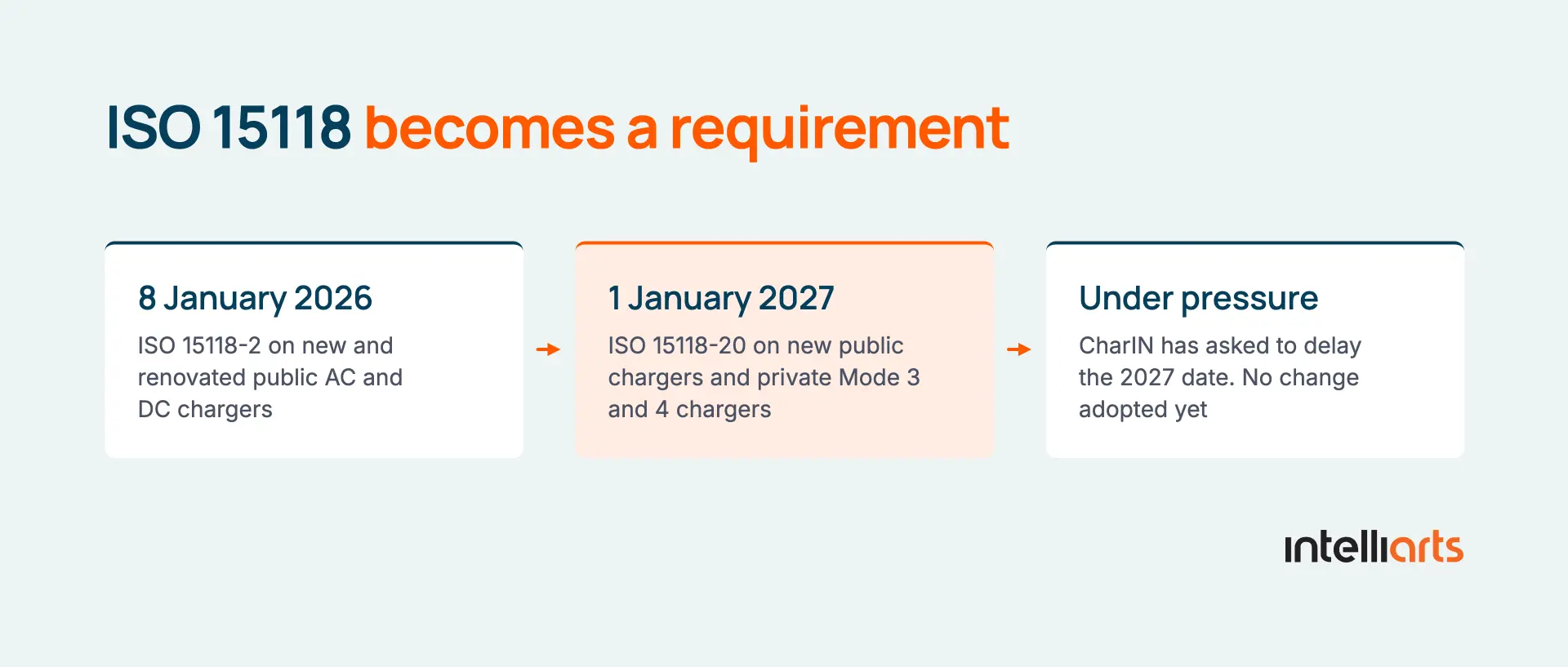
- ISO 15118-20 becomes mandatory on new EU chargers from 1 January 2027, laying the groundwork for vehicle-to-grid (V2G).
- V2G at scale is likely at least two years away, so managed charging is where the near-term value lies.
Charging infrastructure used to be a transport question: are there enough chargers, and can drivers pay? Today, energy regulators want to know when every charge point draws power, how fast, and who controls it.
On 27 October 2026, I joined Cornwall Insight’s EV Insight Service webinar as a guest speaker to discuss this shift, alongside Jacob Briggs, Energy Users Lead at Cornwall Insight. I focused on the charging side: how chargers moved closer to the grid and how the UK and the EU regulate them.
In this article, I summarise the main insights from the webinar: the cost pressure on charging sites, the transport and energy lenses for EV charging regulations, how the UK and EU frameworks compare, where V2G really stands today, and what each player in the ecosystem should prepare for.
About the Author
Yuliia Zabudska is an eMobility Solution Expert at Intelliarts. She started her career as a software engineer 10 years ago, and for the last 5 years she has focused entirely on EV charging platforms: V2G, EV fleet management, and power management systems in the UK, North America, Germany, Norway, and other markets.
She’s also an active member of the Open Charge Alliance’s Regional & Regulatory Requirements Working Group and a LinkedIn writer. Yuliia covers dynamic load management, CPMS architecture, V2G, and EV charging regulations.
Load balancing and energy management feature in almost every project she works on, so she deals regularly with how chargers interact with the grid. Her work sits where technology, product development, and regulation meet.
Learn more about EV charging software development at Intelliarts.
See our eMobility solutions
Charging costs rise while flexibility pays more
At the start of the webinar, Jacob Briggs, Energy Users Lead at Cornwall Insight, provided forecasts that set the economic context: electricity is getting more expensive for charging sites, but flexibility is becoming more valuable.
When charging gets more expensive, and flexibility gets more valuable, the ability to control charging load stops being a feature. It becomes a business model.
Network charges drive EV site costs up
A representative public or depot charging site, with peaky demand and a larger-than-average connection, is expected to pay more than 50% more for electricity by 2030.
Wholesale prices should ease from their four-year highs, but rising network charges more than offset that. From 2028, distribution charges could rise by +10–15% up to +45–50%, depending on connection and band, mostly in the fixed part of the bill.
Flexibility revenues are growing
Revenues for grid-scale batteries rose by about 35% year on year, almost entirely from capturing wholesale volatility. Demand assets such as EV charging now earn around £7,000 per MW per year in flexibility markets, mainly balancing and ancillary services, up from about £2,000 a year earlier.
Chargers have moved closer to the grid
I opened my talk with a phrase Roger Atkins used at a Berlin industry conference in September 2026: “Energy marries mobility.” Vehicles are becoming electrical assets, batteries are becoming energy infrastructure, and chargers are becoming the connection points between the two.
We no longer build charging platforms that simply manage sessions. We build systems that communicate with utility providers, manage electrical load, and respond to what’s happening in the grid.
From conventional charging to bidirectional charging
Chargers have always drawn power from the grid. What has changed is our ability to see and manage that consumption.
Stage What it means
1. Conventional charging Full power as soon as a car plugs in. No control over load or timing.
2. Smart charging The back office can schedule, throttle, and pause sessions and balance load across a site.
3. DER integration Distributed energy resources such as on-site solar and batteries cut grid draw at peak times.
4. Bidirectional charging Power flows both ways, so the car can support a home through vehicle-to-home (V2H) or the grid through vehicle-to-grid (V2G).
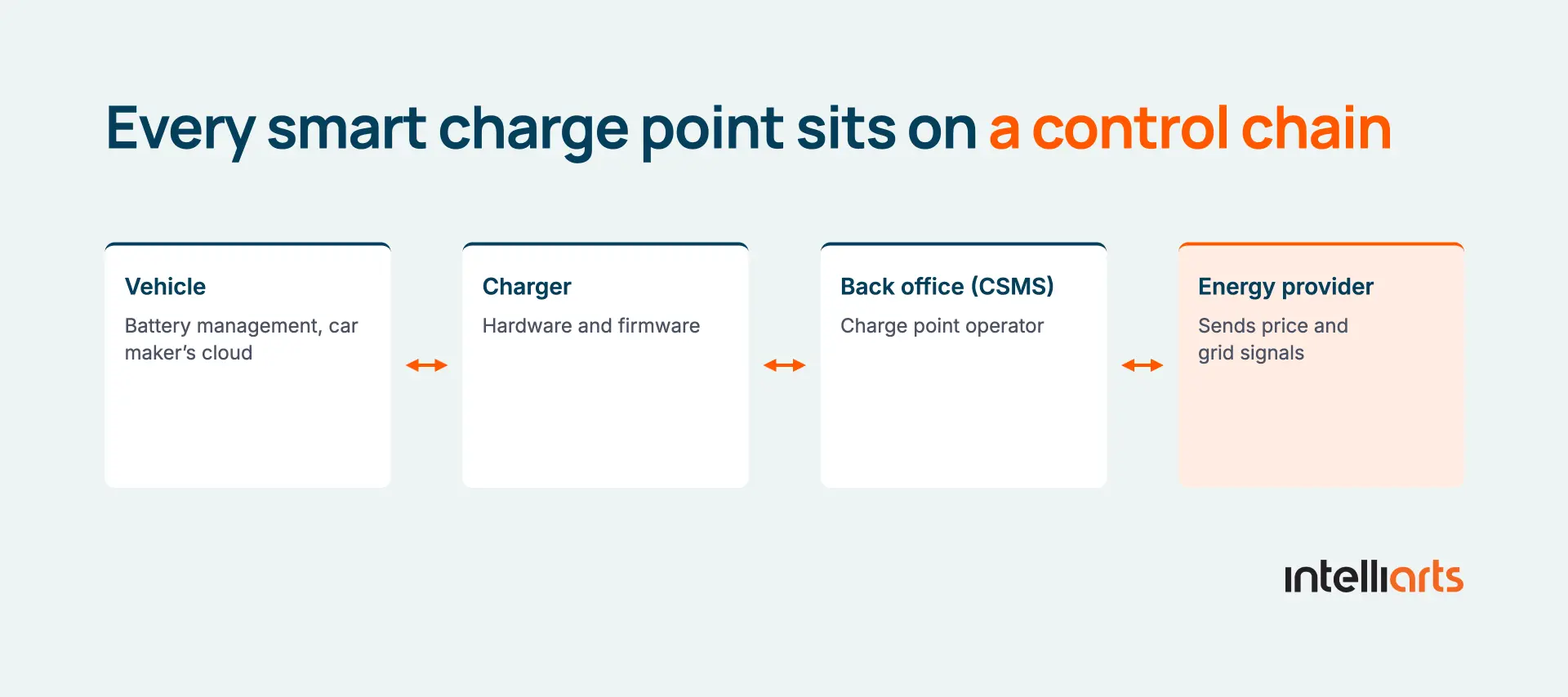
Every smart charge point sits on a control chain
Flexibility never happens in one device. It runs through a chain: the vehicle (battery management and the car maker’s cloud), the charger, the charge point management system (CPMS, also called CSMS) run by the operator, and the energy provider sending price and grid signals.
A request to cut consumption must travel through every link while respecting the battery’s limits. That’s why regulating one link affects all the others.
Two lenses for regulating a charge point
This was the central question of my talk. A single charge point can fall under several regulators at once, and each one expects something different from the same hardware and software. So, when a charge point goes live, which regulator is it answering to: transport, energy, or both?
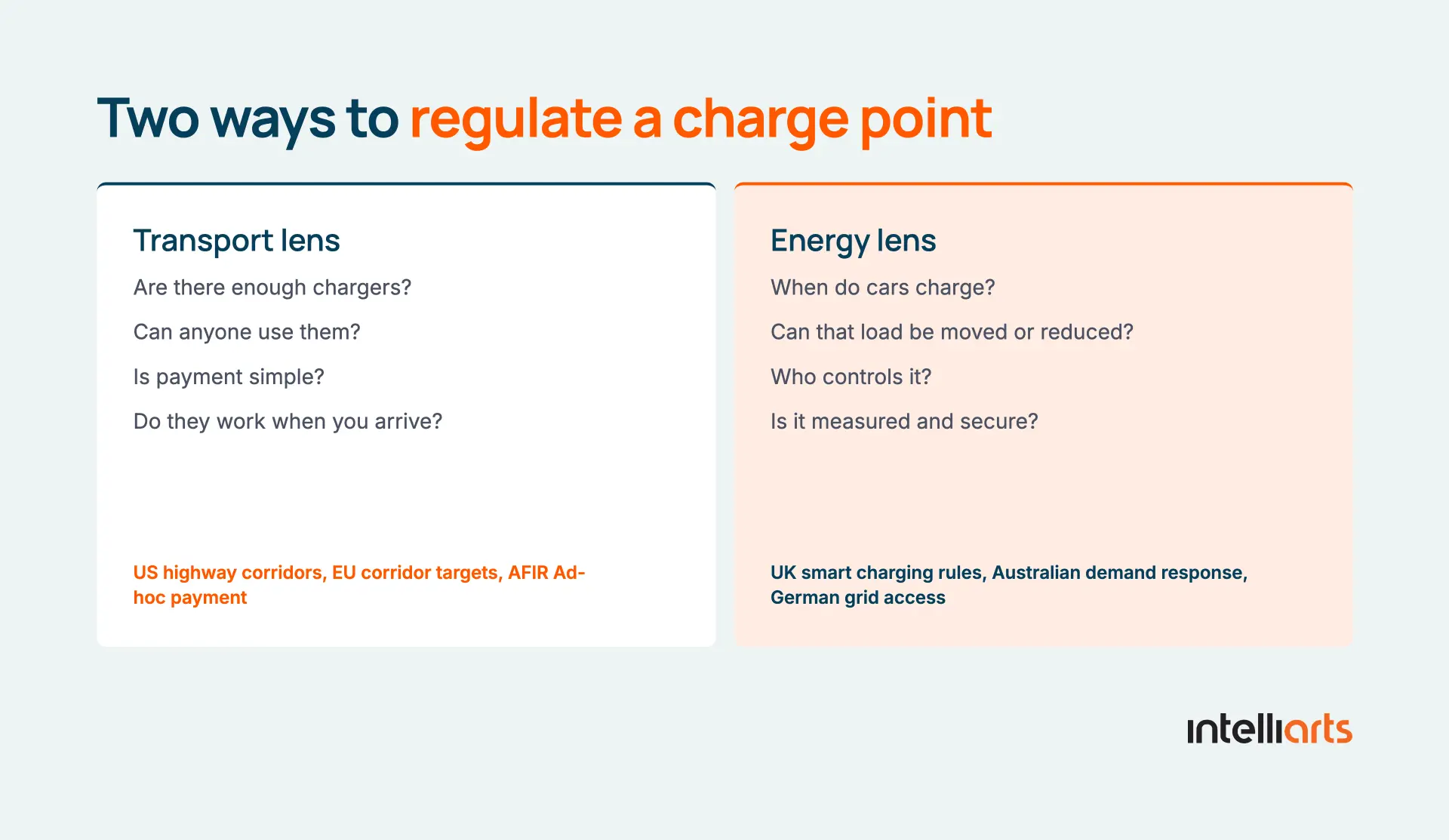
Transport lens vs. energy lens
Both lenses look at the same charge point, but from opposite ends of the control chain. The transport lens starts with the driver standing at the charger, and the energy lens starts with the grid that powers it.
Most markets use both
In the UK, DfT and OZEV own public charging rules, while DESNZ and Ofgem handle smart charging regulations and flexibility. The EU has AFIR on the transport side but no single energy regulation. South Australia already mandates OCPP 2.1 or an approved alternative for certain V2G equipment.
Three levels of EV charging flexibility
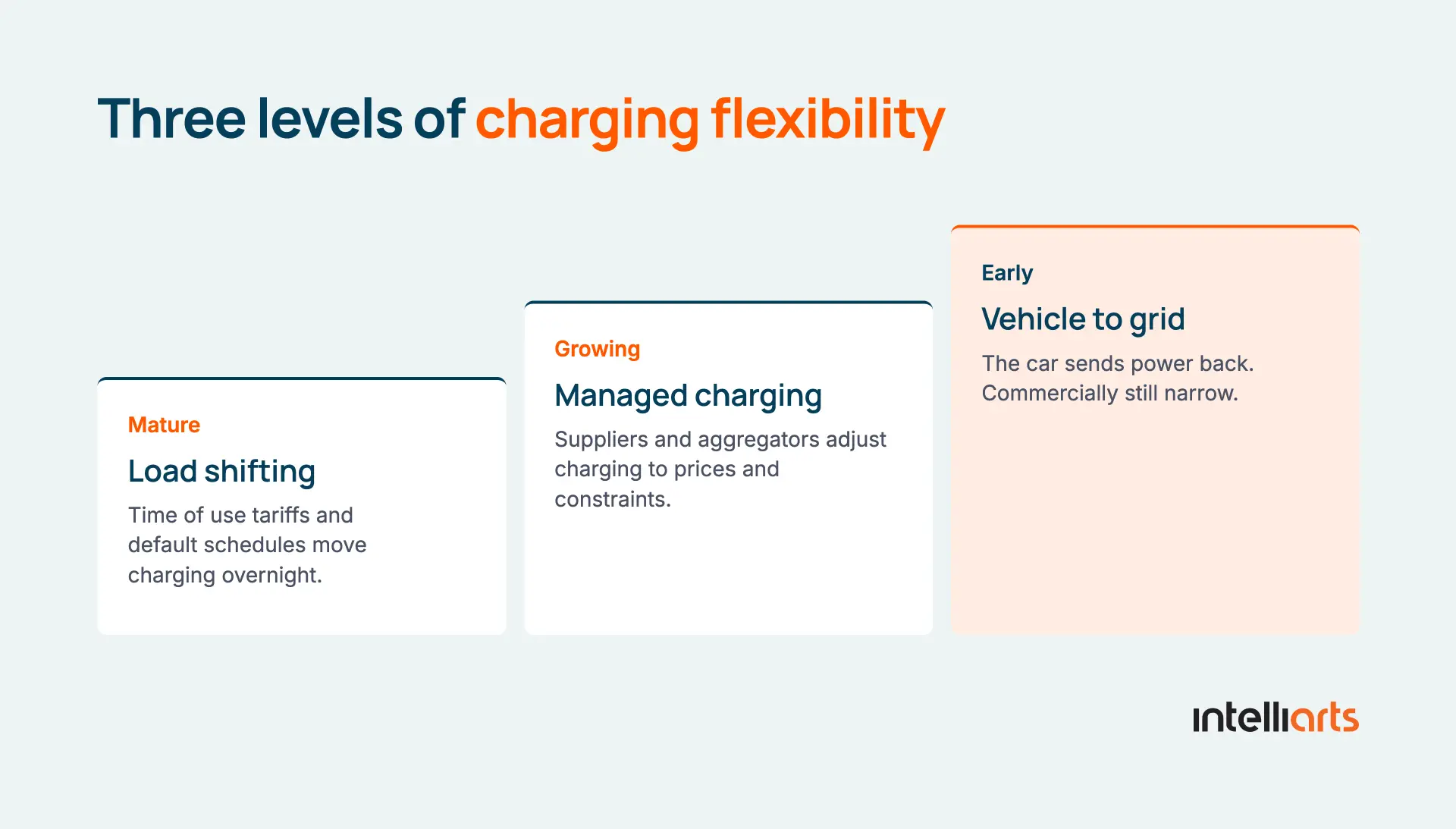
EV charging flexibility is the ability to change when and how much electricity a vehicle draws, or to send electricity back, in response to prices or grid conditions.
Load shifting, managed charging, and V2G
- Load shifting (mature): time-of-use tariffs and default schedules move charging to off-peak hours.
- Managed charging (growing): suppliers, aggregators, or network operators adjust charging power to prices and network constraints.
- Vehicle-to-grid (early): the car exports power. Technically possible, commercially narrow, because vehicle makers, operators, and energy providers must all support it.

A car battery can power a home for days
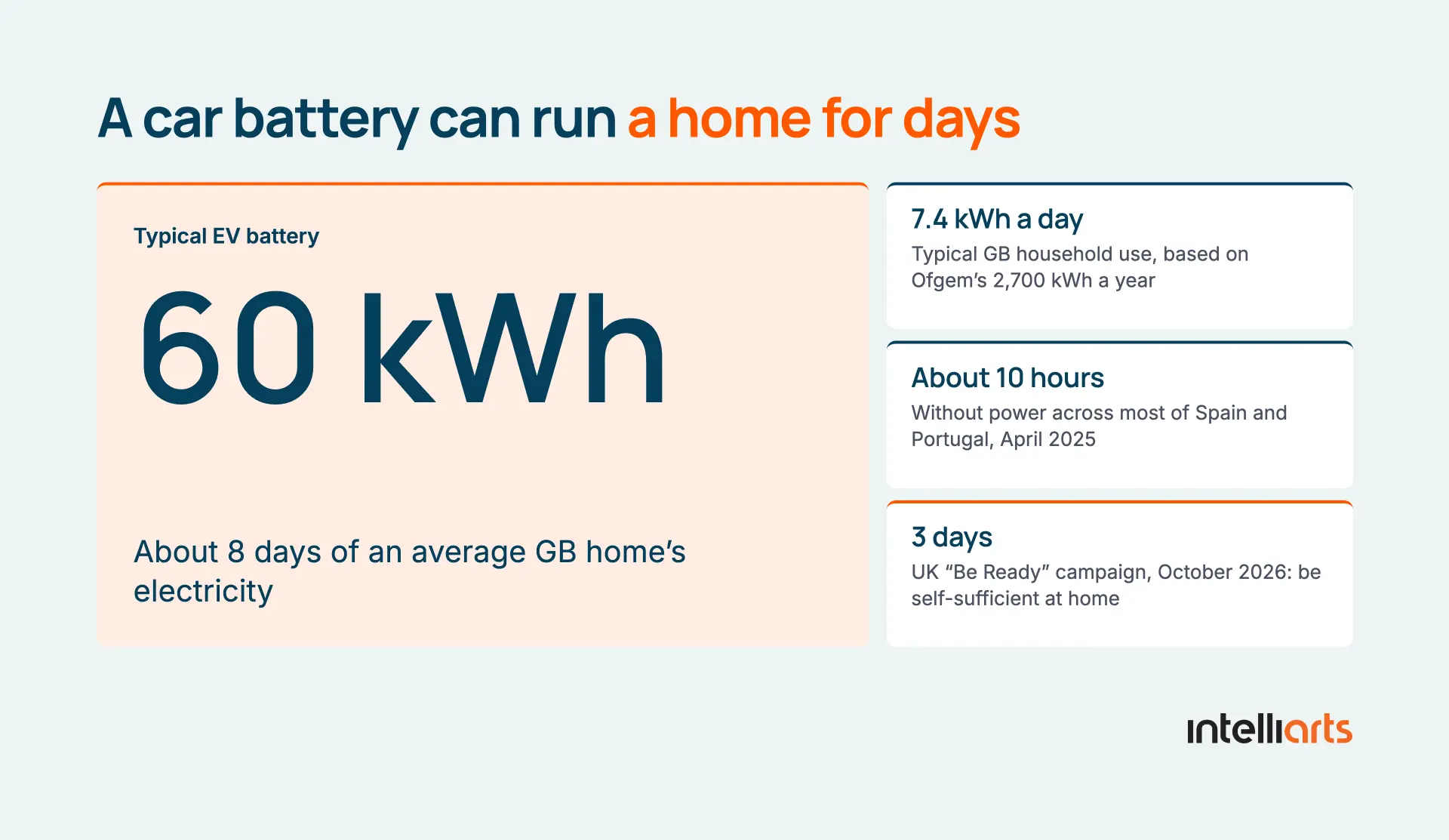
A typical EV battery holds around 60 kWh. Ofgem’s typical household electricity use was 2,700 kWh a year, revised to 2,500 kWh from July 2026. So a full battery holds roughly 8–9 days of an average GB home’s electricity.
That’s timely, given the April 2025 Iberian blackout and the UK’s “Be Ready” emergency preparedness campaign in October 2026.
What bidirectional charging requires
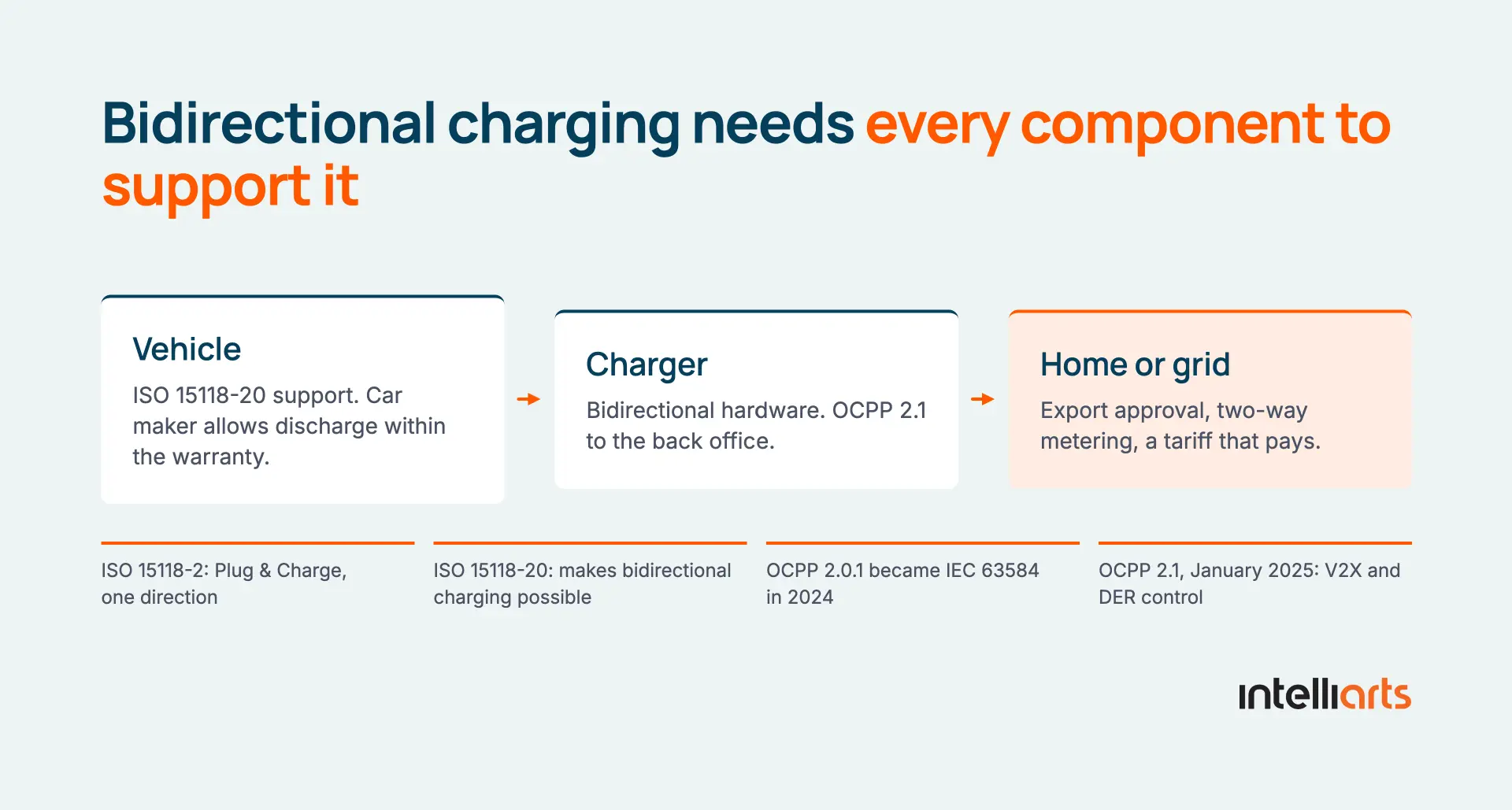
Every component must support it: the vehicle (ISO 15118-20 and a warranty that allows discharge), the V2G charger and CPMS (bidirectional hardware and OCPP 2.1), and the grid connection (export approval, two-way metering, and a tariff that pays).
Vehicle manufacturers don’t want to expose battery health data to drivers. That’s what currently stops bidirectional charging at scale.
The UK: smart by default at home, consumer protection in public
The UK regulates home and public charging separately. Home chargers must help shift demand away from peak hours, while public chargers must be reliable, easy to pay for, and transparent on price.
Smart Charge Point Regulations 2021
The Electric Vehicles (Smart Charge Points) Regulations 2021, in force since 2022, apply to new private charge points sold in Great Britain. Chargers must:
- send and receive information and respond to signals;
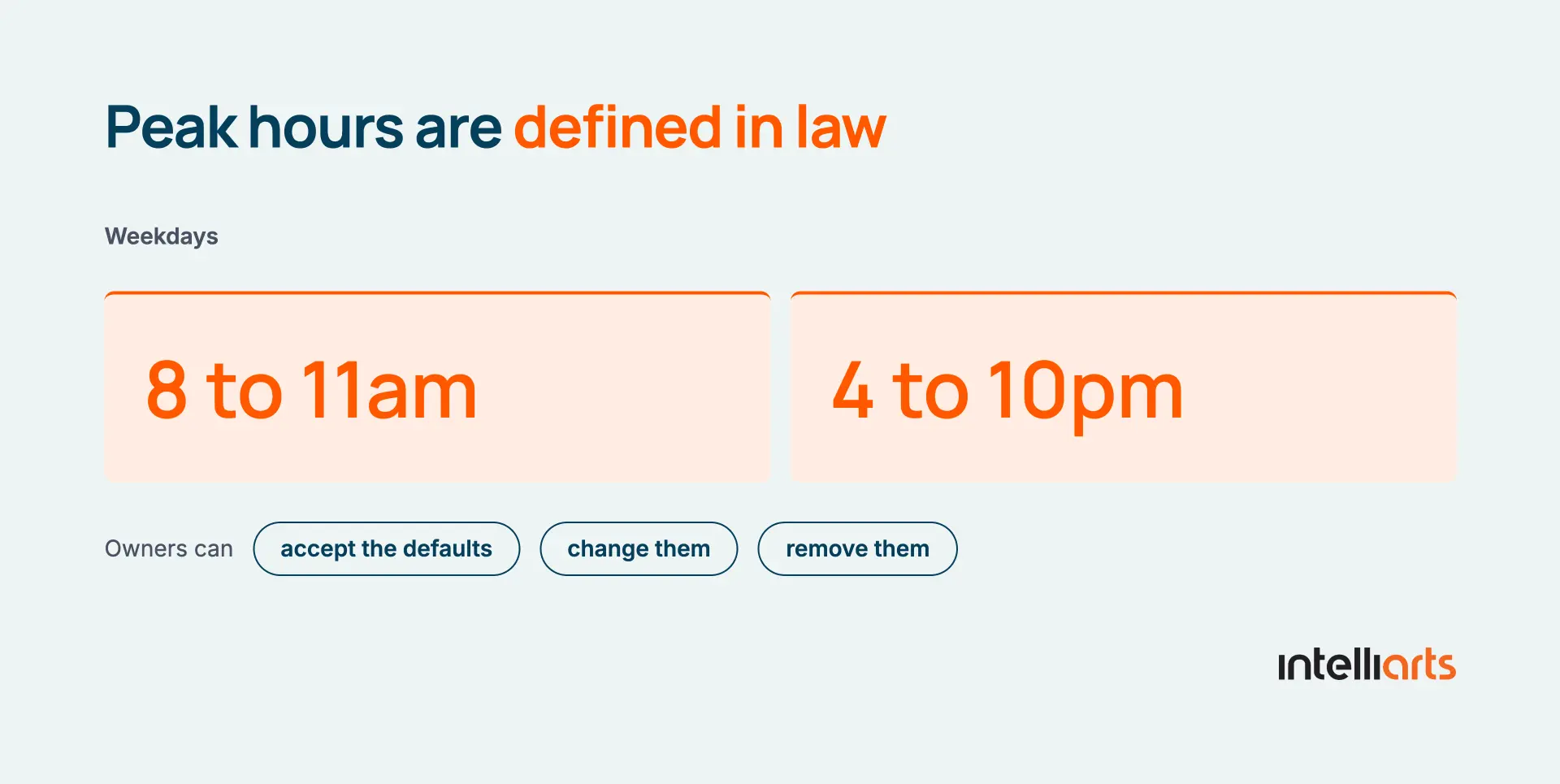
- come with default charging hours outside peak times, defined as 8–11 am and 4–10 pm on weekdays (owners can accept, change, or remove them);
- apply a randomised start delay of up to 10 minutes by default, adjustable remotely to 30 minutes;
- support demand-side response, stay smart after a supplier switch, and meet security requirements.
Imagine 100 vehicles waiting for off-peak hours. If they all start at the same moment, we just create a new spike. Randomised delay spreads those starts over time.
From smart chargers to energy smart homes
Through the Smart Secure Electricity Systems (SSES) program, the UK is extending smart requirements to heat pumps and home batteries.
Organisations that remotely control these devices for flexibility will need an Ofgem load control licence: applications are expected from March 2027, and the requirement applies from March 2028.
Public Charge Point Regulations 2023
The UK has made charging equipment smart by default. The next challenge is turning that capability into flexibility the energy system can use at scale. Public charging rules focus on the driver:
- 99% reliability across each operator’s rapid network;
- contactless payment on new chargers from 8 kW and existing rapid chargers;
- pence-per-kWh pricing, open data;
- a free 24/7 helpline.
Proving 99% reliability requires consistent charger status reporting and data quality monitoring in the CPMS.
The EU: strong on access, energy rules still forming
EU law already sets clear rules for how drivers find, use, and pay for public chargers. How charging connects to the grid, though, is still mostly decided by each member state.
AFIR sets the rules at the charger
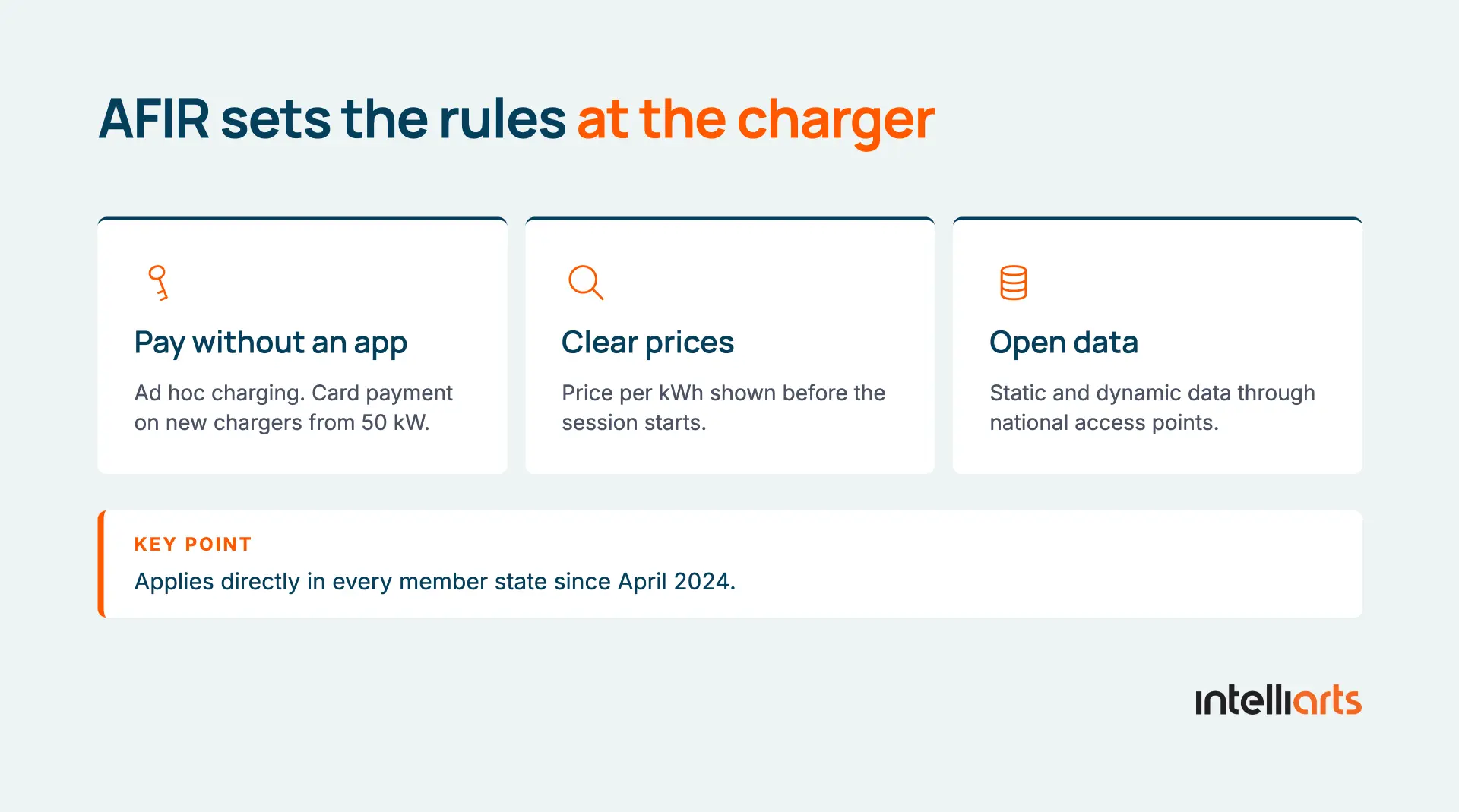
The Alternative Fuels Infrastructure Regulation (AFIR) has applied directly in every member state since April 2024. It requires ad hoc payment without an app (card payment on new chargers from 50 kW), clear per-kWh prices before a session, open data through national access points, and deployment targets along major transport corridors.
ISO 15118 becomes a requirement
AFIR is mostly a transport regulation, but it reaches into energy territory through communication standards. The 2025 delegated regulation that supplements AFIR makes ISO 15118, the standard for communication between the vehicle and the charger, mandatory in two steps.
Energy rules arrive country by country
There is no single EU energy regulation for charging. Rules come from the Buildings Directive, the Renewable Energy Directive (including battery data access), the electricity market design reform, and national law.
In Germany, §14a of the Energy Industry Act (EnWG) lets grid operators manage controllable devices such as wallboxes in exchange for lower network charges.
EV charging regulations UK vs. EU side by side
The regulatory approaches differ, but many of the remaining challenges are the same for both the EU and the UK. The table below compares both approaches area by area, from home charging to V2G:
Area UK EU
Home charging Smart by default since 2022 Set by each member state
Load control Ofgem licensing from March 2028 Varies by country
Battery data No direct requirement Access in law, still debated
Public access Contactless, price per kWh, 99% reliability Ad-hoc access, card payment, clear prices
Charging data Published by each operator National access points
V2G First offers, no clear route to scale First offers, no clear route to scale
Vehicle-to-grid: technically ready, commercially early
The technology and standards for V2G are largely in place. What’s still missing are the rules and business models that make it pay off beyond pilots.
Where V2G stands today
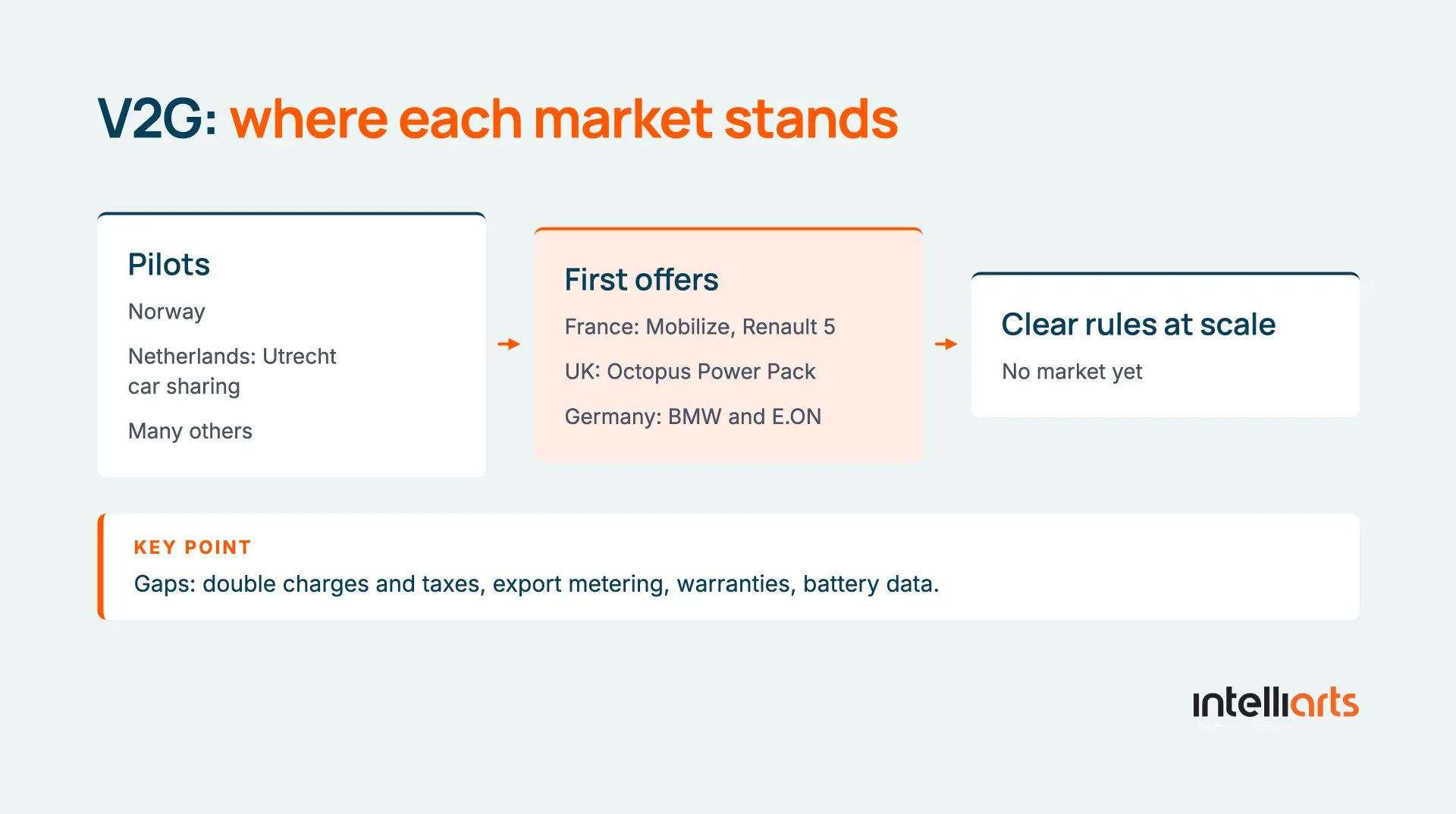
Pilots are running in Norway, the Netherlands, and elsewhere. First commercial offers exist in France (Mobilize with the Renault 5), the UK (Octopus Power Pack), and Germany, where BMW and E.ON launched a consumer V2G bundle in September 2025.
- No market has clear rules for V2G at scale yet. The gaps are double charges and taxes, export metering, warranties, and battery data access.
Home and fleet charging will lead
During the Q&A, I named two use cases most likely to lead:
- Home charging, because powering your own home avoids the question of reimbursing drivers for battery wear.
- Fleet charging, because fleet managers can discharge some vehicles to charge others faster.
Jacob added that in Great Britain the most valuable pound per kWh comes from avoiding imports, since households pay the full stack of network and policy costs on imported power. So managed charging captures the biggest near-term value.
I believe we need at least two more years before vehicle-to-grid moves beyond pilot discussions.
What it takes to scale
Scaling flexibility will take interoperability beyond bilateral integrations, regulatory clarity on export and network charges, reliable data access, and commercial viability.
On the interoperability side, Task 53, an international project under the International Energy Agency’s (IEA) Electric Vehicles Technology Collaboration Programme, tests how bidirectional chargers, vehicles, and grids work together to replace isolated, proprietary solutions with harmonised ones that let V2G scale.
As subsidies shrink in Europe, making charging pay increasingly depends on working smartly with tariffs and energy costs.
Plan your next 36 months of compliance across the UK, the EU, and other key markets.Download our eMobility Regulations White Paper

What energy regulations mean for each player
These rules affect each part of the charging value chain differently. Here is what grid operators, energy suppliers, CPOs, and vehicle makers in the UK market should prepare for.
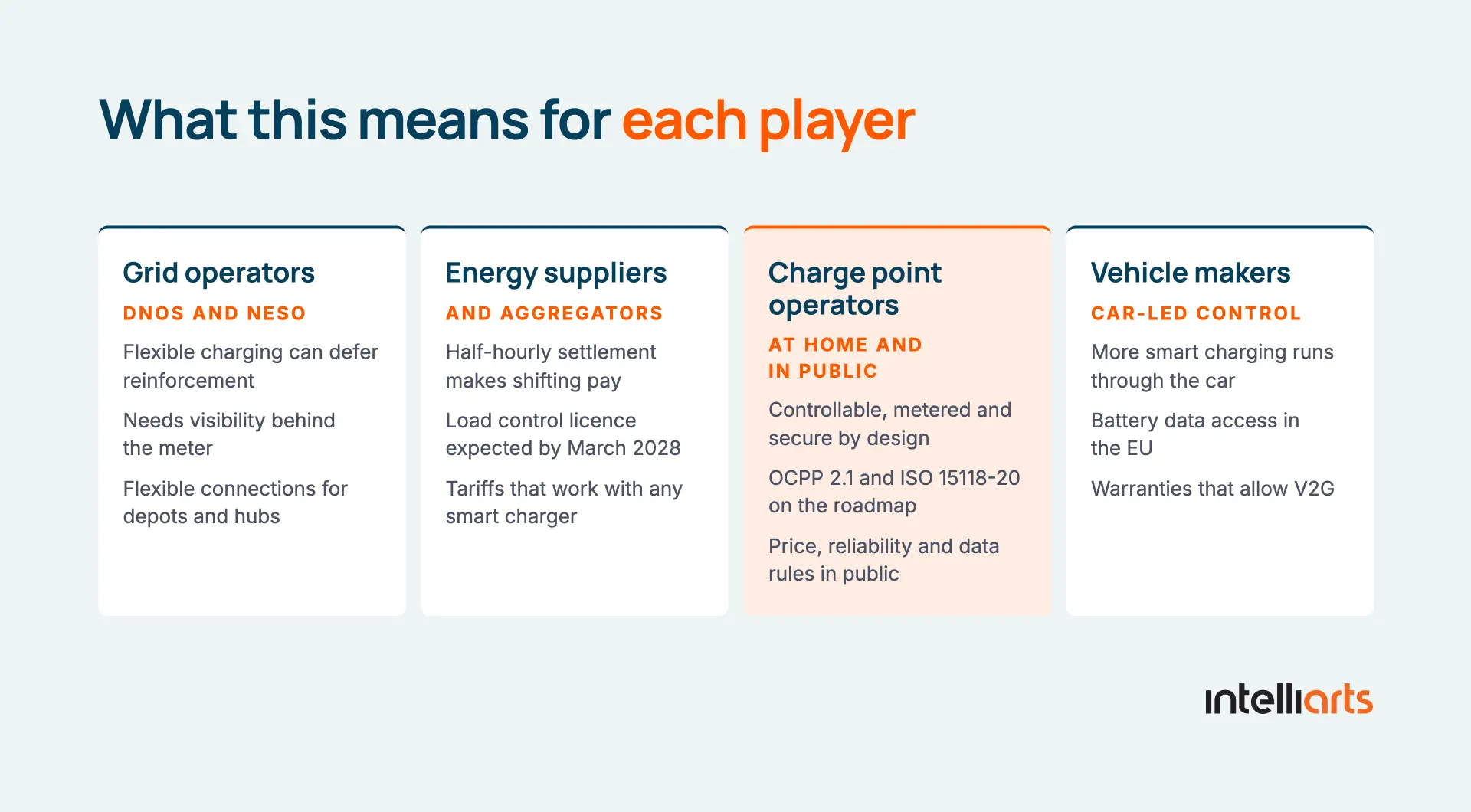
For charge point operators, the key message is to treat energy integration as a core part of infrastructure and software, not an add-on. Everyone in this chain holds a part of the opportunity, and a part of the responsibility for making it work.
How Intelliarts built a compliant eMSP platform for a fast-charging network
For one of our clients, a fast-charging network operator in Saudi Arabia, we delivered the core of a custom eMSP platform in six months. It turned out that local rules, roaming, and future growth drove most of our decisions:
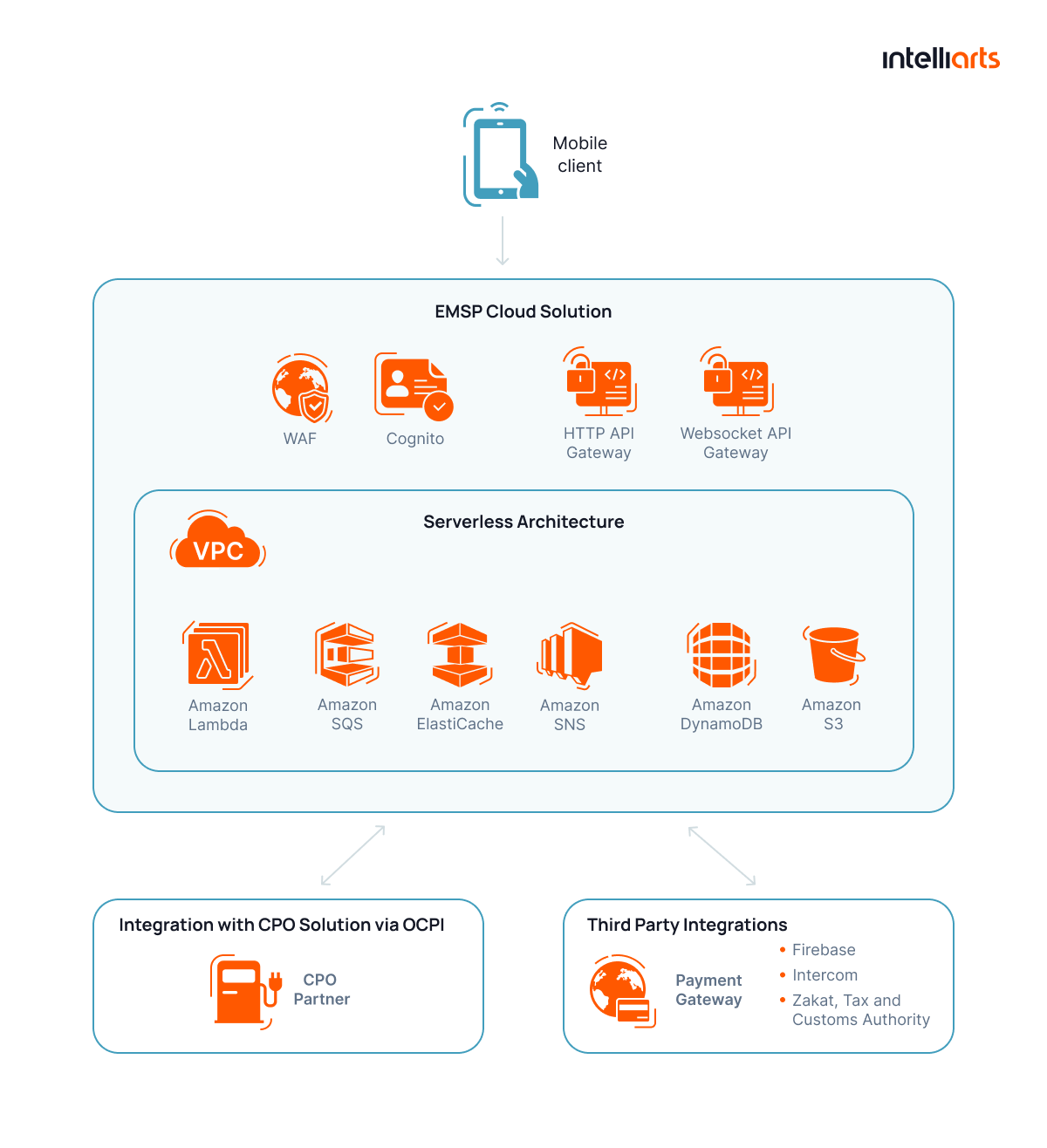
- Driver-facing platform. We built a bilingual Arabic and English mobile app with billing and payments, covering everything the driver sees.
- Local compliance. We integrated regional payment gateways and set up e-invoicing that meets the rules of ZATCA, the Saudi tax authority.
- Ready for roaming. We implemented OCPI, so drivers will be able to charge on other networks through the same app.
- Built to scale. The AWS serverless architecture lets the network grow without large infrastructure investments.
- Proven adoption. Tens of thousands of drivers use the app, which is rated 4.1 on Android and 4.8 on iOS.
Read the full success story here
Conclusion
EV charging regulations in the UK and Europe are converging on one idea: a charge point is no longer just a transport amenity; it’s an energy asset. In both regions, V2G is technically ready but waiting on data access, warranties, metering, and viable business models.
The next few years will decide how well energy and mobility work together. So, I closed the webinar with a quote from economist Rüdiger Dornbusch:
Things take longer to change than you thought they would, and then they change faster than you thought they ever could.
Where to go next
Charging regulations keep changing, and your software has to keep up. At Intelliarts, we build EV charging and energy management systems ready for these changes, from smart charging and load balancing to OCPP 2.1 and ISO 15118 integration.
We’ve built eMSP platforms, OCPI roaming, and predictive maintenance for chargers, so we know where compliance meets real operations. If you want to check how ready your platform is, we’re happy to take a look.
Looking for EV charging software that keeps pace with new energy regulations?
Talk to our team
FAQ
What are the main EV charging regulations in the UK and Europe?
In the UK, the core rules are the Electric Vehicles (Smart Charge Points) Regulations 2021 for home chargers and the Public Charge Point Regulations 2023 for public charging, with Ofgem load control licensing coming in 2028.
In the EU, the Alternative Fuels Infrastructure Regulation (AFIR) governs public charging, while energy-side rules come from the Buildings Directive, the Renewable Energy Directive, electricity market design reform, and national laws such as Germany’s §14a EnWG.
What is the difference between the transport and energy lenses in EV charging regulation?
The transport lens asks whether there are enough reliable chargers that anyone can use and pay for easily. The energy lens asks when cars charge, whether that load can be shifted or reduced, who controls it, and whether it is measured and secure. Most markets, including the UK and the EU, regulate charging through both.
What do the UK Smart Charge Point Regulations require?
New private charge points sold in Great Britain must be able to send and receive data, respond to signals, and support demand-side response.
They must come with default charging hours outside weekday peaks (8–11 am and 4–10 pm), apply a randomised start delay of up to 10 minutes (adjustable remotely to 30), stay smart after a supplier switch, and meet security requirements.