
TL;DR
- 71% of organisations now use generative AI in at least one business function, according to McKinsey. Only 17% of respondents report that AI accounts for more than 5% of their organizations’ Earnings Before Interest and Taxes (EBIT).
- The gap between adoption and measurable return largely comes down to how RAG gets deployed.
- RAG delivers faster payback when it is embedded into specific workflows, not used only as a generic chatbot.
- The strongest enterprise use cases are internal knowledge synthesis, sales briefs, operations reporting, contract reviews, and BI context explanation.
- ROI comes from reducing manual research, speeding up document-heavy work, and making outputs more consistent across teams.
- Successful RAG development projects start with a narrow workflow, clear data sources, and measurable KPIs like time saved, backlog reduction, or win-rate impact.
- Implementation quality depends on retrieval design, metadata, access control, source traceability, and ongoing evaluation after launch.
Why RAG is more than a chatbot trick
AI-led transition may, unfortunately, lead to unsuccessful implementations if not approached with expertise and experience. One of the most common examples is simplifying launching an internal chatbot on top of a document library and treating it as a “RAG implementation.” Some of those chatbots might be genuinely useful. Nevertheless, such organizations would be sitting on a capability they have barely touched.
RAG is a system design pattern where a language model’s responses are grounded in retrieved, organisation-specific content pulled at query time.
The most business value here lies in the capability of a RAG system to enhance any LLM’s responses with reliable data extracted from a suitable database. Have you ever noted that your chatbot or an AI agent hallucinates a lot and struggles to retrieve and reuse data from provided materials?
That’s exactly what RAG technology solves. And a chat interface is just one way to surface a database, and usually not the most valuable one.
Looking for relevant data on RAG usage for business LLM?
In our recent research, we covered how to drive efficiency with RAG-based solutions
Read white paper here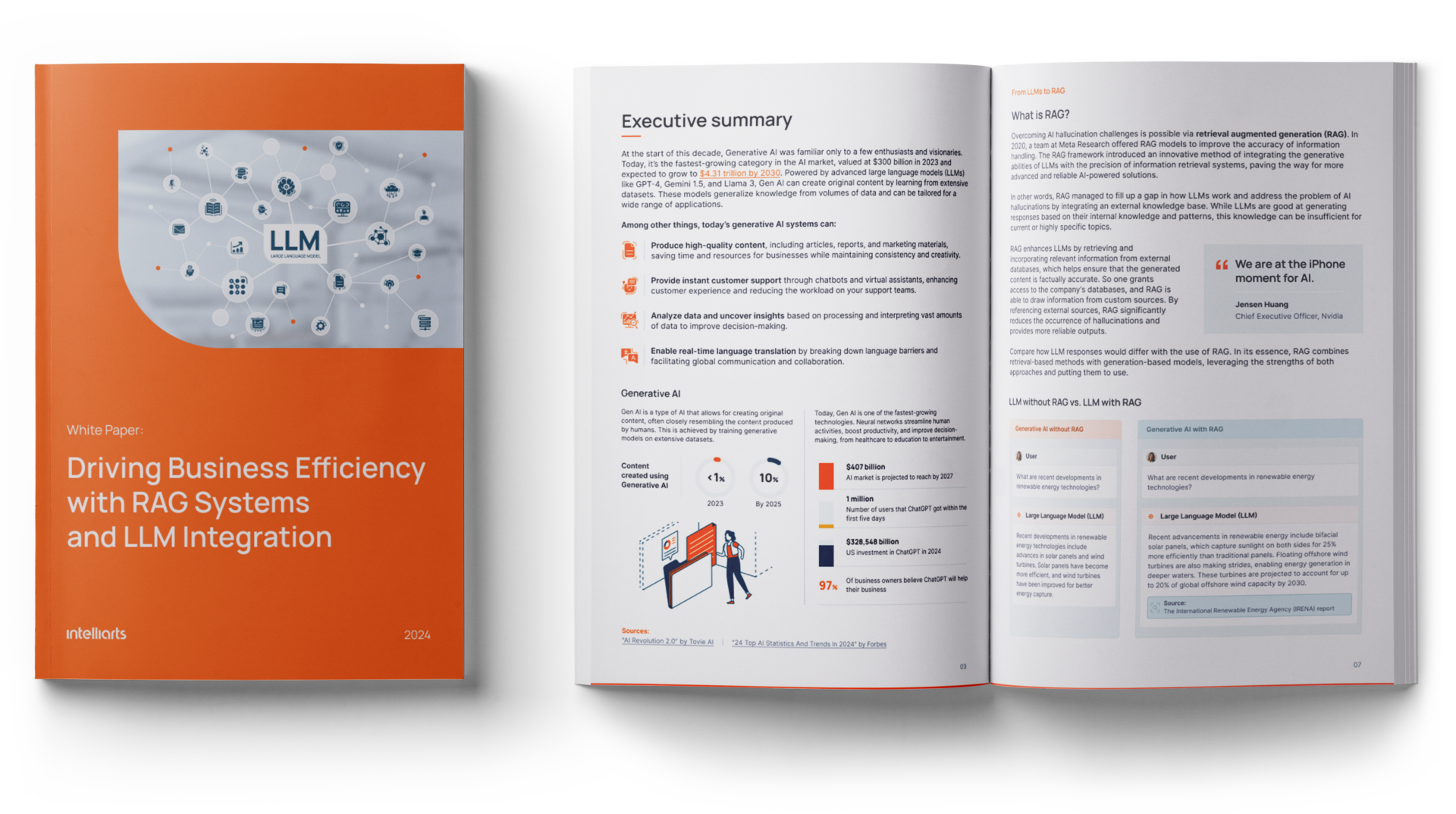
The “RAG = chatbot for a database” assumption leads to three fundamental limitations in ML development:
- It isolates RAG from core workflows, so outputs never connect to the systems and decisions that actually matter.
- It makes ROI nearly impossible to attribute, because generic conversational use doesn’t tie to any measurable business process.
- It leads teams to under-invest in retrieval quality, security, and evaluation, which are the components that determine whether a RAG system is production-ready.
The most successful RAG projects Intelliarts has worked on all have RAG embedded into existing digital infrastructure, with an AI chatbot of a customer’s choice working upon.
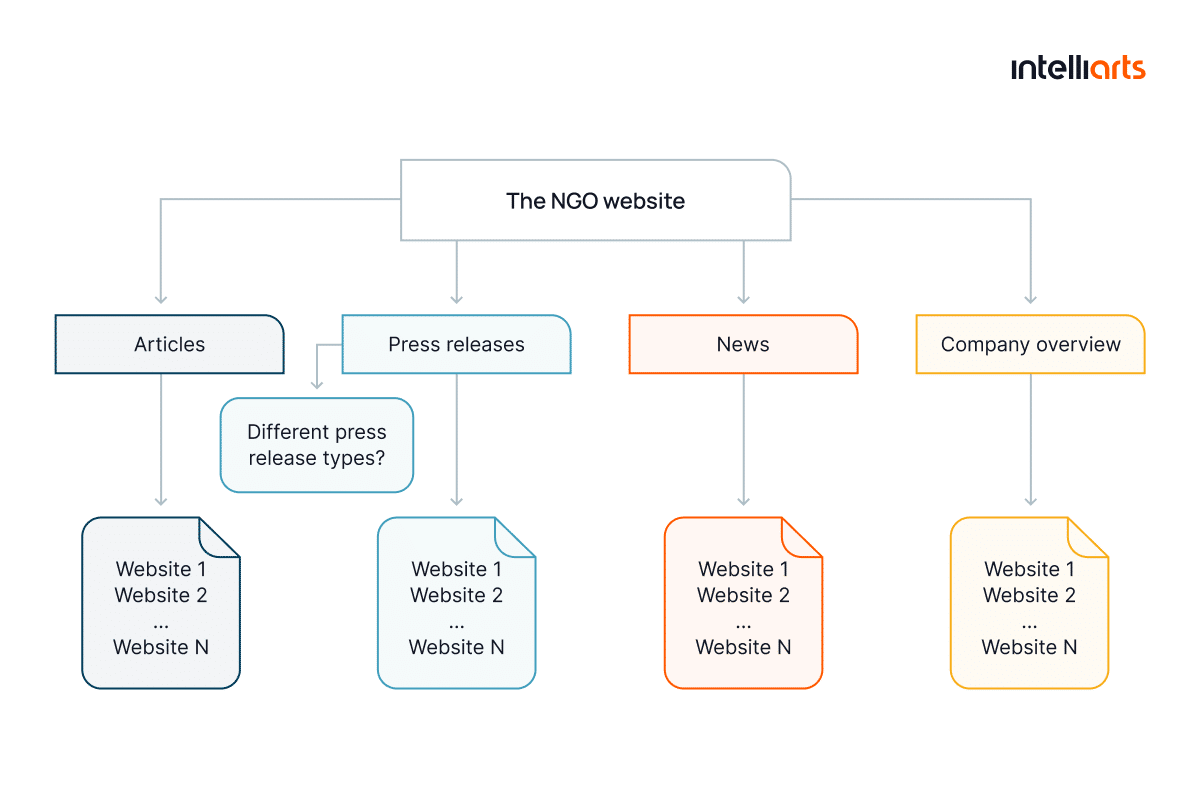
See the example of a RAG-enabled AI chatbot for fast data extraction in the success story by Intelliarts.
Quick refresher: How retrieval‑augmented generation works in the enterprise
As mentioned previously, retrieval-augmented generation combines search over enterprise data with large language models. This way, every response is grounded in current, organisation-specific content instead of the model’s training data alone.
“Oftentimes, enterprise AI failures we have scrutinized are attributed to poor data handling rather than a bad AI model choice.” — Martha Urbanovych, ML Engineer at Intelliarts
Here are two of the main procedures in the RAG workflow:
- Ingestion and indexing. In this phase, data gets collected, structured, and split into chunks. Each chunk is enriched with metadata and converted into embeddings, then stored in a vector index alongside a traditional keyword index.
- Retrieval and generation. This is a real-time process that happens at query time. When a user submits a request, the system runs a hybrid search combining keyword and vector matching, filtered by permissions and relevant metadata. The retrieved chunks go into the LLM’s context window, and the model generates an answer based on that specific content.
In an enterprise context, three additional concerns sit on top of this foundation:
- Access control. The retrieval layer must respect document- and row-level permissions, so users only get answers based on content they are authorised to see.
- Compliance and auditability. As per regulations, such as the EU AI Act, responses need a traceable source, especially in regulated industries where decisions have to be explainable.
- Evaluation. Answer quality, retrieval relevance, and hallucination rates all need ongoing measurement. Without it, you have no reliable signal that the system is working.
See the example of an enterprise RAG-enabled LLM architecture pattern in the infographics below:
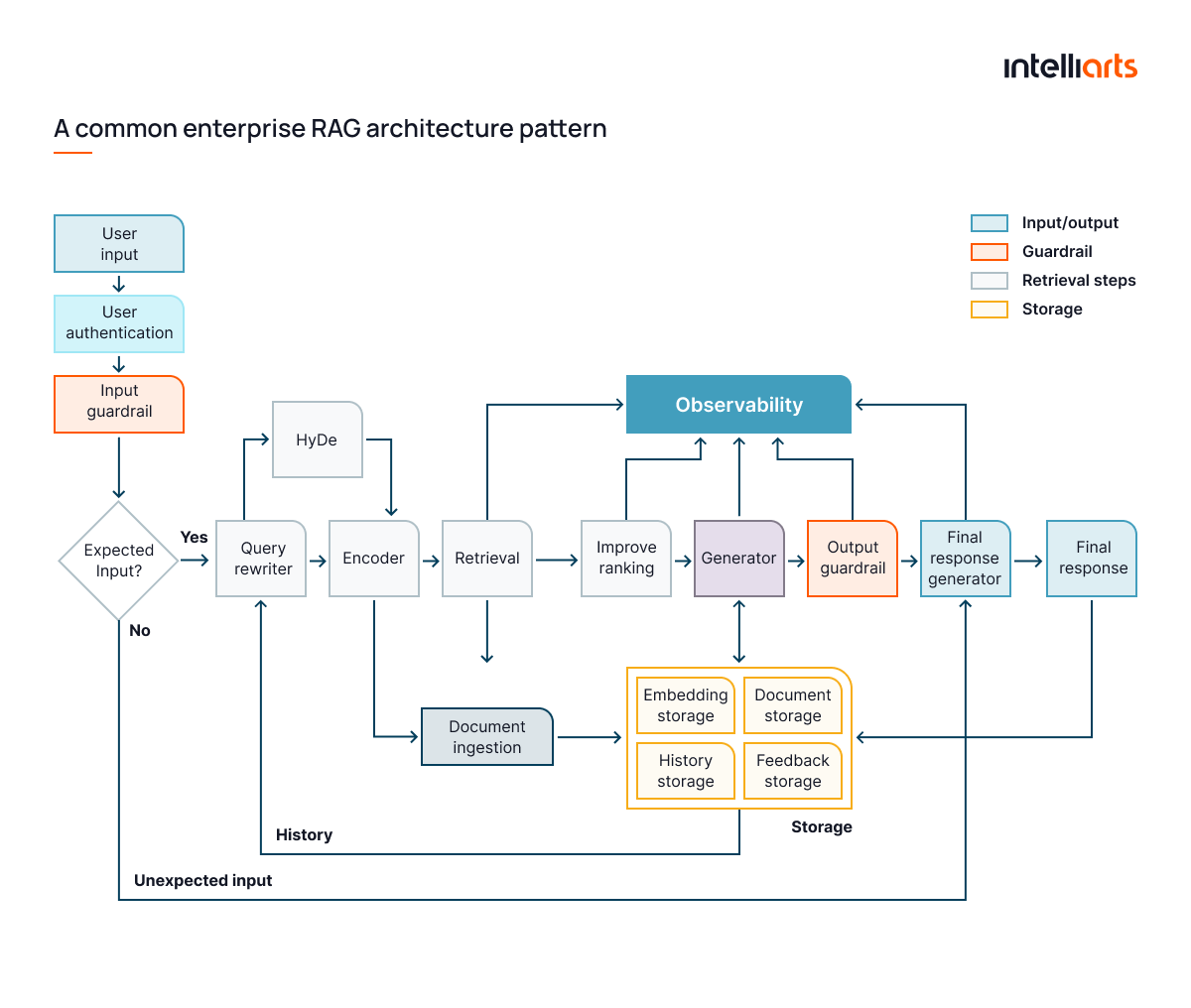
The diagram shows the workflow where user input passes authentication and an input guardrail. From there, the system runs through retrieval, generation, and two validation checkpoints before delivering a response.
Key components:
- Query rewriting and encoding refine the input before retrieval
- Ranking improvement filters results before they reach the generator
- Dual guardrails validate both input and output
- Storage layer covers embeddings, documents, history, and feedback
- Observability spans the entire flow for evaluation and hallucination monitoring
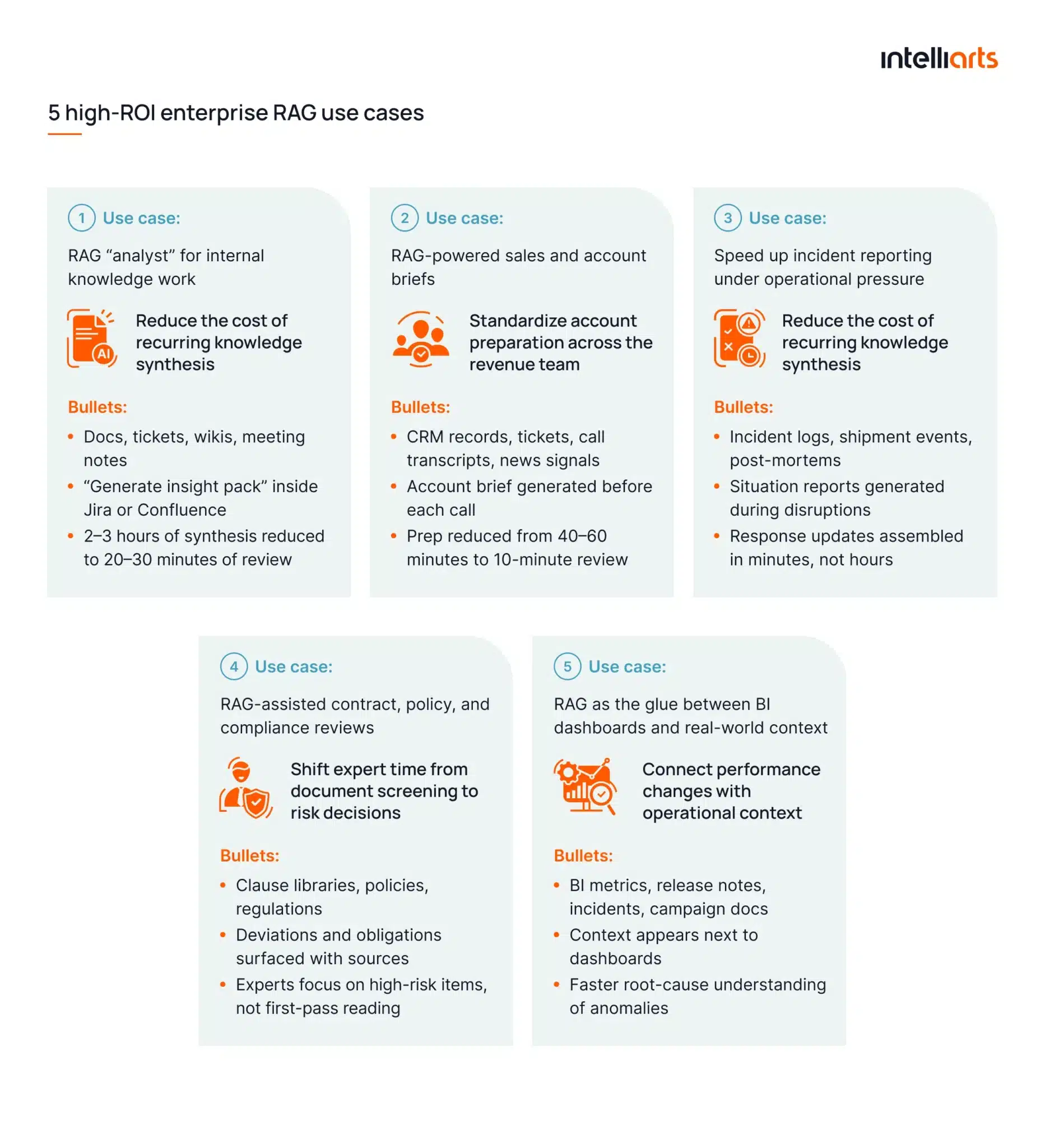
Get the foundation of RAG right, and this technology becomes applicable across a wide range of high-value enterprise workflows. The five use cases below are where Intelliarts sees the fastest payback from RAG development and integration.
Use case #1: RAG “analyst” for internal knowledge work
This use case integrates RAG technology inside the tech stack teams already work with. In a nutshell, this approach cuts the manual layer between information and decision-ready output. It’s practically the same as the above-mentioned RAG-enabled AI chatbot case from Intelliarts’ portfolio.
Business problem
Product managers, support leads, and analysts spend hours each week pulling together reports, incident summaries, and decision briefs from docs, tickets, and wikis spread across multiple systems. The work is repetitive, the outputs vary in quality, and it pulls skilled people away from higher-value work.
What the RAG solution does
Top RAG development companies can embed RAG as a generation trigger inside tools like Confluence, Notion, or Jira. A PM clicks “Generate insight pack” on a feature ticket and gets a structured memo synthesising past incidents, user feedback, and roadmap notes. A support manager triggers a weekly digest and gets a prioritised incident summary with links to root-cause documents.
Two things make this work in practice:
- Users stay in the tools they already use, with no new interface to learn.
- Output is structured and fits directly into existing reporting and review workflows.
Why it pays back fast
- Each synthesis task drops from two to three hours of manual effort to twenty to thirty minutes of review and editing.
- New team members reach productive context faster, with historical decisions and incidents accessible in one step.
- Documentation quality becomes consistent across teams, since outputs follow a defined structure regardless of who triggered them.
Architecture and implementation notes
Data sources: wiki pages, project docs, tickets, incident reports, issue tracker comments, and meeting notes.
Retrieval notes:
- Use document-aware chunking that preserves section structure, so summaries respect headings and context.
- Apply hybrid search with metadata filters on product area, team, and status to keep retrieval focused.
Pitfalls to avoid:
- Indexing everything without a governance layer leads to irrelevant or sensitive content surfacing in summaries.
- Skipping permission models creates security exposure in larger organisations.
Looking for a Trusted RAG Development Partner?
From consulting and research to design, development, and delivery, Intelliarts covers everything
Explore our services
Use case #2: RAG-powered sales and account briefs
This use case automates that assembly inside the CRM, so representatives walk into every conversation with full context.
Business problem
Sales and customer success teams spend significant time before each call or quarterly business review. Oftentimes, they have to pull together CRM history, open tickets, call transcripts, and recent news manually. Preparation quality varies by rep, which means deal outcomes depend partly on individual discipline rather than a repeatable process.
What the RAG solution does
A “Generate account brief” trigger inside the CRM pulls recent interactions, open issues, expansion signals, and relevant battlecards into a single structured brief. For strategic accounts, the system enriches it with external signals like recent funding events or product announcements from news APIs.
Representatives get a ready-to-review document before the call, built from the same sources they would check manually. Output follows a consistent template across the team.
Why it pays back fast
- Call and QBR preparation drops from forty to sixty minutes of manual research to a ten-minute review.
- New sales hires reach full account context in their first week, without relying on tribal knowledge.
- ROI is directly measurable: compare win rates and sales cycle length for opportunities with RAG-assisted briefs against the baseline.
Architecture and implementation notes
Data sources: CRM records, ticketing system, call recording transcripts, marketing automation logs, and external news APIs.
Retrieval notes:
- Use metadata filters on account ID, region, product line, and deal stage to keep the retrieval precise.
- Blend semantic search with ID-based filters to avoid surfacing content from unrelated accounts.
Pitfalls to avoid:
- Briefs without a consistent template produce outputs that vary too much for representatives to trust.
- Representatives showcase AI-generated content to customers without review creates reputational risk.
“We once audited a client’s AI setup and found their in-house chatbot leveraging a 6-month-old database. Multiplied by users’ personal data leaks and a lack of audit trails, this is essentially a non-compliance case. We rearchitected the system and added RAG on top of it promptly.” — Alexander Barinov, a Managing Partner at Intelliarts
Use case #3: RAG for operations and supply chain “war rooms”
This use case gives ops and supply chain teams a faster path from alert to coordinated response.
Business problem
When disruptions occur, operations and supply chain teams have to spend hours stitching together what happened across TMS, WMS, and incident tools. As per the best RAG implementation practices, leadership updates require manual synthesis into situation reports, often under time pressure, while the incident is still active.
What the RAG solution does
Through the tuned RAG development, the solution is able to pull data from incident logs, shipment events, maintenance records, and previous post-mortems. This way it can answer situational questions on demand and be, for example, a part of a truck driver support software system. Teams can ask “Summarise all high-impact incidents affecting region X this week” and get a structured answer with source links.
Why it pays back fast
- Time to assemble situation reports drops from hours to minutes during active incidents.
- Response coordination improves when teams share a consistent, sourced summary instead of fragmented updates.
- Each incident documented through the system feeds back into retrieval, making future responses faster and better grounded.
Architecture and implementation notes
Data sources: event streams, incident reports, ticket comments, and post-mortems.
Retrieval notes:
- Use agentic RAG development for multi-step queries, e.g., identify affected assets, fetch related incidents, then summarise patterns across them.
- Prioritise recent data and high-severity incidents using metadata in retrieval ranking.
Pitfalls to avoid:
- Presenting answers as real-time when underlying systems update with a delay creates false confidence during live incidents.
- Letting the model explain anomalies without sufficient grounded context leads to unreliable root-cause narratives.
Use case #4: RAG-assisted contract, policy, and compliance reviews
This use case reduces the manual reading load and puts expert attention where it matters most.
Business problem
Legal, procurement, and compliance teams spend significant time on first-pass reviews of contracts, vendor policies, and regulatory documents. This work is repetitive, but omitting it carries real risk if something is missed. Review quality drops under time pressure or when teams are handling high document volumes.
What the RAG solution does
RAG solution compares incoming contracts against a clause library, flags deviations from standard terms. More than that, it can summarize key obligations, risk factors, and version differences in a structured output. It can also map specific clauses to internal policy requirements or external regulatory references, giving reviewers a prioritised list of items that need attention.
Why it pays back fast
- First-pass review time drops significantly, letting legal and compliance experts focus on high-risk clauses.
- Review quality becomes consistent across team members and jurisdictions, reducing reliance on individual expertise.
- Stakeholder trust is easier to maintain because the system supports human decisions rather than replacing them.
Architecture and implementation notes
Data sources: clause-level templates, standard playbooks, previous negotiation records, internal policies, and relevant regulations.
Retrieval notes:
- Use fine-grained chunking at the clause and section level with metadata on jurisdiction, contract type, and risk category.
- Apply hybrid search to handle legal synonyms and jurisdiction-specific terminology accurately.
Pitfalls to avoid:
- Displaying model output without the retrieved source passages reduces reviewer trust and auditability.
- Skipping confidence indicators and human sign-off requirements creates compliance exposure.
Use case #5: RAG as the glue between BI dashboards and real-world context
This use case shows how BI analytical procedures changed in the matter of connecting metric movements to the operational context that explains them.
Business problem
BI tools show what a metric did, but oftentimes don’t reveal enough of the operational context behind the movement. The most valuable information to act upon is usually spread thin across release notes, incident reports, and campaign docs in separate systems.
That’s exactly how teams catch themselves reconstructing why one or another number changed before any decision can be made.
What the RAG solution does
RAG development enables LLM to connect metrics in BI tools to the unstructured context behind them. When someone spots an anomaly in a chart, they can ask, for example: “What events likely explain this change?” and get a summary pulling from relevant post-mortems, change logs, and campaign briefs, all with source links.
The system works as an explanation layer sitting alongside existing dashboards. Therefore, RAG reads context that already exists and surfaces it at the moment it’s needed.
Why it pays back fast
- Root-cause understanding of metric anomalies speeds up, cutting the time between spotting a problem and acting on it.
- New managers get up to speed on the story behind key metrics without needing institutional memory from colleagues.
- Deployment risk is low: RAG operates as a read-only side panel on top of existing BI tools with no changes to the analytics layer.
Architecture and implementation notes
Data sources: BI metadata such as metrics and dimensions, post-mortems, meeting notes, release notes, Jira epics, and campaign plans.
Retrieval notes:
- Tag documents with related metrics, products, and time ranges so retrieval stays relevant to the specific anomaly being investigated.
- Use multi-step agentic workflows to first identify the relevant metric context, then fetch associated commentary from connected sources.
Pitfalls to avoid:
- Models extrapolating beyond the available grounded context produce explanations that look credible but aren’t sourced.
- Misaligned time windows between metric data and event documents surface irrelevant context and erode trust quickly.
How to prioritize RAG use cases that pay back fast
The worst-case scenario for any enterprise AI initiatives is to have it stall because the scope is too broad. Projects that show measurable returns fast, especially in small and medium businesses (SMBs), start narrow. That means that they should target a workflow where the cost of slow or inconsistent output is already visible on a P&L.
Detect several workflows that may benefit from RAG-enabled AI integration. Run each candidate workflow through the following three filters:
- Value per decision. Contract reviews, deal briefs, and incident reports have a measurable cost when they’re slow or inconsistent. Workflows where output quality affects revenue or customer retention score highest here.
- Task volume. Weekly or daily repetition turns marginal time savings into material cost reduction. A task done once per quarter produces limited ROI regardless of how well the system performs.
- Data readiness. Where the data trail is already digital and organised across docs, tickets, or logs, implementation time is shorter, and retrieval quality is higher on launch.
Any workflow that clears all three filters is a viable first use case.
The matrix below maps the example use cases to show one of the ways in which the workflow for potential RAG Implementation may be prioritized.

This visualization is called a priority matrix. This tool maps initiatives across two axes to identify the highest-return options and is a widely used framework in enterprise decision-making.
Sales, legal, and operations tend to qualify early. If several workflows score equally, pick the one where a failed output has the lowest consequence. That keeps the first deployment low-risk while the team builds confidence in the system.
Once the use case is selected, define success metrics before development begins: time per task, backlog reduction, or win rate. That baseline is what turns a working prototype into a funded programme.
Intelliarts offers end-to-end enterprise RAG system development. We cover everything from technology consulting and market research to development, deployment, and maintenance. Don’t hesitate to reach out.
Final take
RAG delivers measurable enterprise value when it’s embedded into specific, high-frequency workflows with clear success metrics defined upfront. Internal knowledge synthesis, sales briefs, compliance reviews, operations reporting, and BI context explanation all share the same foundation: structured retrieval over proprietary data, built into tools teams already use.
The Intelliarts team has more than 26 years of experience delivering AI and RAG-powered solutions to businesses from across multiple industries. With more than half of senior engineers in-house and 90% customer return rate, we are ready, willing, and able to drive your RAG development enterprise project end-to-end.
FAQ
1. What are examples of high-ROI RAG use cases beyond chatbots?
RAG development that shows high-ROI includes cases of internal knowledge synthesis, sales account briefs, incident “war room” summaries, contract and compliance reviews, and BI context explanation.
These workflows pay back faster because they reduce repetitive analysis, speed up decision-making, and fit into tools employees already use. Strong RAG development focuses on one measurable workflow first.
2. How to choose an AI consulting partner?
Choose an AI consulting partner with proven enterprise delivery experience, not only model experimentation skills. In particular, look for expertise in data architecture, retrieval quality, security, evaluation, and workflow integration.
A strong partner should help define business metrics early, select a narrow use case, and build a system your teams can safely adopt and improve.
3. What are the top questions to ask an AI consulting vendor?
Ask how they evaluate answer quality, prevent hallucinations, enforce access permissions, and measure ROI after launch. You should also ask which data sources they can integrate, how they handle sensitive information, and whether they have delivered similar enterprise RAG development projects before. The best vendors can explain both architecture and business impact clearly.





![Top MLOps Tools in 2026 and Their ROI [Based on Real Projects]](https://intelliarts.com/wp-content/uploads/2026/08/ChatGPT-Image-23-июн.-2026-г.-11_16_54-1.webp)