
Global electric vehicle adoption is expanding fast, with more than 17 million EVs sold worldwide over the past two years and EVs accounting for over 20% of new car sales. This growth makes it more complex and resource-demanding to operate for both businesses that use EV fleets and provide any related services. That’s exactly why there’s a need for ready-made and custom EV fleet solutions.
In this guide, you’ll find out how off-the-shelf EV platforms compare to custom solutions. Besides, you’ll review the top 8 EV fleet management platforms, delve into the limitations and advantages of software, and, finally, discover how to choose the right EV software for your business.
What is EV fleet software and what does it do?
EV fleet software is a digital solution that helps businesses optimize the way electric vehicles operate across multiple processes to bring measurable financial gains.
EV fleet software is designed for the centralization of data obtained from vehicles, chargers, IoT devices, and drivers into one system. This enables real-time visibility into vehicle status, energy consumption, and usage patterns. EV fleet software is also used for strategic planning and cost control.
From the leadership standpoint, EV fleet software solves the following suite of problems:
- Fragmented fleet data
- Inefficient charging management
- Limited insight into battery health
- Difficulties scaling EV infrastructure
Core capabilities of EV fleet software include:
- Fleet telematics for real-time vehicle tracking and status monitoring
- Charging management to control charging schedules, costs, and infrastructure usage
- Route optimization to improve efficiency and reduce energy consumption
- Battery health monitoring to extend battery lifespan and prevent failures
- Analytics and reporting for performance insights and TCO analysis
- Integrations with EV fleet management platforms, energy systems, and enterprise tools
Get additional insights into EV fleet management tips and challenges in another blog post by Intelliarts.
Why companies choose ready-made EV fleet platforms
Before delving any further into the topic, it’s useful to understand why exactly companies even opt for solutions available on the market. After all, custom software is normally regarded as a superior solution based on functionality and long term margins.
Intelliarts experience reveals several common considerations that make companies prioritize off-the-shelf apps:
- Need for fast deployment of EV fleet software without long development cycles
- Limited internal engineering resources to build and maintain custom systems
- Lower upfront effort compared to custom EV fleet software
- Access to predefined features for charging management, tracking, and analytics
- Vendor-managed updates and support for the electric vehicle fleet management system
These pain points should be respected even if practice shows that it’s usually possible to address them with custom development. It’s also important to mention that not only new businesses would lean towards ready-made EV fleet management platforms. In fact, it’s often a matter of prioritization, tech expertise, and resource allocation rather than the business scale or the budget size.
Overview of 8 popular EV fleet management platforms
By now, you are probably wondering what some of the popular electric vehicle fleet management systems on the market are. Probably, you are also looking for the reference of their smart charging features, before comparing what they have to offer for custom development.
The table below provides an overview of popular EV fleet management platforms based on several key factors:
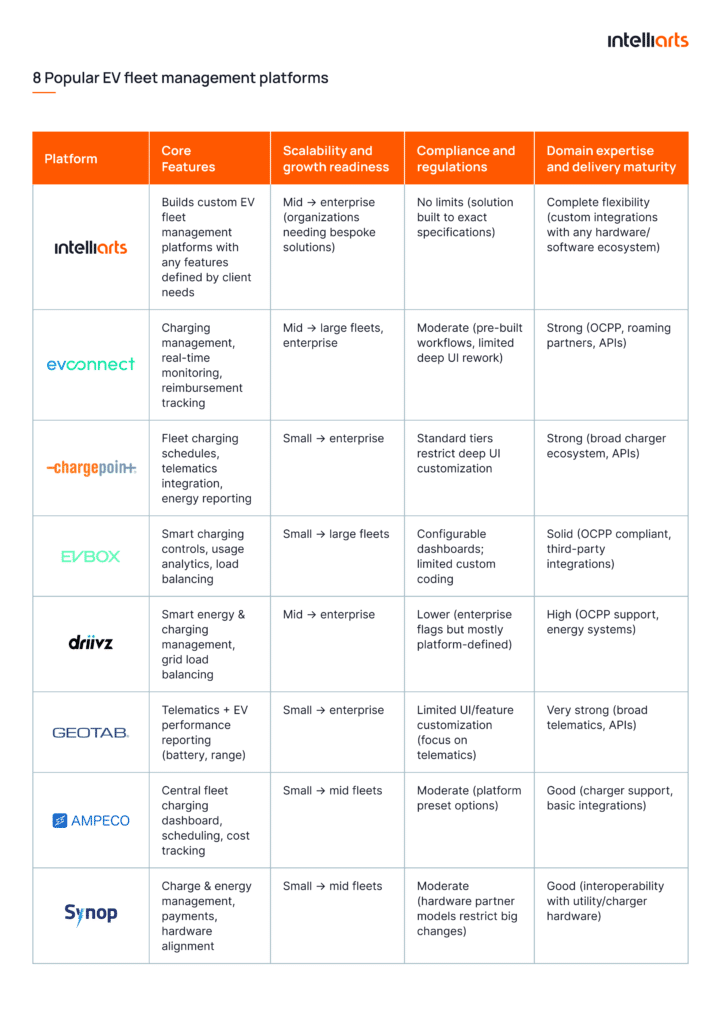
As you can see, there are some lucrative features of off-the-shelf EV fleet management platforms. Probably the best of them, aside from core functionalities, is the implementation speed.
Intelliarts, a software development partner, has taken part in the development of multiple EV fleet software platforms and adjacent products. As such, we provided OpenADR implementation for load management for EV Connect, listed in the table. Don’t hesitate to check the full case at our respective success story page.
The next section will focus on the limitations of using such ready-made software.
What are the limitations of off-the-shelf EV fleet software?
From Intelliarts experience with customers considering off-the-shelf software or switching from one, the main concerns are the following:
- Vendor lock-in. Off-the-shelf EV fleet platforms tie fleets to a single vendor’s ecosystem, APIs, and roadmap. For example, when a fleet adopts new charger hardware, it may discover the software does not support it, forcing continued reliance on the original vendor.
- Limited customization. Prebuilt EV fleet software supports generic workflows and restricts customization. A logistics operator may be unable to configure depot-specific charging rules aligned with shift schedules, resulting in inefficient charging windows and manual operational workarounds.
- Scaling and cost constraints. As fleets grow, off-the-shelf pricing models scale per vehicle or charger. Expanding from hundreds to thousands of EVs can dramatically increase subscription costs while system performance and reporting flexibility remain unchanged.
- Shallow integrations. Many off-the-shelf solutions offer limited integration with ERP, fleet management telematics, or energy systems. As a result, fleet managers often export charging data manually to reconcile costs, usage, and emissions reporting across disconnected platforms.
- Limited control over data and compliance. Data storage, access, and retention policies are controlled by the vendor. For instance, a European fleet may be unable to enforce EU data residency or custom retention rules, creating compliance risks with internal or regulatory requirements.
As you can conclude, the main challenges of using a ready-made fleet and charging management solution boil down to data and compliance issues. They also reveal a basically limited ownership over the product that customers have. For businesses, again, it may be a deal breaker.
Across EV fleet projects in which we participate, we consistently see charging-related factors determining operational stability and even end revenue. Fleet readiness and cost savings are the most impactful aspects here. — Ihor Rudnyk, an eMobility Tech Specialist at Intelliarts
You may be interested in learning additionally about Intelliarts’ emobility solution expertise.
What is a custom EV fleet software solution?
A custom EV fleet software solution is a purpose-built electric vehicle fleet management system designed around a company’s specific technical and regulatory requirements.
Unlike off-the-shelf EV fleet management platforms, a custom software is developed to match existing workflows, EV infrastructure, and data models rather than forcing the business to adapt to predefined features. This feat is both a challenge and an opportunity, depending on the perspective.
From a leadership standpoint, custom EV fleet software addresses a different class of strategic and structural problems:
- Rigid workflows imposed by standard EV fleet management platforms
- Limited ability to unify fleet data with internal business systems
- Inflexible charging logic that does not reflect real operational constraints
- Lack of control over data ownership, security, and compliance
- Scaling limitations when EV infrastructure, fleet size, or regions expand
Explore fleet management technology in greater detail in another blog post by Intelliarts.
Additional capabilities of custom EV fleet software, present on top of regular functionality, include:
- Custom charging management logic
- Route optimization rules adapted to real-world business scenarios
- Battery health monitoring models tuned to specific vehicle types and usage patterns
- Custom analytics and dashboards supporting leadership-level TCO analysis
- Deep integrations with ERP, TMS, energy systems, and other enterprise tools without platform constraints
Custom EV Fleet Software Development Services
Looking for a trusted partner to build or modernize your EV fleet platform? Explore Intelliarts’ EV software development services.
Don’t hesitate to reach out
Platforms vs custom EV fleet software: Side-by-side comparison
Choosing between software for your tech stack is always a business decision and should not be taken lightly. Let’s proceed by comparing off-the-shelf EV platforms with custom solutions across several key parameters:
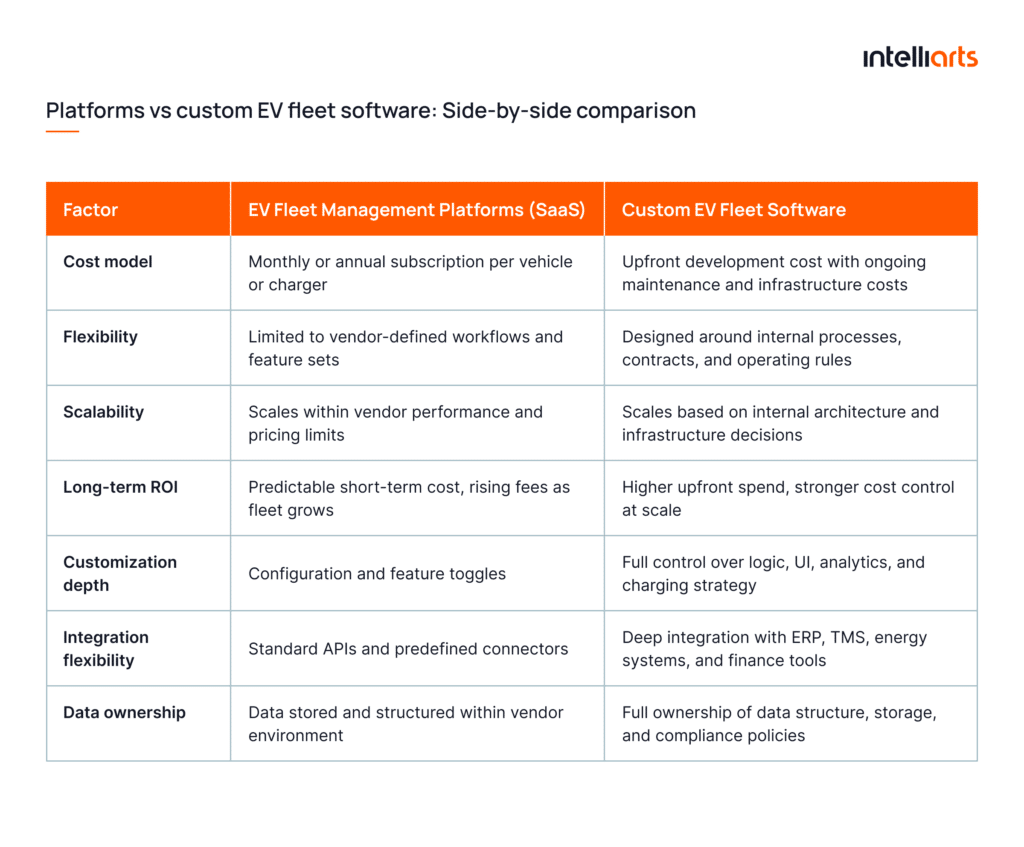
Due to our 25+ years of experience and multiple technical consulting sessions, Intelliarts has formed strategic ideas that help to make value out of this comparison. Here they are:
- The decision is not purely technical. It reflects whether EV fleet operations are treated as a cost center or a strategic capability.
- As EV infrastructure expands, system rigidity can become a hidden operational risk.
- Data ownership and integration depth increasingly influence long-term competitiveness.
- The more complex the fleet ecosystem, the stronger the case for custom architecture.
- Long-term efficiency gains often outweigh short-term implementation savings.
Quick tip: Off-the-shelf solutions may be viewed as some sort of a stater kit. A good, fast decision for an MVP project or just starting a business. Then, later on, as a company expands, it may opt for a custom solution. For example, Intelliarts can build any custom instrument on top of a ready-made platform you might have in place, or smoothly transition you to a customized software built from scratch.
When does a custom EV fleet solution make more sense?
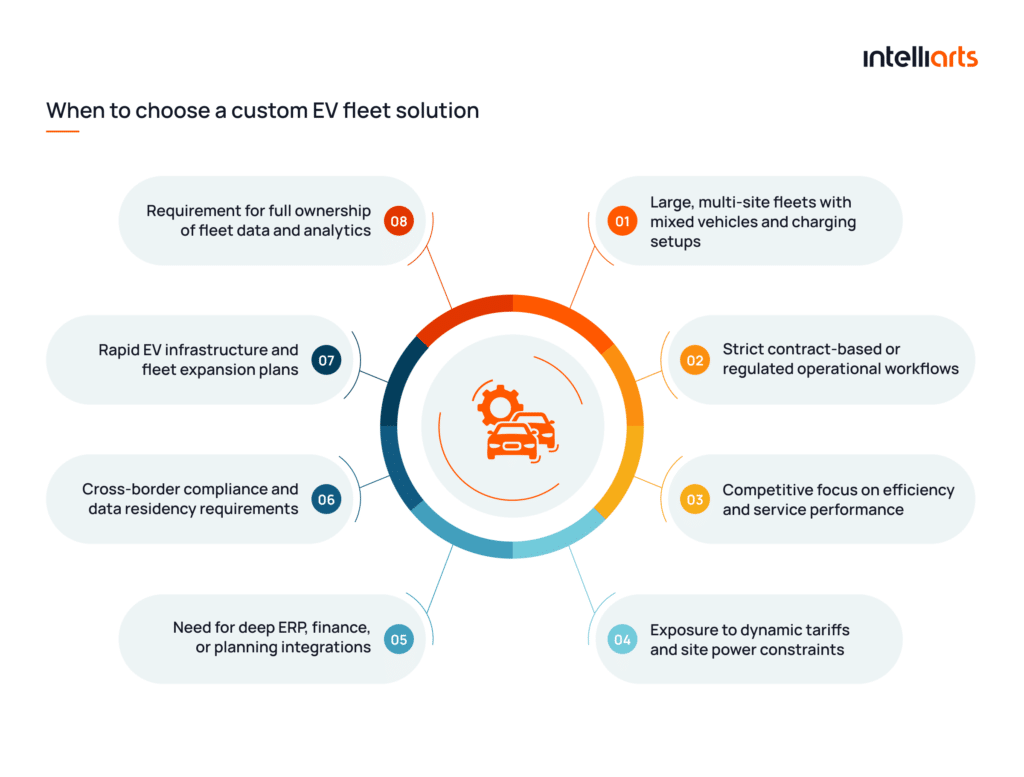
Now that we have reached the end of the off-the-shelf vs custom electric vehicle fleet management system comparison, let’s review some use cases. As EV operations expand, standard platforms may no longer support operational depth or integration needs. The following list shows when the business situation require custom solution instead of opting for a ready-made one:
- Large or complex fleets. Multi-site fleets with diverse vehicle types and charging models often outgrow standard EV fleet management platforms. Custom systems support scale, performance stability, and structured reporting across regions.
- Unique operational workflows. Fleets with contract-based schedules, regulated routes, or internal process rules need system logic that reflects how they operate. Custom EV fleet software aligns charging and dispatch with real workflows.
- Need for competitive differentiation. When fleet efficiency impacts margins or service levels, tailored route optimization and charging prioritization create a measurable advantage beyond generic EV fleet software features.
- Advanced energy optimization requirements. Dynamic tariffs, site power limits, and renewable energy contracts require precise load management. Custom charging management logic supports energy cost control and smarter allocation.
- Deep enterprise integrations. If fleet telematics must connect directly with ERP, finance, or planning systems, custom architecture ensures clean data exchange and unified reporting.
- Multi-country compliance and data control. Cross-border operations require control over data storage, tax logic, and regulatory compliance. Custom systems provide flexibility beyond vendor infrastructure constraints.
- Long-term infrastructure expansion plans. As EV infrastructure grows, subscription costs and vendor limits can scale quickly. Custom EV fleet software supports expansion without structural restrictions.
- Strategic ownership of fleet data. Fleet data drives forecasting and TCO analysis. A custom electric vehicle fleet management system allows full ownership of analytics models and performance metrics.
In a nutshell, custom solutions make sense when fleet operations are strategic to business performance and require control, scalability, and long-term flexibility.
Does your business’s situation fit any of the scenarios provided above? If so, don’t hesitate to contact Intellairts for a free strategy session.
Case study by Intelliarts: Creating a next-gen EV management software
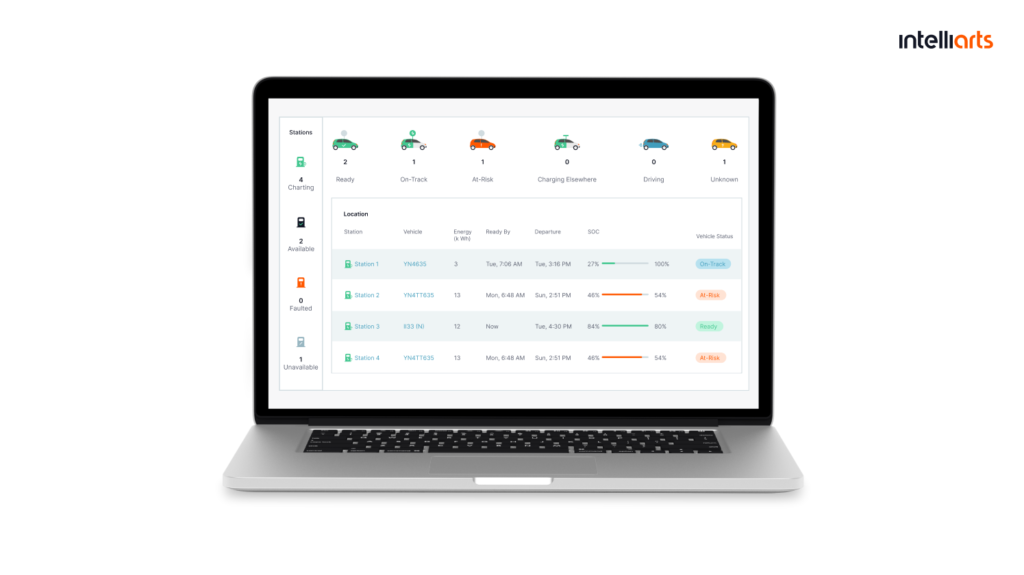
A great example of custom EV fleet management solutions in practice is the Intelliarts’ success story.
Background: The client, an established EV charging platform provider, aimed to expand into fleet operations by launching its own EV fleet software. The goal was to enter the fleet management market with a solution that supports at-home charging while improving energy optimization for commercial electric vehicle fleets.
Solution: Intelliarts developed a custom electric vehicle fleet management system integrated with telematics, energy management, and charging infrastructure. The platform enabled real-time EV status tracking, predictive charging prioritization, load balancing, and at-home charging reimbursement.
Results: The solution improved operational efficiency through intelligent charging management and real-time analytics. Fleet operators gained better visibility into energy consumption, vehicle readiness, and infrastructure utilization. This strengthened the partner’s market position and expanded its offering within the EV fleet management market.
How to choose the right EV fleet software for your business
There has been a tendency for years. It shows that long-term competitiveness in electric mobility increasingly depends on data architecture decisions in EV products you primarily use. — Alexander Barinov, a Managing Partner at Intelliarts.
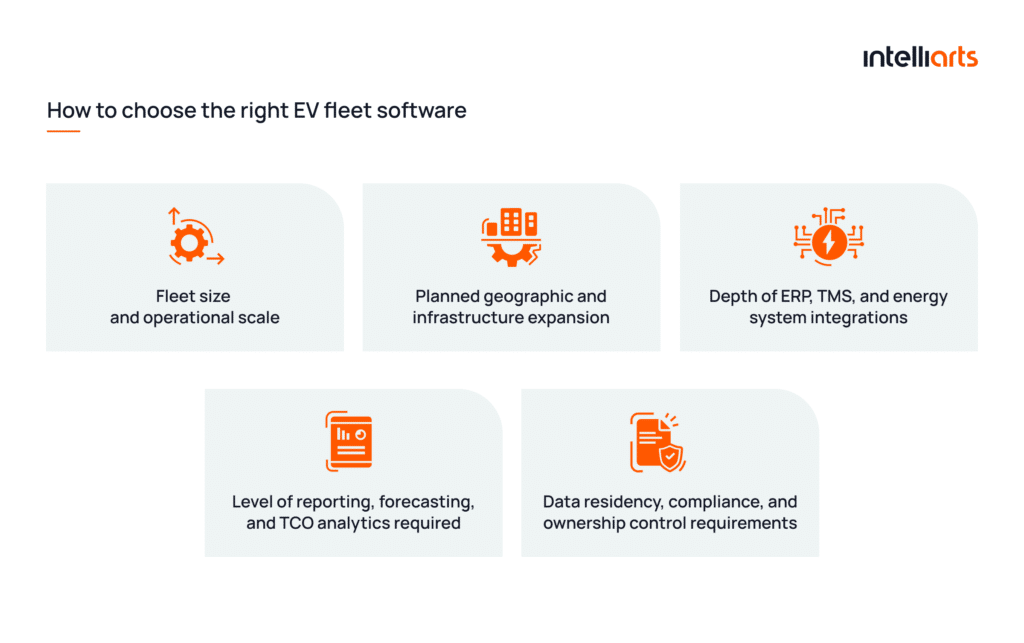
With all the insights on off-the-shelf and custom EV fleet software, you know what type of solution is needed. Now, you are likely choosing a particular product or a provider. The framework below covers several critical concerns that, based on Intelliarts experience, customers have before signing a deal:
Decision checklist:
- Fleet size. Platforms built for small fleets may struggle with performance when managing hundreds or thousands of vehicles across multiple depots. System latency, reporting delays, and pricing per asset can become operational bottlenecks at enterprise scale.
- Growth plans. If expansion includes new regions or additional EV infrastructure, verify whether the system supports multi-site management and regional configurations. Some EV fleet management platforms increase fees significantly with each added charger or vehicle.
- Integration requirements. Basic API access may not support structured data exchange with ERP, TMS, or energy billing systems. Poor integration leads to manual reconciliation and inconsistent reporting.
- Reporting and analytics depth. Standard dashboards may not support custom TCO analysis or predictive maintenance modeling. Limited analytics restrict leadership visibility into cost and performance trends.
- Data ownership and compliance. Fleet data may be stored in vendor-managed cloud environments located in specific countries. This affects data residency compliance, cybersecurity exposure, and access control. Limited data export options can also reduce long-term flexibility and vendor independence.
Hopefully, you now understand what type of solution, ready-made or custom, suits your business needs best. You should also know exactly what to look out for when comparing service or product offerings on the market.
Final take
Choosing between ready-made EV fleet management platforms and custom EV fleet software depends on scale, integration depth, and long-term strategy. SaaS solutions provide speed and simplicity, while custom systems offer control, flexibility, and stronger alignment with complex operations.
Here at Intelliarts, with more than 25 years of experience and 90% customer return rate, we can offer industry-leading expertise in EV fleet software. Our senior experts can both consult on the nuances of choosing ready-made platforms or a custom solution, as well as integrate one. Additionally, we can offer end-to-end development of your custom EV fleet platform from scratch.
FAQ
Is custom EV fleet software more expensive than SaaS platforms?
Not always. Custom EV fleet software may require a higher upfront investment, but it is tailored to your EV infrastructure, fleet telematics, and charging management needs. Over time, it can lower the total cost of ownership through optimized operations and reduced licensing fees compared to SaaS options.
Can EV fleet platforms scale to enterprise fleets?
Yes. Modern EV fleet management platforms are designed to scale from small fleets to enterprise-level operations. They support route optimization, battery health monitoring, and integration with existing systems, which makes them suitable for large electric vehicle fleet management systems.EV fleet management platformsEV fleet management platforms.
How long does it take to build custom EV fleet software?
Development time depends on scope and complexity. A basic custom EV fleet software solution can take up to 6 months, while more advanced systems with charging management and analytics may take longer. Clear requirements and phased delivery help reduce time to value.