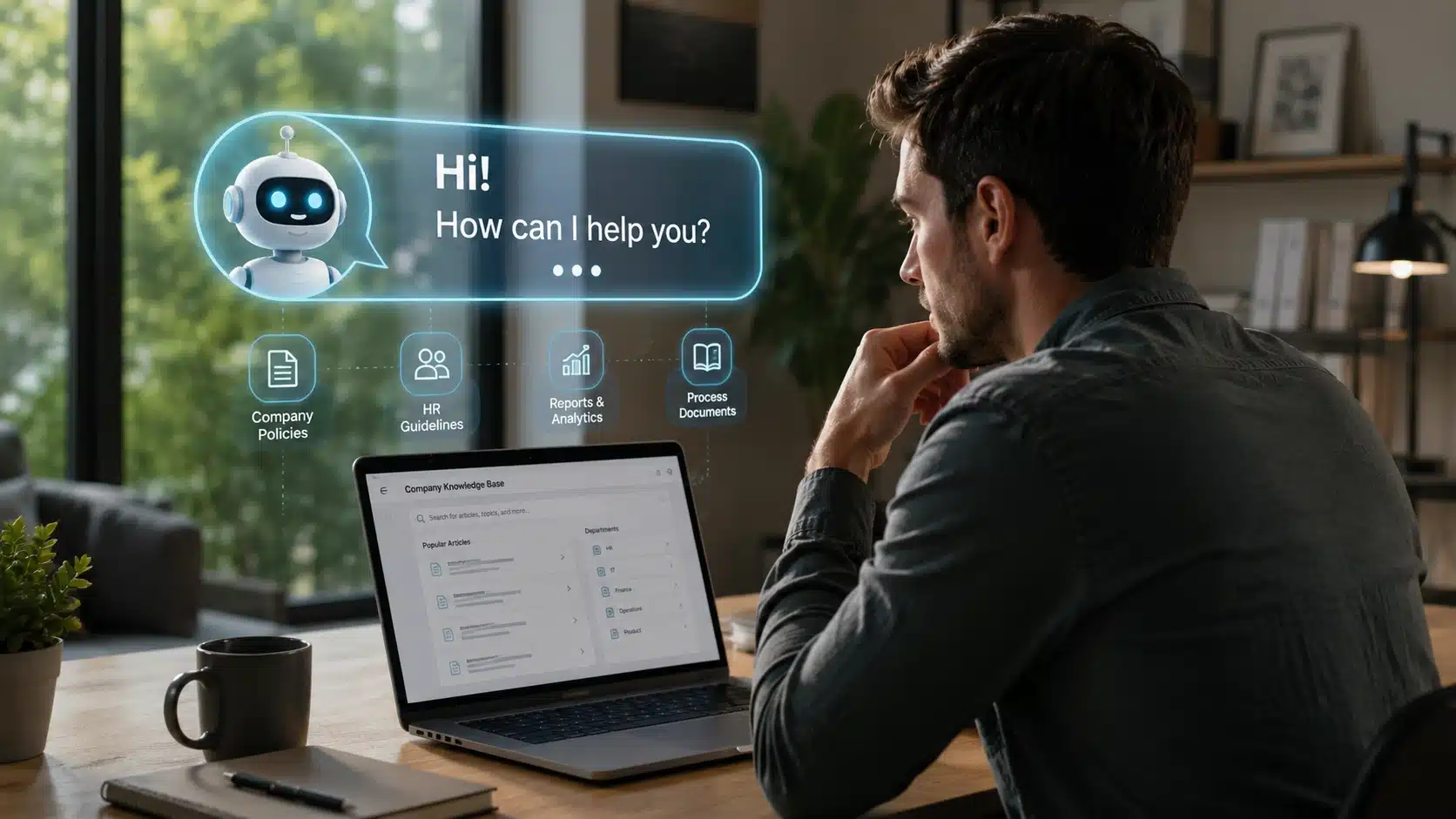

As enterprises scale up generative AI, building sustainable, governed systems is becoming a priority. According to Gartner’s 2025 Hype Cycle for Artificial Intelligence research, AI-ready data architectures are among the top strategic innovations. In this context, Retrieval-Augmented Generation (RAG) is gaining traction as an architecture that connects large language models to structured enterprise data.
In this post, you’ll learn more about the RAG development concept and why businesses need it to boost their generic AI models. Besides, you’ll review the top 10 RAG development companies and find out how to choose among them based on strict criteria. You will also observe a checklist and step-by-step instructions on starting a partnership with a provider of your choosing.
Looking for a Trusted RAG Development Partner?
From consulting to cost optimization - build scalable, production-ready RAG solutions.
Explore RAG Services
What is custom RAG development and why does it matter?
Let’s get started by defining the main concept:
Unlike generic AI integrations, custom RAG development connects large language models (LLMs) with proprietary knowledge bases using structured retrieval pipelines. This approach enables enterprise AI systems to generate responses grounded in verified internal data rather than relying solely on pretrained model knowledge.
This challenge was exactly the case in one of the Intelliarts’ success stories, where we created a data extraction chatbot using RAG and ChatGPT paired together.
And before delving any deeper into the topic, you need to recall what the RAG system, as a complete software solution, is built from.
Core components of a RAG system typically include:
- LLMs (e.g., OpenAI models)
- Embedding models
- Vector databases
- Retriever layer
- Re-ranking models
- Orchestration frameworks (e.g., LangChain, LlamaIndex)
- Data ingestion pipelines
- Chunking and indexing mechanisms
- Access control and security layer
- Monitoring and evaluation modules
- AI agents (optional)
Take a look at how a RAG-enabled LLM works on a user prompt with a vector database in the infographics below:
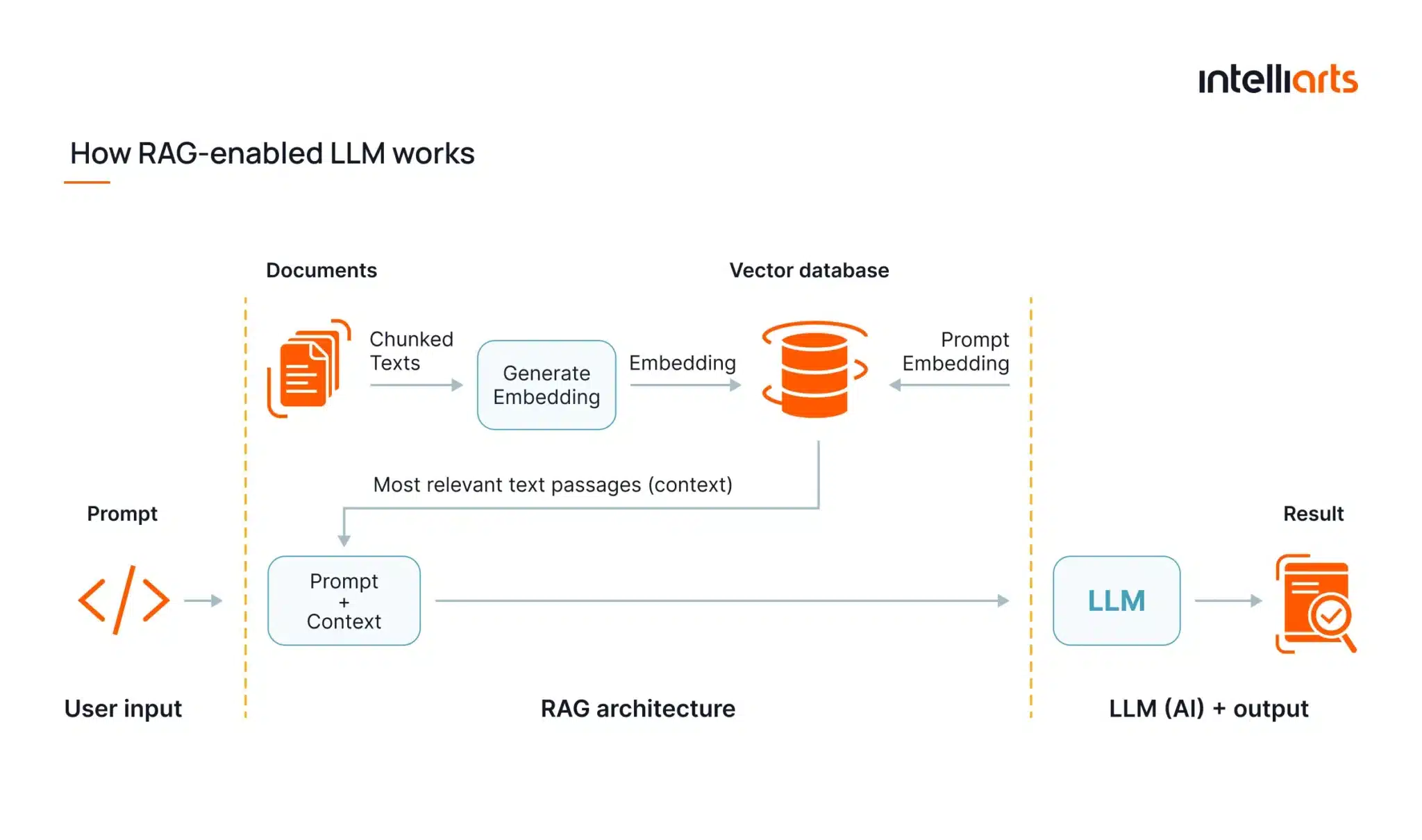
Software development companies like Intelliarts primarily focus on the design of the GenAI architecture, i.e., selection and orchestration of components in a particular way. The purpose is to align the end RAG system with business goals, scalability, and governance requirements.
You may explore in great detail what RAG models are and how to implement them in business in the corresponding blog post by Intelliarts.
When do businesses need a custom RAG solution?
The RAG system connects LLMs to curated internal and external knowledge sources. This way, it directly makes responses grounded in verified information rather than the model’s generic database alone.
Therefore, retrieval augmented generation development handles limitations of standalone LLMs, which typically include the following:
- Hallucinations in LLM outputs. Models generate inaccurate or unverifiable answers, RAG grounds responses in trusted data sources.
- Need to leverage private or regulated data. Internal documents, policies, or sensitive datasets must be used securely and compliantly.
- Lack of answer traceability and data integrity. Industries require source attribution, auditability, and controlled knowledge retrieval.
- Fragmented knowledge across systems. Data is scattered across CRMs, ERPs, cloud storage, and internal tools.
- Performance and scalability limits. AI prototypes must evolve into production-grade, enterprise AI systems.
- Complex, domain-specific queries. Use cases demand contextual accuracy beyond generic public model knowledge.
At the basic scale, a generic language model can help extract some info or brainstorm ideas. A RAG-based system is what actually supports real decisions in business because it’s grounded in this business’s very own data.
— Alexander Barinov, a Managing Partner at Intelliarts.
So, the short answer is:
Businesses need a custom RAG solution every time their AI model has to work with additional data sources other than those that comprise its regular database. Otherwise, the result would be insufficient for any real-world business applications.
This reason is exactly why companies require RAG experts and their custom development assistance. And now, we have come to the challenge of selecting the top RAG solution providers available in the industry.
You may be additionally interested in reviewing RAG system implementation best practices in another blog post by Intelliarts.
How we evaluated the top RAG development companies
Intelliarts, as a trusted software development company with expertise in RAG, has its own set of evaluation criteria. These are formed mainly through strategy sessions with our customers, who express their concerns and preferences in choosing.
Evaluation criteria list:
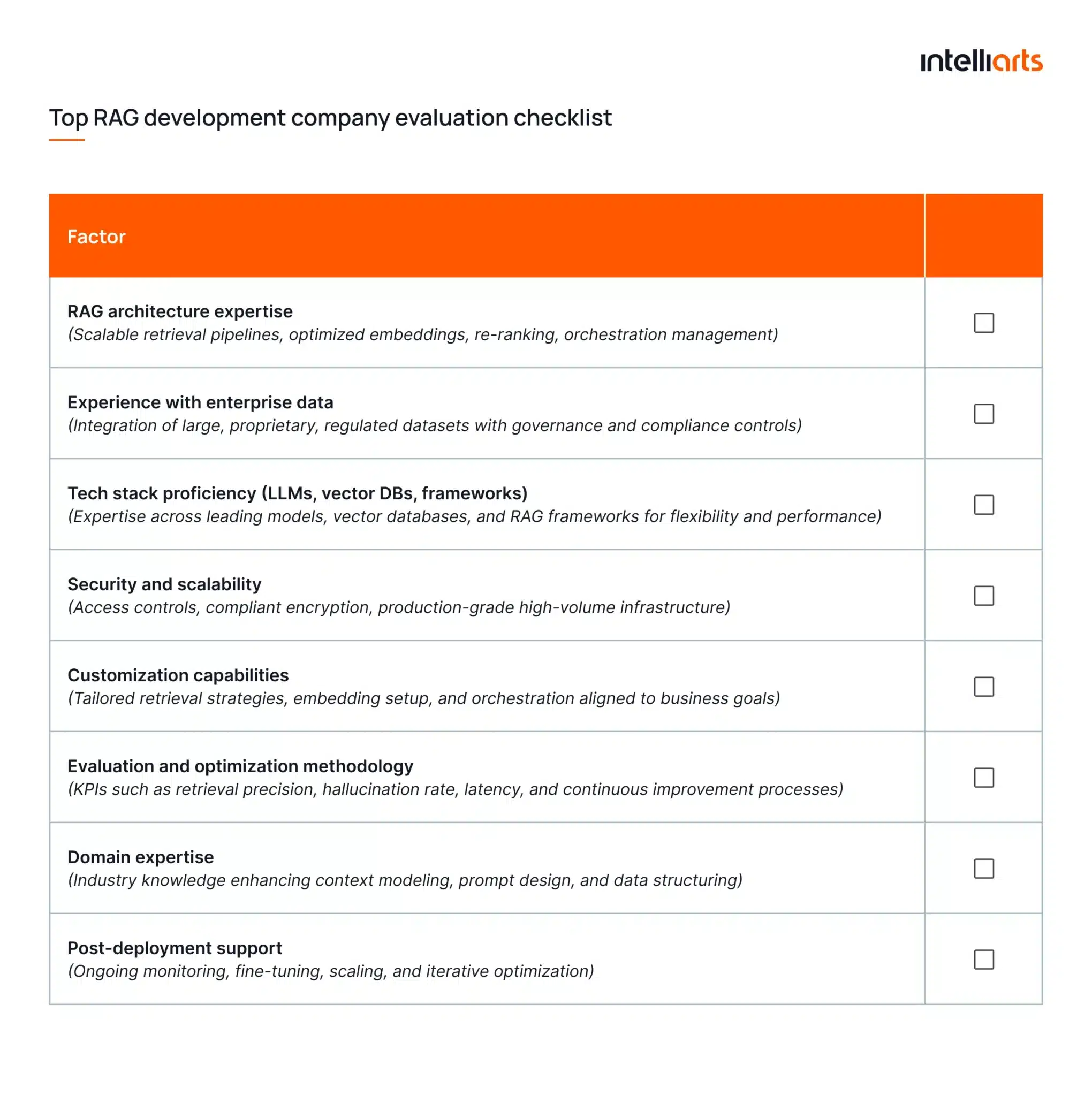
- RAG architecture expertise. Demonstrated ability to design scalable retrieval pipelines, optimize embeddings, implement re-ranking, and manage orchestration.
- Experience with enterprise data. Hands-on experience integrating large, proprietary, and regulated datasets while maintaining governance, compliance, and data integrity.
- Tech stack proficiency (LLMs, vector DBs, frameworks). Deep expertise across leading LLMs, vector databases, and RAG frameworks to ensure flexibility, vendor neutrality, and performance optimization. Since the underlying language model significantly impacts performance, it’s important to evaluate options such as Claude and ChatGPT before selecting a RAG technology stack.
- Security and scalability. Ability to implement access controls, compliant encryption standards, and infrastructure capable of supporting high-volume, production-grade workloads.
- Customization capabilities. Ability to tailor retrieval strategies, embedding configuration, and orchestration logic to specific business objectives and workflows.
- Evaluation and optimization methodology. Use of measurable KPIs such as retrieval precision, hallucination rates, latency benchmarks, and continuous improvement processes.
- Domain expertise. Industry-specific understanding that enhances context modeling, prompt engineering, and data structuring.
- Post-deployment support. Commitment to ongoing monitoring, fine-tuning, scaling, and iterative system improvement.
If you are currently communicating with a number of RAG companies and trying to run a quick assessment of each, you need some sort of checklist. Just print the image below and fill it in manually for every company. Alternatively, use it as a basis for any evaluation framework you might already have in place.
Top 10 custom RAG development companies globally
Here’s a list of top RAG service providers operating at an international scale and meeting high standards based on the checklist above.
#1. Intelliarts
Intelliarts is a technology consulting and software engineering company founded in 1999. The company specializes in data engineering, machine learning, and custom RAG development services for enterprises. It combines 25 years of engineering experience with more than five years of focused AI and LLM practice.
Intelliarts team includes Amazon Web Services (AWS)-certified engineers and 40 percent senior-level specialists, with innovation supported by PhD talent. Intelliarts reports that 90 percent of clients return with new projects. Typical PoC and Minimum Viable Product (MVP) delivery takes 6 to 8 weeks. The company works with complex enterprise data and builds scalable, secure RAG architectures aligned with compliance requirements.
Core RAG offerings:
- End-to-end RAG architecture design and implementation
- Enterprise data ingestion, normalization, and chunking
- Embedding model selection and optimization
- Vector database setup and search tuning
- Retrieval and re-ranking strategies
- Prompt orchestration and context injection
- LLM integration for grounded response generation
- Evaluation frameworks for accuracy and hallucination monitoring
- Observability and performance tracking
- Secure deployment with governance and access control
Typical use cases: Enterprise knowledge assistant, customer/support agent with grounded answers, research and analytics copilots, compliance and regulatory advisory assistant, technical documentation navigator. RAG systems can also enhance analytics workflows by providing contextual access to historical datasets, including time series data used for forecasting and trend analysis.
Learn more about Intelliarts’ RAG development services
#2. CaliberFocus
CaliberFocus is recognized for delivering tailored RAG services that build explainable AI systems for enterprises. Their work includes integration of business data with LLMs and design of RAG pipelines that handle domain-specific information retrieval and generation.
Core RAG offerings:
- RAG pipeline design
- Data context integration with LLMs
- Explainable and auditable response generation
- Domain-specific retrieval strategies
Typical use cases: Knowledge search and Q&A, document intelligence workflows, compliance-aware assistants, enterprise search augmentation, and domain-specific decision support.
#3. Vstorm
Vstorm appears in market listings of RAG development firms and is noted for experience in the delivery of contextual AI systems and retrieval-augmented solutions. Their portfolio emphasizes AI agent work and contextual retrieval integrations.
Core RAG offerings:
- Custom RAG solution delivery
- Contextual AI and agentic system design
- Retrieval-grounded conversational interfaces
Typical use cases: AI assistants with knowledge access, contextual search systems, automated support responders, document-centric query workflows, workflow automation with grounding.
#4. SoluLab
SoluLab is frequently listed among providers that build RAG-based systems integrating enterprise data with LLMs. Their services include custom retrieval augmented generation solutions tailored to business data sources.
Core RAG offerings:
- RAG system implementation
- Integration with enterprise knowledge repositories
- Custom retrieval logic and LLM augmentation
Typical use cases: Enterprise Q&A systems, data-grounded assistants, knowledge discovery dashboards, contextual content generation, search-enhanced applications.
#5. DataRoot Labs
DataRoot Labs offers RAG-focused AI development services designed to strengthen generative systems with accurate, context-aware retrieval. Their services center on aligning LLM outputs with structured and unstructured enterprise data to produce accurate, relevant responses tailored to client workflows.
Core RAG offerings:
- RAG pipeline development
- Semantic search and knowledge retrieval systems
- Integration with enterprise data sources (CRM, databases)
- Retrieval optimization (ranking, filtering, hybrid search)
Typical use cases: Context-aware chatbots, internal knowledge assistants, document intelligence platforms, AI-powered search, and automated reporting.
#6. Sphere Partners
Sphere Partners delivers custom retrieval augmented generation solutions that ground AI outputs in an organization’s internal documents and systems. They emphasize compliance, secure access control, and production-ready RAG deployments.
Core RAG offerings:
- RAG discovery and assessment
- Data auditing and ingestion
- Retrieval architecture blueprinting
- Secure RAG deployment
Typical use cases: Internal knowledge base assistants, product and operations Q&A, compliance support agents, leadership insight portals, and regulated knowledge retrieval.
#7. Rishabh Software
Rishabh Software offers tailored agentic RAG development services that connect proprietary enterprise data with LLMs to enhance knowledge access, decision-making, and content delivery.
Core RAG offerings:
- Custom retrieval augmented generation workflows
- Context-aware applications development
- Integration of structured and unstructured data
Typical use cases: Decision support applications, knowledge retrieval agents, automated answer generation, business insights tools, data-rich assistants.
#8. ITRex Group
ITRex Group provides RAG-as-a-Service offerings that integrate retrieval pipelines with prompt optimization and LLM integration into enterprise systems. Their work includes building end-to-end RAG solutions tied into existing data ecosystems.
Core RAG offerings:
- Custom retrieval pipeline implementation
- Prompt augmentation and optimization
- Seamless LLM integration
Typical use cases: Grounded conversational AI, enterprise search enhancement, contextual automation workflows, intelligent document query systems, and data-driven assistant tools.
#9. TechAhead
TechAhead offers RAG application development services that ground generative AI models in proprietary enterprise data for secure and scalable deployments. Their approach includes connecting company data sources with context-aware generation.
Core RAG offerings:
- Enterprise-grade RAG service delivery
- Data integration for retrieval workflows
- Secure and scalable implementations
Typical use cases: Secure RAG assistants, enterprise knowledge retrieval, contextual AI for customer service, internal support bots, document-driven applications.
#10. Clover Dynamics
Clover Dynamics offers advanced RAG development services that combine large language models with dynamic information retrieval workflows. Their offerings include building custom RAG pipelines aligned with operational goals in industries like healthcare, law, and finance.
Core RAG offerings:
- RAG pipeline development
- Integration with structured and unstructured data
- Enterprise-oriented retrieval systems
Typical use cases: Sector-specific knowledge systems, healthcare information support, legal data assistants, financial document processing, operational decision support.
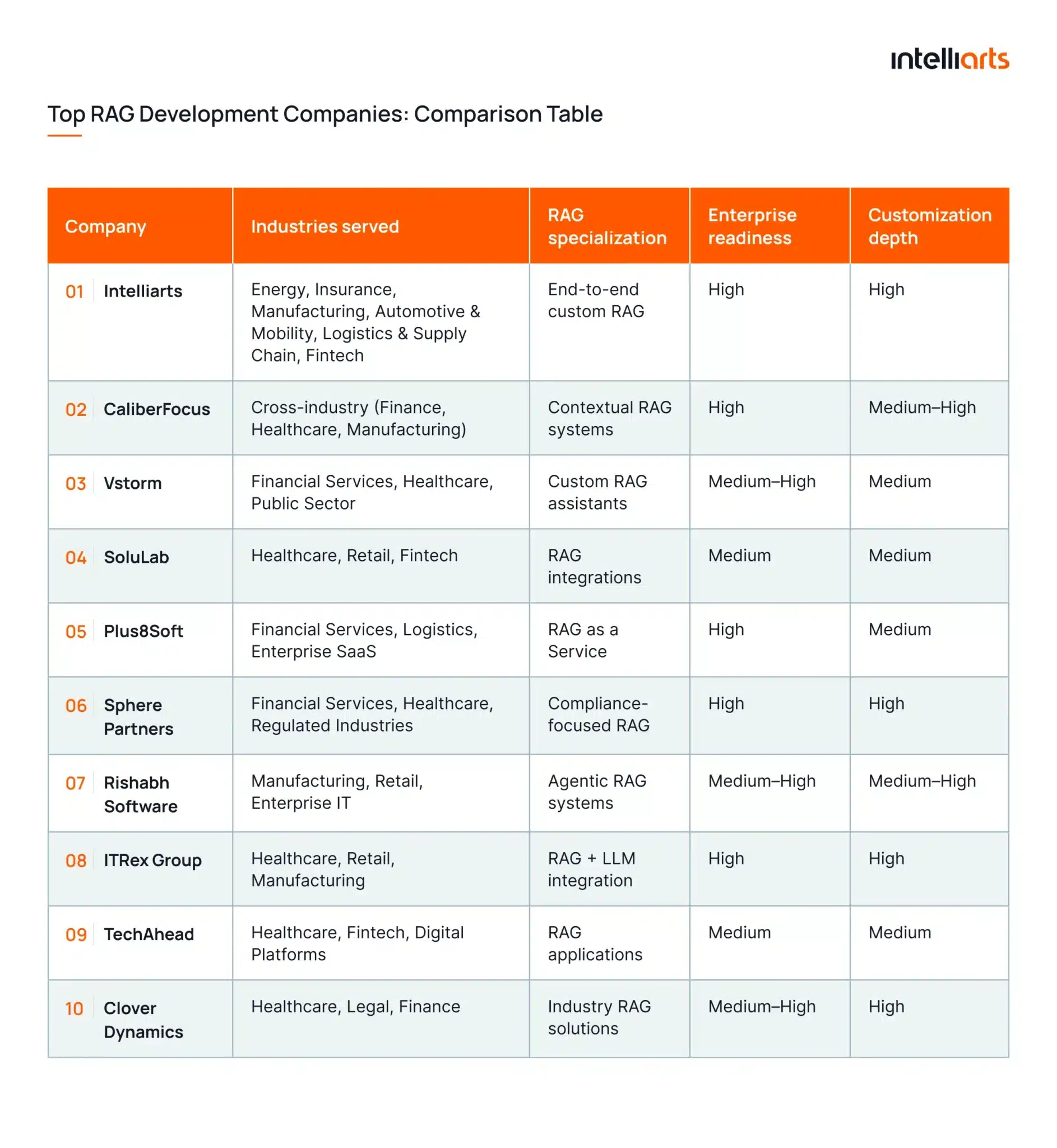
Comparison table: Top RAG development companies
Find the visualized comparison of the top providers of RAG service providers in the table below:
Should you need RAG development assistance from an experienced team, don’t hesitate to contact Intelliarts.
Custom RAG vs generic AI integrators
Still not sure if a RAG-driven, custom solution is superior to a generic, integrated AI model like ChatGPT or Claude AI? See the comparison in the table below:
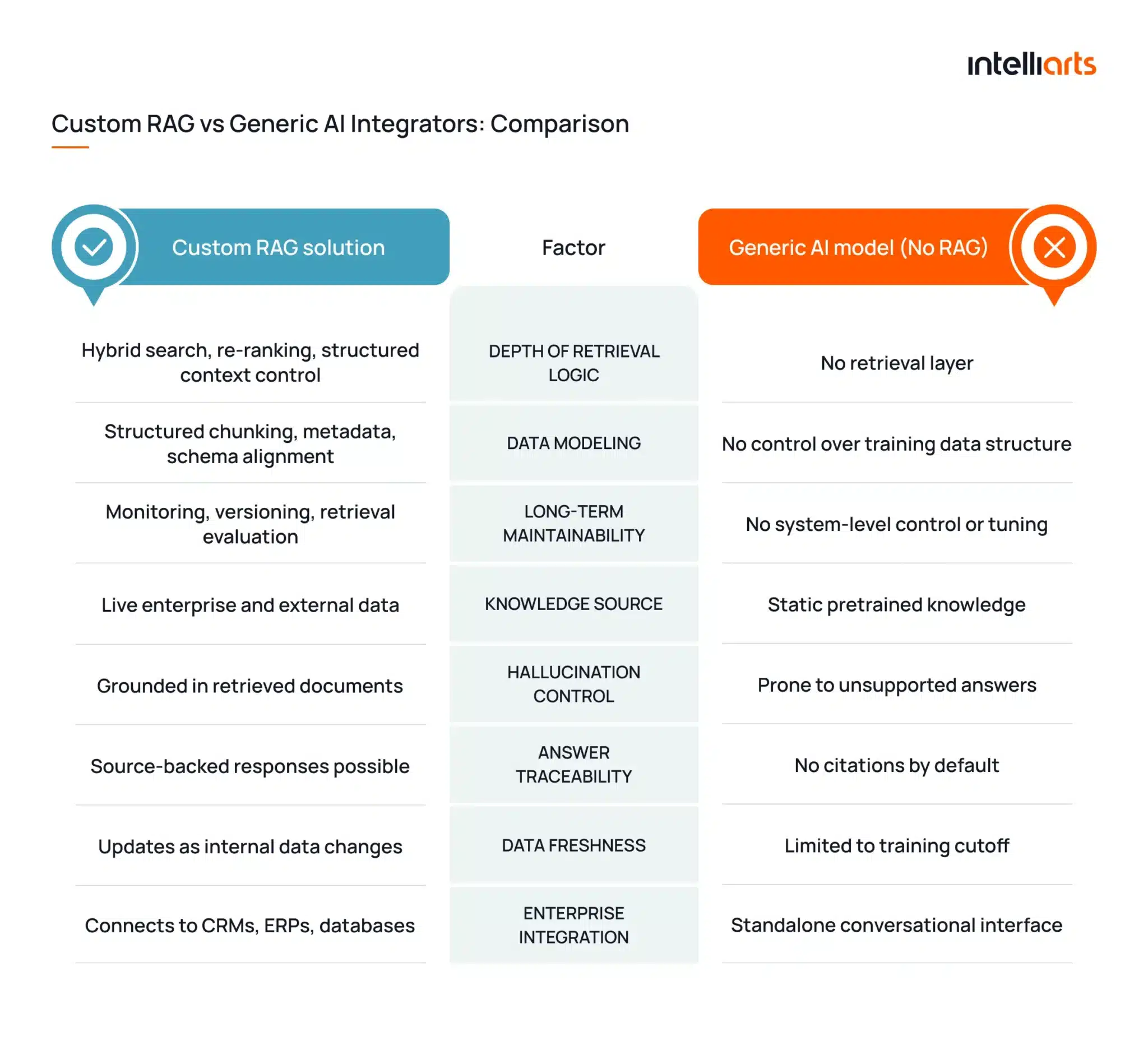
Basically, there’s no need to consider which one is a better choice. A RAG-powered solution is always superior to any generic AI, as RAG is a direct enhancement on top of any AI model you might consider integrating and using.
We typically see that teams operating AI require tracing back to a source, especially in regulated environments. Otherwise, the risk of using AI for them is simply too high.
— Volodymyr Mudryi, a data scientist and ML expert at Intelliarts.
How to choose the right RAG development partner
As of now, you have a list of top RAG development companies, a checklist on how to evaluate them, and a table with their direct comparison. Here are your next steps towards selecting a partner:
- Shortlist candidates with proven RAG delivery. Check for RAG-focused service pages, public technical materials, and credible case evidence. Skip vendors who only mention RAG as a buzzword within generic AI services.
- Run a structured discovery call. Use one agenda: data sources, access constraints, integrations, compliance, target users, and success metrics. A strong partner asks clarifying questions and proposes an approach based on constraints, not tools.
- Request a written PoC plan. Ask for a 1–2 page plan that includes scope boundaries, deliverables, timeline, assumptions, risks, and KPIs. If they cannot define PoC inputs and outputs, the delivery risk is high.
- Validate the proposed team. Confirm roles and seniority. You should see a solution architect, a data engineer, and an ML or RAG engineer assigned. Ask who owns retrieval design, evaluation, and deployment.
- Check delivery governance. Agree on milestones, review cadence, acceptance criteria, and how changes are handled. RAG work requires iterative validation.
- Confirm handover and post-launch support. Define what you get at the end: documentation, runbooks, monitoring, and knowledge transfer. Clarify whether ongoing optimization is included and what the support model looks like.
Results of the process: You select a RAG development partner with verified architectural competence, delivery discipline, and long-term support readiness. This is formalized through a clearly scoped PoC plan, defined KPIs, a documented architecture outline, an agreed team composition, a timeline, and post-launch support terms embedded in the contract.
Looking for custom AI solutions that are powered by RAG? Discuss your business needs with Intelliarts experts.
Final take
Custom RAG development is needed to help convert general-purpose language models into enterprise-grade systems. This modification directly reduces hallucinations and supports compliance in regulated environments. However, the long-term value of RAG depends less on the tools chosen and more on architectural rigor, data modeling discipline, and delivery maturity. Selecting the right development partner is how you maximize the chances of making it a significant AI investment for your business rather than a short-term experiment.
At Intelliarts, we have curated expertise in RAG, whether it’s development and integration from the ground up or modifying an AI system already in place. With more than 25 years in the market delivering AI and ML software services, over 80 large-scale projects under our belt, and a 90% customer return rate, we present the top choice in the niche. Our experts are ready, willing, and able to contribute to your next RAG project.
FAQ
How long does it take to build a custom RAG system?
The timeline depends on data complexity and integration requirements. A basic RAG system MVP takes 4-8 weeks. At the same time, enterprise-grade solutions with custom pipelines, security layers, and multi-source retrieval can take more than 6 months. Most solutions fall between 4 weeks and 6 months, depending on scope and complexity. Proper scoping, data preparation, development, and iterative testing are the biggest time factors.
What tech stack is best for RAG solutions?
The most proven stack includes LangChain or LlamaIndex for orchestration, OpenAI or open-source LLMs like Llama for generation, and vector databases such as Pinecone, Weaviate, or Chroma for retrieval. The right stack depends on your scalability needs, existing infrastructure, and whether you require on-premise or cloud deployment.
Is RAG suitable for regulated industries?
Yes. RAG is particularly well-suited for regulated industries like healthcare, finance, and legal because it grounds AI outputs in verified, proprietary data rather than relying solely on model training. This improves explainability and auditability, both critical requirements for compliance with standards like HIPAA, GDPR, and SOC 2.




![Top MLOps Tools in 2026 and Their ROI [Based on Real Projects]](https://intelliarts.com/wp-content/uploads/2026/08/ChatGPT-Image-23-июн.-2026-г.-11_16_54-1.webp)