
Recently, IEA calculated that the global number of public EV charging points exceeded 5 million, with more than 1.3 million chargers added in a single year. Since EV infrastructure worldwide is expanding, and more businesses are entering the niche, it’s useful to know relevant software practices. After all, virtually every company in the EV industry uses applications to obtain data and improve its services.
In this guide, you’ll explore types of EV software design paradigms and find which one is the most suitable for your projects. Besides, you’ll explore core layers of electric vehicle solutions, protocols and standards, common mistakes, and learn how software is designed for scalability from day one.
What is EV charging software architecture and why does it matter?
EV charging software architecture is the structural design of how charging stations, backend services, and applications connect and exchange data within an EV charging network.
Typically, software architecture options include monolithic, modular, and hybrid approaches.
- In a monolithic architecture, all system functions run as a single application where components are tightly coupled.
- A modular architecture organizes the platform into separate functional modules that remain logically independent but may still run within the same system. It’s similar to a microservices alternative, where architecture components are independent, but usually belong to different external systems.
- A hybrid architecture combines both approaches, keeping some tightly integrated components while separating others into independent modules or microservices.
Important note: Monolith architecture is typically used for cybersecurity, banking, government, and similar apps. EV charging software usually has either modular or hybrid paradigms, so this blog post elaborates on patterns and specifics with only these two architectures in mind.
Here’s a list of core capabilities that most off-the-shelf and custom EV charging software have:
- Device management to connect chargers to the platform and manage configuration, firmware, and diagnostics.
- Session control to start and stop charging sessions and record energy usage.
- Billing and payments to calculate tariffs and process transactions.
- User authentication to authorize drivers through apps, Radio Frequency Identification (RFID) cards, or accounts.
- Load balancing to distribute power across chargers and prevent grid overload.
- Smart charging to adjust charging behavior based on grid signals or pricing.
- Monitoring and alerts to track charger status and detect faults.
- Analytics and reporting to analyze usage, utilization, and revenue.
- API integration to connect the platform with mobility, energy, and business systems.
You might be asking yourself: “How will architecture impact the uptime and user experience of my future app?” and: “How are core capabilities related to architecture usability?”
From the business standpoint, the EV charging platform architecture basically determines how reliably the platform handles session data and system failures. Architecture also affects how quickly the system reacts to charger events. Therefore:
When one component or feature fails, proper EV charging software architecture enables the rest of the platform to continue operating, which prevents network-wide outages.
Leading the industry requires trusted dev partners
Find out how the Intelliarts team handles EV projects of any complexity for our customers.
Explore industry expertise
The following blog post sections will show you why you should and how exactly you can achieve this desirable outcome.
What core layers should a modern EV charging platform include?
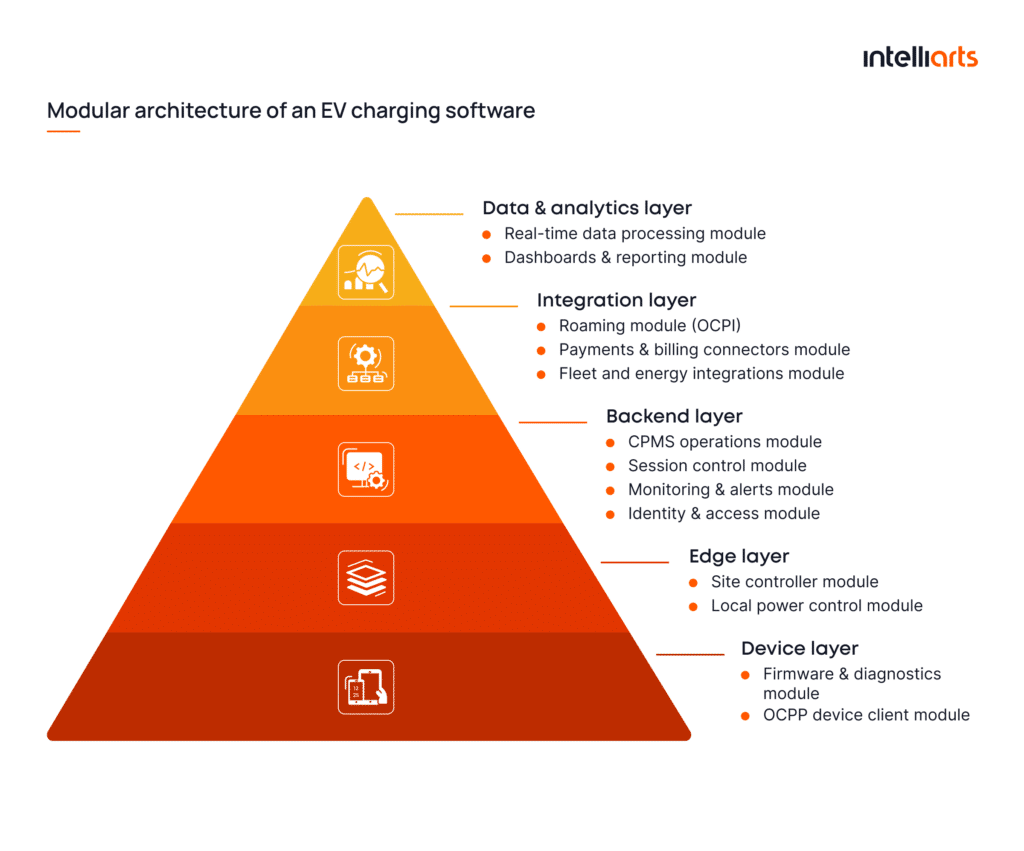
Let’s proceed by taking a good look at an EV fleet managed charging software structure, layer by layer and module by module. That will help to see where the backend and the capabilities listed above are contained. It will also indicate what other critical components the modular or hybrid architecture is composed of:
#1 Device layer
This layer includes software that runs on charging stations or interacts directly with charger hardware. It handles firmware control, diagnostics, and charger communication with the backend through protocols such as OCPP, enabling reliable device connectivity within an EV charging platform architecture.
Separating this layer allows the platform to support different charger models while keeping a consistent device interface for the rest of the EV charging software system.
Firmware & diagnostics module
- Firmware lifecycle management
- Secure firmware updates
- Charger diagnostics and fault codes
- Local logs and health checks
- Meter interface and energy measurements
OCPP device client module
- OCPP message creation and parsing
- Charger state management
- Connection keep-alive and heartbeats
- Local retry and reconnect logic
#2 Edge layer
This layer operates at the charging site level and manages groups of chargers locally. It relies on edge computing to maintain stable charging operations when connectivity to the backend is unstable and to execute fast on-site decisions.
Edge components reduce backend dependency by enforcing local policies and buffering communication with the central EV charging management software.
Site controller module
- Local authorization cache
- Offline mode operation
- Message buffering
- Store-and-forward queues
- Ordered message replay
Local power control module
- Local load balancing rules
- Site power limit enforcement
- Charger power allocation
- Fallback smart charging schedules
#3 Backend layer
This layer forms the operational core of EV charging software. It manages chargers, charging sessions, and operational workflows through services such as a charge point management system (CPMS).
Most core capabilities of EV charging network software, including device management, session control, and monitoring, run within this layer.
CPMS operations module
- Charger provisioning
- Device configuration management
- Firmware rollout coordination
- Site and asset management
- Remote commands (unlock, reboot, availability)
Session control module
- Session start authorization
- Session stop handling
- Session state machine
- Meter value ingestion
- Energy consumption tracking
Monitoring & alerts module
- Charger status tracking
- Fault detection rules
- Availability calculation
- Operational alerts and notifications
Identity & access module
- Driver authentication (app, RFID, QR)
- Operator role management
- Permission policies
- Audit logging
The difference between a pilot network and a real charging business is software reliability. When the backend goes down, the whole network goes down. — Jurij Aulikh, an eMobility Software Engineer at Intelliarts.
#4 Integration layer
This layer connects the platform with external services such as roaming networks, payment systems, fleet platforms, and utilities. These integrations allow EV fleet charging software and mobility services to interact with the charging network through standardized API integration.
Separating this layer simplifies partner integrations and enables interoperability across different charging ecosystems.
Roaming module
- Open Charge Point Interface protocol (OCPI) endpoint management
- Partner authentication
- Roaming session exchange
- Tariff publication
- Settlement data export
Payments & billing connectors module
- Payment gateway integration
- Transaction processing
- Invoice generation
- Tax and VAT calculation
Fleet and energy integrations module
- Fleet management system integration
- Vehicle and driver mapping
- Utility signal ingestion
- Energy price feed integration
#5 Data & analytics layer
This layer processes operational data generated by chargers and backend services. It enables real-time data processing, analytics dashboards, and reporting used by operators to evaluate network performance and usage patterns. It also helps to implement measures to optimize electric fleet charging.
Separating analytics workloads prevents reporting processes from affecting the operational performance of EV charging software.
Real-time data processing module
- Event ingestion
- Telemetry processing
- Data aggregation
- KPI calculation
Dashboards & reporting module
- Utilization dashboards
- Availability reporting
- Revenue analytics
- Data export APIs
Important note: Not every module should look like this in every EV charging software architecture. Capabilities may be combined in different clusters and have a varying scope.
The pyramid from the beginning of the section shows a dependency-based viewpoint on software architecture. The rules are that upper layers depend on lower layers and lower layers provide capabilities used by the layers above. That’s why hardware and related modules go first, then backend, then the components in which apps interface, and finally, UX and data output.
Looking for a trusted provider of EV software development services to handle the development for your best EV project? Don’t hesitate to reach out to Intelliarts.
How should you design for scalability from day one?
As mentioned above, any trusted software development partner, like Intelliarts, would advise you to go either a modular or a hybrid architecture route for your EV charging platform. Here are several main considerations, with indications of exact technologies covering one or another business need:
#1. Rapid station expansion
Rapid station expansion refers to the ability of EV charging software to onboard and operate large numbers of new charging stations. The platform should be able to do so quickly without disrupting existing network operations.
Technologies that support rapid expansion
- Microservices architecture
- Cloud-native infrastructure (Kubernetes, containers)
- Event-driven architecture (Kafka, RabbitMQ)
- Horizontal API scaling and load balancers
- Automated device provisioning pipelines
- Multi-tenant platform design
#2. Peak load and real-time session spikes
Peak load and real-time session spikes occur when large numbers of vehicles start or stop charging simultaneously, creating sudden bursts of session traffic and telemetry across the EV charging network software.
Technologies that support peak load handling:
- Event-driven architecture (Kafka, RabbitMQ)
- Horizontal service scaling
- Load balancing across services
- In-memory data stores (Redis)
- Streaming data processing
- Asynchronous message queues
#3. Multi-region deployments
Multi-region deployments enable EV charging software to operate reliably across different geographic regions while maintaining low latency, regulatory compliance, and high availability.
Technologies that support multi-region deployments:
- Multi-region cloud infrastructure
- Global load balancing
- Distributed databases
- Region-aware service routing
- Data replication and failover mechanisms
- Content Delivery Network (CDN) and edge gateways
Now, let’s combine all bits of knowledge, layers, architectures, and key considerations into one insight. The table below shows how exactly these two approaches, which share a core of similar layers and modules, compare to each other and to a rigid, monolithic architecture:
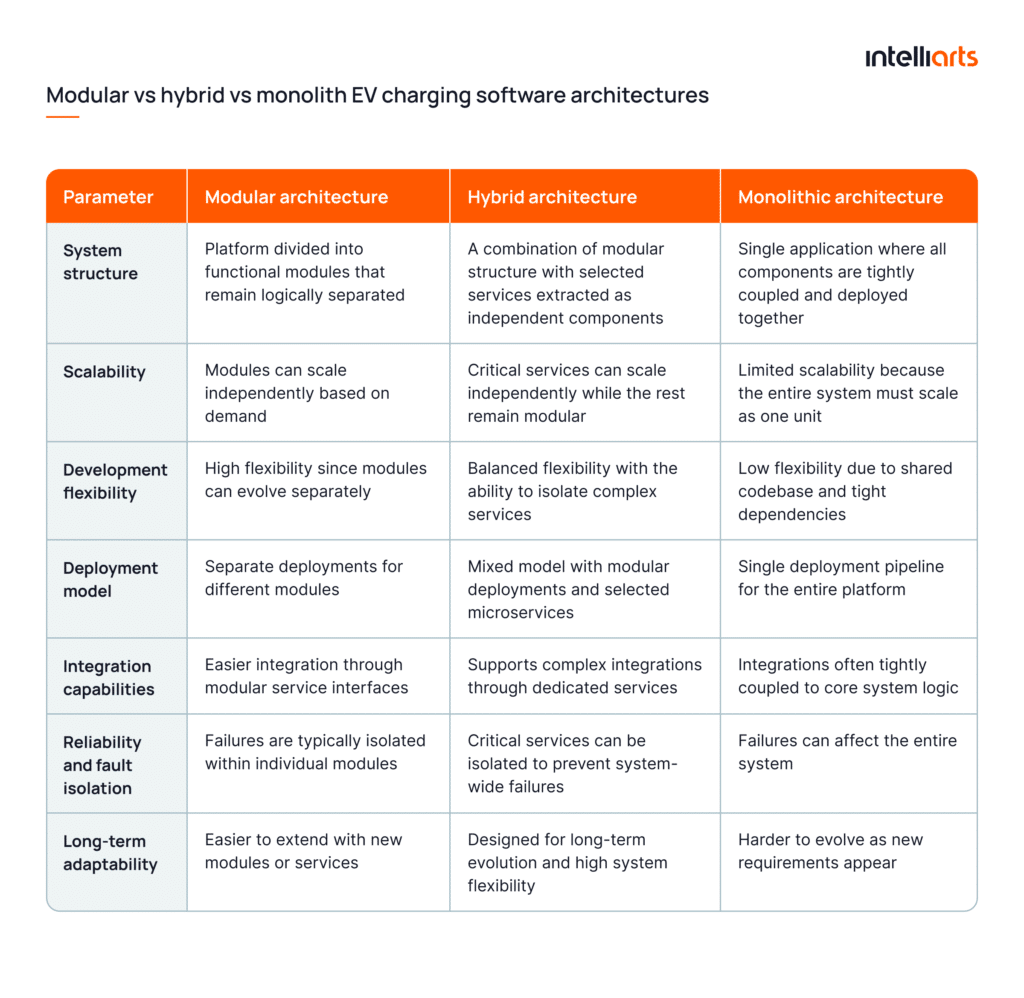
As you can see, modular and hybrid approaches are fairly similar, and both are superior, in the EV software scenario, to a monolith. Hybrid is more favored when there’s a core structure, probably the legacy monolithic code, or when there are business and compliance considerations involved.
The main take: You design for scalability from day one by sticking to either a modular or a hybrid approach and utilizing best practices in software architecture design.
In practice, the modular architecture and scaling opportunities it provides are what appeal to businesses in the niche the most. — Ihor Rudnyk, an eMobility Tech Specialist at Intelliarts.
What protocols and standards must be considered?
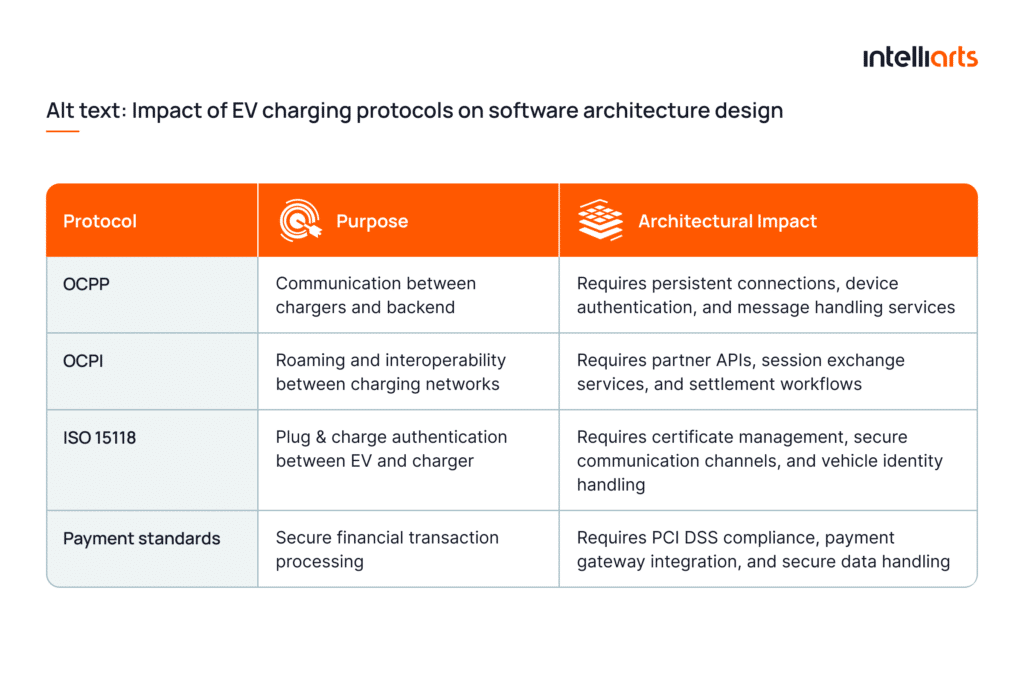
Modern EV charging software must support several industry protocols and standards. These specifications determine how devices exchange operational messages, how charging networks interoperate, and more. See the short overview of protocols and their main provisions below:
#1 OCPP (Open Charge Point Protocol)
OCPP is the primary protocol governing communication between charging stations and the backend charge point management system (CPMS). It standardizes how chargers report status and how backend systems control device operations across the charging network.
Regulatory organization: Open Charge Alliance (OCA)
Key provisions defined by the protocol:
- Charger boot notifications
- Device authorization requests
- Charging session start and stop events
- Meter value reporting
- Remote commands (start/stop, reset, unlock)
- Firmware update management
- Smart charging profiles and power limits

Explore how Intelliarts can help your business navigate global standardization frameworks and achieve optimal implementation results. Read the white paper.
#2 OCPI (Open Charge Point Interface)
OCPI is the interoperability standard used for roaming between charging networks and mobility service providers. It defines how operators exchange operational and billing information across different platforms.
Regulatory organization: EV Roaming Foundation
Key provisions defined by the protocol:
- Charger location and availability data exchange
- Tariff and pricing publication
- Charging session information exchange
- Token authorization for roaming users
- CPO–eMSP settlement records
- Partner credential and role management
#3 ISO 15118
ISO 15118 defines the communication framework between electric vehicles and charging stations. It enables plug & charge functionality and secure authentication without requiring driver interaction.
ISO 15118 standard also enables advanced energy scenarios such as Vehicle-to-Grid (V2G) technology, allowing EVs to act as distributed energy resources within the power system. Simply put, it allows EV batteries to return electricity to the grid to support energy balancing.
Regulatory organization: International Organization for Standardization (ISO) in cooperation with the International Electrotechnical Commission (IEC)
Key provisions defined by the standard:
- Vehicle authentication through digital certificates
- Secure EV-to-charger communication channel
- Contract certificate management
- Plug & charge authorization workflows
- Smart charging negotiation between EV and charger
- Vehicle-to-grid communication support
#4 Payment standards
Payment standards regulate how financial transactions are processed within EV charging software, ensuring secure handling of payment credentials and billing data.
Regulatory organization: PCI Security Standards Council (PCI SSC)
Key provisions defined by these standards:
- Secure card data handling requirements (PCI DSS)
- Payment tokenization mechanisms
- Transaction authorization flows
- Fraud detection and monitoring controls
- Secure integration with payment gateways
- Compliance reporting and audit requirements
And here’s a brief overview of the impact of protocols on the architecture design:
How do you ensure security and compliance in EV charging systems?
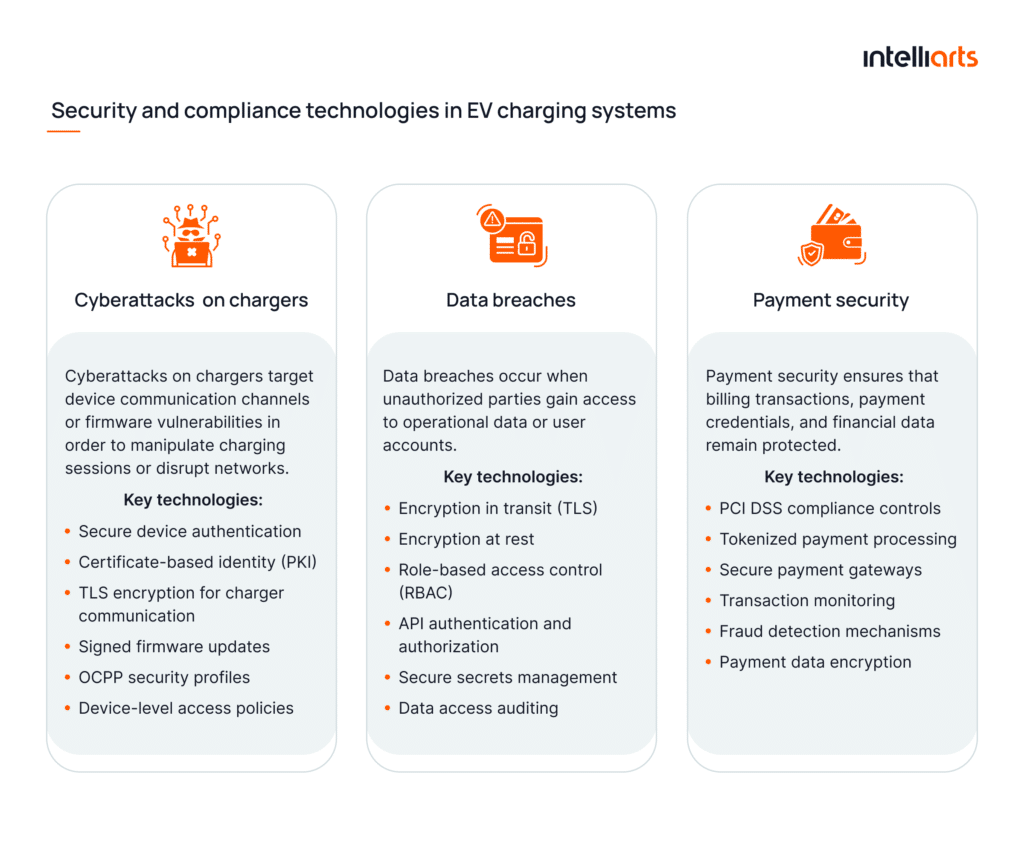
In the displayed software architecture, security & identity are not a separate layer, module, or microservice. Instead, it’s a cross-cutting concern. A quick example, encryption, data security, secure updates, compliance, etc., are all parts of a broader security concept, despite being distributed across nearly all layers and modules.
The infographics below summarize the sensitive aspects of security covered by one or another technology implementation:
What does an optimal EV charging workflow look like?
So, given all the EV software architecture choices and design paradigm constraints, what does a workflow with an EV charger look like? The diagram below shows the flow of data from an EV being charged to the data and analytics layer, through the EV charging infrastructure, backend, and all the external systems:
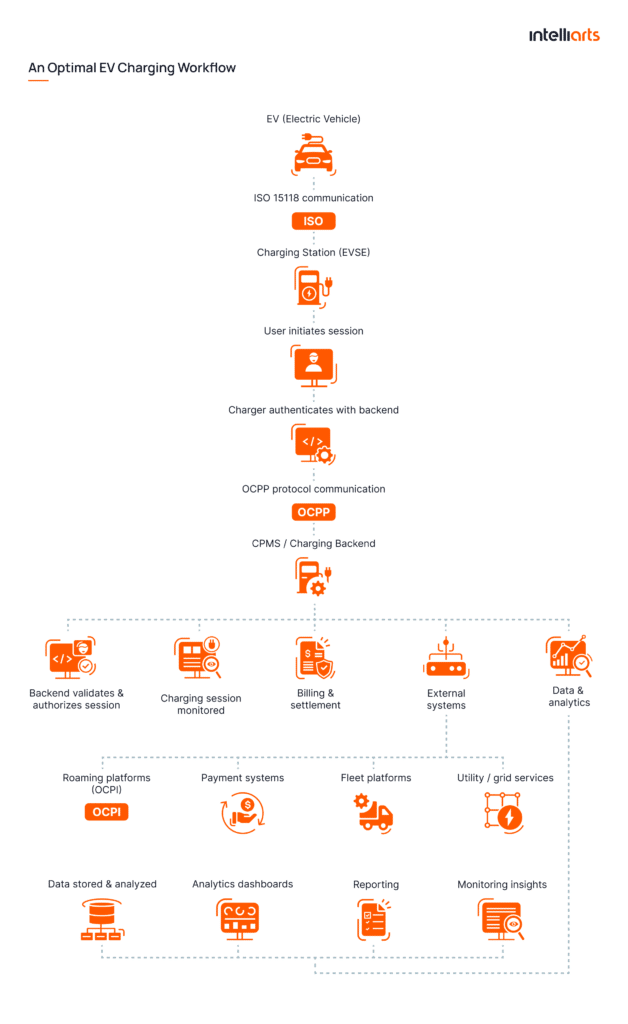
Basically, data is generated during EV charging, and then, in full compliance with regulations, passed through a suite of layers comprising an EV software architecture. That’s how you end up with clear electricity consumption patterns and actionable insights.
Looking for a trusted dev partner to design your EV charging management system? Don’t hesitate to reach out to Intelliarts.
When should you build custom EV charging software vs use an off-the-shelf platform?
The choice between custom development and an off-the-shelf platform determines how much control an operator has over its EV charging software and how easily the system can evolve as the charging network grows.
#1 Custom EV charging software advantages:
Custom development allows operators to design the EV charging platform architecture around specific operational needs rather than adapting business processes to a predefined product. This approach is particularly useful for companies that require deep integrations, differentiated services, or specialized charging logic.
- Greater architectural flexibility
- Full control over system integrations
- Ability to build differentiated charging features
- Easier adaptation to new standards and regulations
#2 Off-the-shelf platform advantages:
Off-the-shelf solutions allow companies to launch charging services faster without building a full backend platform from scratch. These platforms provide core functionality out of the box and reduce the initial engineering investment.
- Faster deployment of charging infrastructure
- Lower upfront development cost
- Prebuilt charger management capabilities
- Standard protocol support, such as OCPP
See the decision framework table that can guide you in choosing between a custom EV fleet charging software and off-the-shelf solutions available in the market:
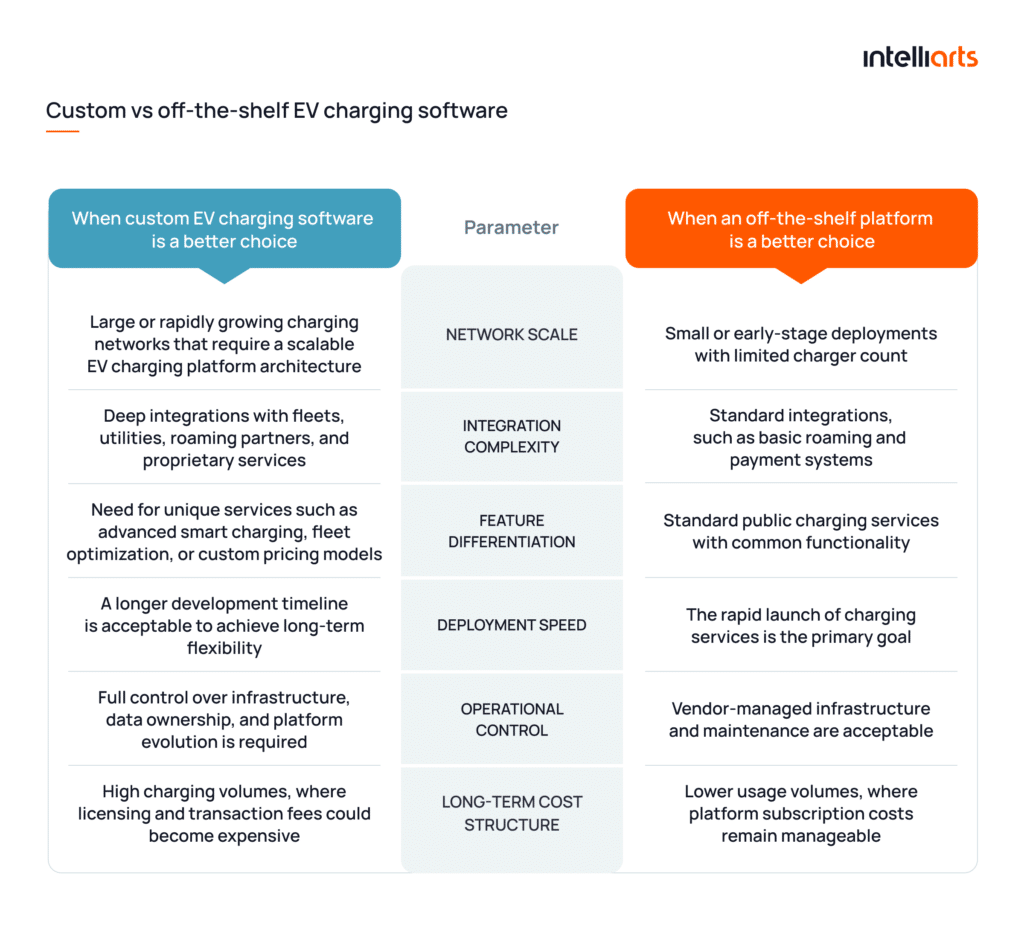
Important note: While for many small-scale or beginning projects an off-the-shelf software may seem like a better choice, money and effort-wise, it’s slightly more complicated than that. Off-the-shelf solutions are inefficient and not always possible to scale.
At the same time, custom development services may offer a tailored MVP at an affordable cost and scale easily once the idea is validated. As another alternative, Intelliarts offers to add customization to a pre-built solution of your choosing. It’s usually a good trade-off in terms of time and money.
Common architecture mistakes in EV charging projects
Building EV charging software means dealing with distributed devices and connectivity challenges on top of regular software architecture complexities. Here are some of the most common mistakes that the Intelliarts team sees occurring in projects based on our experience:
- Ignoring offline scenarios because chargers regularly lose connectivity, which can cause interrupted sessions and delayed synchronization with the backend system.
- Underestimating real-time data load, especially when there is insufficient event processing capacity, resulting in delayed monitoring and unstable session handling.
- Poor API design in cases when charging platforms must integrate with apps and inconsistent interfaces make integrations hard to use.
- Vendor lock-in that occurs due to tightly coupling the system to proprietary infrastructure limits architectural flexibility and makes scaling significantly more difficult.
- Treating security as an afterthought, especially when it comes to delayed implementation of device authentication, encryption, and monitoring, which results in higher risks.
Success in avoiding these mistakes usually boils down to the experience of a development team and their expertise with EV solutions specifically. That’s exactly why we recommend assistance from trusted EV software development agencies like Intelliarts.
Intelliarts’ Experience: EV Charging Management Software for EVIQ
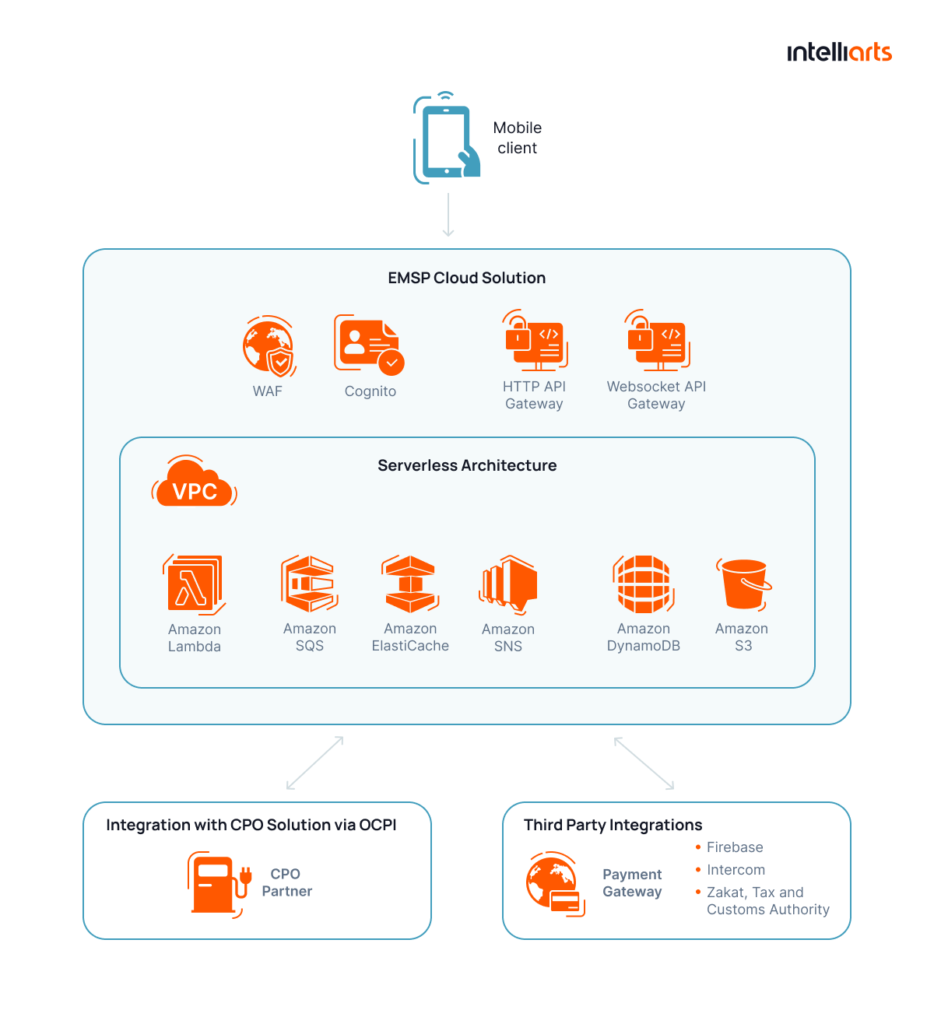
Our customer, EVIQ, needed software to support a rapidly expanding EV charging network in Saudi Arabia while meeting strict regional requirements. The platform had to enable station monitoring, charger lifecycle management, user payments, and fast deployment within an ambitious six-month development timeline.
Intelliarts designed and built custom EV charging software using a scalable AWS serverless architecture, which is basically a hybrid solution. The platform was launched on time and now supports thousands of EV drivers. The mobile app achieved strong ratings on Android and iOS, while the scalable architecture allows EVIQ to expand its nationwide charging network.
Should you need to learn more about our experience, take a look at the full EV charging case study in our portfolio.
Final take
Well-designed EV charging software architecture determines whether a charging network can grow without operational instability. As charger fleets expand, platforms must handle thousands of devices without downtime.
Modular or hybrid architectures make this possible by separating critical services such as CPMS operations, session control, and data processing. Combined with standards like OCPP and OCPI, this approach allows operators to scale infrastructure while maintaining reliability and control.
Here at Intelliarts, we are proud to have more than 25 years of experience delivering custom software solutions. We also possess substantial expertise in EV and AI development. With over 80 successful large-scale projects completed, 54% senior staff engineers, and a 90% customer return rate, we are ready, willing, and able to contribute to your next EV charging software project.
FAQ
What is the difference between CPMS and EV charging management software?
A charge point management system (CPMS) operates charging stations: device onboarding, firmware updates, diagnostics, and OCPP session control. EV charging management software extends these capabilities with billing, roaming through OCPI, analytics, user apps, and integrations with energy systems and external platforms.
How scalable should EV charging architecture be?
Scalability must support thousands of chargers, high session volumes, and continuous telemetry. A well-designed EV charging platform architecture handles peak demand, enables horizontal scaling, and maintains stable performance as networks expand across regions, fleets, and public charging locations.
Is microservices architecture necessary for EV charging platforms?
Microservices can support independent scaling of modules such as payments, telemetry, and device management. Yet many platforms begin with a modular monolith and evolve later. The choice depends on system complexity, development resources, and the long-term roadmap for custom EV charging software.