

Solution Highlights
- Built a RAG-powered AI chat that helps users research commodities market archive in natural language
- Deployed a mobile app with 100+ downloads shortly after the launch
- Enabled instant insight extraction from years of financial reports
- Saved analysts hours of manual document review by accessing context-aware responses

About the Project
Customer:
Our partner (under NDA) is a boutique macroeconomic research and advisory firm focused on analyzing China’s political economy and its global market. Among its clients, there are hedge funds, investors, and corporations.
In 2024, the company launched an AI-driven platform designed to provide faster, clearer intelligence across global commodities markets. The solution aggregates volumes of historical data points and daily updates into structured dashboards, AI-generated briefs, and research workflows, forming the foundation for a scalable financial AI solution.
Challenges & Project Goals:
Our partner provides subscription-based access to proprietary macroeconomic and financial research on China. As their library of reports and analytical materials expanded, the company wanted to provide their clients with a faster way to extract insights without the need to manually go through lengthy documents.
The company contacted Intelliarts with the idea of an AI chat that could answer user questions strictly based on their internal reports. The chat was planned to be tailored for financial and commodities use cases to help users speed up their research-driven decision-making.
Solution:
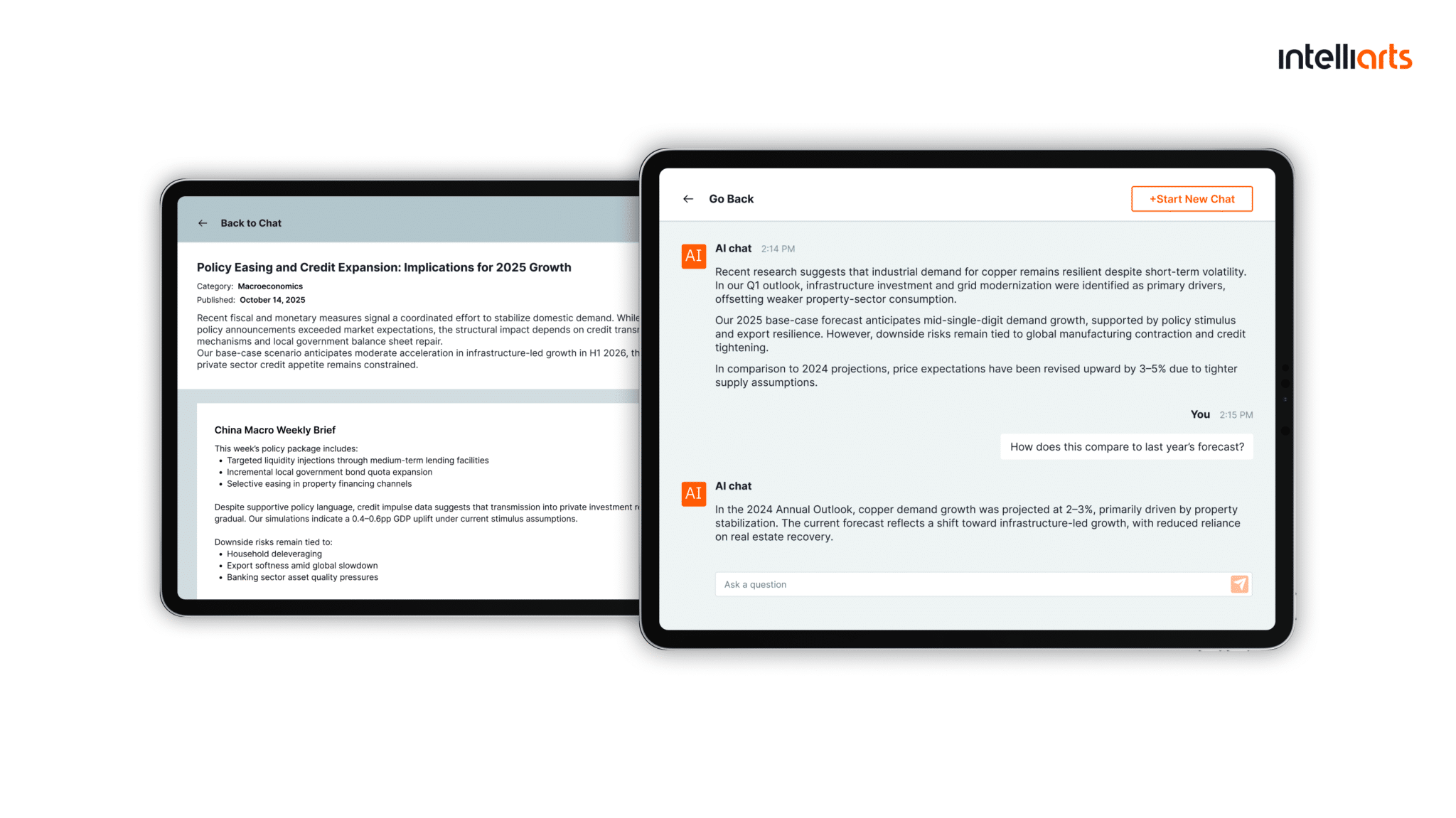
We built a client-facing AI chatbot powered by a Retrieval-Augmented Generation (RAG) pipeline, combining our expertise in LLM development services and domain-specific AI implementation. Users can ask questions in natural language and receive answers based on the company’s research library.
The chatbot retrieves the most relevant report excerpts and makes sure the answers are accurate, consistent, and aligned with the source material.

Technology Solution
As part of our AI chatbot development services, we built a RAG-powered solution designed for AI for hedge funds and institutional investors. The solution architecture followed a standard RAG approach, though the complexity of financial analytics and proprietary research required several domain-specific adaptations.
Here’s a detailed description of how the AI interactive chatbot was built:
1. Document analysis
The project began with the collection and analysis of the company’s full archive of financial reports: monthly, annual, and thematic publications focused on macroeconomic and commodities research.
Here our ML engineer faced an early challenge connected to the fact that many documents contained non-extractable charts and images. Since financial interpretation largely depended on visual data, we could not ignore these elements as this would have affected answer quality.
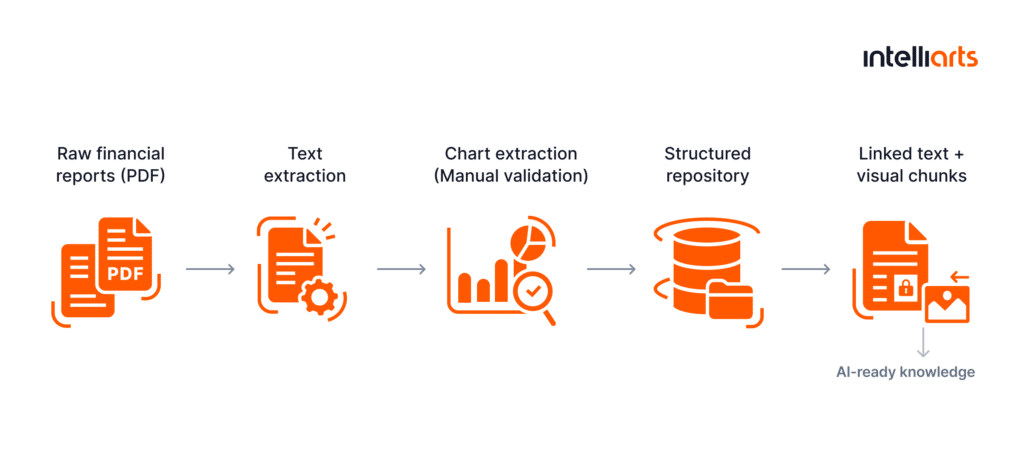
To address this, we implemented a semi-automated workflow:
- Parsed and manually validated embedded images
- Stored them in a separate structured repository
- Linked visuals to the corresponding text segments
This approach allowed the chatbot to return textual answers along with the associated charts when relevant and, thus, preserve analytical context for users.
2. Building the RAG pipeline
Once the knowledge base was structured, we implemented the core RAG pipeline using a modular framework (LangChain-based orchestration) to manage retrieval, ranking, and generation flows.
The architecture included:
- Document chunking and embeddings generation to convert structured report sections into searchable semantic vectors
- Vector-based semantic retrieval to surface the most relevant extracts for each query
- A reranking layer to refine top results and reduce retrieval noise
- Guardrails and validation logic to prevent out-of-scope questions and minimize hallucinations
We also had to introduce an extra domain-specific logic as we faced temporal ambiguity in financial data. Many reports covered the same indicators across different periods (monthly, annual, or multi-year). So when users asked questions like “What is the forecast for oil prices?”, the correct answer depended on whether they referred to the latest update, a specific year, or a longer-term trend.
To resolve this, we incorporated a time-intent detection and filtering layer into the retrieval stage. Each document was indexed with precise date metadata, and before running semantic search, the system determined the relevant time frame of the query. Retrieval was then restricted to documents matching that period. This approach reduced conflicting answers and improved analytical consistency.
3. Optimizing the results
After the initial RAG pipeline was implemented, we focused on performance tuning. This included refining embeddings, adjusting retrieval thresholds, improving reranking precision, and optimizing prompt structure to reduce ambiguity and hallucinations.
Because the AI chatbot operated in a specialized financial domain, we also worked closely with in-house China market experts who regularly reviewed the outputs. Their feedback helped us improve the accuracy and clarity of the results to make sure the AI assistant provided specialized answers rather than generic chatbot replies suitable for AI-driven financial analysis for institutional investors.
4. Evaluation and quality assurance
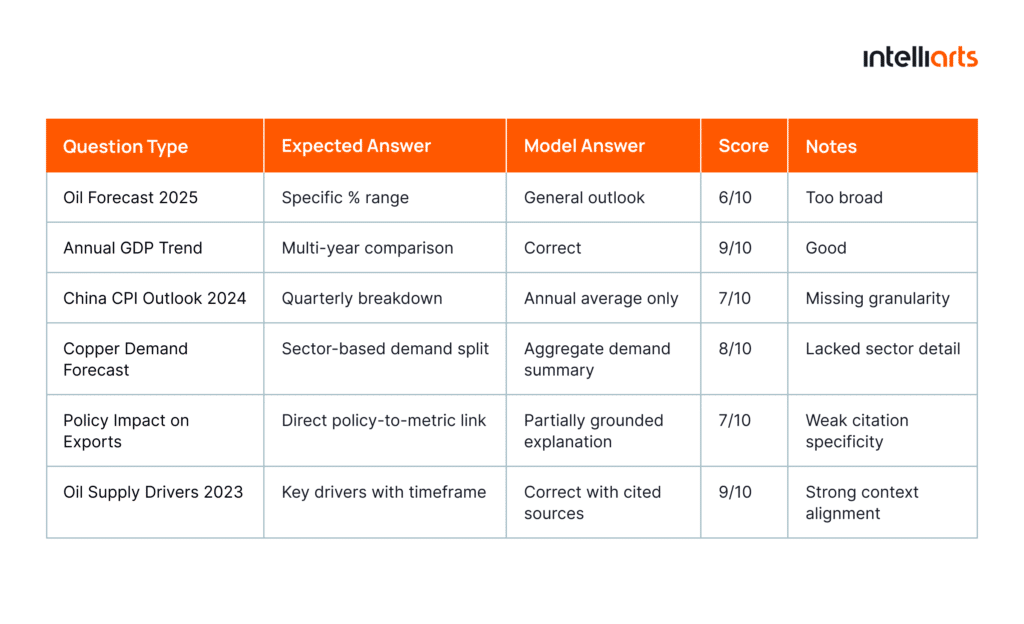
Another critical challenge met in this project was the absence of a pre-labeled evaluation dataset. Since no structured benchmark questions existed at the start of the project, we had to build the evaluation framework from scratch.
We solved this by:
- Collecting realistic, user-style financial questions
- Creating labeled evaluation examples with domain expert input
- Establishing a repeatable testing workflow for response assessment
This framework allowed us to systematically measure performance, identify weak spots (e.g., retrieval noise or incomplete context usage), and make data-driven improvements to the system.
5. Integration and deployment
After stabilizing the AI chat engine, we integrated it into the existing client-facing application in collaboration with the frontend developer.
The final deployment delivered secure API-based access to the AI chat along with controlled generation based on proprietary materials.
Business Outcomes
With our AI-powered chat, Intelliarts helped the customer transform a static research archive into an interactive analytical tool. Our partner highlights the key benefits of the delivered financial AI solution:
- Fast insight extraction – Users can retrieve precise answers from financial reports without manually parsing complex documents
- Research efficiency – Analysts save hours by accessing context-aware responses
- High engagement – The AI chat increased accessibility and usability of the client-only research archive
- Validated product-market fit – Early downloads and user registrations confirmed demand for AI-powered financial research tools
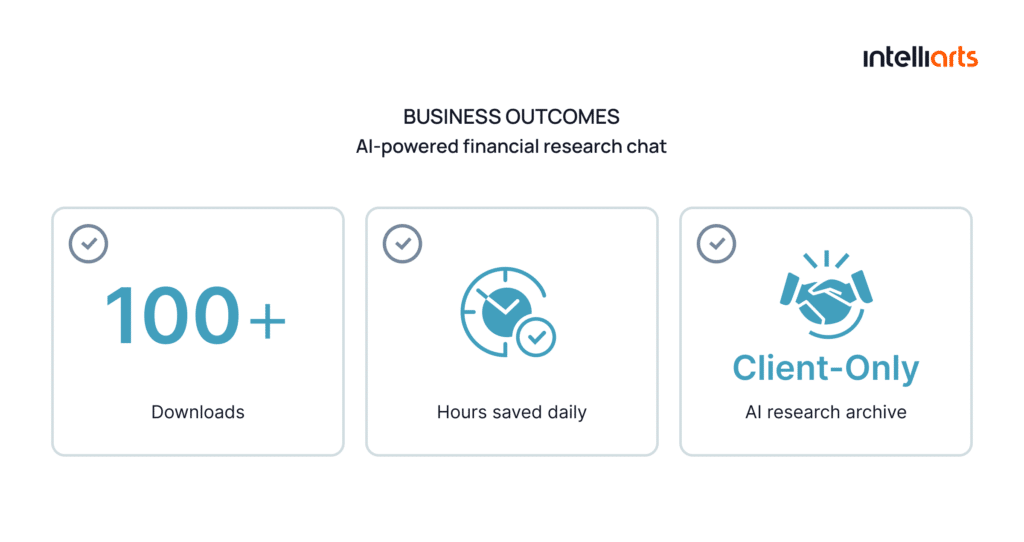
The app achieved early adoption on the Apple Store, with 100+ downloads and a clear user interest in AI-assisted research workflows.