

If your charging network is growing and your CPMS is slowing you down, you’re likely weighing three options: configure what you have, build a layer on top, or develop from scratch.
The EV charging market is scaling rapidly, with global public charging infrastructure surpassing 4 million chargers over the past few years and continuing strong double-digit growth into 2025, according to the IEA Global EV Outlook 2025. At the same time, reliability remains a concern, with 20% of users reporting failed charging attempts in the J.D. Power 2025 EV Charging Study. As operations become more complex, standard CPMS platforms often fall short, and additional developments or even fully custom creation of a CPMS solution becomes more effective long-term.
This article indicates when standard CPMS solutions stop supporting operational needs at scale. It also outlines the key signals indicating growing complexity and explains how custom CPMS development addresses these gaps, as well as compares practical implementation approaches.
What is custom CPMS development for charge point operations?
Custom CPMS development is the process of designing and building a tailored charge point management system that aligns with a specific operator’s charge point infrastructure and business logic.
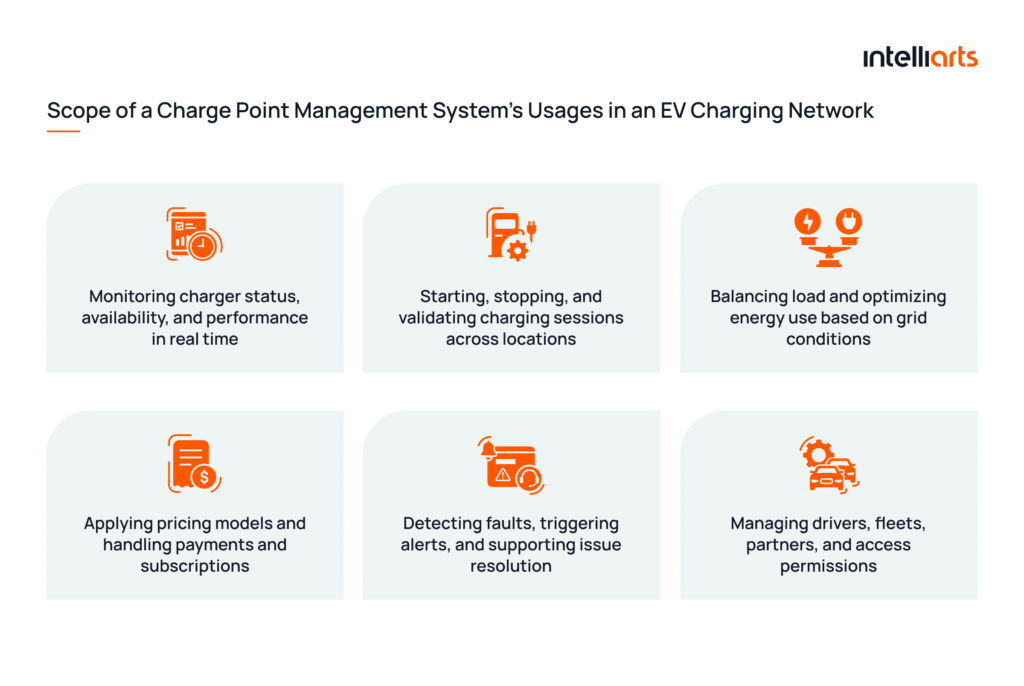
Here’s a brief scope of what a charge point management system supports in the daily operations of an EV charging network:
- Monitoring charger status, availability, and performance in real time
- Starting, stopping, and validating charging sessions across locations
- Balancing load and optimizing energy use based on grid conditions
- Applying pricing models and handling payments and subscriptions
- Detecting faults, triggering alerts, and supporting issue resolution
- Managing drivers, fleets, partners, and access permissions
For many operators, a standard CPMS engine like AMPECO or Noodoe provides these capabilities out of the box. However, it often does so within predefined workflows, limited configuration options, and fixed integration models.
The difference between standard CPMS usage and building a custom platform layer instead comes down to control and flexibility.
With a standard CPMS, operators use predefined features and workflows. With custom CPMS development, workflows, integrations, and data flows are built around the real needs of an operator. The platform adapts to the business, not the other way around.
Custom CPMS development becomes preferred when an off-the-shelf EV charging software solution no longer supports efficient scaling, partner ecosystems, or differentiated service models.
In practice, going for custom CPMS development often does not mean replacing everything. Many operators keep a CPMS engine and build a custom layer on top of it. This layer handles integrations, orchestration, and operational logic that standard tools cannot support.
When does a standard CPMS stop being enough?
A standard CPMS stops being enough when it limits operational control, slows down scaling, or forces workarounds in charge point operations.
Taken directly from our customers’ and leads’ complaints, here are the exact operational bottlenecks you can spot in daily workflows that indicate CPMS limitations:
- Workflows are rigid and cannot be adapted without manual intervention
- Visibility is fragmented and does not provide complete real-time insight across chargers, locations, or partners
- Platform logic is restrictive and forces teams to adjust processes to fit the system
- Integrations are brittle and require constant fixes or manual synchronization
- Response times increase and slow down incident detection and resolution across the network
If you are looking for specific reasons why it’s the case, to a certain extent, for every CPMS, they are as follows:
- Partner ecosystems are difficult to expand, and newly emerging roaming and B2B integrations require custom workarounds
- Hardware diversity, such as different charger models and protocols, creates inconsistency
- Pricing models are constrained, and even a mix of dynamic tariffs, subscriptions, or partner-specific pricing may not be sufficient long-term and at enterprise scale
But how do you know it’s no longer a temporary issue? From Intelliarts experience, the tipping point is usually when operational overhead increases while control decreases, and that appears to be a strong tendency. Are you looking to expand while your off-the-shelf CPMS provider still adjusts tariffs on a monthly basis and releases workflow-breaking updates? Then the time to switch to a custom solution is now.
How does custom CPMS development typically work?
While the development procedure itself is common knowledge, CPMS has its own intricacies that EV businesses should know. Let’s delve into how the charge point operations software works based on several specialized solutions and extra dev steps they include:
- Discovery and operational requirements mapping
This measure serves to analyze real charge point operations and translate them into software logic. For example, it highlights where sessions fail, where billing diverges, and where manual intervention occurs.
- Charger estate, protocol, and integration assessment
This step focuses on evaluating the infrastructure. In practice, charger behavior often differs from protocol specifications, with inconsistencies such as delayed events, missing statuses, or vendor-specific quirks. These factors define how much normalization and fault tolerance the system must include to remain stable.
- CPMS architecture and module planning
A CPMS is typically built around session lifecycle and event processing rather than static data models. Proper separation between device communication, operational logic, and billing ensures that failures in one layer do not cascade across the system.
- Core workflow design for monitoring, control, alerts, billing, and support operations
Workflows reflect non-ideal conditions such as interrupted sessions and incorrect data. That’s why procedures should include correction and recovery paths alongside the main flow, making the system more fail-proof.
- Third-party integrations and data flows
Almost any modern-day public solution is built to interact with external services. Aside from security concerns, there are also data consistency and integrity issues. Cleansing methods must be implemented, and data flows in place should be able to handle retries, duplication, and asynchronous updates.
- Iterative optimization
As a general development practice, software should be improved based on actual usage data over time. In the case of CPMS, it means that failed sessions and reconciliation issues should inform workflow refinement in order to benefit reliability and ROI over time.
The following infographics show a simplified workflow from business needs to development, testing, rollout, and continuous improvement, including the steps described above and other dev phases:
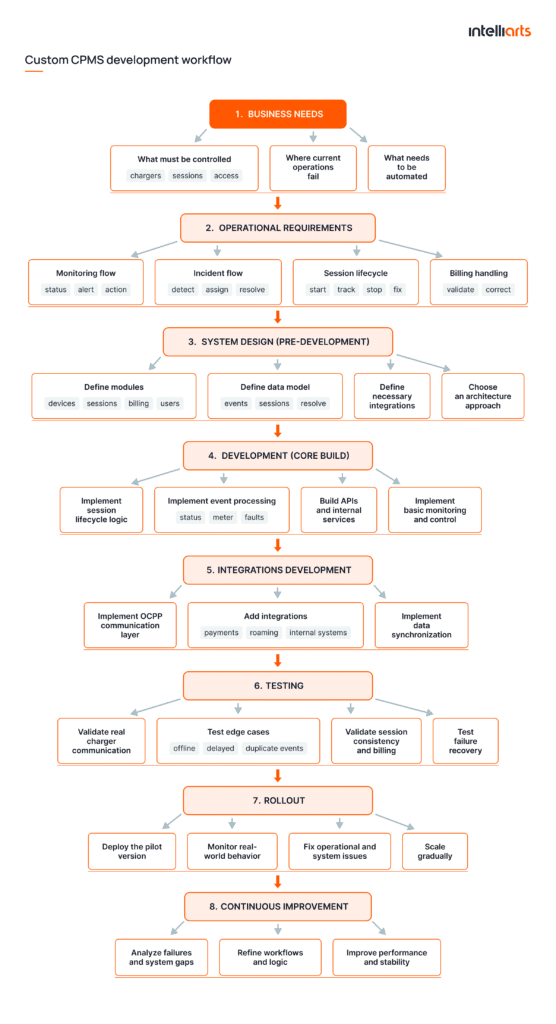
Important note: Development of a specialized CPMS or even adding functionalities on top of the existing one requires substantial EV niche-related expertise and experience. Should you need advice and assistance, don’t hesitate to reach out to the Intelliarts team.
What business scenarios justify a custom CPMS?
A custom CPMS becomes justified when standard platforms limit control over operations, integrations, or monetization, or fail to meet EV charging standards and protocols.
Looking for a reliable CPMS development partner? From architecture design to full-scale implementation, Intelliarts offers to build scalable and production-ready charge point management solutions.
#1 Multi-site or multi-country operations
Key signals:
- Fragmented visibility across regions
- Local pricing or regulatory constraints
- Growing number of partners and locations
Typical cases:
- CPOs expanding across EU markets with different tax and tariff rules
- Networks operating in urban and highway environments with different usage patterns
- Operators managing roaming partnerships in multiple countries
Real-world signal (2025):
Updates tied to AFIR Regulation EU require consistent pricing transparency and roaming accessibility across EU member states. Industry coverage notes that operators face challenges aligning tariffs, VAT handling, and session data.
#2 Mixed hardware ecosystems and protocol complexity
Key signals:
- Multiple charger vendors with inconsistent behavior
- Missing or delayed session data
- Increasing need for error handling and normalization
Typical cases:
- Operators growing through acquisitions with legacy hardware
- Fleets using a mix of depot and public chargers from different vendors
- Networks integrating newer chargers alongside outdated firmware models
Real-world signal (2025):
Industry reporting from the International Energy Agency (IEA) highlights that interoperability issues and uneven protocol implementation remain a core barrier in EV infrastructure scaling.
It can be noted in many growing EV businesses that hardware diversity introduces variability that only a well-designed CPMS can normalize. — Alexander Barinov, a Managing Partner at Intelliarts, with over 10 years of experience in EV software solutions
#3 Custom pricing, billing, or partner logic
Key signals:
- Complex pricing models beyond flat tariffs
- Manual billing adjustments and corrections
- Partner-specific settlement requirements
Typical cases:
- Fleet operators with negotiated pricing agreements
- Charging providers offering subscriptions or bundled services
- Businesses working with multiple partners requiring revenue split logic
Real-world signal (2025):
Market data from the European Commission and energy regulators show continued volatility in electricity pricing across Europe. This drives adoption of dynamic pricing and time-based tariffs, increasing backend billing complexity beyond what standard CPMS tools typically support.
#4 Unique support, maintenance, or operational workflows
Key signals:
- Manual intervention in daily operations
- Custom support or escalation processes
- Disconnected tools for monitoring and maintenance
Typical cases:
- Operators with dedicated support teams handling high-volume incidents
- Networks requiring strict SLAs for uptime and response times
- Businesses managing maintenance across distributed charger fleets
Real-world signal (2025):
Recent EV infrastructure reliability studies indicate that a significant share of public charging attempts still fail or are interrupted. These findings continue to highlight gaps in automated incident handling.
Find out more about EV charging compliance
The white paper presents five global frameworks changing the industry, built on Intelliarts’ 10+ years of experience delivering emobility software.
Read the white paper
Build vs adapt vs integrate: Which route makes the most sense?
It’s safe to claim that the right approach depends on how much control, flexibility, and scalability your charge point operations require. Options solve different levels of complexity, so in order to make a good choice, you need to find what can cover your business needs effectively.
When adapting an existing CPMS is enough
Adapting works when your operations fit within standard system logic and only require configuration or light extensions.
Indications:
- Single-country or limited network scale
- Standard pricing and billing models
- Minimal partner or roaming complexity
- Stable hardware setup with a few vendors
What it means in practice: You configure existing features, use built-in workflows, and add minor integrations without changing core system logic. Suitable for small-scale or new EV businesses.
When integration-heavy architecture is a better choice than a full rebuild
This approach keeps a core CPMS but builds a custom layer around it to handle integrations and operational logic.
Indications:
- Multiple external systems (payments, CRM, roaming)
- Increasing need for custom workflows
- Data inconsistencies between systems
- Growing operational complexity without full system limitations
What it means in practice: The CPMS acts as a base, while custom services manage orchestration, data normalization, and business-specific logic. Suitable for the majority of businesses.
Important note: Intelliarts experience shows that sometimes it’s hard to clearly distinguish when pure off-the-shelf software adjustment ends and integration-based developments on top of it start. Usually, the charge point operator software usage is a mix of both until actual, long-term development is triggered.
When full custom CPMS development creates strategic value
Full development is justified when standard platforms limit core operations and cannot support business requirements.
Indications:
- Multi-country operations with regulatory complexity
- Mixed hardware ecosystems with unstable behavior
- Advanced pricing, billing, or partner logic
- Heavy reliance on manual operations or workarounds
What it means in practice: You design and build the system around your operations, controlling workflows, integrations, and data handling end to end. Suitable for enterprise-level businesses.
See the comparison table in the image below:
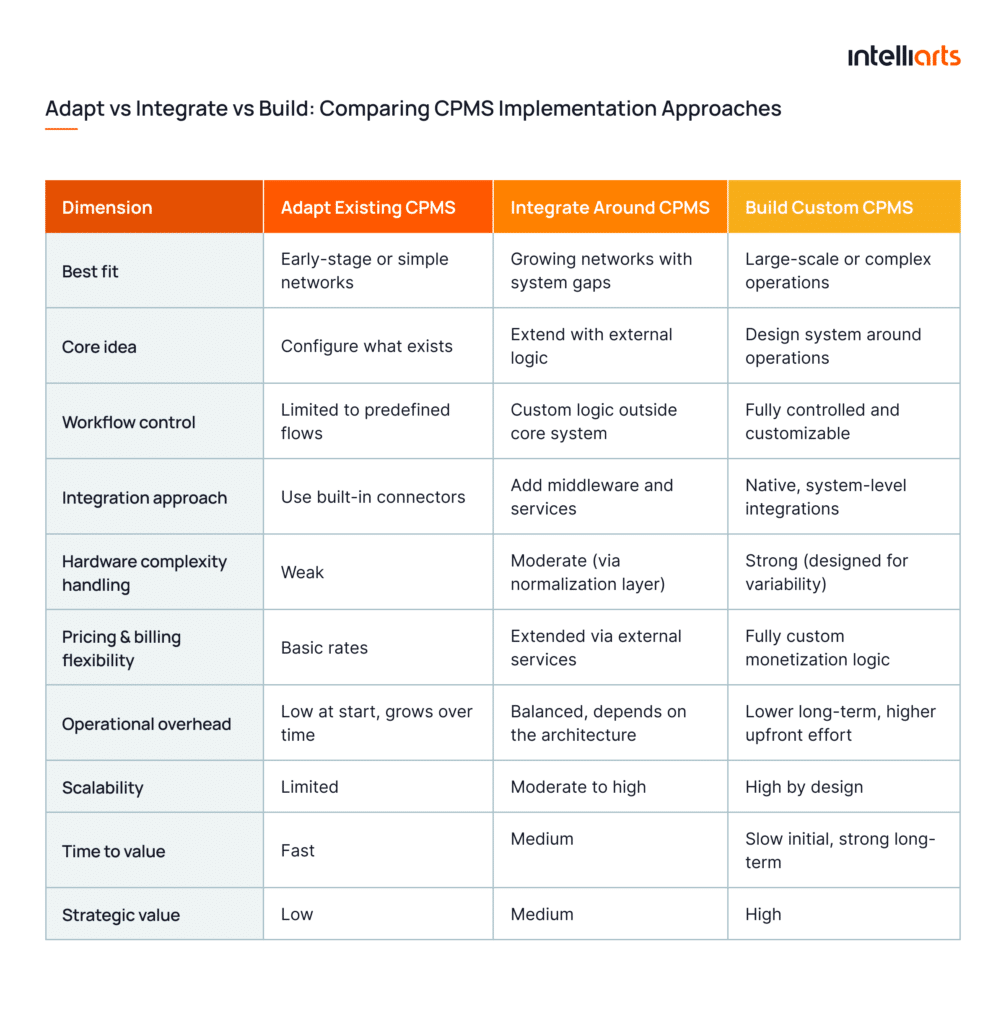
Summary:
- Adapt when operations are simple and stable
- Integrate when complexity grows around the system
- Build when the system itself becomes the limitation
Which capabilities matter most in charge point operations?
As charge point operations scale, complexity shifts from infrastructure to control. The following capabilities define whether a CPMS can operate reliably under real-world conditions or require constant manual intervention.
Real-time monitoring and control
This capability provides continuous visibility into charger status and allows operators to act on it. It is built on event streams from chargers, often with delays or inconsistencies, which must be normalized before use.
From a development perspective, it requires stable event ingestion, state management, and command execution across unreliable devices. The complexity comes from handling out-of-order events and maintaining accurate charger state.
Benefits:
- Faster issue detection and response
- Reduced downtime across the network
- Centralized operational control
Find out more about smart charging platform features that a high-performing solution should have.
Alerting and incident management
This capability defines how the system reacts to failures. It is not just about alerts, but about linking events to actionable workflows.
It is built by defining trigger conditions, escalation logic, and resolution paths. Complexity lies in filtering noise, avoiding false positives, and ensuring alerts lead to action, not overload.
Benefits:
- Reduced manual monitoring effort
- Faster incident resolution
- Structured and repeatable support workflows
Tariffs, billing, and monetization support
This capability determines how sessions are translated into revenue. It must handle incomplete or inconsistent session data while still producing accurate billing.
Development involves building pricing engines, validation logic, and reconciliation mechanisms. Complexity comes from edge cases such as interrupted sessions, delayed meter values, and pricing rules that vary by context.
Benefits:
- Accurate and flexible billing
- Support for complex pricing models
- Reduced need for manual corrections
User, asset, and partner management
This capability manages access, ownership, and relationships across the system. It includes drivers, fleets, partners, and physical assets.
It is built through identity management, access control, and hierarchical data structures. Complexity arises from multi-tenant setups and overlapping permissions.
Benefits:
- Clear control over access and roles
- Scalable partner and fleet management
- Consistent data across entities
Scaling a charging network exposes the limits of predefined workflows and rigid integrations. It also makes the cost and effort inefficiency of inconsistent asset ownership clear. Sometimes there’s no other good choice but to resort to extra development. — Yurii Aulikh, Software Engineer at Intelliarts
Analytics, reporting, and operational visibility
This capability turns operational data into insight. It aggregates events, sessions, and system metrics into usable reporting.
It requires data pipelines, storage, and aggregation logic. Complexity comes from ensuring data consistency across sources and handling incomplete datasets.
Benefits:
- Better decision-making based on real data
- Visibility into performance and failures
- Continuous optimization of operations
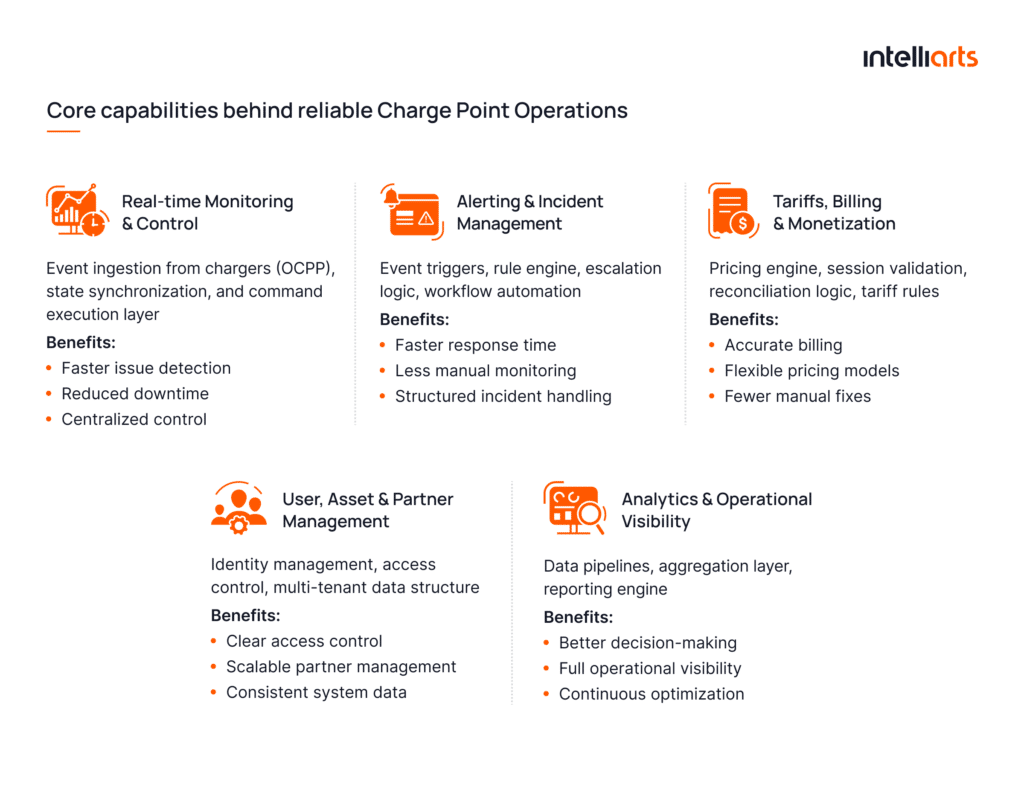
See short technical details and benefits for these capabilities outlined in the infographic below:
What increases complexity and delivery effort?
Complexity in a CPMS engine is driven by real-world variability. The more unpredictability the system must handle, the harder it becomes to design, build, and maintain.
- Charger variety and interoperability
Chargers from different suppliers and driven by distinct software may not behave consistently, even when operating under the same protocol. This results in the following:
- Different vendors send events in different formats or sequences
- Some chargers delay, duplicate, or skip critical data
- Firmware differences introduce unpredictable behavior
Why it matters: The system must normalize unreliable inputs and still maintain accurate session and billing logic.
- Legacy systems and third-party dependencies
External systems such as payments, roaming platforms, and internal tools operate with their own logic and timing. In practice, this leads to:
- Data mismatches between sessions, billing, and payments
- Asynchronous updates that arrive late or in the wrong order
- Dependency on systems outside your control
Why it matters: Integration logic must handle inconsistencies without breaking core operations.
- Regulatory and regional requirements
Modern CPMS development also becomes more complex when the platform must support protocols such as OCPP 2.0.1, OCPI, and ISO 15118. OCPP 2.0.1 expands charger communication requirements, OCPI adds roaming-related data exchange with external networks, and ISO 15118 introduces Plug&Charge workflows with certificate handling and secure vehicle-to-charger authentication.
Regulatory and regional requirements manifest as:
- Variations in tariff calculation and reporting
- Region-specific data storage and compliance requirements
- Ongoing updates that require system changes
Why it matters: The system must adapt to local constraints while preserving global consistency.
- Scalability, uptime, and support expectations
As the network grows, the volume of devices, sessions, and events increases significantly. This introduces the following challenges:
- Higher load and concurrency across the system
- Wider impact of failures across multiple locations
- Stricter expectations for availability and recovery
Why it matters: System failures scale with growth if the architecture is not designed to handle load and recovery.
Developing a smart power management system: Intelliarts’ success story
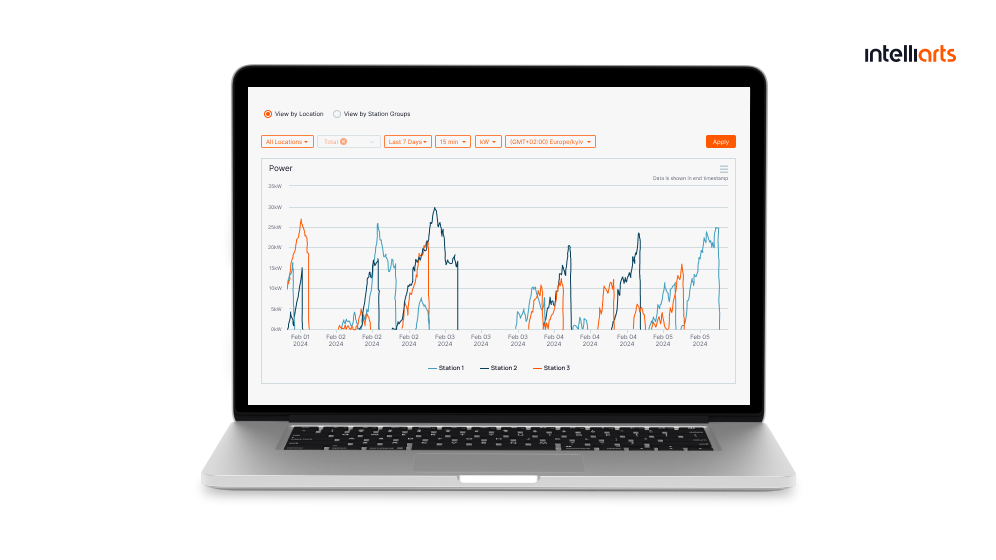
As a showcase of a custom EV development and associated complexities, let’s take a look at the smart power management platform created by Intelliarts for an EV company.
Challenges: This development was complex due to the need to balance energy demand across multiple EV charging stations while staying within grid and infrastructure limits. Variability in charging loads, differences in measurement units such as kilowatts and amps, and peak-hour electricity costs created additional challenges. The system also needed to comply with regulatory requirements and support diverse hardware configurations, making it difficult to maintain stability, efficiency, and consistent control over energy consumption.
Solution: Intelliarts developed a custom smart power management system that enables scheduling power limits and dynamically adjusting load across charging stations. The solution integrated data analytics, cost tracking, and API-based control, allowing users to optimize energy use and reduce peak demand.
Outcomes: The customer achieved lower electricity costs, improved infrastructure stability, and gained full visibility into consumption patterns. Altogether, it resulted in more efficient and scalable EV charging operations.
How should operators evaluate ROI?
ROI for a CPMS comes from two levers: cost reduction and revenue improvement. Cost reduction is typically measured as Ongoing Operational Costs (OPEX), which means operational expenditure and includes ongoing costs such as support teams, monitoring, maintenance, and daily operations.
- Operational efficiency
A CPMS engine reduces manual effort across monitoring, support, and billing by automating repetitive workflows.
- Fewer manual checks and interventions
- Less time spent on resolving routine issues
- More processes handled automatically
Impact on ROI: Lower Ongoing Operational Costs.
How to calculate: OPEX Savings = (Time saved per operation × Number of operations × Hourly cost)
- Faster issue resolution
Improved monitoring and workflows reduce the time it takes to detect and fix issues.
- Faster detection of charger failures
- Shorter time to resolve incidents
- Fewer disrupted charging sessions
Impact on ROI: More completed sessions and less lost revenue.
How to calculate: Recovered Revenue = (Failed Sessions Before − Failed Sessions After) × Avg Revenue per Session
- Better control over service differentiation
A flexible CPMS allows operators to implement pricing and service models that match real demand.
- Dynamic pricing and tariff adjustments
- Fleet and partner-specific agreements
- New monetization models
Impact on ROI: Increased revenue per session and new revenue streams.
How to calculate: Revenue Uplift = (Revenue per Session After − Revenue per Session Before) × Total Sessions
- Lower long-term platform constraints
A scalable CPMS reduces the need for costly changes as the business grows.
- Less reliance on workarounds
- Fewer system replacements or migrations
- Easier integration of new services
Impact on ROI: Lower long-term operational and infrastructure costs.
How to calculate: Avoided Cost = (Cost of Future Replatforming + Cost of Additional Integrations + Cost of Workarounds) − Cost with Current CPMS Approach
See all the formulas gathered in a single infographics below:
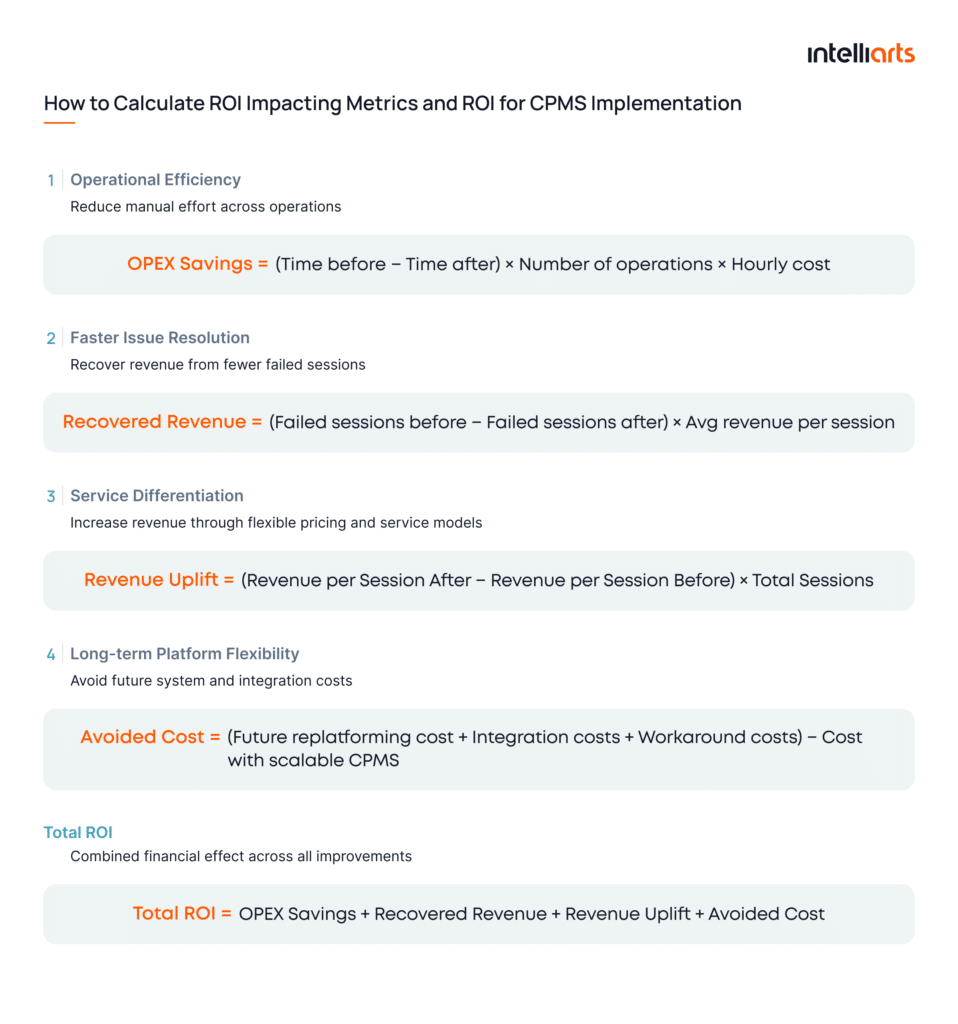
In practice, ROI is driven by a combination of reduced operational costs and improved revenue capture across the charging network.
Final take
Custom CPMS development becomes relevant when operational complexity starts to limit control, scalability, and revenue potential. As networks grow, challenges shift from infrastructure to orchestration, integrations, and reliability. Operators must evaluate whether adapting, integrating, or building a CPMS aligns with long-term goals. In practice, ROI is driven by efficiency gains, reduced failures, and better monetization. The right approach ensures scalable operations without introducing additional system constraints.
Over the course of 26 years delivering custom AI and conventional software, the Intelliarts team acquired industry-leading expertise and experience across domains, including EV. With 54% of in-house engineers being senior-level and 90% customer return rate, we are ready, willing, and able to contribute to your best CPMS development project.
FAQ
What is custom CPMS development?
Custom CPMS Development is the process of building a tailored charge point management system for specific charge point operations. It delivers an EV charging software solution with a flexible CPMS solution and full control over EV charger management.
When does it make sense to build a custom CPMS?
Custom CPMS development makes sense when charge point operations require unique workflows, deep integrations, or high scalability. It fits operators with complex EV charging infrastructure and those who need advanced smart charging and control of an EV charging network.
Can operators customize an existing CPMS instead of building one?
Yes, operators can customize existing charge point operator software instead of full CPMS Development. Many EV charging software supports APIs and extensions, but they offer less flexibility than a fully custom CPMS Engine.