
Switching transportation to electric power is more urgent than ever. Yet, electric vehicles place new pressure on the grid. Driving an EV about 160 km uses roughly the same electricity as a typical household needs for a day. Why?
Power systems were built for one-way traffic. Electricity flows in, gets used, and that’s it. Vehicle-to-grid technology (V2G) flips that logic. When parked and plugged in, EVs become batteries that push energy back to homes, buildings, and the grid when demand spikes.
In this article, we’ll look at how V2G technology works, its key components, the benefits it offers to society, and the core differences between V2G, V1G, and V2H, drawing on our hands-on work with platforms like EVIQ and EVConnect.
Turn idle EVs into energy assets for your fleet.
Reduce energy expenses and get more value from every vehicle in your fleet.
Explore our services
What is vehicle-to-grid technology?
Vehicle-to-grid, or V2G, is a smart technology that lets car batteries discharge excess energy back to the power grid when they’re plugged in.
Normally, electricity flows one way: a power plant → grid → homes, factories, and cars.
V2G solutions invert that setup. Bidirectional charging stations can both charge EVs and send electricity back to the grid. In simple terms, V2G means:
- EVs store electricity while charging
- The grid can borrow some of the stored energy later
- Power can move in both directions
A system like this is a part of a larger concept: vehicle-to-grid integration (VGI). Cars parked in garages become useful energy storage. Thousands of plugged-in cars stabilize the grid and supply power to nearby buildings.
How does V2G work in practice?
V2G is simple in concept, but in reality, it depends on a stack of hardware, software, and communication infrastructure. It starts when an EV connects to a bidirectional charger, which can both:
- Deliver electricity to the vehicle battery
- Send electricity from the battery back to the grid
Once connected, the software layer monitors electricity demand and available supply. It then decides when the vehicle should charge or discharge based on overall system needs.
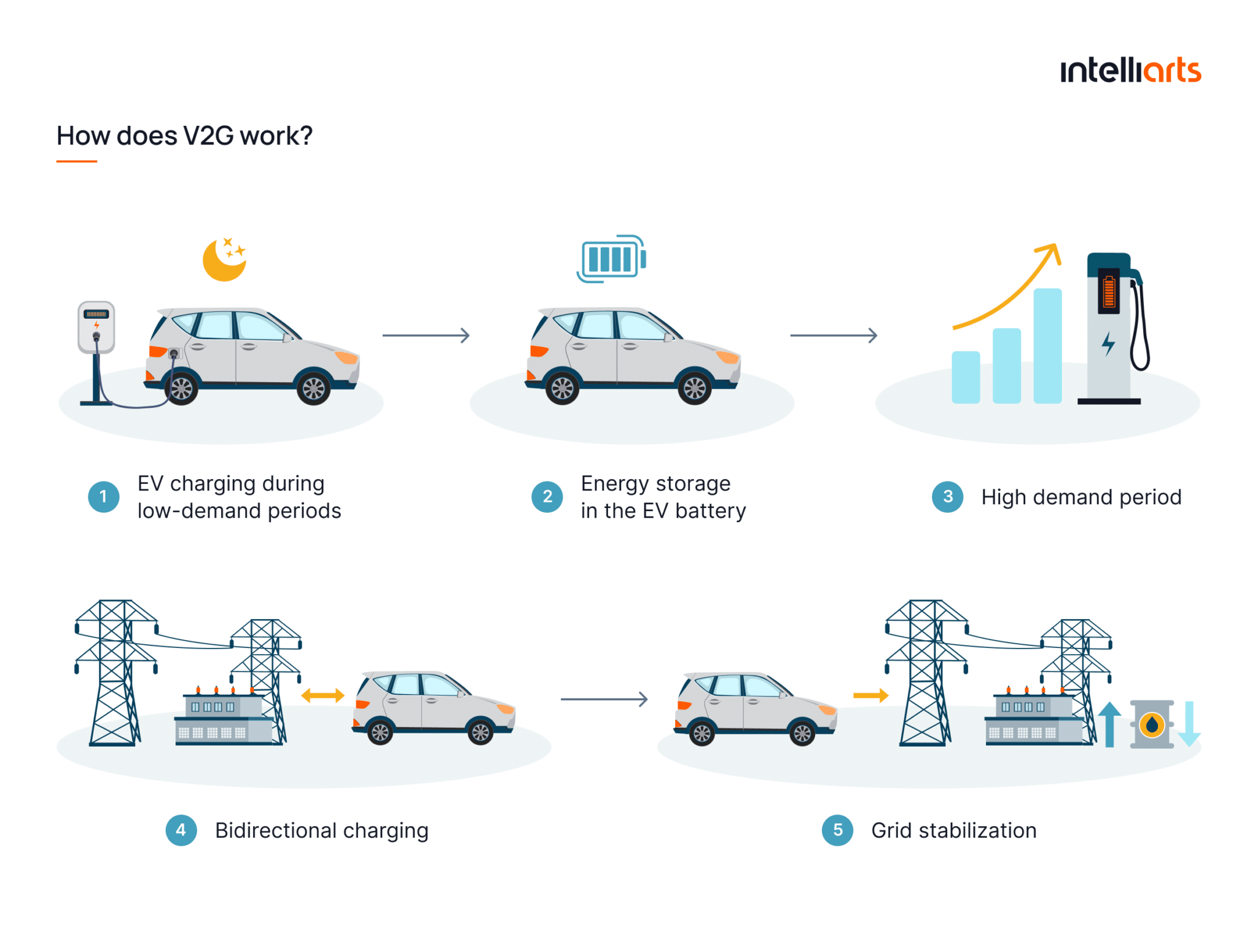
A typical flow looks like this:
- The EV connects to a bidirectional charger
- The system monitors real-time grid demand
- It sets a charging or discharging schedule
- If the electricity supply is high, the car continues charging
- If demand increases, the system uses energy from EV battery storage
- Energy flows between the EV and the grid accordingly
- All activity is recorded for billing and compensation
We’ve seen such grid balancing strategies many times in other forms. For example, some power plans offer lower prices during quiet hours to encourage charging when demand is lower.
What makes it even better? Once everything works, it largely takes care of itself. The system charges a vehicle when electricity is abundant, and sends power back when the grid needs it most.
What are the core components of a vehicle-to-grid system?
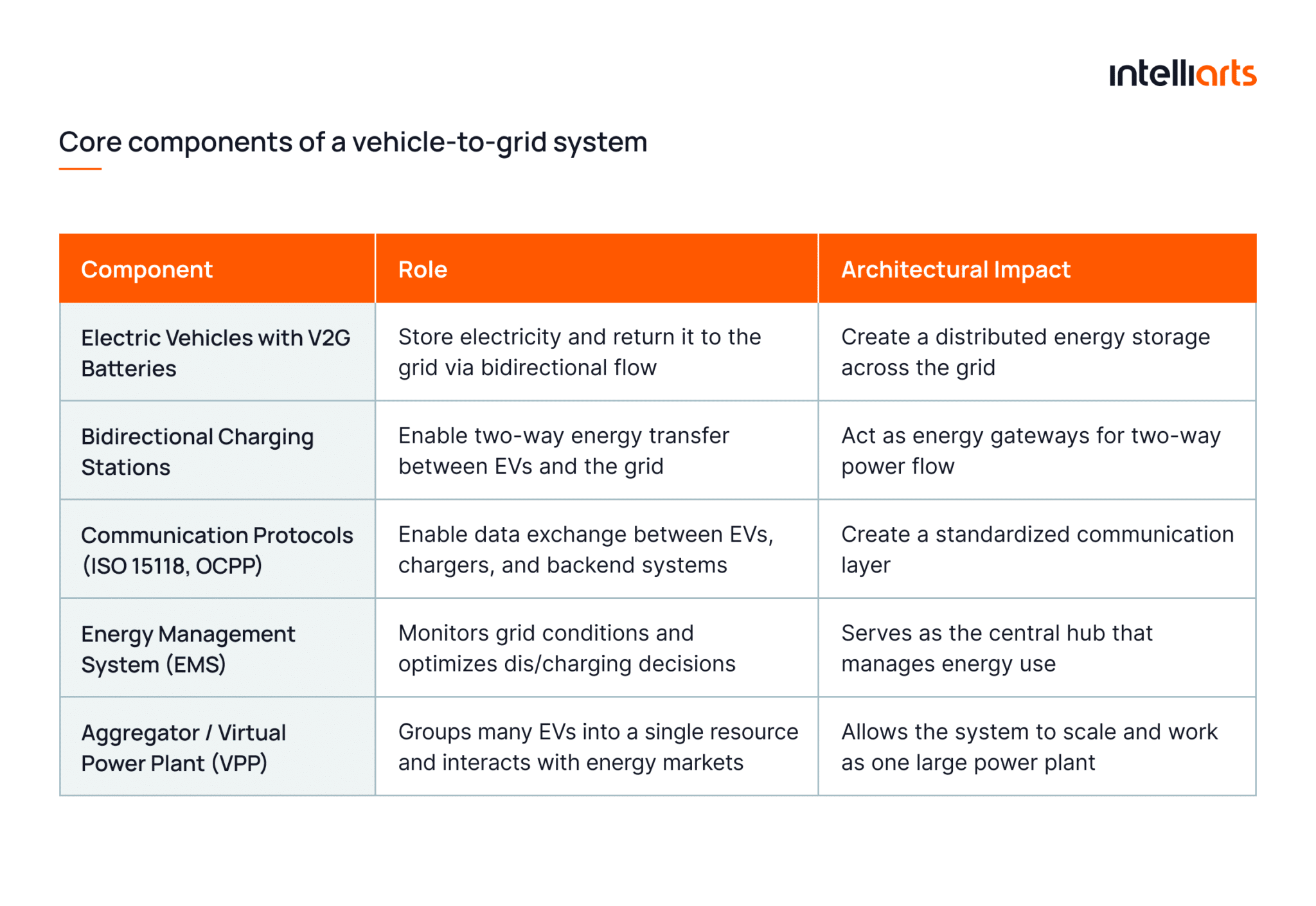
Vehicle-to-grid systems use a multi-layer infrastructure. Each part plays its role: storing energy, moving it, and coordinating when it flows to or from the grid. Let’s explore in detail.
1. V2G electric vehicles
In the V2G setup, EVs are basically mobile power banks. Their batteries store electricity during charging and can give some of that power back to the grid later.
Not every EV can do this yet. The car must support bidirectional power flow, which means electricity can move both into the battery and out of it.
Main things the EV does:
- Stores electricity in the battery
- Supplies energy back to the grid when needed
- Connects to the system through a compatible charger
From what we’ve learned, cars with larger batteries can return more electricity, which gives the grid a bigger buffer when demand climbs.
2. Bidirectional charging stations
A regular EV charger pushes electricity into the car. A bidirectional charger can also pull energy from the battery and send it back to the power network.
What a V2G EV charger can do:
- Charge the EV battery
- Move electricity from the battery to the grid
- Pass data to grid management systems
3. Communication protocols (ISO 15118 and OCPP)
Vehicles, chargers, and grid software need a way to connect. Two standards guide most of this communication.
- ISO 15118 – defines how an EV and a charging station exchange data. It supports automated charging control and bidirectional power transfer.
- Open Charge Point Protocol (OCPP) – connects charging stations with central management systems. Operators use it to watch stations, control charging sessions, and manage networks.
Combined, these protocols support communication, automation, remote control, and secure data handling.
We’ve built similar logic a few times. For one client, we implemented OpenADR-based load management that connected energy systems to utility signals, giving operators control over how and when assets respond.
Explore protocol-first architectures.
Learn why OCPP, OCPI, and ISO 15118 are key to scaling.
Download our white paper
4. Energy Management System (EMS) software
The energy management system (EMS) is the main decision-maker for the entire V2G. It checks grid conditions in real time: electricity demand, available generation, and grid stability.
Based on that information, EMS decides when vehicles should charge normally, release some electricity, or stay idle. Everything happens automatically once the vehicle connects to the charger.
What the EMS does:
- Optimizes charging and discharging schedules
- Balances cost savings and battery health
- Forecasts energy demand and supply
5. Aggregator/Virtual Power Plant (VPP) platform
A single EV doesn’t make much impact on the grid. But when hundreds are combined, they become a huge energy source.
Many V2G systems use aggregation platforms to group vehicles, or distributed energy resources (DER), into one Virtual Power Plant (VPP) and operate at scale.
How a VPP works:
- Unites many EVs into a controllable resource
- Dispatches energy to the grid when needed
- Participates in energy markets
Provides services like demand response and frequency regulation
Consult Intelliarts for custom V2G software and management solutions. Get in touch
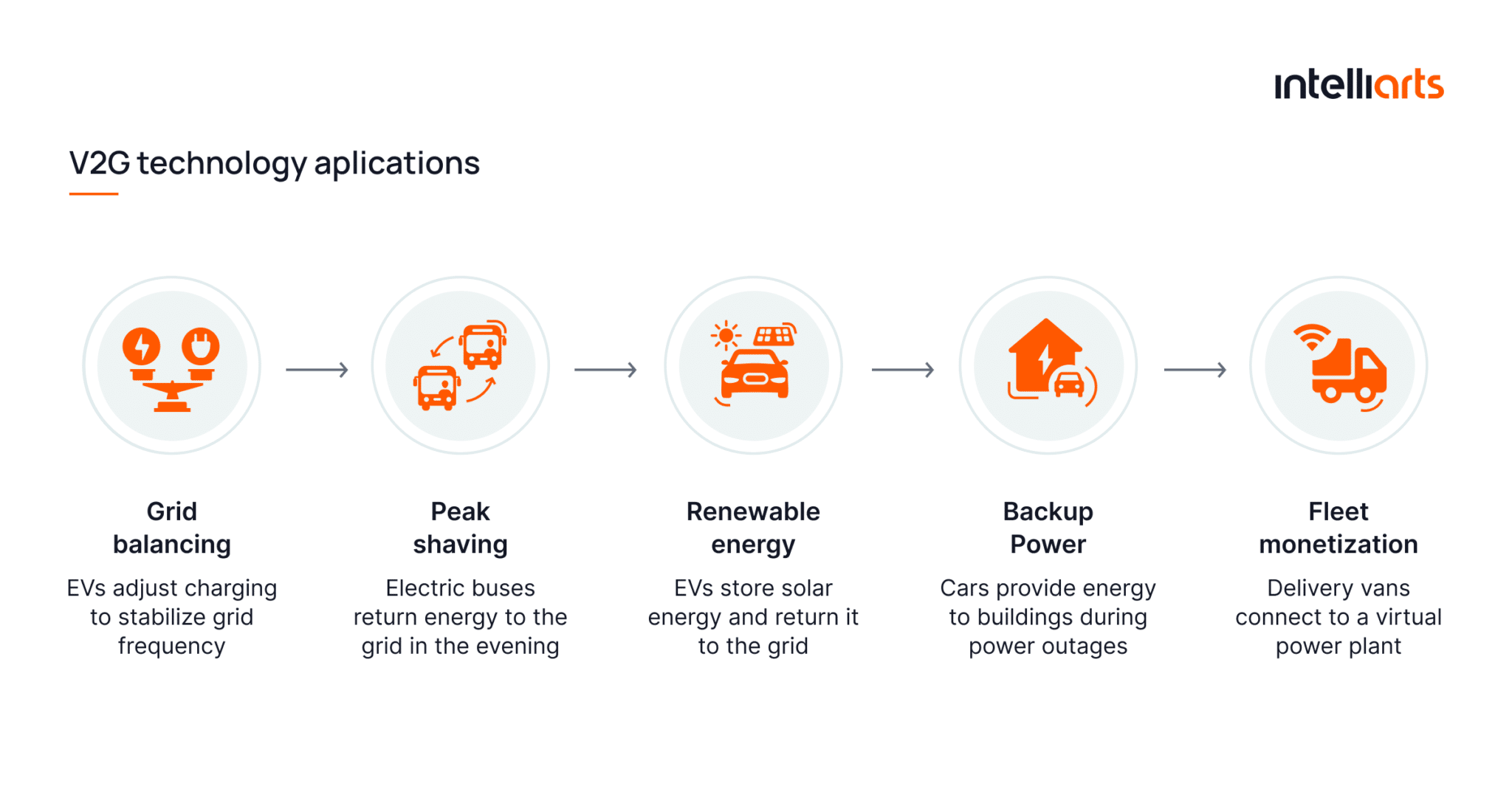
What are the main applications of V2G technology?
V2G solutions already have many practical use cases, including peak shaving, frequency control, and congestion management. Let’s look at some real-world cases.
Grid balancing and frequency regulation
Electric grids must stay balanced. Supply and demand need to match from second to second. If they drift apart, the grid frequency moves outside the safe range, which can damage equipment or cause outages.
Electric vehicles connected through V2G correct these small swings. Studies show that a single EV can deliver up to about 20 kW back to the grid, which makes it suitable for frequency regulation programs.
- Real-world case: In February 2024, a fleet of Nissan LEAF EVs in Australia helped stabilize the national grid during a transmission outage. When frequency dropped, the connected EVs delivered power back within 6 seconds, each at up to 5 kW.
Peak shaving
Mornings usually bring the highest consumption of electricity, so utilities use additional generation capacity, which increases costs. V2G redirects part of that demand to quieter hours.
In practice, we’ve found that vehicle-to-grid programs transfer 2.7% to 4.3% of charging loads from peak to off-peak periods at the city level. Even such a small reduction is important, as peak electricity is the most difficult to supply.
- Real-world case: Renault Group, together with the Municipality of Utrecht in the Netherlands, deployed a V2G car-sharing fleet. Vehicles charge during off-peak hours and discharge energy during morning peaks, helping balance demand without extra generation.
Renewable energy integration
Existing storage systems can absorb only part of the renewable energy, while sudden surges (like strong winds) push them to their limits. Over our 9 years in the renewable energy field, we’ve seen this gap more than once.
V2G helps store that extra energy instead of letting it go to waste. Parked vehicles absorb surplus electricity when renewable output is high. Later, when production drops, those same vehicles send part of the stored energy back.
- Real-world case: In April 2025, China launched multiple grid-connected V2G pilot stations that combine EV charging with onsite solar and storage systems to provide electricity back to the grid when needed.
Backup power for buildings (V2B)
Vehicle-to-grid ideas also work on a smaller scale. In this case, the energy flows between the car and a building, with the electric vehicle being a temporary backup battery. Many people call this vehicle-to-building, or V2B.
- Real-world case: During Hurricane Beryl in Texas, EVs (including Ford F‑150 Lightning and Tesla Cybertruck) supplied electricity to homes when the grid went down.
Fleet energy monetization
Large vehicle fleets create one of the strongest business cases for V2G, as we’ve seen in our projects. Since fleets spend long periods parked, they can connect hundreds of vehicles into a “virtual power plant.”
When demand spikes, the system pulls small amounts of energy from those batteries, compensating the operator.
- Real-world case: An independent analysis of a vehicle‑to‑grid pilot in Australia found that EV fleets could earn the equivalent of about C$10,700 per EV annually by participating in grid services.
What are the benefits of vehicle-to-grid systems?
Vehicle-to-grid systems help reduce energy costs, improve grid stability, and even monetize surplus energy by feeding it back when demand is high.
Even though V2G has been around since the 2000s, we see the industry only starting to reap its benefits. Fraunhofer Institutes for Transport & Environment estimate that widespread V2G use could save the EU up to €22 billion annually by 2040.
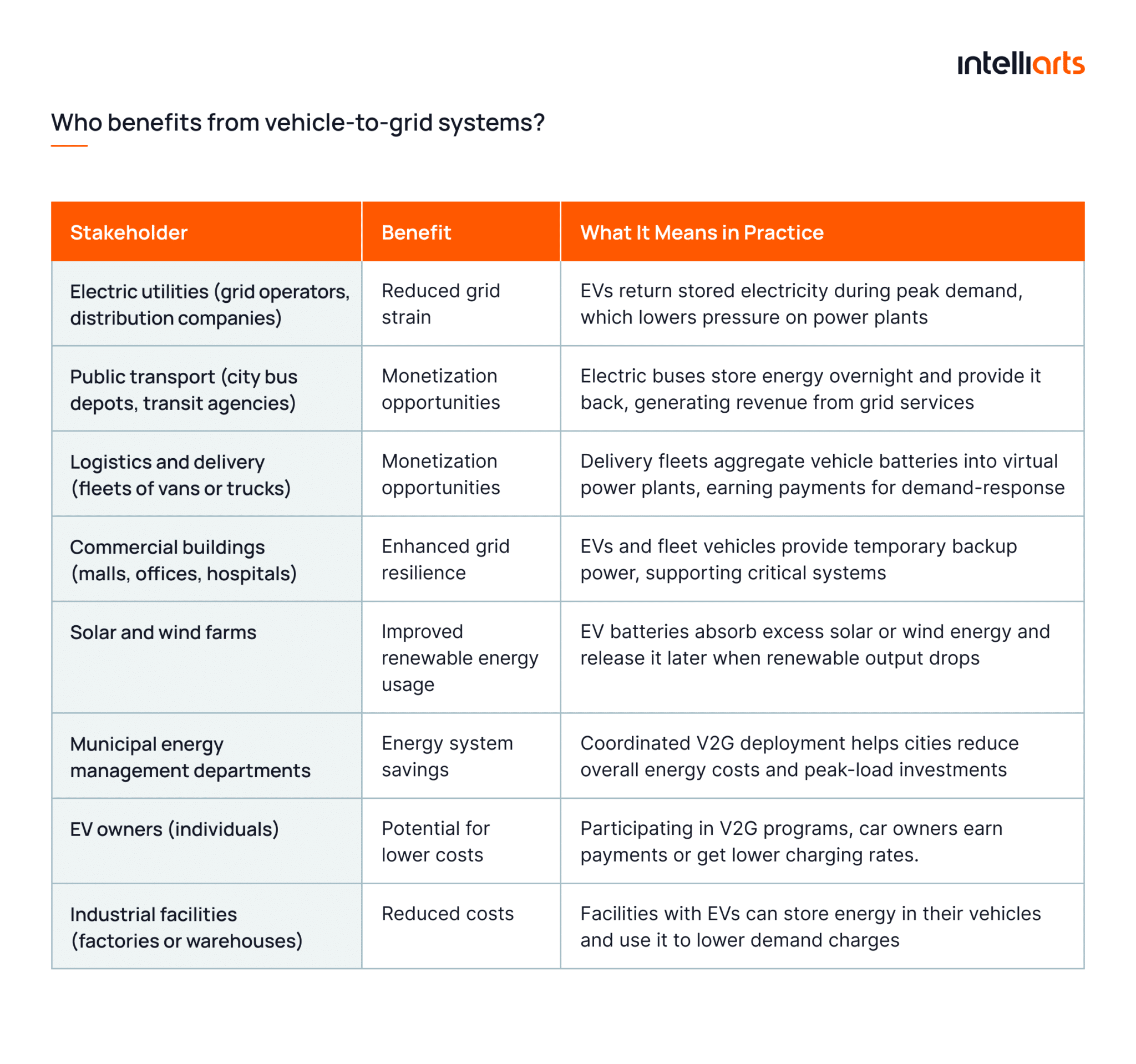
To give you a quick snapshot, here’s a concise table of the key benefits of V2G, describing its value for both operators and EV owners.
Discover real results from our EV fleet management project. Check out the case study
What are the technical and regulatory challenges of V2G?
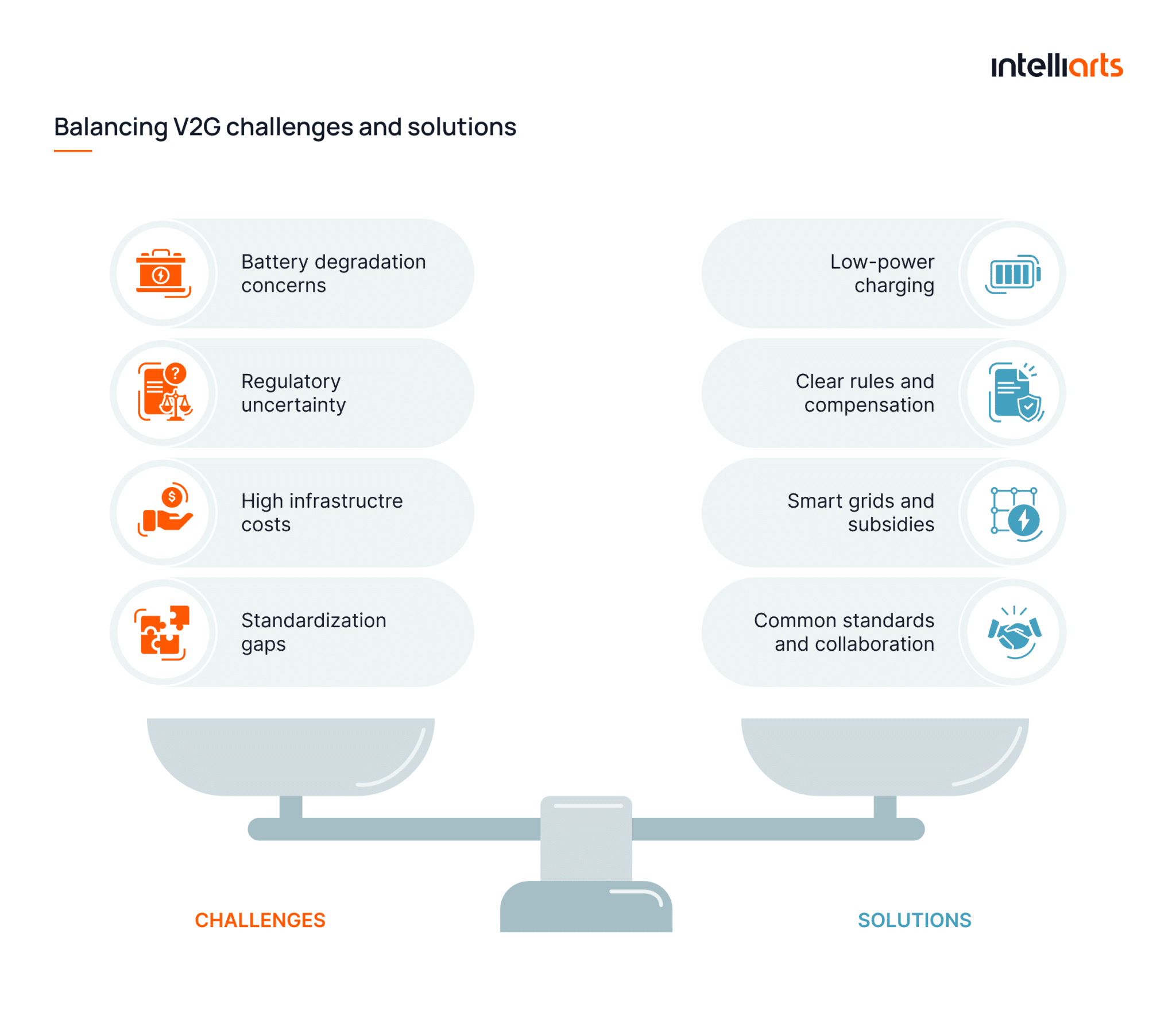
Despite its promise, there’s still a long way to go before the vehicle-to-grid chargers market becomes popular. Most existing vehicles are still unidirectional, although progress is steadily being made. Some issues block wider V2G adoption:
Battery degradation concerns
One common concern is that frequent charging and discharging cycles can accelerate battery wear. Accordingly, this could reduce its lifespan and lead to higher replacement costs.
- Expert comment: We work with e-mobility systems, and we find this risk overstated. A discharge rate of around 3 kW, typical for V2G, is unlikely to have a noticeable impact on the battery. Since V2G relies on low-power AC charging, similar to home charging, it doesn’t appear to place unusual stress on the battery.
Regulatory uncertainty
Rules around V2G are still a bit unclear. There’s often no answer to who’s allowed to sell energy back to the grid, whether you need a special license or how taxes apply to that income.
For example, in some countries, only certified energy suppliers can participate in electricity markets. So even if your EV can technically send power back, you might not be legally allowed to sell it.
Payment is another grey area. In one region, you might get compensated at wholesale prices (which can drop below €0.05/kWh), while in another, subsidies might temporarily boost that to €0.20/kWh or more.
- Expert comment: The main blocker here is not technology, but market structure. With clear rules, standardized settlement, and aggregator support, V2G scales quickly. Often, the systems are ready, it’s the market that isn’t.
Infrastructure costs
V2G could reduce the need for building new power plants, which sounds great in theory. But getting there isn’t cheap. A bidirectional charger alone can cost anywhere from €3,000 to €10,000, which is way more than a standard home charger.
Then there’s the grid itself. Upgrading local transformers and distribution lines across entire cities or regions can cost millions, and that’s before factoring in software and control systems. And even when funding is available, these upgrades can take years to plan and implement.
- Expert comment: Smart grids, subsidies for chargers, and incentives for early adopters can help spread costs over time. From our side, we usually push customers toward pilots first, to gather more data before making bigger upgrades.
Standardization gaps
Right now, there’s no single standard that everyone follows for V2G. Different car brands, charger manufacturers, and software providers often use their own systems.
For example, the Nissan Leaf already supports bidirectional charging using CHAdeMO. In contrast, the Tesla Model 3 does not support V2G and uses its own charging system instead of ISO 15118.
- Expert comment: Using ISO 15118 as a common base, along with OCPP and OCPI, makes things a lot easier in real life. Most of the complexity ends up in integration work instead of the technology itself if you don’t have that.
What’s the difference between V2G, V1G, and V2H?
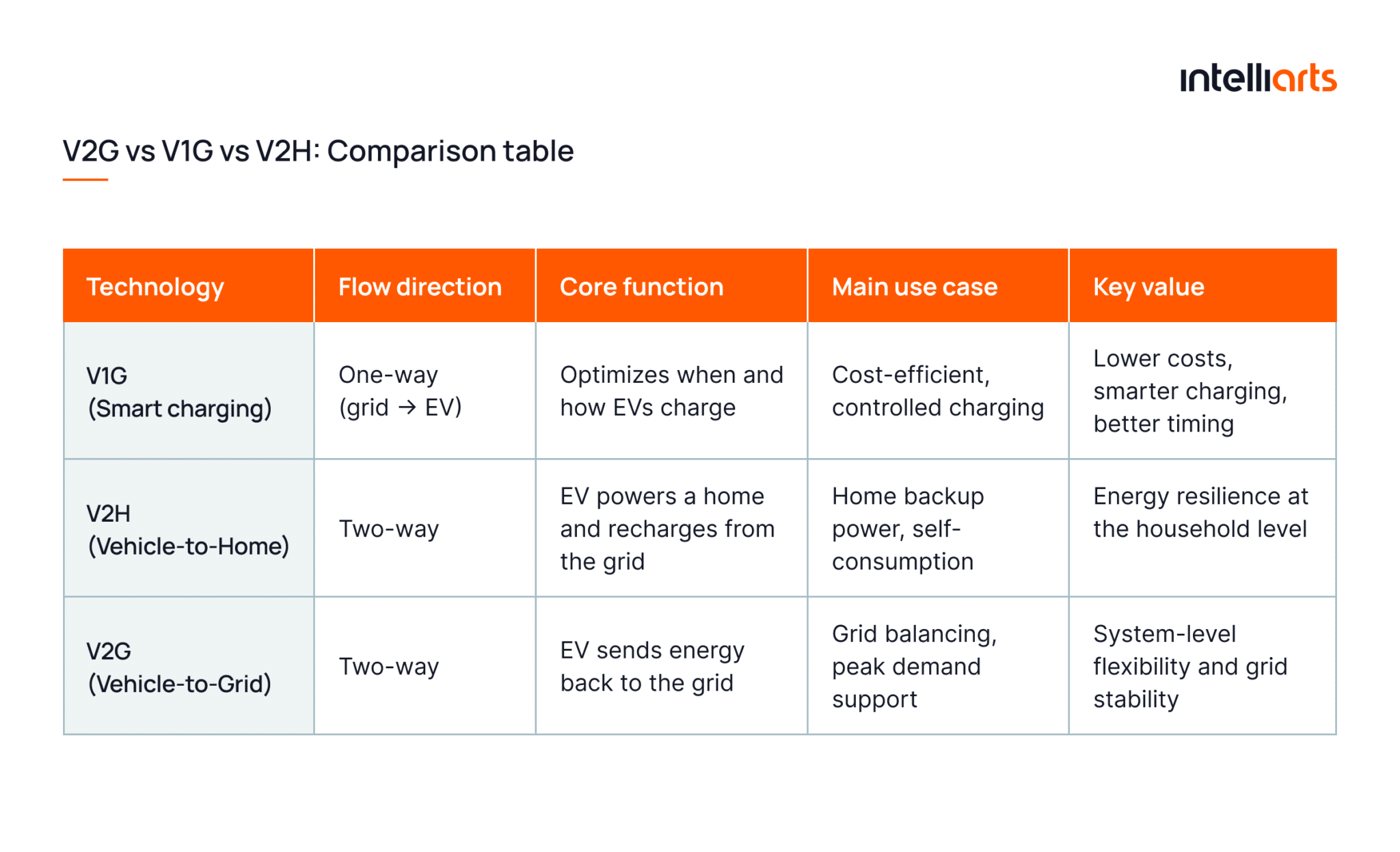
Smart charging comes in more than one form. V1G, V2G, and V2H each have a different role, some simpler, some more advanced. Let’s break them down.
V1G (Smart One-Way Charging)
V1G is the basic form of smart charging. Energy flows only from the grid to the EV, but charging is optimized using station data.
It helps:
- Schedule charging at cheaper or cleaner times
- Reduce costs and peak load
- Monitor and optimize energy use
V2H (Vehicle-to-Home)
V2H allows energy to flow both ways between an EV and a home or building. It helps balance fluctuating renewable energy and provides backup during outages.
It’s used for:
- Powering homes or buildings with stored EV energy
- Local energy balancing, especially with renewables
V2G (Vehicle-to-Grid)
With V2G, EVs can send electricity back to the grid through bidirectional charging. It also coordinates communication between vehicles, chargers, and control systems.
V2G can:
- Balance grid demand and supply
- Integrate renewable energy
- Reduce system costs with stored energy at peak times
While still not widely deployed, examples exist, for instance, TEPCO in Australia has tested V2G systems using Nissan LEAFs in grid-balancing pilots.
When should companies invest in vehicle-to-grid solutions?
The short answer: when V2G stops being a technical possibility and becomes a predictable business case.
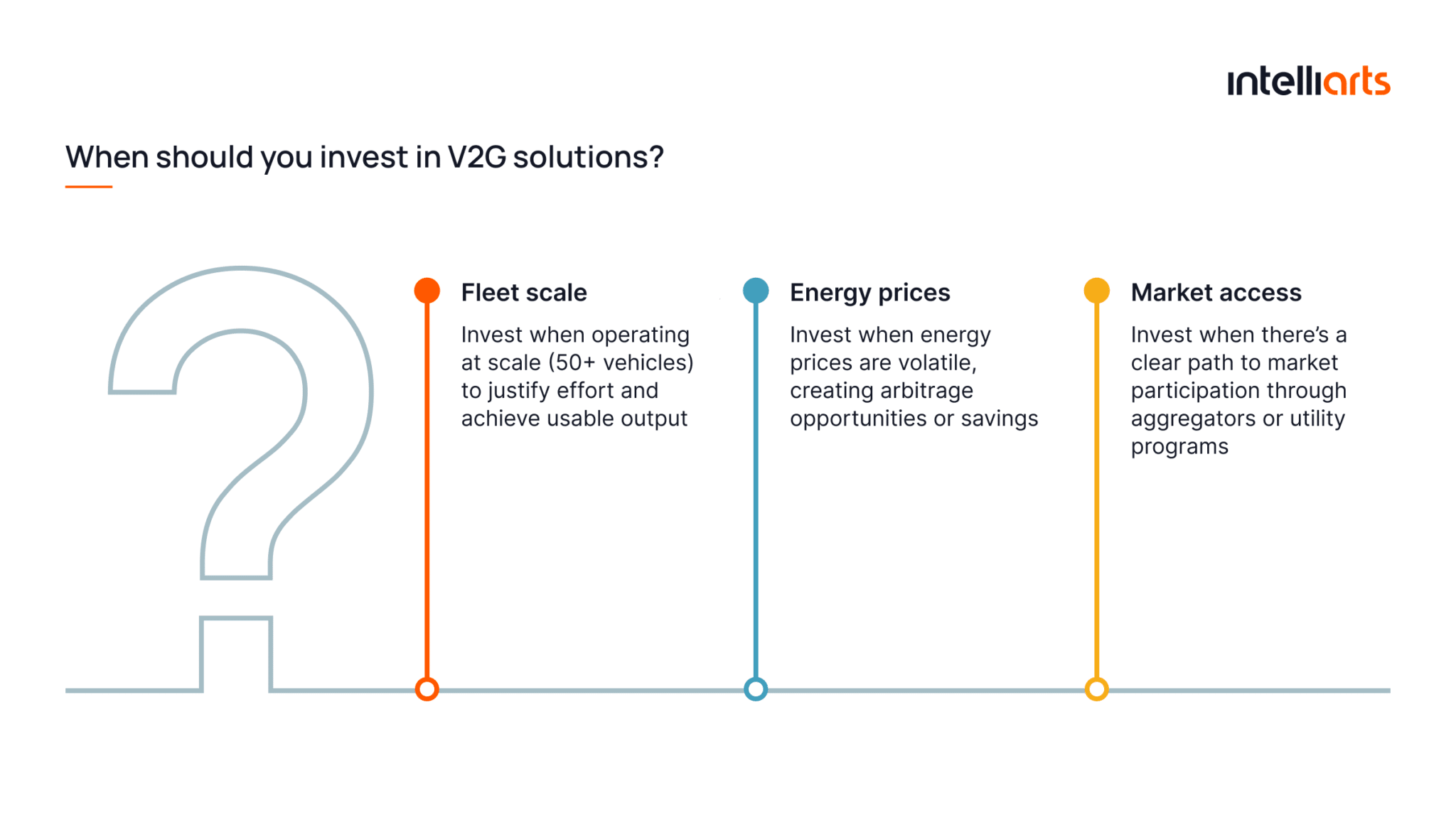
For this to happen, a few key conditions should come together: a large enough fleet, volatile energy prices, and a clear path to working with the grid. Let’s go into detail.
1. When fleet scale thresholds
With a small fleet, V2G is more of an experiment than a strategy. The revenue (or savings) simply won’t justify the effort. But once you’re operating at scale (typically 50+ vehicles), even modest per-vehicle output adds up to something usable.
In our experience, the sweet spot is fleets with predictable downtime (overnight parking, scheduled routes). That’s when you can reliably “offer” energy to the grid without any drawbacks.
2. When energy prices create real arbitrage or savings
V2G only works financially if there’s a gap between when you buy electricity and when you sell (or avoid buying) it. If your energy costs are fixed, the upside is limited.
For those of our partners who’re exposed to time-of-use tariffs or real-time pricing, the economics improve a lot. Even a €0.10–0.20/kWh spread can be huge at scale, so we generally recommend taking advantage of it where the setup allows.
3. When there’s a clear path to market participation
Technically, your vehicles might be V2G-ready, but that doesn’t mean you can monetize them. In many markets, you can’t just “sell electricity” directly.
Working with aggregators or utility programs may be helpful here. They take care of market access, bundle capacity, and manage grid communication. Without them, most companies won’t get far.
From what we’ve learned, V2G projects only move beyond pilots when there’s a defined partner and revenue model in place. Otherwise, they tend to stall at the proof-of-concept stage.
Conclusion
Growing demand for electricity puts new pressure on grids built for one-way power flow. Vehicle-to-grid (V2G) offers a smart solution: parked EVs can store energy and feed it back to the grid when it’s needed most.
Of course, adoption challenges remain, but when fleets are large, energy prices fluctuate, and access to the grid is secured, V2G starts to have real business sense, making it a huge opportunity to explore.
At Intelliarts, we combine 20+ years of software expertise with deep e-mobility know-how. Our teams support companies with end-to-end software and ML development, including PoC delivery, and expertise in energy protocols like OCPI, OCPP, and OpenADR.
We treat your product as our own, stay focused on results, and build to fit real business needs. Reach out to start your project with a team that gets you.
FAQ
What is the difference between V2G and smart charging?
V2G and smart charging both optimize how your EV interacts with the grid, but the key difference is direction. Smart charging only adjusts when a car charges, based on grid demand or electricity prices. V2G goes a step further, letting EVs send energy back to the grid when it’s needed.
Does V2G damage EV batteries?
V2G is designed to be gentle on batteries. Typical bidirectional discharge rates (around 3 kW for home setups) are similar to regular AC charging and don’t significantly impact battery health. Some manufacturers even set minimum charge limits to protect the battery while keeping it ready for trips.
What standards enable vehicle-to-grid communication?
The main standard is ISO 15118, which defines how vehicles and chargers exchange data for bidirectional energy flows. Other relevant standards include CHAdeMO (primarily DC fast-charging) and Open Charge Point Protocol (OCPP) for managing communication between chargers and the grid.