
With a population of nearly 18 million, Shenzhen was the first major city in the world to operate a fully electric bus fleet. China leads the world in this space, with electric buses making up 30% of its total bus fleet. Europe is catching up fast. From January through September 2025, EU countries registered 6,444 new electric buses. That is 49 percent more than in the same months in 2024. One in five new buses sold in Europe today is electric.
But swapping diesel for electricity is only the beginning. Fleet operators are learning this the hard way. Optimizing charging schedules, tracking battery health, planning routes around range limitations – none of this is manageable without a dedicated fleet management system. This article walks through a step-by-step implementation of an EV fleet management system for public transit.
What is an EV fleet management system?
An EV fleet management system is a software platform used to manage and optimize a fleet of electric vehicles. It helps companies or organizations monitor, control, and improve how their EVs are used, charged, and maintained.
In the context of public transport, the system addresses specific challenges. City buses operate on fixed routes with strict schedules. Depot charging takes place overnight when the entire fleet returns to base. The system must distribute the load on the electrical grid so that every bus is fully charged and ready to depart by morning. Charging optimization alone involves multiple layers which we’ve explored in detail in our overview of smart charging platform features.
Demand for such solutions is growing alongside fleet electrification. The EV fleet management market is valued at $9.1 billion in 2025 and is projected to reach $32 billion by 2030. This growth reflects broader shifts in fleet management technology trends for 2026, including AI-driven analytics, predictive maintenance, and smart energy orchestration.
Core components of the EV fleet management solution
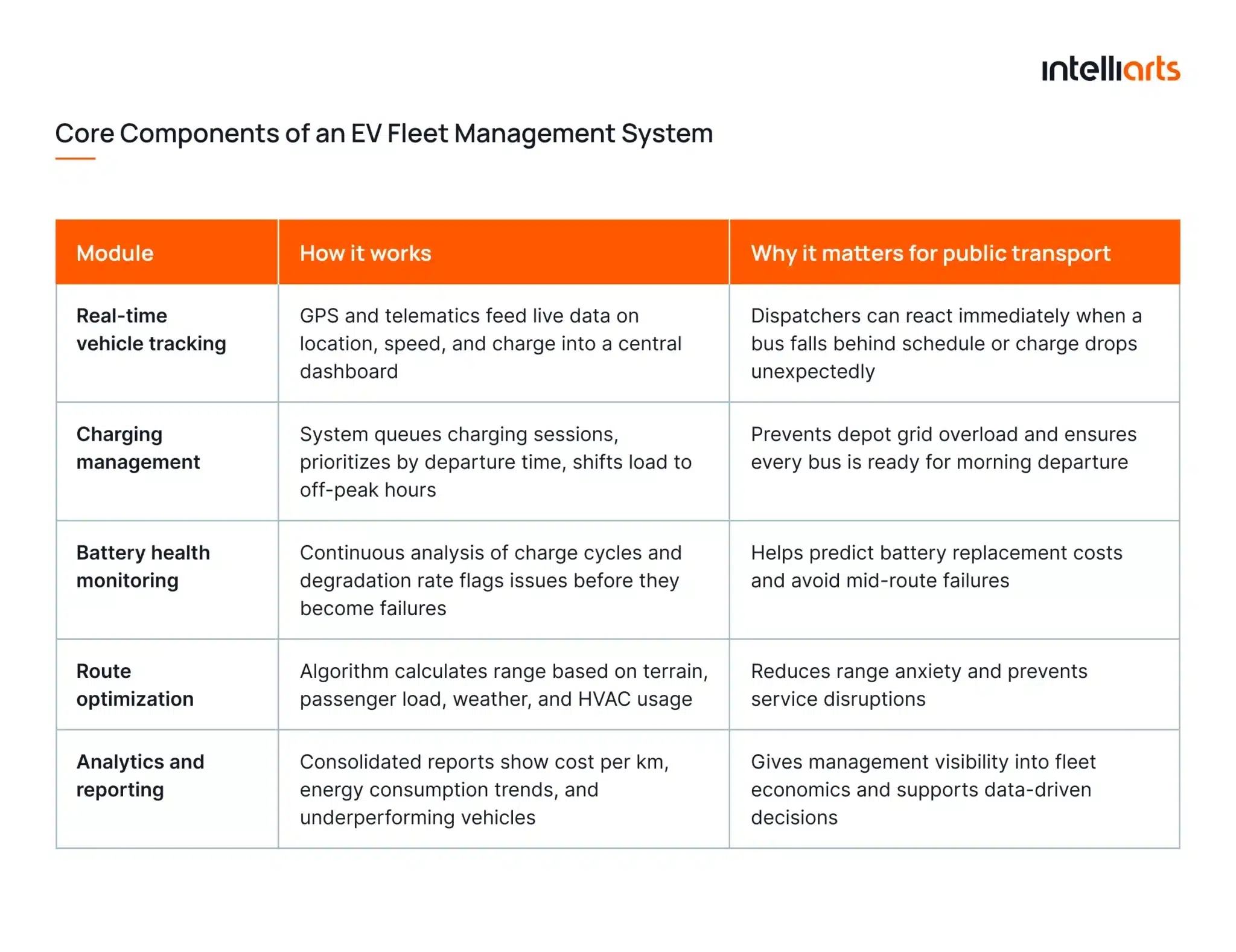
A typical EV fleet management solution consists of several interconnected modules. At its core, the system continuously collects data from vehicles, charging stations, and energy infrastructure, and turns it into operational decisions.
Here are its main features:
- Real-time vehicle tracking gives operators a complete picture of the fleet at any given moment.
- Charging management handles the distribution of charging across vehicles.
- Battery health monitoring tracks the condition of each vehicle’s battery. The system analyzes charging cycles, depth of discharge, and degradation rate.
- Route optimization takes the specifics of electric transport into account when planning routes.
- Finally, route optimization and analytics tie everything together. Operators receive reports on fleet efficiency and the performance of individual vehicles. Read more on the role of analytics in EV energy management.
Steps to implement an EV fleet management system for public transport
Intelliarts is a software development team with over 25 years of experience building complex digital systems across various industries. We have 9+ year expertise in the domain in particular, with industry leaders like EV Connect, EVIQ, and Greenline in our portfolio.
Below is a framework we recommend using when designing an EV fleet management system. Please note that this is not a one-size-fits-all approach but rather a template to guide your process. You should discuss all the details with your chosen vendor throughout the implementation period.
1. Assess the fleet and existing infrastructure
The first step is to build a complete picture of the fleet’s current state. This includes the number of vehicles, route network, average daily mileage, operating schedules, and the age and technical condition of the vehicles.
In practice, energy infrastructure often becomes the main constraint on the system. That is why it is essential to understand from the outset what loads are feasible today and what limits exist for future scaling. This data gives your technical vendor a solid starting point.
2. Map daily operations to system requirements
The next stage involves formalizing operational requirements. Here, it is important not to rely solely on management’s vision but to involve the people who work with the fleet every day since this is where key usage scenarios are defined.
This stage answers the fundamental question of how your fleet management system will actually be used in day-to-day operations.
3. Plan charging infrastructure together with the platform
Charging infrastructure planning runs in parallel with the digital side of the project. The two most common scenarios are depot charging and opportunity charging.
Depot charging suits fleets that return to base at the end of a shift and can charge overnight. Opportunity charging is used for intensive routes where vehicles need top-ups during the day at terminals or hubs.
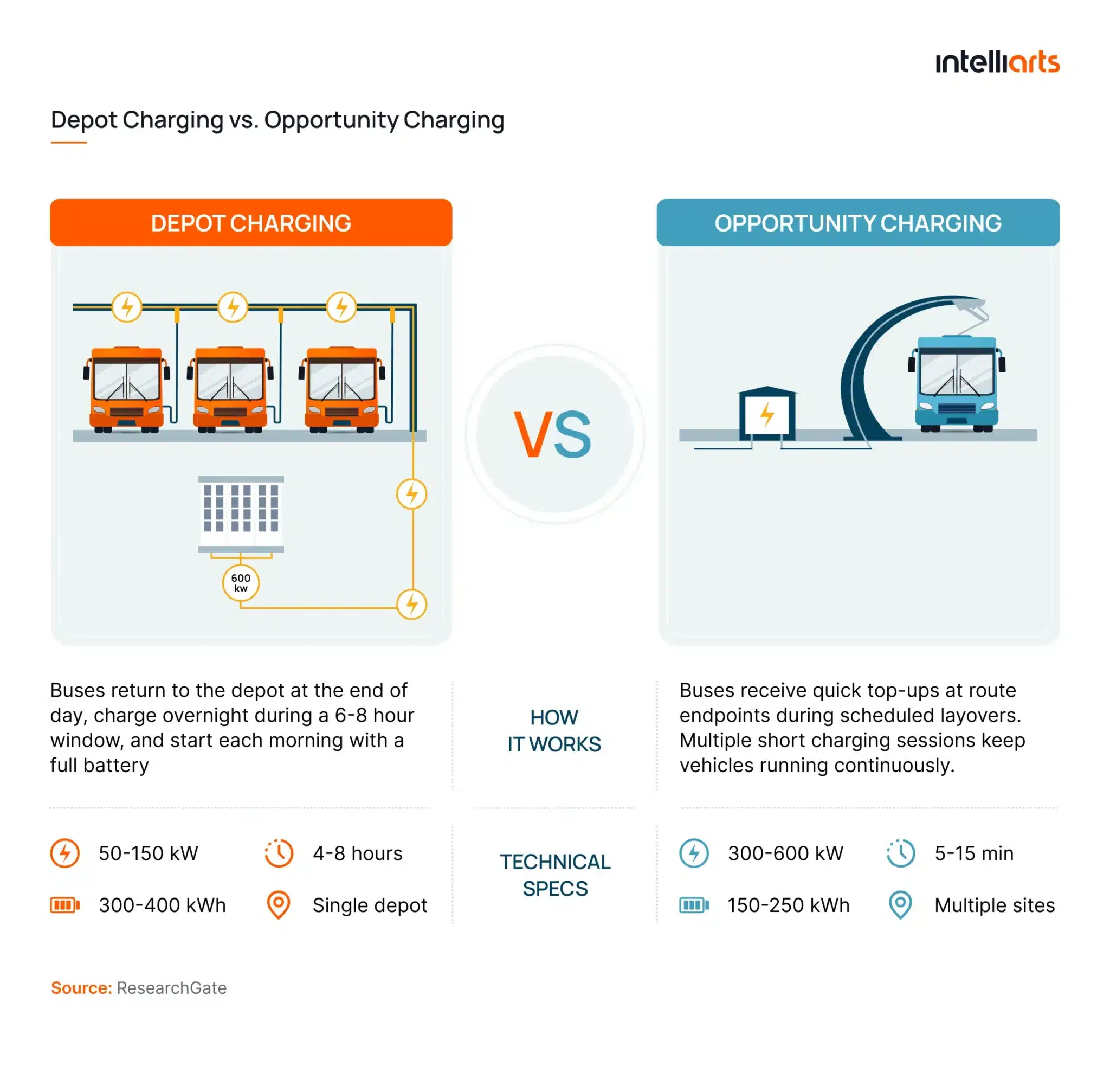
For each scenario, you calculate the number of charging stations, their capacity, usage schedules, and impact on the electrical grid. The main goal at this stage is to find a balance between the fleet’s operational needs and actual infrastructure constraints.
4. Decide on off-the-shelf vs custom software
Off-the-shelf solutions can work for standard cases. However, public transport often involves legacy systems, specific business processes, and regulatory requirements that are difficult to address with out-of-the-box products.
In such cases, custom development offers greater control over architecture and allows the system to adapt to real processes rather than forcing processes to fit the software. Regardless of the approach, it is critical to incorporate open APIs, support for standards such as OCPP, and the ability to scale without redesigning the entire system. For this reason, custom solutions tend to be more cost-effective in the long run. This approach is informed by years of building software for renewable energy and e-mobility sectors.
Project spotlight
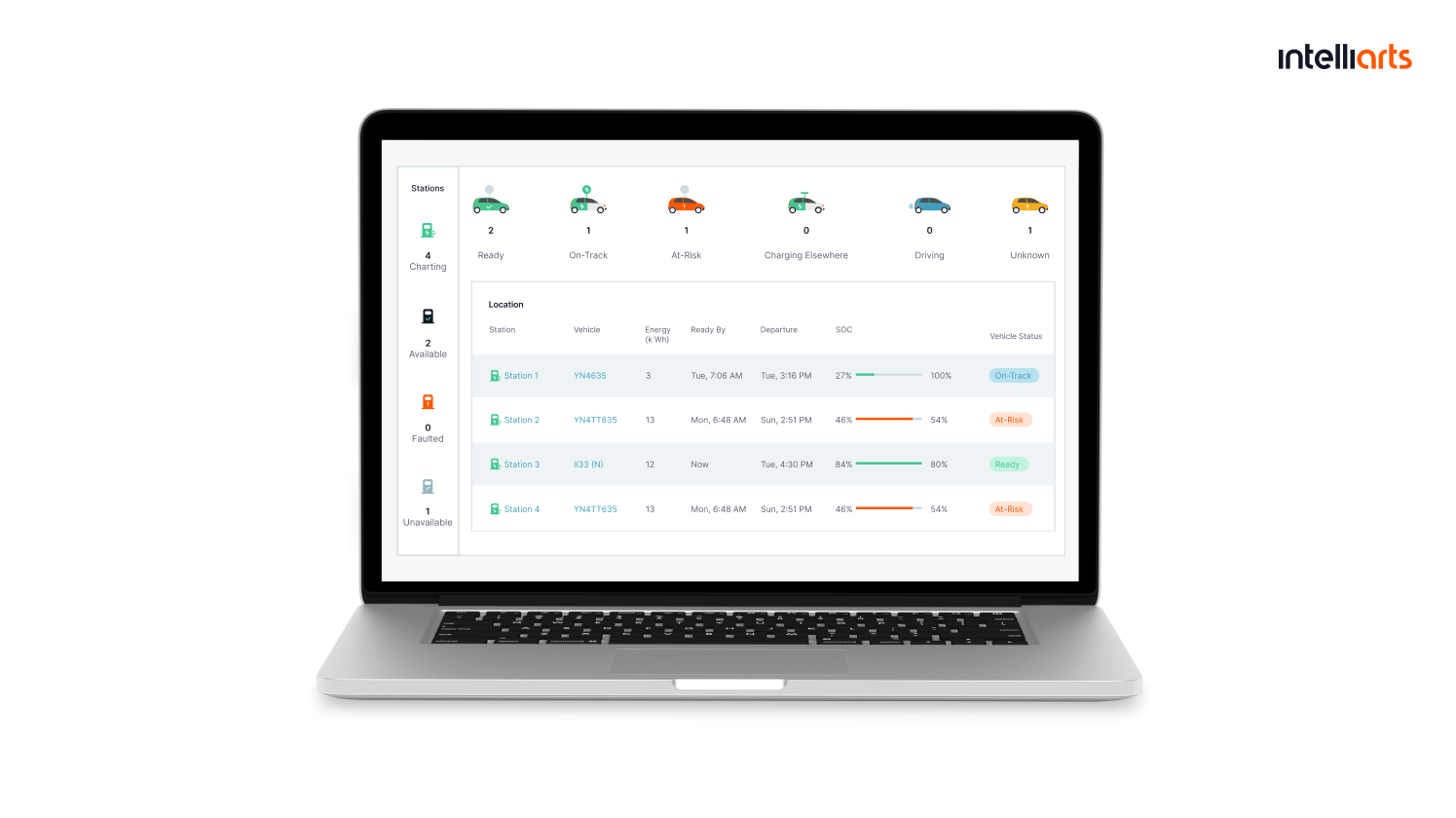
In our recent US-based project for an EV charging provider entering the fleet market, the Intelliarts team built a custom EV fleet management solution tailored to real operational workflows. The system enabled:
- Optimized depot, on-route, and at-home charging
- Energy consumption control and cost reduction
- Automated compensation for at-home charging
- Real-time analytics and battery charge predictions
By integrating telematics and smart energy management, the platform helped fleet operators improve efficiency while keeping charging flexible and scalable. Respectively, we showed how custom architecture can help adapt to complex fleet requirements better.
5. Run a pilot on a limited scope
Before a full-scale launch, the system is typically deployed in pilot mode. The best approach is to implement it on a single route, for example. This allows you to test key hypotheses, collect real data, identify unusual scenarios, and train staff to work with the new tools.
6. Phased rollout and continuous improvement
After a successful pilot, the system scales in phases. As the volume of data grows, opportunities for deeper analytics emerge. From a technical standpoint, this means continuous system evolution. You release regular updates, ensure adaptation to new scenarios, and maintain close collaboration between the engineering team and the client’s operations side.
Helping EV companies become fleet platforms
Explore how we built an end-to-end EV fleet management system with smart energy optimization.
Read the case study
Key challenges and how to address them
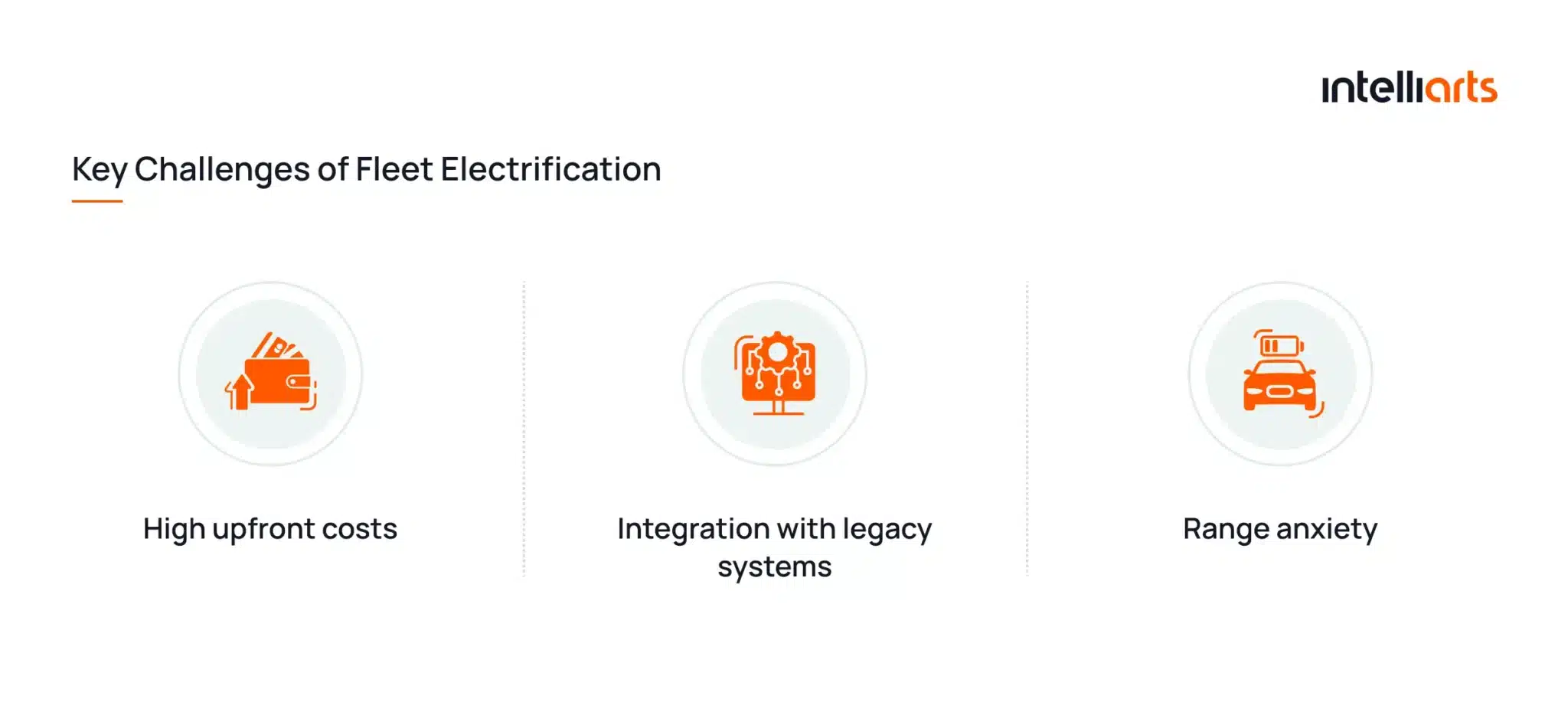
Fleet electrification is not just a matter of technology. In practice, you may encounter a range of obstacles. Below we outline the most common ones and the approaches that typically work.
High upfront costs
Electric buses remain expensive. On average, they cost 1.5 to 2 times more than their diesel counterparts, with additional associated expenses on top of that. For municipal operators working with fixed budgets, this often feels like too risky a starting point.
However, if you look beyond the initial investment, the picture changes. E-buses have no fuel costs, fewer wearing components, and simpler maintenance requirements. Based on our observations, full payback typically occurs between the fifth and eighth year of operation.
It is also worth considering support programs. In the EU, the US, and other regions, governments often subsidize 20 to 60 percent of electric bus and infrastructure costs (for example, the federal EPA Clean School Bus Program in the United States).
Integration with legacy systems
Transport companies do not start from scratch. They already have fully established internal processes. Completely replacing the entire IT infrastructure for the sake of EVs sounds like an almost unrealistic scenario.
That is why EV fleet management software must fit into the existing environment. The practical approach involves open APIs and an integration layer that allows you to connect the new system without dismantling the old one. This is especially critical in public transportation fleet management systems where telematics, dispatch, and ticketing platforms must operate as one ecosystem.
At the same time, in more complex cases, middleware is used to synchronize data between legacy solutions and EV modules. The key principle here is simple: new software should not break processes that are already working.
A fleet management system only works when it truly reflects the day-to-day responsibilities of dispatchers and fits naturally into their workflows. Even the most advanced technology delivers no value if users don’t trust it or if it makes their work more complicated.
– Ihor Rudnyk, E-Mobility Solution Expert
Range anxiety
For operators, this is a very real risk. A bus stopping mid-route can cause serious damage. The solution lies not in larger batteries but in more precise planning. An EV fleet management system works with historical route data, weather conditions, traffic patterns, and actual passenger loads.
In practice, this looks as follows: trips are scheduled with a buffer, and dispatchers receive alerts if projections approach critical levels.
Final take
Electric buses on their own do not solve any operational problems. Without a system that brings daily fleet operations into a unified logic, electric transport quickly becomes a source of constant compromises. A well-designed EV fleet management system for public transport turns electrification into a manageable process.
At Intelliarts, we bring to the table over 20 years of software engineering experience, deep expertise in e-mobility, and cross-functional teams that cover technology consulting through full-cycle development. We help companies design scalable, secure EV solutions, both from scratch and on top of existing platforms, depending on your needs. Our goal is to make sure that electrification delivers measurable business results for our partners, not extra complexity.
FAQ
Will this system work with the software we already use?
We build integration into the design phase from the start. Most operators already have core modules in place, and replacing the entire IT system is usually impractical. That is why we use open APIs to connect the new platform to your existing infrastructure. When standard integrations are not sufficient, we develop middleware that synchronizes data between your current systems and the EV modules.
What's the typical ROI timeline for an EV fleet management system?
It depends on fleet size and the initial state of operations. In our experience, operators begin seeing energy savings and reduced downtime within the first year after implementation. Full system payback typically occurs between the second and third year, taking into account lower operating costs and optimized fleet utilization.
Do you provide training for dispatchers and maintenance staff?
Yes, we do. If needed, team training can become a part of the implementation process. The format depends on your needs and may include online sessions, on-site workshops, or a blended approach. We can also prepare documentation and, upon request, video tutorials for onboarding new employees.