
Solution Highlights
- Migrated an Excel-based search workflow into a full-scale web platform
- Built AI-assisted search to find relevant expert witnesses for unique legal cases
- Automated résumé parsing with AI, reducing costs from $10–14K to about $500–600 per 3,000 résumés
- Cut résumé processing time from up to 1 month to within 24 hours
- Brought expert database maintenance in-house, removing dependence on a vendor

About the Project
Customer:
Our partner is the founder of a California-based legal tech startup. He spent 20+ years in semiconductor manufacturing and worked with patents throughout his career. That experience showed him a gap in litigation: patent disputes often depend on expert testimony, yet the right expert for a highly specialized case can be impossible to find.
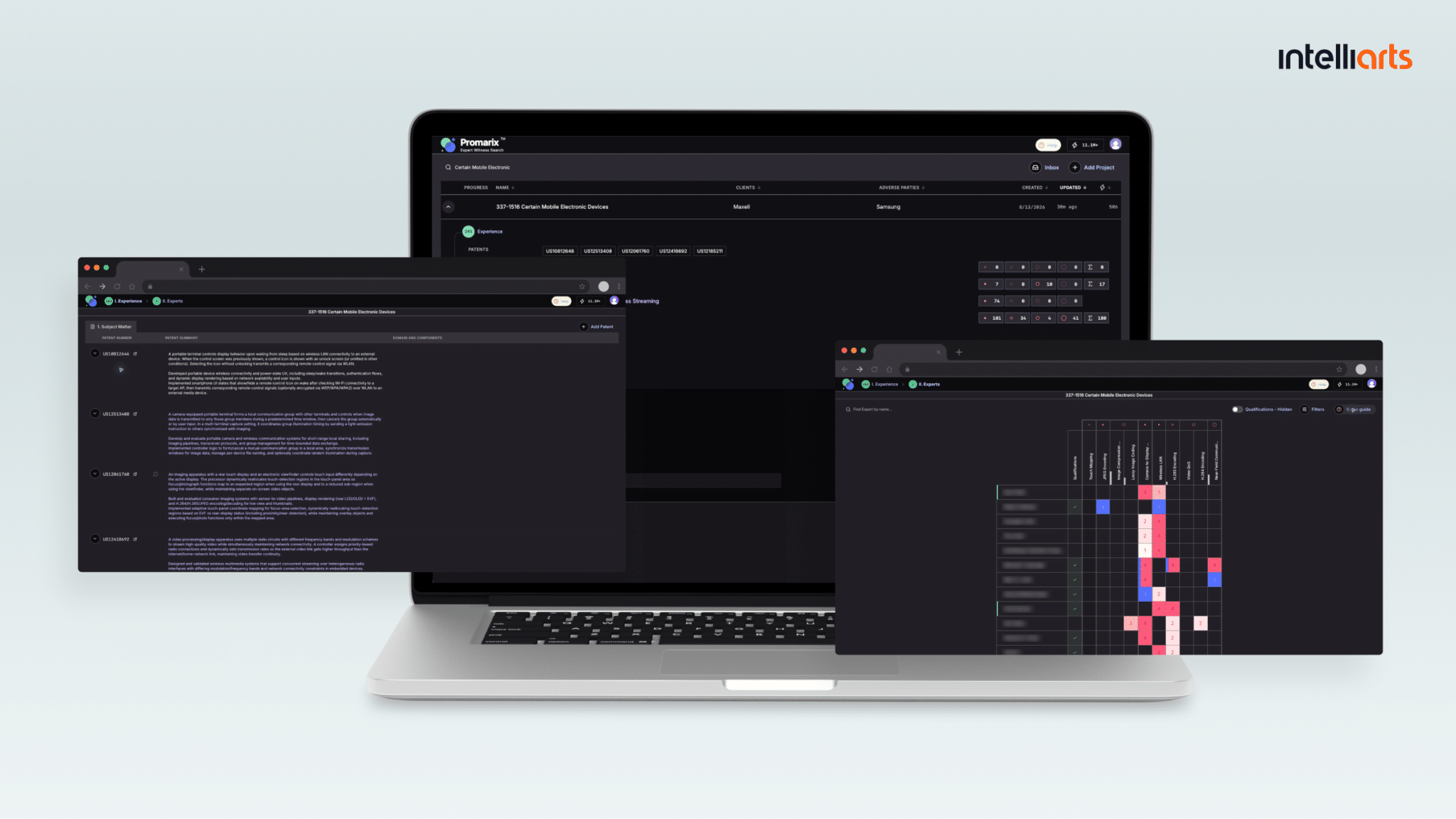
His platform helps litigators close that gap. They enter the patent numbers involved in a case, and the system helps them build a search strategy that surfaces the most relevant experts from a curated database.
Challenges & Project Goals:
The founder ran the entire process in Excel, and he wanted a scalable web product. The bigger problem was hidden in his expert database.
- The database is built from résumés that come from scanned court documents. They range from 10 to 100 pages and are full of OCR errors, broken tables, and formatting issues.
- Before any résumé could be searched, someone had to clean it and sort its content, which cost $10-14K per 3,000 résumés and took up to 1 month.
- The results were almost impossible to verify, because nobody could realistically proofread thousands of résumés.
Solution:
Intelliarts became the founder’s full development team:
- We first moved his Excel workflow into a web application.
- Then we extended it with AI-assisted search that goes beyond his original concept.
- Finally, we removed his most expensive bottleneck with a custom AI pipeline that cleans and categorizes résumés automatically, which the client’s team now runs in-house.
Generative AI, Intelligent Document Processing, Business Intelligence
I initially hired Intelliarts as a contractor to write code, but they became a partner in developing the product… Intelliarts has been responsible for everything related to developing the web application, including AI integration and other services. The team has built the backend, including the database, the frontend, and the UI.

Technology Solution
The project started with a team of four and is now maintained by one engineer, who continues to ship new features. Here are the key decisions that shaped the solution.
1. Migrating the Excel workflow to the web
The project began with the client’s original idea: our engineers rebuilt the search process managed in spreadsheets as a web application.
Users can create a project for each case, or for a group of related cases, because a single patent dispute can run in several venues at once, such as a federal district court, the ITC, and the PTAB.
We deliberately designed the platform for desktop rather than mobile. Expert search is careful, research-heavy work: users need to sit down, read AI-generated context, and make deliberate choices.
2. Building AI-assisted expert search
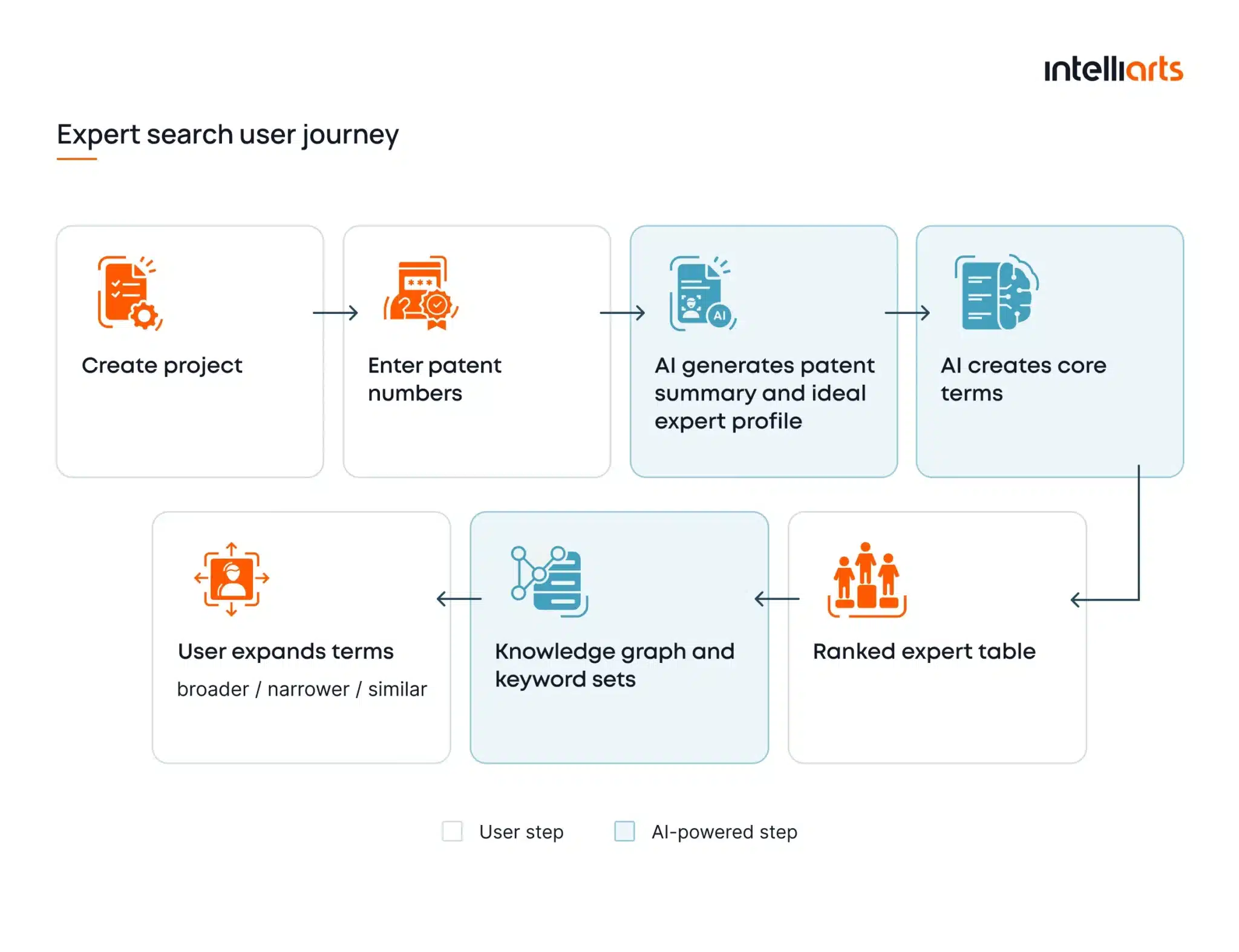
Litigators are legal experts, not specialists in the topics behind their cases. So instead of expecting users to know what to search for, we let AI build the search together with them:
- The user enters one or more patent numbers
- The AI retrieves each patent, writes a readable summary, and describes the ideal expert’s background
- From this input, the AI proposes core search terms, phrases, and definitions
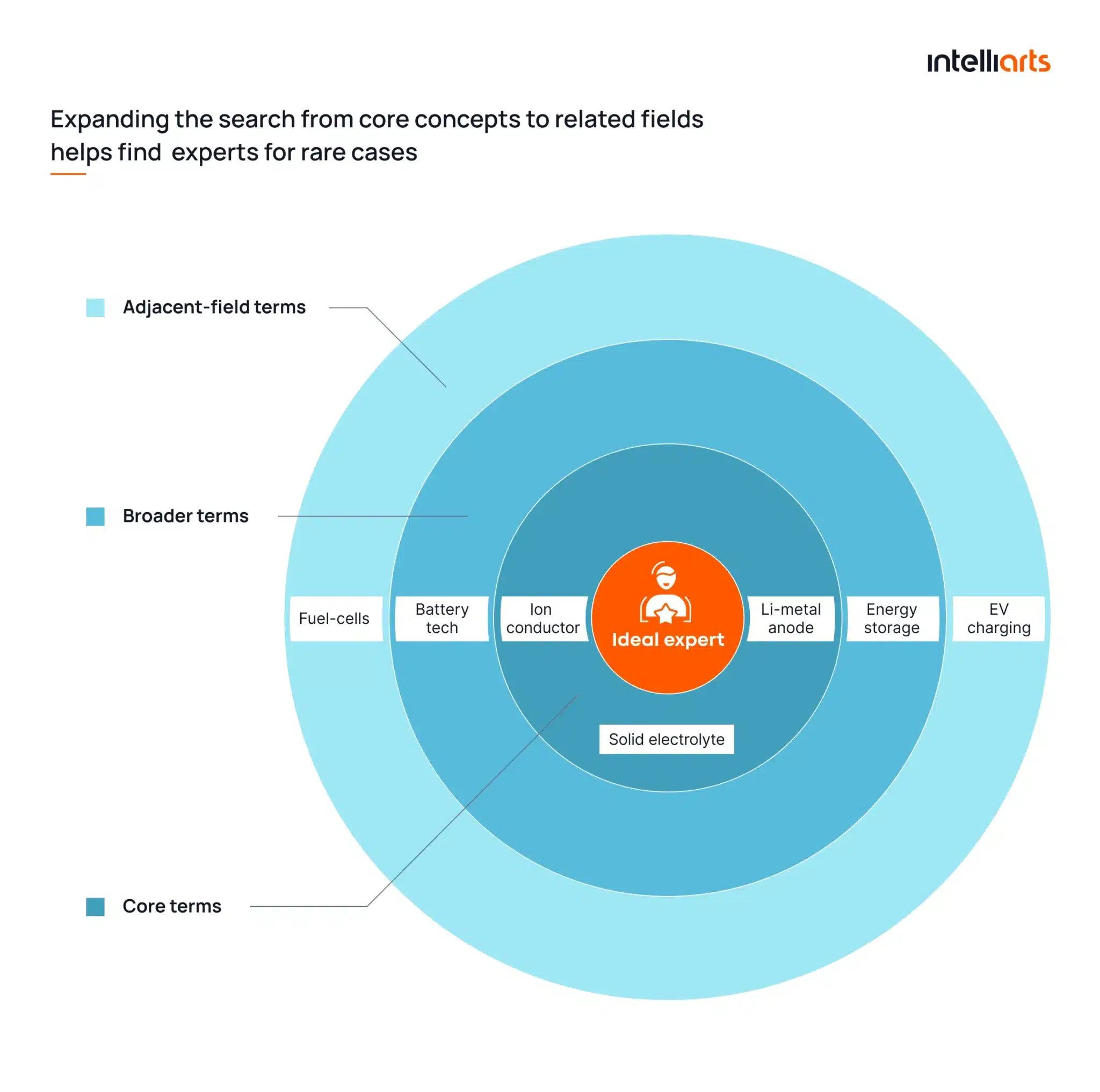
- With one click, the user can expand any term into broader areas, subareas, or adjacent areas, gradually building a knowledge graph
- Behind each readable term, the AI generates up to 10–20 search keywords, so a single search can run on 1,000–2,000 keywords
This is what makes the platform useful for rare cases. If a topic is brand new (let’s say a virus recently discovered), almost nobody has worked with it directly, and a direct keyword search returns nothing. Expanding outward from core concepts surfaces experts in adjacent fields whose experience is still relevant.
3. Ranking experts by relevance
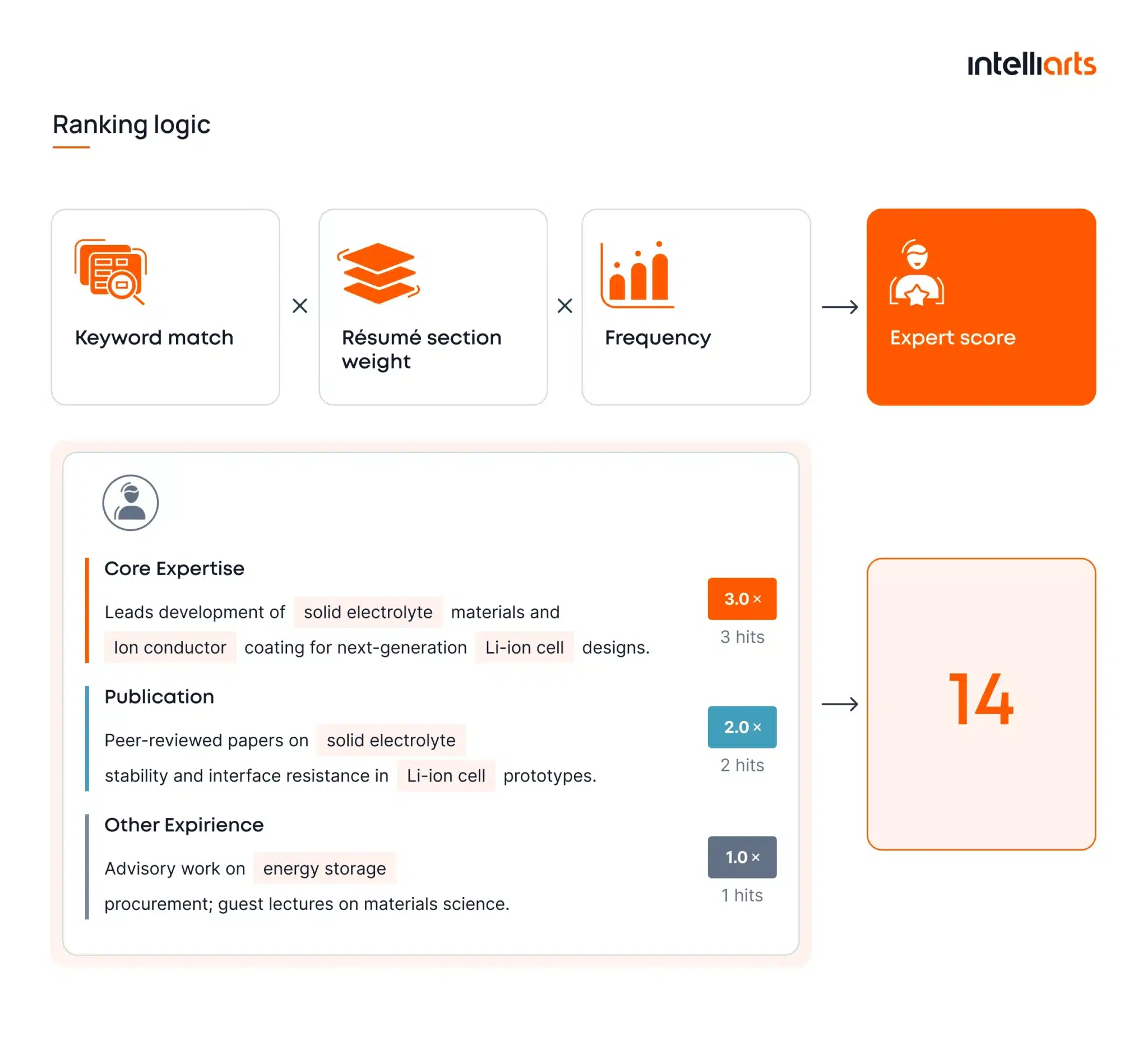
The system searches every résumé for the generated keywords and ranks experts by two factors: how often keywords appear and in which résumé section they appear. A match in a section describing core expertise carries more weight than a passing mention elsewhere.
That design choice raised the stakes on data quality. Ranking is only as accurate as the résumé sections behind it, and sectioning was exactly what the outsourced process struggled to deliver.
4. Automating résumé processing with an AI résumé parser
Automating résumé processing took several rounds. Early pilots failed for two reasons.
- First, LLMs are non-deterministic, so the same input could produce different output.
- Second, with documents of up to 100 pages, models tended to summarize, skip, or truncate content. Every output also had to be checked, which defeated the purpose.
The turning point came when newer LLM models were released. They were better at the task, and they opened up a different way of approaching it. The final pipeline has two steps:
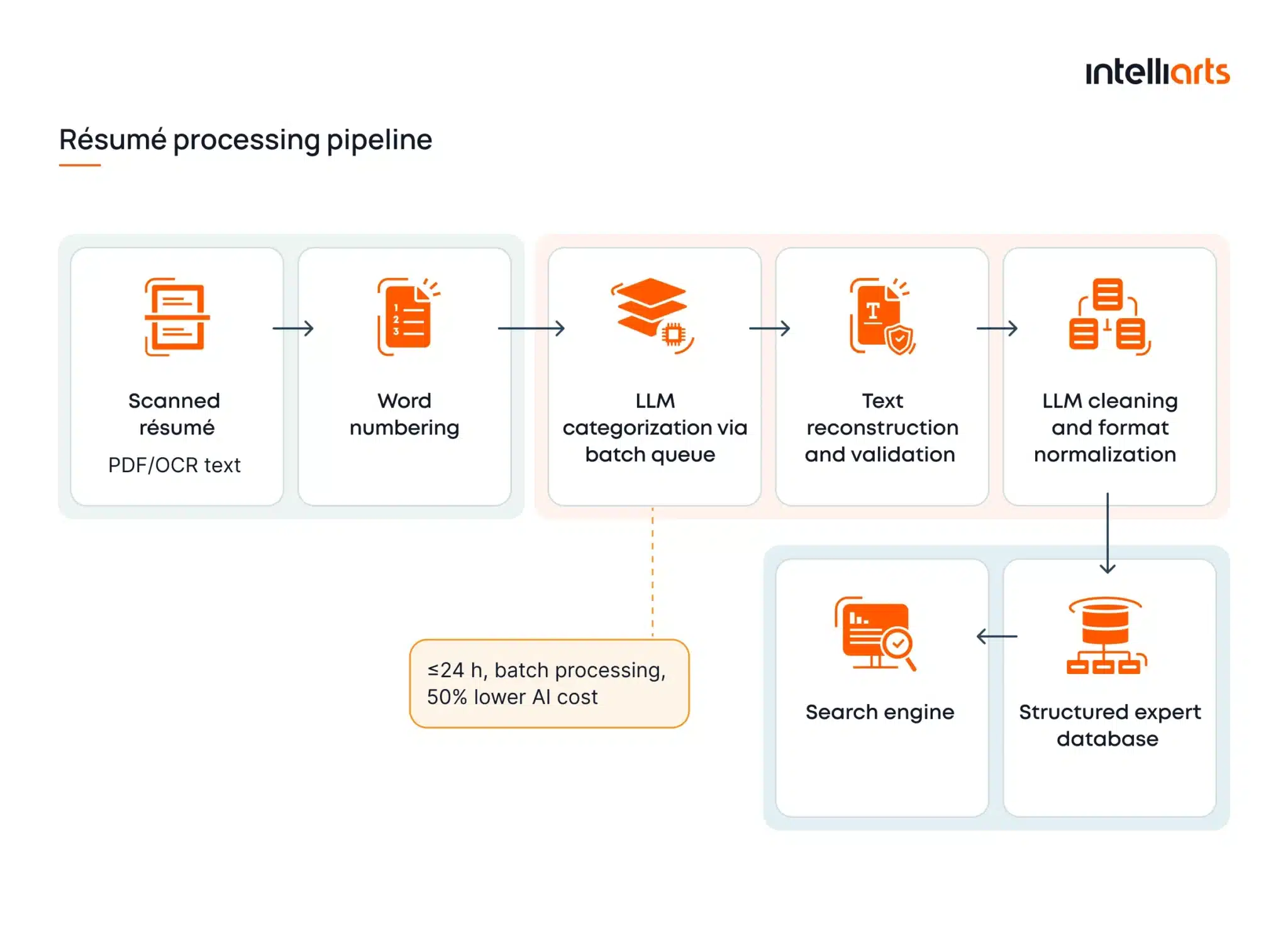
Categorization: AI document classification sorts résumé content into the required sections. To guarantee that no text is lost, every word is numbered. The model returns word-number ranges instead of rewriting the text. This keeps the output short and cheap, and it ensures the text going out is identical to the text coming in. Additional validation checks run on top.
Cleaning: The categorized text is cleaned and converted into a single consistent format that displays well in the platform’s UI.
5. LLM cost optimization with batch processing
Résumé processing isn’t time-critical. It doesn’t matter whether a résumé is ready in one hour or twenty, as long as it gets processed.
So every AI request goes through batch processing instead of the real-time queue. The model provider returns results within 24 hours at about half the standard price. New résumés go into the pipeline daily.
Business Outcomes
The biggest change happened where the founder least expected it. What started as a secondary roadmap item became the project’s most measurable win:
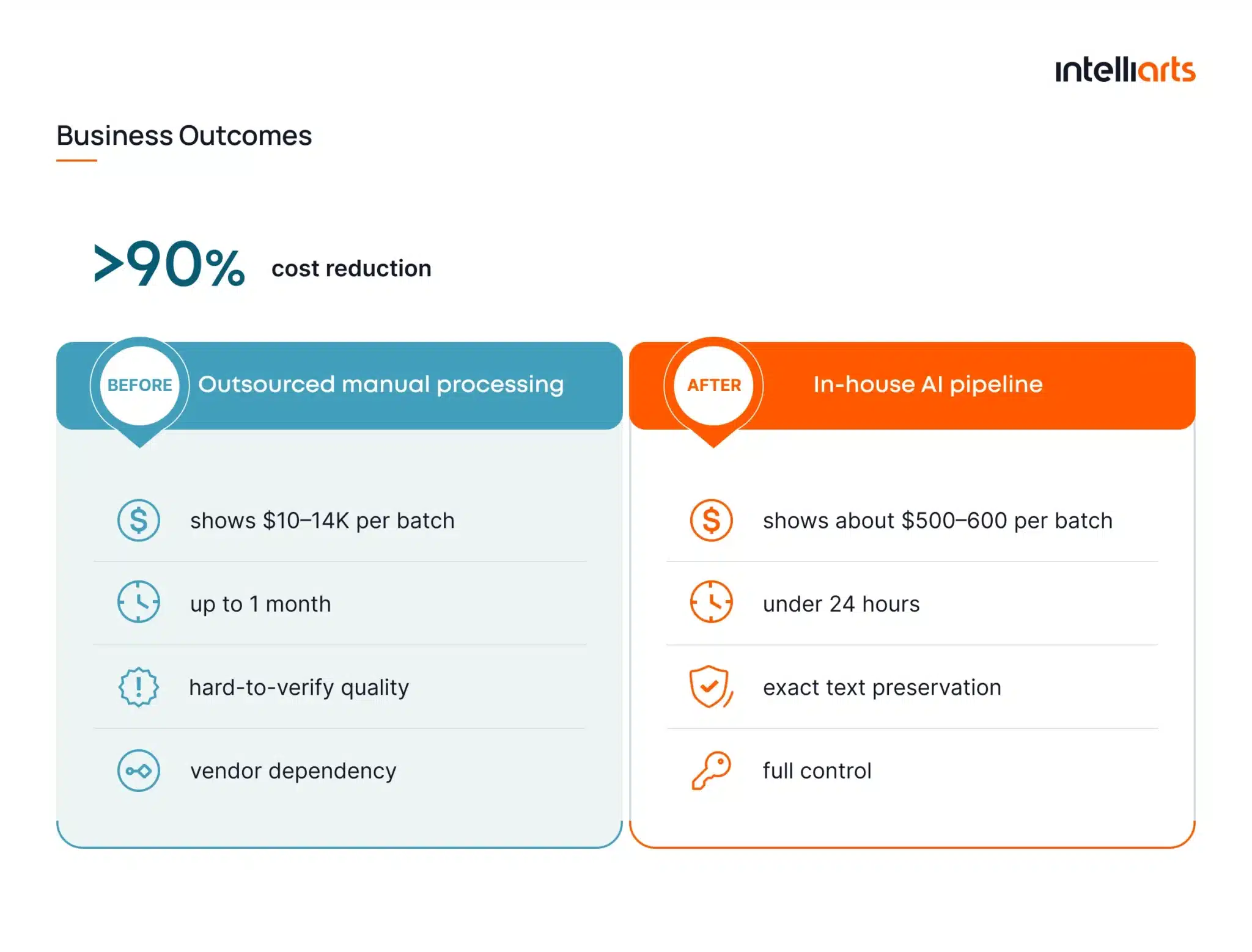
- Résumé processing costs dropped from $10–14K to about $500–600 per 3,000 résumés, a reduction of over 90%. Most of the remaining cost is model API usage.
- Turnaround went from up to a month to under 24 hours.
- Text is preserved exactly as written, so the client no longer has to spot-check thousands of documents.
- The work is fully in-house, with no vendor contract, negotiation cycles, or rework requests.
The platform is also still early in its commercial life: it’s open for account requests, and its first users are coming in through demos. Usage is naturally occasional, because a litigator typically needs an expert once per case, every six to twelve months. For a high-value niche tool, a hundred monthly users would be a strong result.