

Emissions management in agriculture is both an operational necessity and a regulatory requirement today. FAO reports that agrifood systems emitted about 16.5 gigatons of CO2, which is roughly 32% of global anthropogenic emissions. Agricultural companies that track CO2 emissions can’t afford to have their data scattered across spreadsheets. This will quickly break their scale and auditability.
In this post, you’ll review the emissions management software options your business has. Besides, you’ll find out how to choose the best solution, what tech features to look out for, and what the industry-best emissions software practices are.
Common approaches to emission management in agriculture
Emissions management in agriculture is the structured process of measuring, managing, and reducing greenhouse gas emissions across farm operations and supply chains.
While the process itself may be clear, what software to use to manage emission management efforts is not that easy to figure out.
For starters, let’s take a look at three approaches to utilize emissions management solutions that are specifically designed to tackle this green energy challenge:
#1 Off-the-shelf emissions management platforms
These are vendor products that provide a complete, ready experience. They typically include standard methodologies, factor libraries, dashboards, and reporting outputs. They aim to help teams move from spreadsheets to consistent calculations with minimal configuration.
Pros
- Fast rollout, often in weeks
- Lower upfront spend compared with a build
- Standardized outputs that support consistency across sites
- Vendor maintenance, updates, and security practices
- Easier onboarding for non-technical users
- Common integrations are often available out of the box
Cons
- Limited flexibility for unique farm practices or niche commodities
- Data model constraints can force awkward workarounds
- Custom analytics can be expensive or impossible
- Integration depth may stop at file uploads or basic APIs
- Methodology changes depend on the vendor roadmap
- Risk of paying for unused modules as needs expand
#2 Custom-built emissions management solutions
This approach delivers a purpose-built platform designed around your operations, data sources, and governance rules. It gives full control over data structures, factor management, audit trails, and decision logic. It fits complex agribusinesses and sustainability teams that need high data confidence, advanced analytics, or differentiation in Monitoring, Reporting, and Verification (MRV).
Pros
- Full control over data and calculation logic
- Strong fit for unique workflows and internal KPIs
- Better support for advanced analytics and scenario planning
- Clearer ownership of data quality rules and approvals
- Easier to evolve with program changes and new regulations
- Can become a strategic asset across the value chain
Cons
- Higher initial investment and longer lead time
- Needs strong product ownership and stakeholder alignment
- Requires ongoing maintenance and platform operations
- Data integration work can exceed expectations
Explore precision ag tools in the industry in another blog post by Intelliarts.
#3 Hybrid or modular approach
This combines a core platform or analytics layer with custom integrations and tailored data pipelines. Teams keep vendor strengths for reporting and governance, while they build the agriculture-specific pieces that matter most. This approach fits organizations that need speed but cannot accept shallow integration or rigid workflows.
Pros
- Balanced speed and flexibility
- Less build scope than compared to a fully custom
- Better integration quality than pure off-the-shelf
- Phased rollout across regions and business units
- Reduces risk by reusing proven components
Cons
- Shared accountability across vendor and custom layers
- Integration complexity still requires strong engineering expertise
- Vendor constraints remain in the core modules
- The architecture discipline is essential to avoid fragmentation
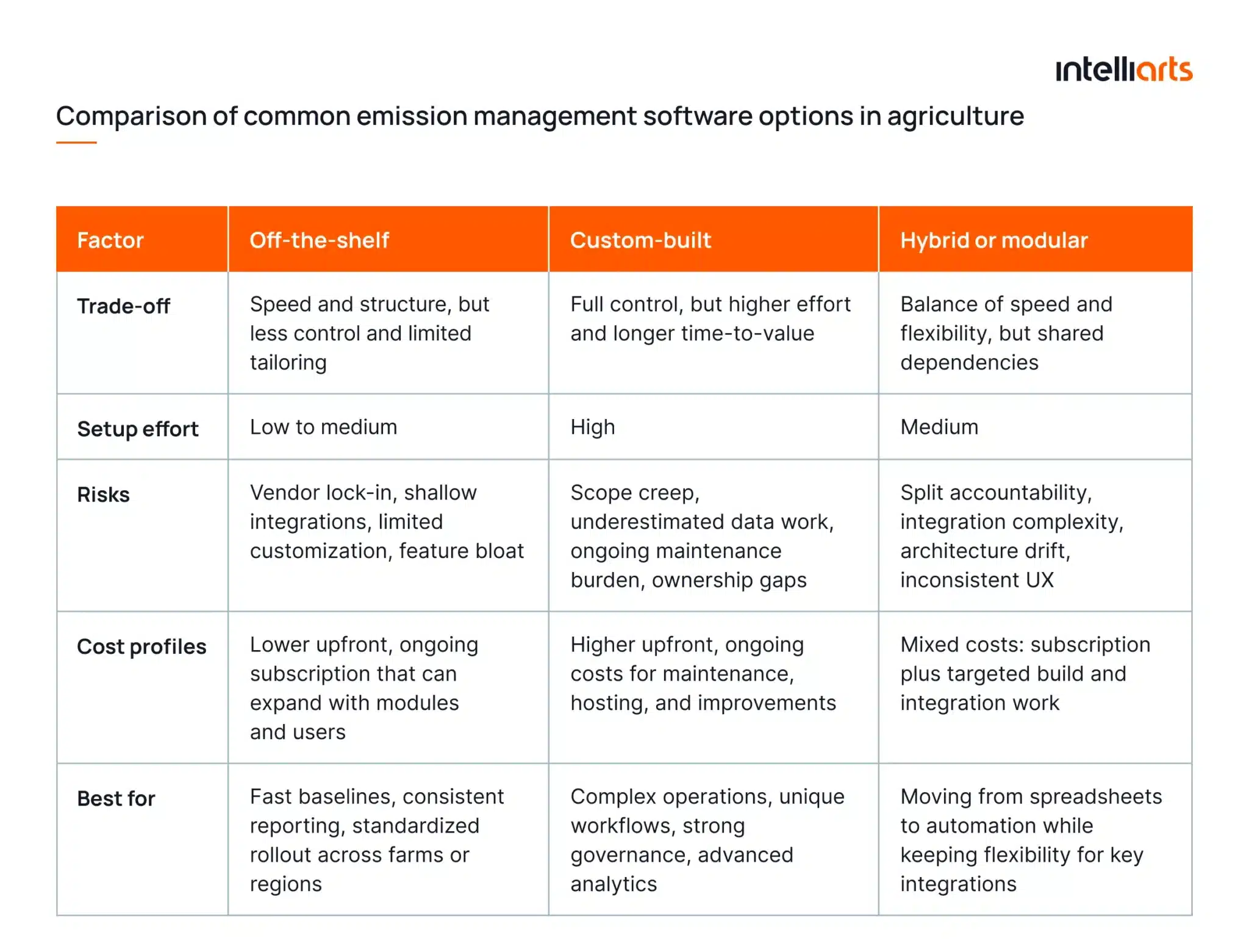
Each approach reflects a different level of control over data, methods, and workflows. See additional comparison factors in the table below and an in-depth insight:
How to choose the right approach for your agri-business
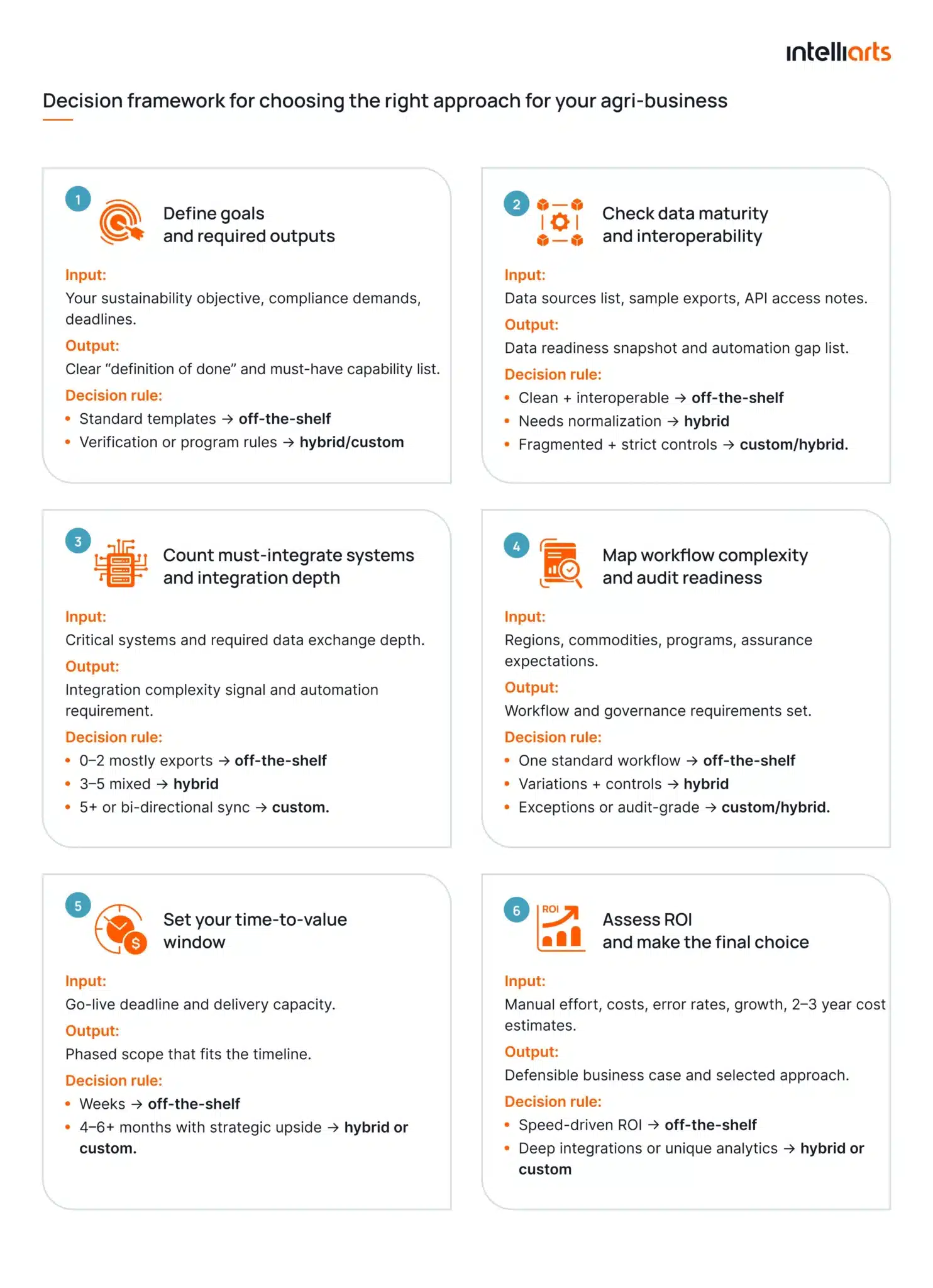
Choosing between software options is never simple. To assist you, the Intelliarts team has prepared a decision framework that can guide you through the nuances of selecting software, while simultaneously helping with a software implementation scope:
Step 1: Define your sustainability goal and the outputs you must produce
Input: Primary objective (compliance, certification, carbon credits, supply chain transparency), buyer or regulator requirements, deadlines.
What to do:
- Pick the single primary goal for the next 12 months.
- Write down required outputs (reports, certificates, verification files, supplier disclosures).
- Mark non-negotiables (audit trail, evidence handling, factor transparency, multi-entity reporting).
Outcomes:
- A clear “definition of done” for the software.
- A shortlist of must-have capabilities.
Decision rule:
- Standard, template-based outputs → off-the-shelf may fit.
- Verification workflows or program-specific rules → lean hybrid or custom.
Need assistance with your best emission management project? See how Intelliarts helped our customer with a data automation solution in a success story from our portfolio.
Step 2: Assess data maturity and system interoperability
Input: List of data sources, e.g., Facility Management Systems (FMS), Enterprise Resource Planning (ERP)/procurement, logistics, energy, suppliers, livestock systems, spreadsheets, sample exports, API access notes.
What to do:
- Inventory the sources that feed calculations needed for evaluating emissions management.
- Rate each source as reliable, usable with cleanup, or unreliable.
- Document how data moves today (manual copy, CSV export, API).
Outcomes:
- A data maturity snapshot and gap list.
- A realistic view of phase-one automation potential.
Decision rule:
- Mature data and simple interoperability → off-the-shelf is viable.
- Mixed quality that needs normalization → hybrid is usually best.
- Highly fragmented data plus strict governance needs → custom or hybrid.
Step 3: List your must-integrate systems and required integration depth
Input: Systems that hold emissions-relevant data (FMS, ERP/procurement, logistics, energy, IoT/sensors, supplier tools) and what you need from each.
What to do:
- Mark systems that are critical for the first reporting cycle.
- Count them and note API vs export-only.
- Label each integration as upload/export, one-way API, or bi-directional sync.
Outcomes:
- An integration count and complexity signal.
- Clarity on whether you need simple connectivity or real automation.
Decision rule:
- 0–2 systems, mostly exports → off-the-shelf is often enough.
- 3–5 systems, mixed APIs/exports → hybrid or custom are usually best.
- 5+ systems or bi-directional sync required → custom.
Step 4: Map workflow complexity and audit-readiness requirements
Input: Operating scenarios across regions, commodities, and programs; assurance needs; evidence and approval expectations.
What to do:
- List distinct workflows you must support (by region, commodity, program).
- Count different rule-sets (methodologies, eligibility, evidence requirements).
- Confirm audit-readiness needs: traceability, factor governance, change logs, evidence queues.
Outcomes:
- A “workflow uniqueness” and governance requirement set.
- Early clarity on whether standard tools will force workarounds.
Decision rule:
- One standard workflow and basic governance → off-the-shelf can work.
- Some variations and moderate controls → hybrid is safer.
- Exception-heavy workflows or audit-grade control → custom or hybrid.
Step 5: Set your time-to-value window
Input: Deadline for first outputs (reporting cycle, program launch, buyer request) and delivery capacity.
What to do:
- Set the go-live date for a usable baseline.
- Define the phase-one scope versus the phase-two scope.
- Align timeline with realistic delivery constraints.
Outcomes:
- A phased scope that prevents overbuilding.
- A feasibility filter for the approach.
Decision rule:
- Weeks → off-the-shelf.
- 3–6+ months with strategic upside → hybrid or custom.
Step 6: Assess ROI and make the final choice
Input: Current manual effort (hours per cycle), staffing costs, error/rework rate, audit risk, growth assumptions, and cost estimates for each option.
What to do:
- Quantify today’s costs: collection, reconciliation, and reporting cycle time.
- Estimate benefits: efficiency gains, risk reduction, growth enablement.
- Compare 2–3 year TCO across options (subscription, integration/build, maintenance, internal time).
- Choose the approach using the triggers below.
Outcomes:
- A defensible decision and rationale you can communicate.
- A phased investment plan tied to measurable gains.
Decision rule:
- Off-the-shelf if goals are standard, integrations are light, workflows are simple, and speed drives ROI.
- Hybrid if you need vendor speed but must add custom pipelines, validation, or agriculture-specific workflows to scale.
- Custom if deep integrations, unique workflows, audit-grade controls, or proprietary analytics drive ROI.
Important note! If you choose an off-the-shelf approach, you still need to undergo the process of selecting emissions management software. Alternatively, with hybrid and custom options, you need a trusted technology vendor to assist you throughout the project.
See the entire decision framework visualized below:
Key features to look for in emissions management software
Let’s return to the challenge of choosing between off-the-shelf, custom, or hybrid software. As mentioned, off-the-shelf software already has lots of features available. This may sound like a positive trait. It sometimes is. However, having lots of functionalities you don’t use results in either overload or excessive payments for subscriptions. After all, you are oftentimes charged for features you don’t use, as they are included in one or another subscription tier anyway.
In most agriculture projects we work on, emissions reporting becomes difficult long before calculations start. The main challenge is collecting data from different systems and making sure it is consistent enough to trust. — Yurii Bondarenko, Software Engineer at Intelliarts
In the case of custom and hybrid approaches, you are more flexible in choosing what you want to include in your configurable air emissions software. But only if you are partnering with a trusted provider of software engineering services that can tailor your app exactly to your needs, of course.
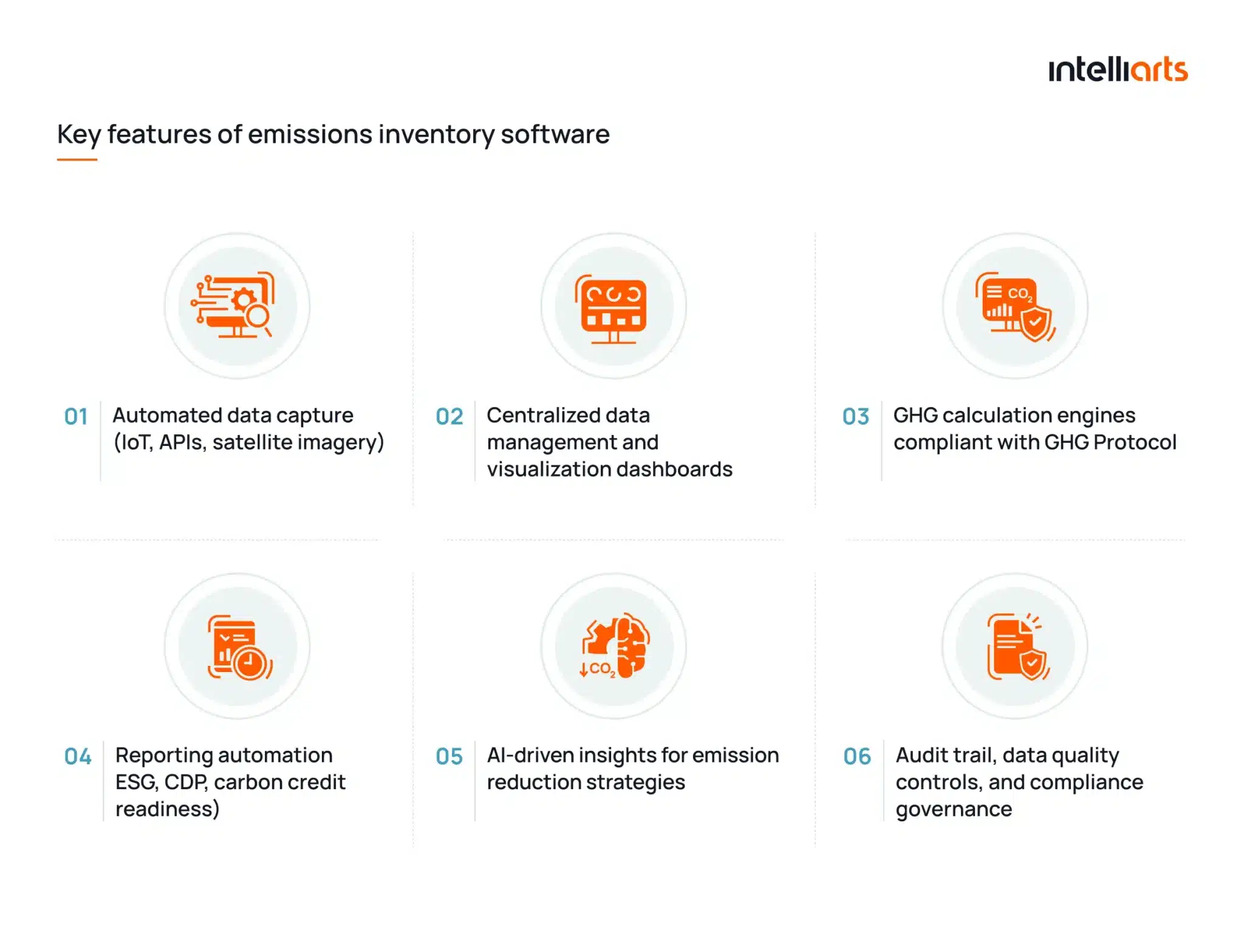
So, here’s a suite of key features of emissions inventory software you are most likely looking to have included in your software:
- Automated data capture (IoT, APIs, satellite imagery). Pulls activity data from devices, enterprise systems, and external sources to reduce manual collection errors. Includes validation rules, timestamps, and source tagging to keep inputs audit-ready.
- Centralized data management and visualization dashboards. Consolidates all emissions-related data into one governed layer with consistent units, site structures, and permissions. Dashboards provide drill-down views by scope, facility, category, and time to support decision-making.
- Greenhouse Gas (GHG) calculation engines compliant with GHG Protocol. Calculates Scope 1, 2, and 3 using transparent, repeatable methodologies aligned to the GHG Protocol. Supports emissions factors governance and standardized outputs for carbon accounting.
- Reporting automation (Environmental, Social, Governance (ESG) solutions, customer data platform, carbon credit readiness). Automates the reporting process with reusable templates, period snapshots, and evidence packs for audits. Produces structured exports aligned with corporate sustainability disclosures and common questionnaires.
- AI-driven insights for emission reduction strategies. Identifies hotspots, anomalies, and key drivers, then recommends actions based on patterns in usage and operations. Helps prioritize initiatives by estimated reduction impact, cost, and feasibility.
- Audit trail, data quality controls, and compliance governance. Tracks who changed what and why, with approvals and versioning to make reviews defensible. Enforces compliance through role-based access, validation checks, and documented methodologies across the organization.
Aside from the provided list of key functionalities, you may opt for some additional features and capabilities. Alternatively, you may need to know what to exclude from a subscription of the configuration list. Either way, here’s a list of features that are usually considered optional even in the best emissions management software options:
- Built-in carbon credit marketplace access
- Blockchain-based traceability modules
- Native sustainability training/e-learning hub
- Integrated project management suite (tasks, Kanban, OKRs)
- Real-time digital twin of facilities
- Mobile-first field data capture app
- Automated assurance-provider workspace (audit collaboration room)
Finally, let’s move on to some important highlights of custom emissions management software. After all, a tailored app is, oftentimes, a much better solution to your mission management needs, even with any team size or budget constraints respected.
But before you find out why custom solutions often win in agriculture, take a look at the example of a software solution by Intelliarts.
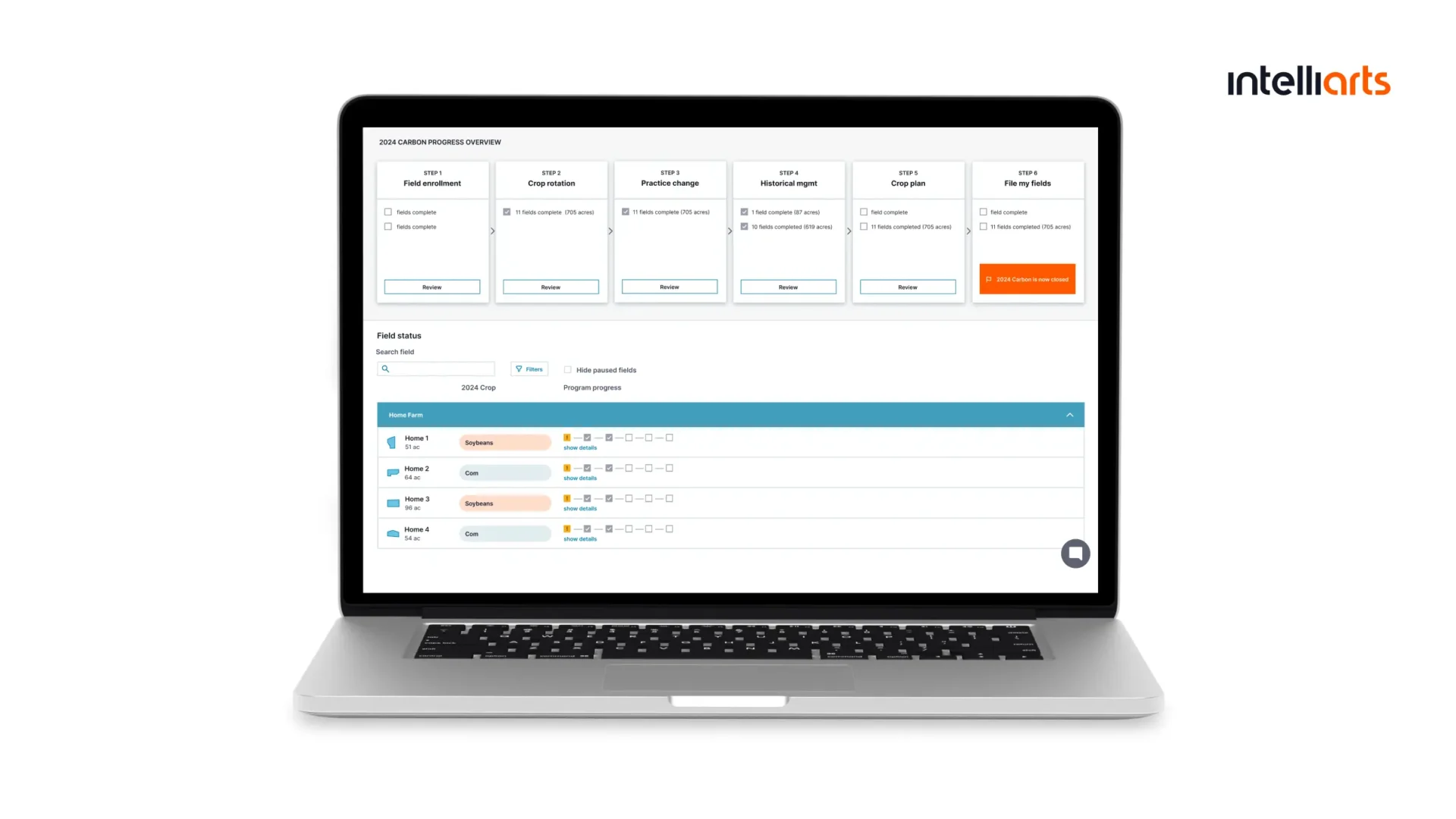
Challenge: An agrotech company had to submit 3–5 years of field records, which took weeks, caused inconsistent data, and limited enrollment scale for a carbon-farming program.
Solution: Intelliarts co-developed a “Lightning” workflow that auto-prefills boundaries, crops, and key events using remote sensing plus the client’s Best Guess API, then guides users through validation.
Results: Data entry dropped to minutes, filed acres rose nearly 3× to 2.6M+, and a program hit 80% retention.
Explore grower data collection success story.
Why custom software development often wins in agriculture
Agriculture rarely fits into a neat, standardized data model. Emissions drivers sit across soil and field operations, yield outcomes, livestock performance, energy use, transport routes, supplier inputs, and weather variability. Custom software development addresses this reality directly. It gives you a flexible foundation that matches how your farms and partners actually operate. Another best thing about custom options is that they are as advanced as any other top AI tools in agriculture.
Audit requirements usually arrive earlier than advanced analytics. Teams first need confidence in their data before they can use it for optimization.— Alexander Barinov, a managing partner at Intelliarts
Here’s an overview of custom development value-adding benefits mapped to the capabilities needed for running emissions programs at scale:
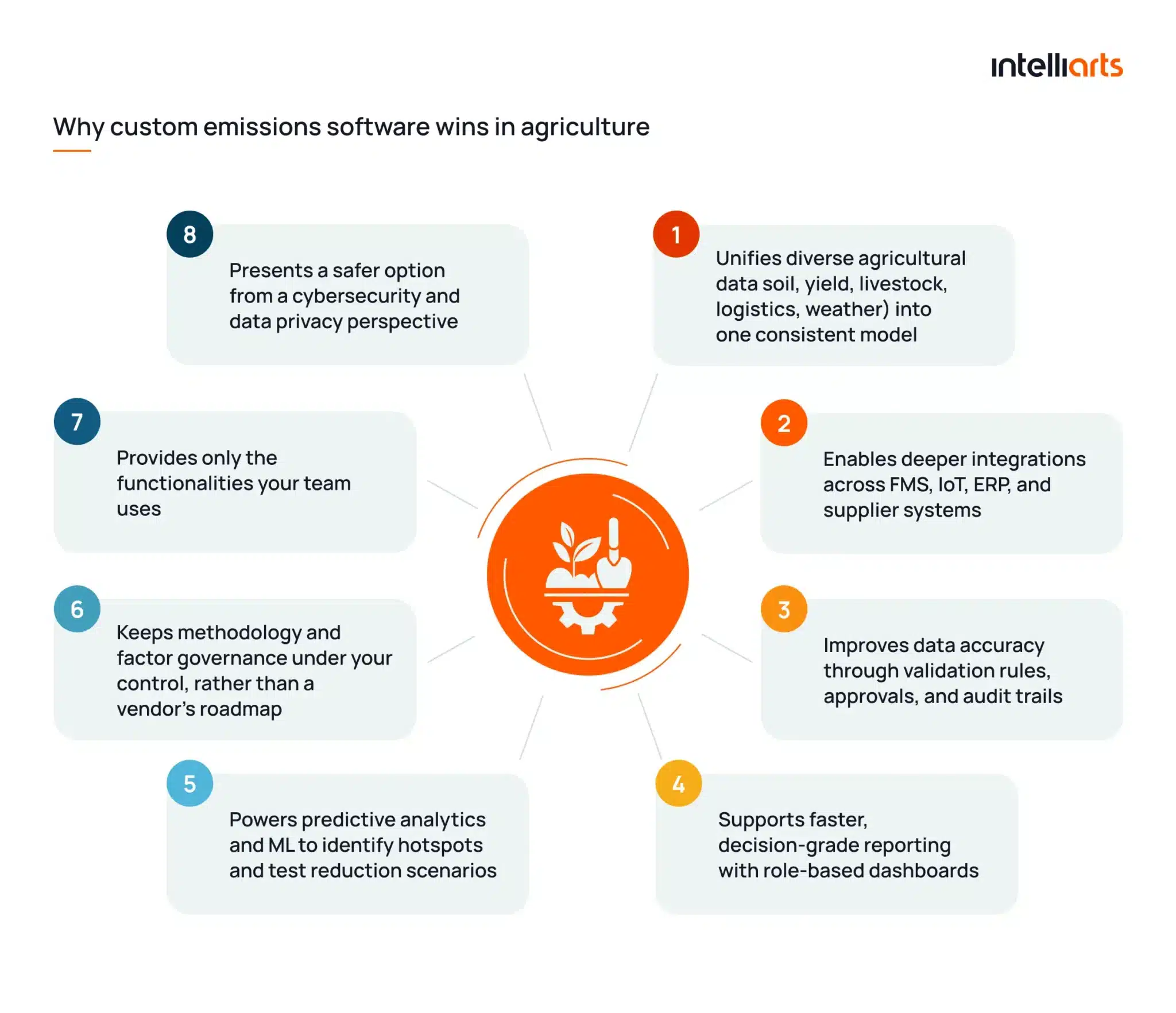
In practice, Intelliarts helps agtech teams operationalize this approach without overbuilding. We design resilient data pipelines that normalize noisy farm inputs and implement quality checks that increase confidence in emission tracking. When clients are ready, we extend this foundation with AI models for forecasting and optimization, plus ESG insight dashboards that connect operational signals to sustainability targets.
Don’t hesitate to explore agriculture software development services by Intelliarts, a trusted software development agency.
Final take
To move from reporting to actual emission reductions, match your software approach to your goals, data reality, and timeline. Off-the-shelf tools suit standardized outputs and light integrations. Hybrid works when you need vendor speed plus custom pipelines and validations. Custom wins when audit-grade governance, deep interoperability, and analytics drive ROI.
Here at Intelliarts, we have more than 25 years of experience providing top-tier software solutions, including automation and management apps for green, agriculture, and EV companies. With a 90% customer return rate and a majority of senior staff engineers in-house, we are ready, willing, and able to contribute to your best emissions management software.
Build your best emissions management software
Our team has expertise in AgriTech software development.
Explore more
FAQ
What’s the difference between emissions management software and carbon accounting software?
Emissions management software focuses on reduction: capturing activity data, identifying hotspots, and supporting mitigation workflows across assets and processes. Carbon accounting software focuses on reporting and disclosure: converting activity into CO₂e, applying standards, and producing auditable statements. Some platforms combine both; others specialize as emissions inventory software for compliance-first use.
How can emissions tracking tools integrate with existing farm management systems?
Integration typically uses APIs or middleware to sync field operations, inputs, yields, livestock records, fuel use, and equipment telemetry securely, bi-directionally. Start with a data map, define ownership, and standardize units and timestamps. A pragmatic emission management software approach is to automate high-volume data, then validate exceptions with human review.
What’s the typical cost range for custom emission management solutions?
Costs vary by scope, data sources, and assurance needs overall. A lightweight MVP with basic calculations and dashboards can start around $30k–$80k, while enterprise builds with integrations, role-based access, audit trails, and multi-site reporting often reach $150k–$500k+. Configurable air emissions software features and compliance modules can push budgets higher.