
EV charging infrastructure is growing fast. According to the IEA Global EV Outlook 2025, more than 1.3 million public charging points were added worldwide over the past few years. This growth is expected to continue through 2026. As charging networks expand across regions, EV businesses may start struggling to comply with a growing set of standards and legal requirements.
In this article, you’ll review the key global and local regulations that impact EV charging businesses across the region. You’ll discover more about respective regulation bodies, the value of compliance, penalties for non-compliance, and how to choose the perfect-fit development partner for your project.
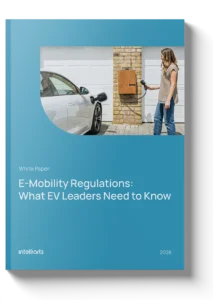
Turn EV Compliance into a Competitive Advantage
Get expert insights on how EV software regulations shape architecture, security, and interoperability and how leaders can stay compliant.
Check our white paper
Key global EV charging regulations
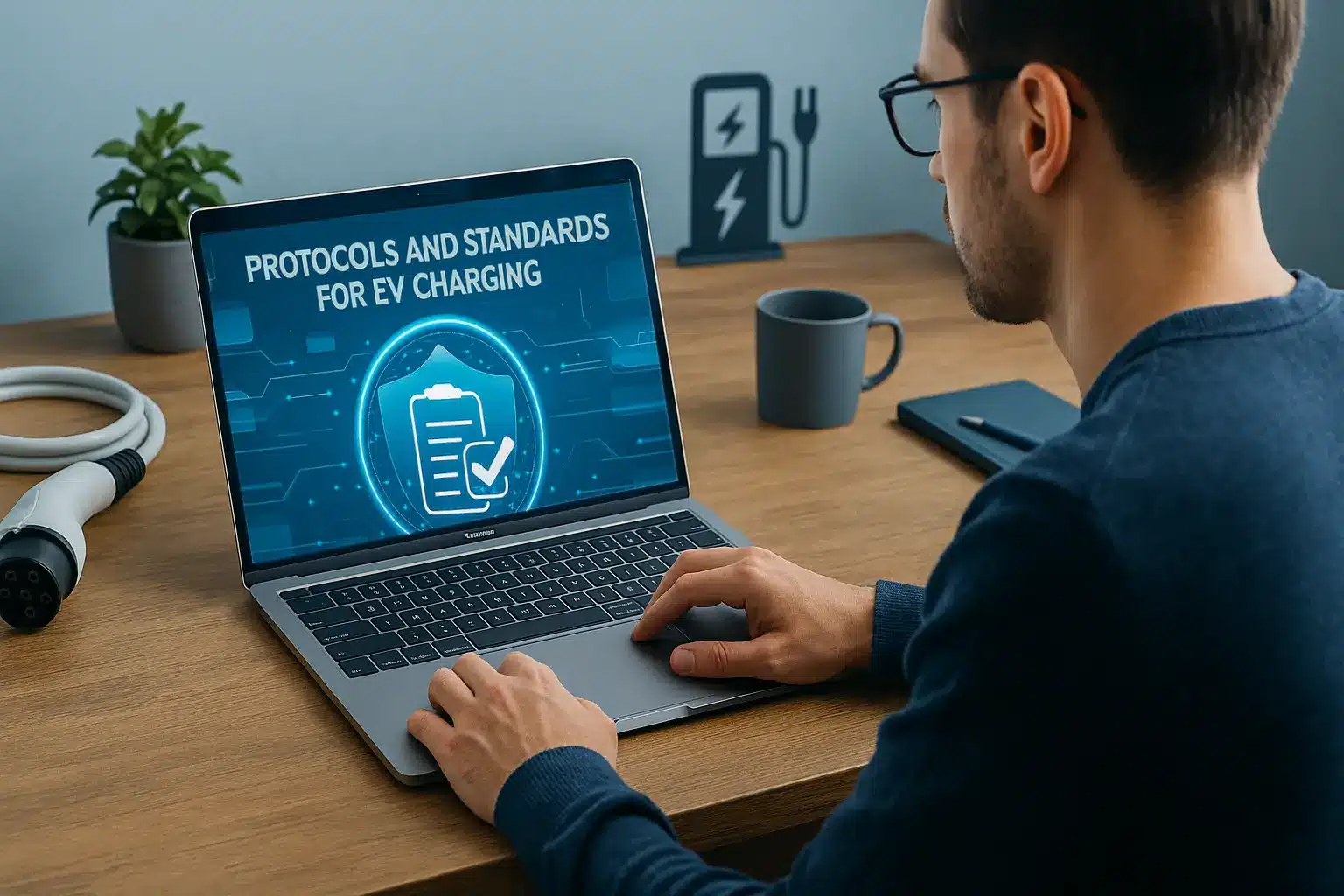
Before reviewing specific global rules, it is important to distinguish between EV charging standards and EV charging regulations. These terms are often used interchangeably, but they serve different roles in EV software development.
1. Global EV charging standard
A global EV charging standard defines technical specifications. These specifications ensure interoperability, safety, and structured communication between EVs, chargers, and backend systems. Standards describe how systems should work together. They are not legally binding on their own.
2. Global EV charging regulation
A global EV charging regulation is a legally enforceable framework. Governments or international regulatory bodies issue these rules. Regulations define what must be complied with to deploy, operate, or sell EV charging hardware and software.
In short, the difference between EV charging standards and regulations is that standards provide technical guidance, while regulations impose legal obligations. The terms are often used interchangeably because regulations frequently reference standards as mandatory compliance requirements.
With this distinction clarified, we can move to the key global EV charging regulations that shape the EV charging industry today.
For an insight into how software partners deal with industry standards, see the EV charging management software success story by Intelliarts.
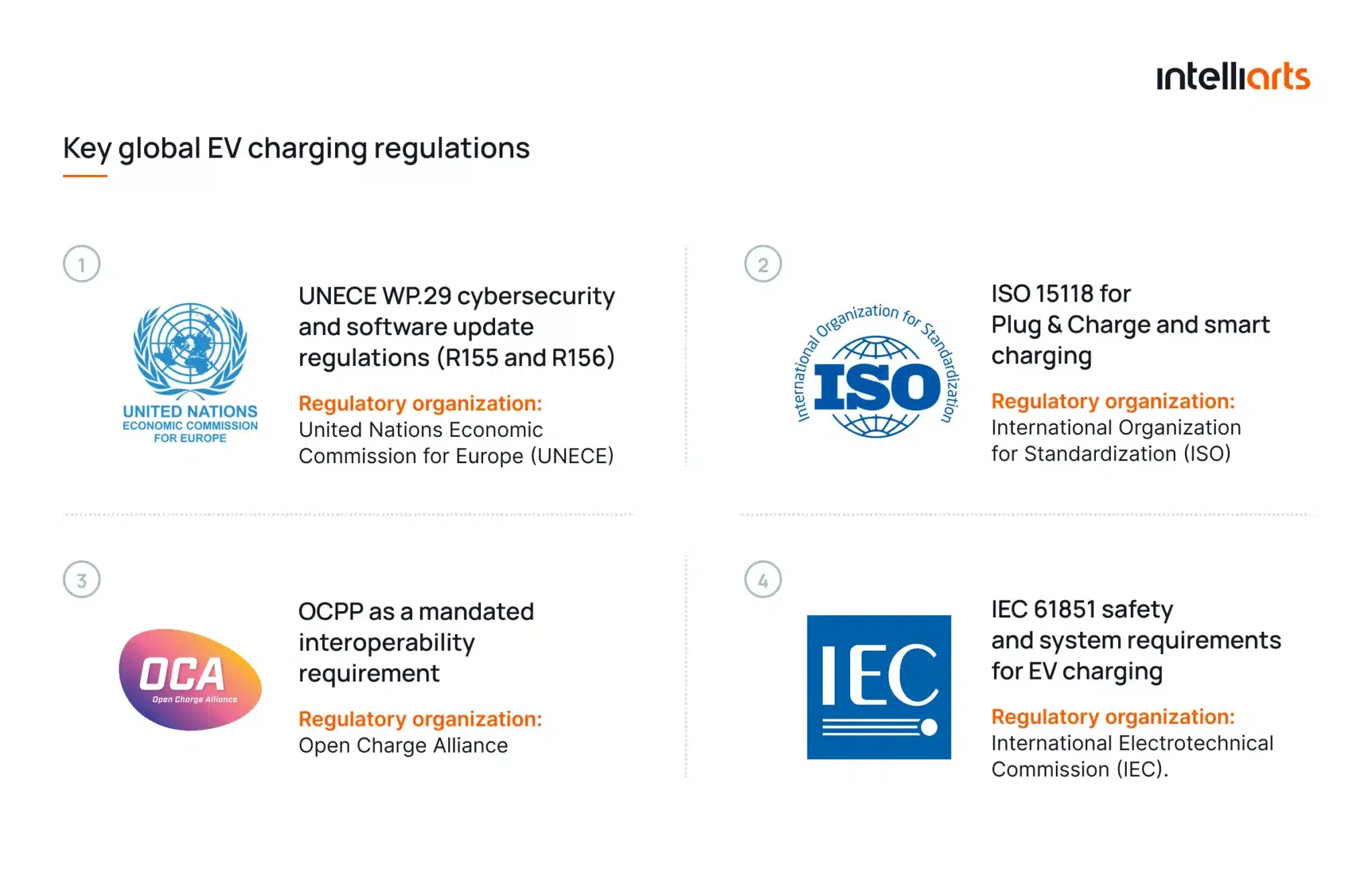
#1 ISO 15118 for Plug & Charge and smart charging
ISO 15118 defines secure communication between EVs and charging stations. It enables Plug & Charge authentication and encrypted data exchange. Although it is a technical standard, many regulators reference it within binding EV charging regulations. ISO 15118 compliance-related questions are some of the most frequent ones based on Intelliarts’ consultation experience.
Regulatory organization: International Organization for Standardization (ISO).
See the ISO 15118 standard description.
Key provisions:
- Certificate-based vehicle and charger authentication
- Encrypted communication channels
- Secure exchange of identity and payment data
- Support for smart charging and grid interaction
Applicable to: EV charger software, EV connect app providers, charging network operators, mobility service providers, and EV charging infrastructure projects that support Plug & Charge.
Penalties for non-compliance: ISO standards themselves do not impose monetary penalties. However, failure to support ISO 15118 can lead to exclusion from regulated public charging projects where compliance is mandatory. This requirement is reflected in the ISO eMobility standard references used by regulators.
#2 OCPP as a mandated interoperability requirement
OCPP defines how charging stations communicate with central management systems. While OCPP is not a regulation by itself, many governments and utilities mandate its use for public EV charging infrastructure.
Regulatory organization: Open Charge Alliance (OCA). Refer to the Open Charge Alliance and OCPP documentation for more information on the regulator.
Key provisions:
- Standardized charger-to-backend communication
- Remote monitoring and fault handling
- Support for firmware updates
- Vendor-neutral interoperability
Applicable to: EV charging software companies, charge point operators, EV charging management software providers, and publicly funded EV charging infrastructure projects.
Penalties for non-compliance: OCPP does not impose direct fines. Penalties usually take the form of procurement disqualification or loss of eligibility for public funding. Many government tenders explicitly require compliance, as stated by the Open Charge Alliance governance framework.
#3 OCPI for roaming and interoperability between charging networks
OCPI enables communication and data exchange between Charge Point Operators (CPOs) and e-Mobility Service Providers (eMSPs). While OCPI is not a regulation by itself, many governments and public infrastructure projects mandate its use to ensure seamless roaming, transparent pricing, and open access to EV charging networks.
Regulatory organization: EVRoaming Foundation. Refer to the EVRoaming Foundation and OCPI documentation for more information on the regulator.
Key provisions:
- Real-time exchange of charging location and availability data
- Token-based authentication for cross-network charging sessions
- Transparent tariff and pricing information sharing
- Automated billing and charge detail records (CDRs)
- Support for roaming between different charging networks
Applicable to: EV charging software companies, charge point operators, e-mobility service providers, charging network operators, and publicly funded EV charging infrastructure projects.
Penalties for non-compliance: OCPI does not impose direct fines. Penalties usually take the form of procurement disqualification or loss of eligibility for public funding. Many government tenders explicitly require compliance, as stated by the EVRoaming Foundation governance framework.
#4 IEC 61851 safety and system requirements for EV charging
IEC 61851 defines electrical safety and operational requirements for conductive EV charging systems. Regulators frequently reference this standard as a baseline safety requirement for EV charging infrastructure.
Regulatory organization: International Electrotechnical Commission (IEC). See the IEC 61851 standard framework.
Key provisions:
- Electrical safety requirements for charging equipment
- Defined charging modes and configurations
- Protection against overcurrent and electrical faults
- Control and communication principles
Applicable to: EV charger manufacturers, infrastructure developers, and EV charging software integrated with hardware control systems.
Penalties for non-compliance: IEC standards do not define direct fines. Non-compliance can lead to certification denial, forced equipment removal, or legal liability after safety incidents. These enforcement actions follow national rules based on IEC conformity and certification guidance.
#5 UNECE WP.29 cybersecurity and software update regulations (R155 and R156)
UNECE WP.29 Regulations R155 and R156 define mandatory requirements for cybersecurity and software updates. R155 addresses cybersecurity management systems. R156 focuses on software update management, including over-the-air updates. These regulations directly affect EV charging software and charger firmware that interact with vehicles.
Regulatory organization: United Nations Economic Commission for Europe (UNECE), World Forum for Harmonization of Vehicle Regulations. See the official UNECE WP.29 overview.
Key provisions:
- Cybersecurity risk management across the full vehicle lifecycle
- Defined processes for secure software updates
- Traceability of software versions and update history
- Incident detection, reporting, and response requirements
Applicable to: Automakers, EV charging software companies, EV charger software vendors, fleet platforms, and EV charging management software that connects to vehicles or vehicle data.
Penalties for non-compliance: UNECE WP.29 does not define fixed monetary fines at the global level. The primary penalty is loss or denial of vehicle type approval, which prevents products from entering regulated markets. National authorities may also require recalls or suspend registrations under UNECE vehicle compliance rules.
Regional regulations for EV software and charging infrastructure
Regional regulations are legally binding requirements that apply within a specific jurisdiction, such as a country or economic bloc. They define what EV charging infrastructure must deliver in that market.
Global regulations and standards set broader baselines. Regional rules translate those baselines into enforceable programs, timelines, reporting duties, and penalties. Regional requirements also differ in funding conditions and consumer protections. That difference is why software teams must map features to each target market.
If your EV platform can’t pass regional compliance checks, scalability doesn’t matter. You won’t be allowed to deploy. — Alexander Barinov, Managing Partner at Intelliarts.
Below are the most relevant regional frameworks for EV charging software and public charging infrastructure.
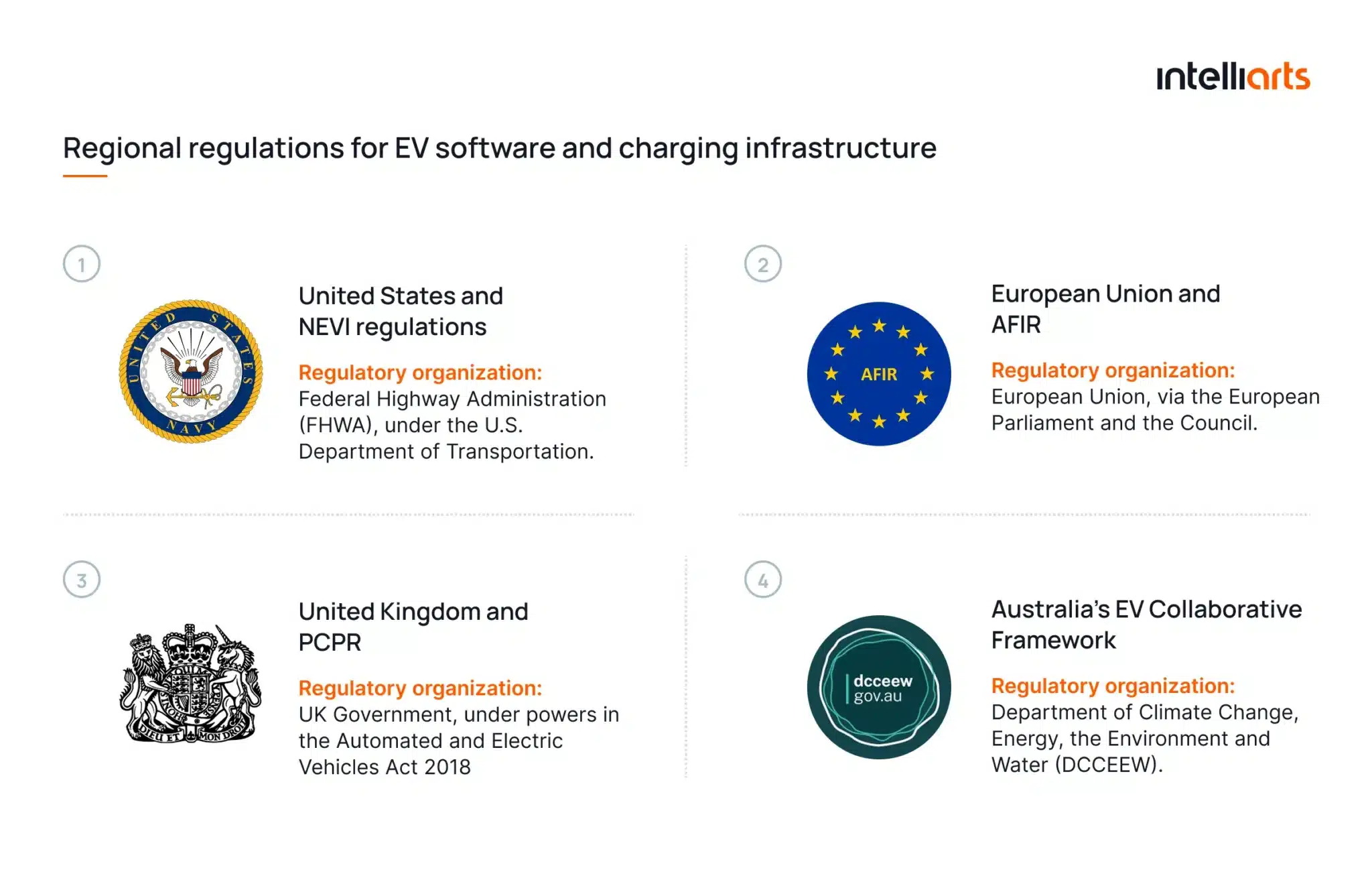
United States and NEVI
The United States uses a program-based approach. NEVI ties federal funding to minimum technical and operational requirements for public fast charging. This approach impacts site design, network operations, data reporting, and uptime targets.
National Electric Vehicle Infrastructure (NEVI) standards and requirements (23 CFR Part 680)
NEVI requirements establish minimum standards for federally funded public EV charging projects. They focus on reliability, interoperability, user experience, and data submission. These rules shape EV charging management software and charger software features.
Regulatory organization: Federal Highway Administration (FHWA), under the U.S. Department of Transportation. See the final rule in the Federal Register NEVI standards and requirements.
Key provisions:
- Applies minimum standards to NEVI-funded and certain federally funded public charging projects
- Requires network connectivity and user-facing information availability, including mapping and real-time availability expectations referenced in Part 680
- Sets technical station expectations commonly implemented in NEVI scopes, including multiple DC fast charging ports and CCS capability for DCFC ports
Links to technical requirement resources and what they request
- The authoritative requirement text is in 23 CFR Part 680. It defines minimum standards, reporting, and operational expectations.
- A practical, implementation-focused reference is the NEVI requirements appendix (example state reference). It summarizes items used in Requests for Proposal (RFPs), such as minimum Direct Current Fast Charging (DCFC) ports and Combined Charging System (CCS) connector expectations.
Applicable to: Charge point operators, EV charging software companies, charger OEMs, site hosts, and integrators building NEVI-funded public charging. It also applies to backend platforms that handle availability, reporting, and network operations for NEVI sites.
Penalties for non-compliance: NEVI is a funding program. Enforcement typically occurs through eligibility, project approval, corrective actions, and potential repayment or loss of funding under the program’s rules and federal-aid requirements. The core consequence is loss of compliance status for funded deployment requirements, not a single fixed federal fine amount in the rule text.
European Union and AFIR
The European Union uses a regulation-led approach. AFIR imposes binding requirements across Member States. It also creates user-facing obligations, especially around payment access, pricing transparency, and data provision. These requirements directly affect EV charger software and roaming integration.
Alternative Fuels Infrastructure Regulation (AFIR), Regulation (EU) 2023/1804
AFIR is the EU-wide regulation for deploying alternative fuels infrastructure, including public EV charging. It replaces the earlier directive model with binding requirements. It also standardizes user information and data-sharing expectations.
Regulatory organization: European Union, via the European Parliament and the Council. The official regulation text is available on EUR-Lex for Regulation (EU) 2023/1804.
Key provisions
- Establishes binding deployment and usability requirements for EV charging infrastructure across the EU
- Sets requirements related to payment access and user information, including pricing transparency obligations
- Introduces data provision obligations for operators, including expectations for static and dynamic data availability over time
Links to technical requirement resources and what they request
- The European Commission provides a policy and implementation context via the EU alternative fuels infrastructure page. It confirms AFIR’s application timeline and Fit for 55 context.
- For the market context tied to EU charging buildout, use the EAFO report on BEV registrations rising in H1 2025.
AFIR is part of the Fit for 55 legislative package. Fit for 55 pushes emissions reduction targets and accelerates infrastructure deployment obligations. This creates pressure for scalable, interoperable charging software and better reporting capabilities. See the Fit for 55 overview and the Commission’s Fit for 55 proposals tracker.
Applicable to: Charge point operators, eMSPs, roaming providers, EV charging software companies, and public charging project owners operating in EU Member States. It also affects systems that expose data to platforms and enable ad hoc access and transparent pricing.
Penalties for non-compliance: AFIR requires Member States to establish penalties that are effective, proportionate, and dissuasive. The regulation does not set one EU-wide fine amount. Monetary penalties, therefore, vary by country and enforcement authority. The enforcement model is described in the EU implementation context pages and AFIR references.
United Kingdom and PCPR
The UK uses a consumer-protection and reliability approach. The Public Charge Point Regulations define payment methods, transparency, and reliability expectations. They also impose explicit civil penalties. These rules drive clear requirements for EV charging management software and monitoring.
The Public Charge Point Regulations 2023 (PCPR)
PCPR imposes operational and consumer-facing requirements on public charge point operators. It addresses reliability metrics, payment access, price transparency, and data sharing. Guidance clarifies how operators should comply.
Regulatory organization: UK Government, under powers in the Automated and Electric Vehicles Act 2018. See the official instrument on legislation.gov.uk for The Public Charge Point Regulations 2023 and the PCPR guidance.
Key provisions:
- Requires consumer-friendly pricing transparency and clear price display rules, supported by the guidance
- Introduces reliability expectations for rapid networks, with compliance measurement details in the guidance
- Mandates data standard usage for reliability measurement, with OCPI referenced in guidance for status reporting
- Sets maximum civil penalty amounts for specific breaches, defined in the legislation
Applicable to: Public charge point operators and operators of publicly accessible charging infrastructure in the UK. It also affects EV charger software and backend systems that support payment flows, uptime monitoring, customer support, and public data obligations.
Penalties for non-compliance: The regulations define a maximum civil penalty of £10,000 per public charge point for specified breaches. This cap is stated directly in the legislation. See the PCPR civil penalty amount and the detailed penalty clause view in the Schedule paragraph on civil penalties.
Australia’s EV Collaborative Framework
Australia uses a coordinated national collaboration model. States and territories align on minimum operating standards for government-supported public chargers. The framework also covers data sharing and grid integration pathways. This approach shapes technical expectations for charger interoperability, payment access, and operational consistency.
National collaboration on EVs and minimum operating standards for public charging
Australia’s national collaboration sets a collective framework across states and territories. It includes minimum standards for government-supported public EV charging infrastructure. It also includes workstreams on data sharing and EV grid integration pathways.
Regulatory organization: Department of Climate Change, Energy, the Environment and Water (DCCEEW), with state and territory collaboration. See National collaboration on EVs.
Key provisions:
- Applies to government-supported charging projects that started on or after 1 January 2024
- Covers minimum expectations for payment methods, accessibility, and interoperability
- Includes aligned work on communications protocols, cybersecurity, and smart functionality for EVSE
- Supports common mechanisms for Electric Vehicle Supply Equipment (EVSE) data sharing and aligned installation rules
Applicable to: Government-supported public charging projects in Australia, including charge point operators and delivery partners. It also affects EV charging software used for payments, accessibility features, interoperability, and operational performance requirements on funded sites.
Penalties for non-compliance: The national collaboration page and standards focus on applicability and minimum expectations for government-supported projects. They do not publish a single national fine schedule on that page. Enforcement typically occurs through grant conditions, procurement requirements, and state or territory compliance mechanisms tied to project funding.
Curious about IoT in EV charging? Don’t hesitate to explore more in another blog post by Intelliarts.
Why EV software regulations matter
EV software regulations define the minimum requirements for how charging platforms, charger software, and backend systems operate in regulated markets. As explained earlier, these rules affect cybersecurity, interoperability, payments, uptime, and data reporting. In practice, they determine whether EV charging infrastructure can be funded and legally operated.
To summarize, most problems appear when regulatory requirements are addressed too late. When EV software does not meet applicable regulations, deployment often stops before it starts. Non-compliant solutions are excluded from public charging programs and regulated tenders, especially in markets where access depends on frameworks such as NEVI, AFIR, or PCPR. Even in private projects, missing compliance leads to approval delays and limits market reach.
Once regulatory requirements are met, compliance stops being a blocker and starts supporting predictable growth and daily operations. Here’s a list of the most valuable outcomes you may expect to obtain due to compliance:
1. Market access and scalability
Regulatory compliance allows EV software to operate in multiple regions without repeated redesign. When core requirements are already in place, teams can follow known approval steps instead of making adjustments for each new market.
Key advantages include:
- Eligibility for public charging programs and government-funded projects
- Faster entry into new regional markets with fewer approval delays
This is especially important for EV charging software companies planning cross-border deployments.
As an example of how compliance affects market access, in one of our success stories, Intelliarts helped EV Connect join the UK market. It was done through charging technology developments that helped EV Connect to be in line with UK smart charging regulations.
2. Trust with regulators, partners, and users
Intelliarts can confidently state that compliance also shapes how different stakeholders view an EV charging data analytics platform. For regulators, it confirms that safety and consumer protection rules are met. For infrastructure partners, it reduces integration and operational risk. For end users, it results in clearer pricing, secure payments, and more reliable charging access.
Together, these factors build confidence in the charging network. That confidence supports:
- Long-term cooperation with municipalities, utilities, and fleet operators
- Higher adoption of public charging networks and EV connect apps
3. Lower operational and legal risk over time
From an operational perspective, regulatory alignment makes day-to-day work more predictable. Clear requirements define what the system must do, how data should be reported, and how updates are handled. As a result, teams spend less time on emergency fixes and dispute resolution.
Over time, compliant systems benefit from:
- Lower audit and certification effort
- Easier updates when regulations change
- Clearer internal ownership and documentation
4. Alignment with future EV charging infrastructure requirements
EV regulations continue to evolve alongside grid integration, cybersecurity expectations, and consumer protection rules. When software already meets current requirements, adapting to new ones is usually incremental rather than disruptive.
This makes it easier to introduce features such as smart charging, roaming, and advanced energy management while keeping the platform stable as EV charging infrastructure expands.
For information on how real‑time data analytics supports EV energy efficiency and compliance, see our insight EV energy management blog post.
How to choose the right EV software development partner
Successfully choosing electric mobility solution providers or EV software development partners is half the battle. The right partner directly impacts product stability in live, regulated environments and brings practical experience beyond specifications.
By providing EV software development for more than 9 years, Intelliarts has been able to form a framework upon which businesses evaluate providers in the EV niche. Here’s a list of key factors:
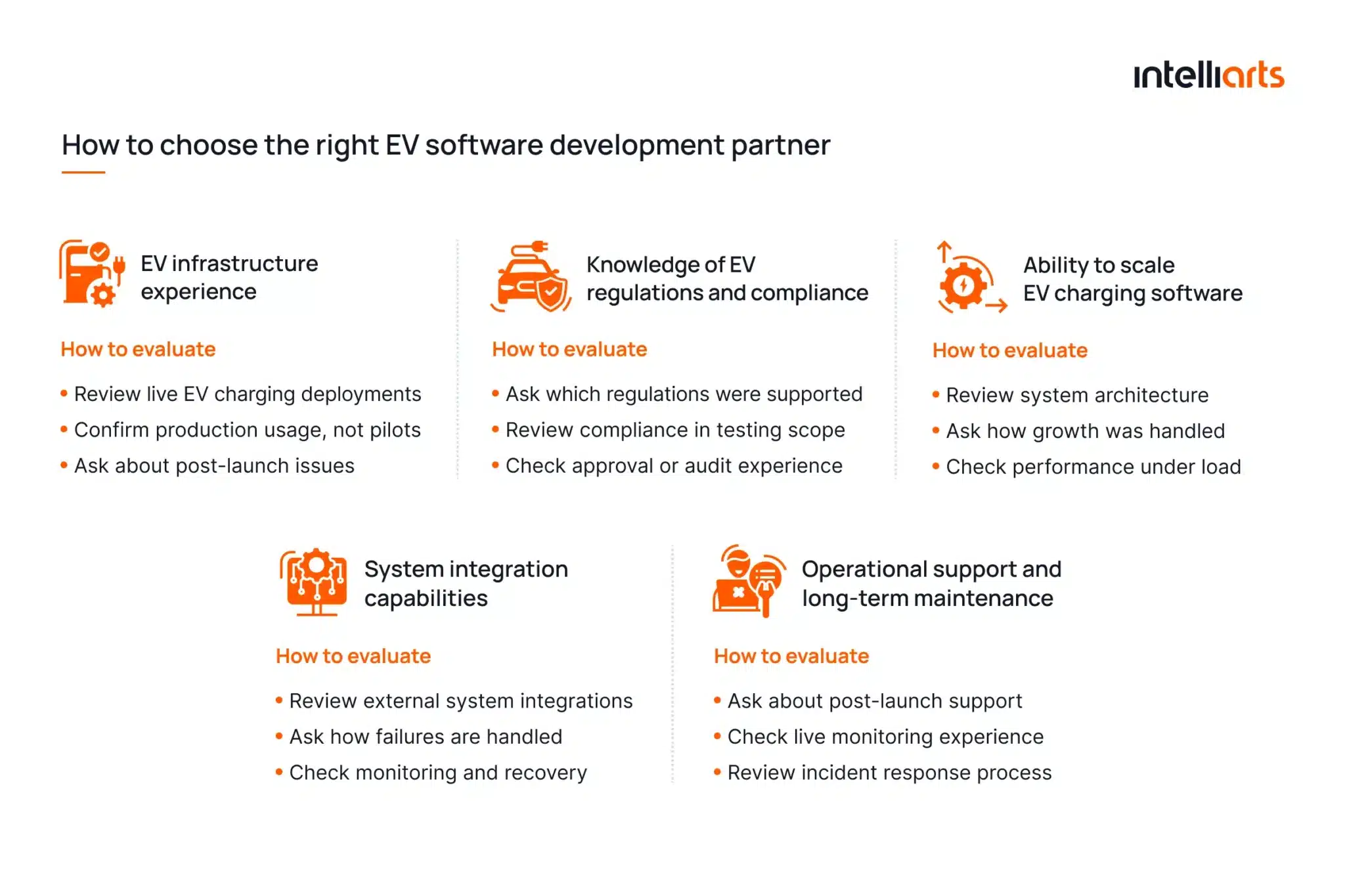
#1. EV infrastructure experience
Hands-on experience with EV charging infrastructure means the team has supported systems in real operating environments. This experience matters because many issues only appear once a system is deployed and used at scale. Teams without this background often underestimate operational complexity and respond too late.
How to evaluate:
- Ask for examples of deployed charging projects
- Confirm that the systems were used in production
- Ask what challenges appeared after launch
- Check whether the team worked with live operational constraints
#2. Knowledge of EV regulations and compliance
Intelliarts’ insights show that experience with EV charging regulations involves understanding how rules influence system design, approvals, and rollout timelines. This matters because compliance issues tend to surface during audits or market entry, when changes are expensive and disruptive.
How to evaluate:
- Ask which regulations or standards were addressed
- Review how compliance is handled during testing
- Ask how regulatory risks are identified early
- Check whether compliance responsibilities are clearly defined
See how an EV partner like Intelliarts can contribute to an EV project of any complexity in our EV fleet management software success story.
#3. Ability to scale EV charging software
Scalable EV charging software remains stable as usage increases and new markets are added. Systems designed without scalability in mind often perform well at first, then degrade once adoption grows.
How to evaluate:
- Review architectural decisions and hosting setup
- Ask how previous systems handled growth
- Ask what limits were reached in earlier projects
- Check how scaling issues were resolved
#4. System integration capabilities
Another key point, based on Intelliarts experts’ opinion, is integration capabilities. Strong integration allows software to exchange data reliably with external systems. This is critical when it comes to cost-effective EV charging optimization, as platforms depend on constant communication across services, which may be expensive to maintain.
How to evaluate:
- Review projects with multiple external integrations
- Ask how integration failures are detected
- Ask how partial failures are handled
- Check experience with recovery and retries
#5. Operational support and long-term maintenance
Experience with operational support means the team understands how EV systems evolve over time. Many issues emerge months after deployment, once usage patterns change or infrastructure expands.
How to evaluate:
- Ask what post-launch support includes
- Check experience with live monitoring
- Ask how long teams stay involved after delivery
- Review documented support and escalation processes
There’s also an alternative method of EV software partner choosing. Here’s a core framework that visually represents what capabilities and in which category a trusted provider should have. Simply print the image or copy it in a photo editing program of your choice and check the boxes. This will provide you with a simple evaluation matrix byusing which you can compare multiple providers to each other.
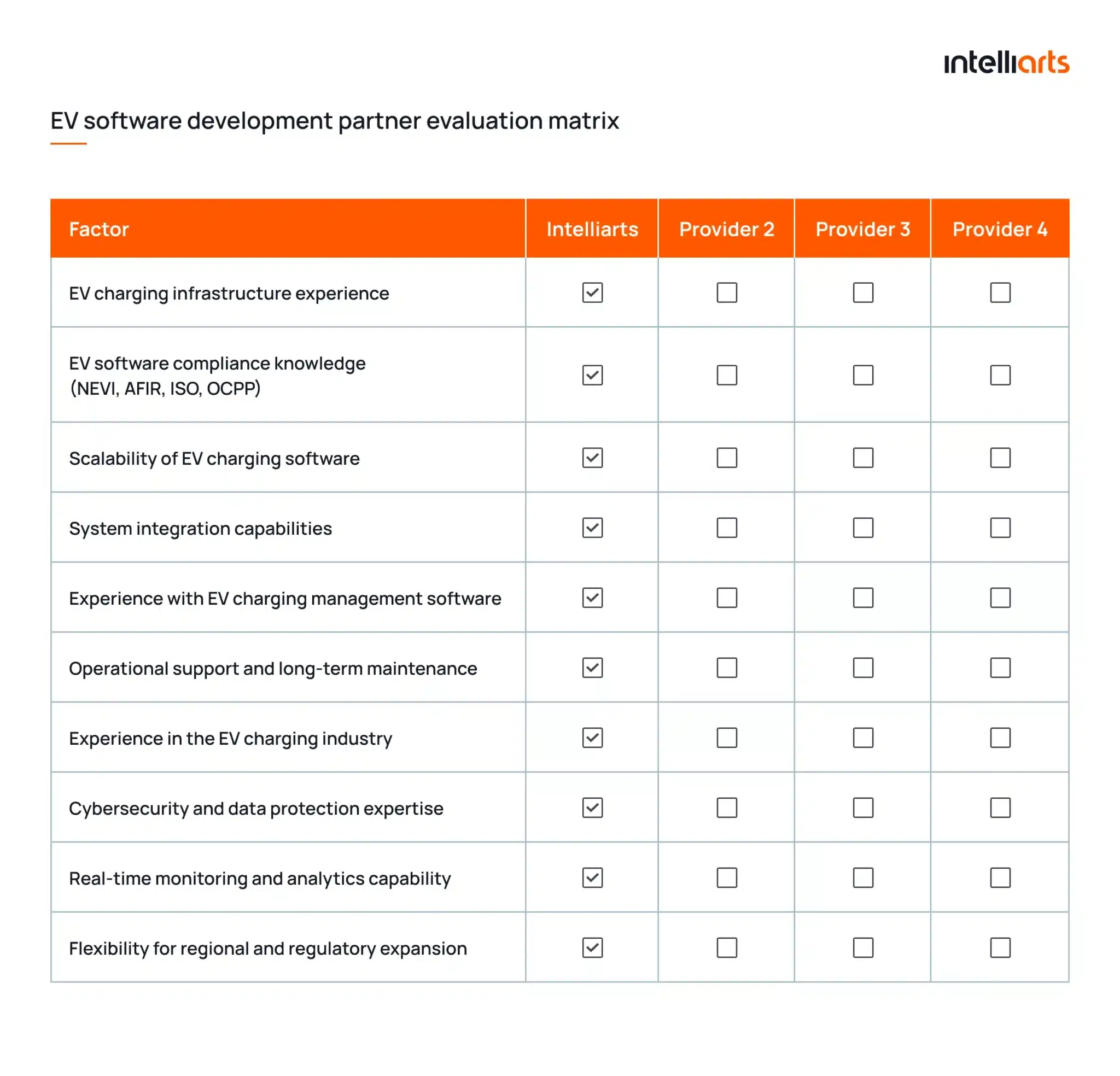
Choosing the right EV software development partner reduces delivery risk and long-term maintenance effort. Teams with practical EV experience, regulatory awareness, scalability knowledge, integration expertise, and operational support capability are better prepared to build and maintain reliable solutions in the EV charging industry.
Do you require EV software development services? Reach out to Intelliarts, to discuss opportunities for your best project.
How Intelliarts helps ensure EV software compliance
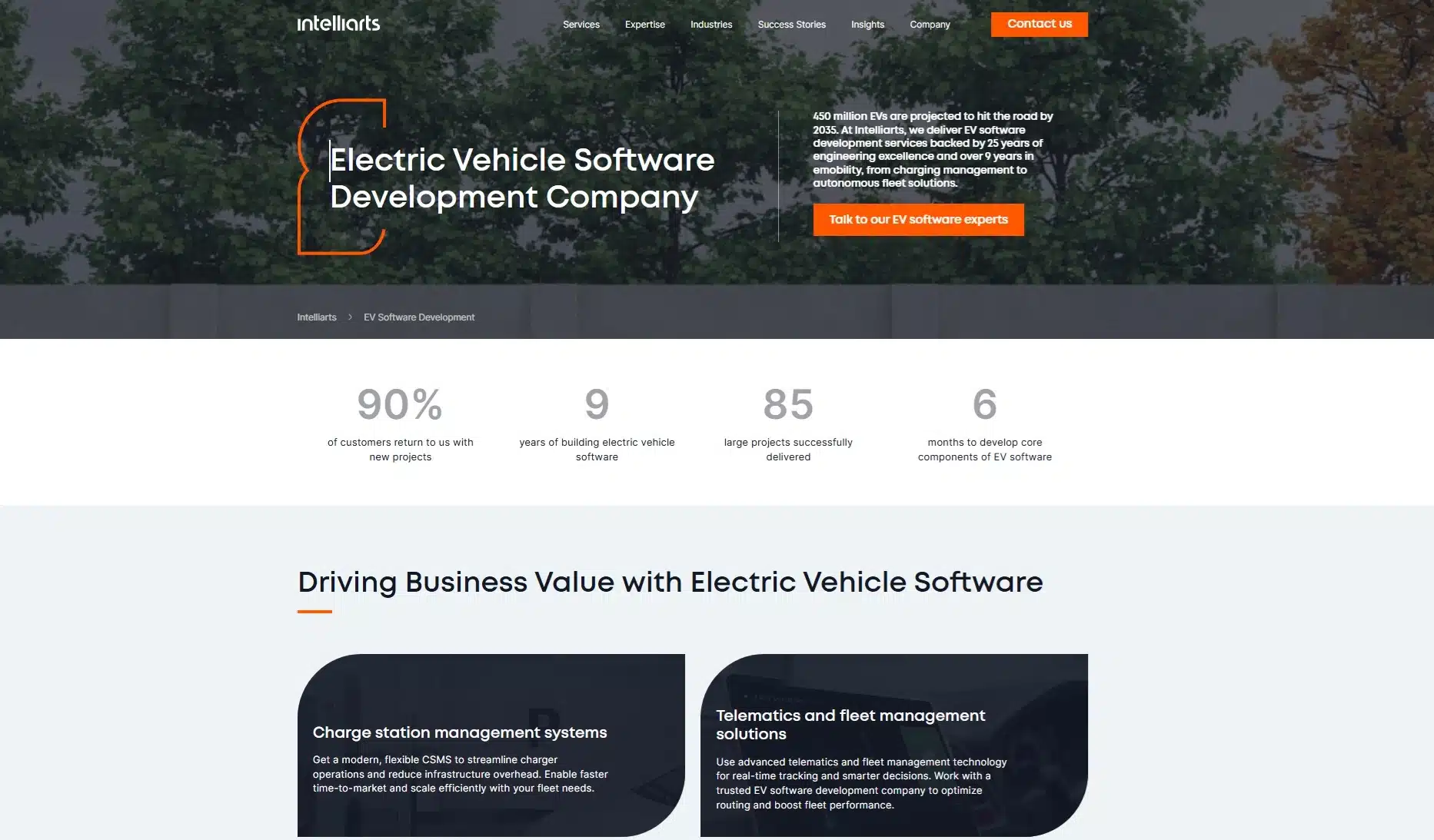
Intelliarts supports EV charging businesses that operate in regulated, multi-market environments where EV software compliance is a core requirement. With more than 25 years of experience in the market and hands-on experience in the EV charging industry, we design, build, and scale EV charging software. We have delivered 90+ large-scale projects for clients worldwide, including EVConnect, Indigo Ag, Greenlane, and Schneider Electric. Our focus is on production-ready systems that integrate smoothly with infrastructure and remain stable as regulations evolve.
Intelliarts has been recognized among the Top 100 Software Development Companies of 2026 by industry reviewers.
Services offered
- Custom software development
- Technology consulting
- Machine learning and LLM solutions
- Data engineering and analytics
- IoT solutions
Some of our key EV capabilities and expertise include:
- Expertise in OCPP and ISO 15118 to enable interoperability, Plug & Charge, roaming readiness, and compliance.
- Capability to include AI-driven features in your custom EV software solutions.
- Expert knowledge of global and local EV standards and regulations for optimal compliance.
- Capability to design and implement business-oriented analytical systems in EV software.
Intelliarts engineers provide custom software development emobility with interoperability, security, and auditability in mind to reduce the risk of late-stage redesigns. This approach is especially important for companies expanding across regions or operating public charging networks.
Beyond implementation, Intelliarts consults customers on EV charging regulations and architecture decisions to help manager regulatory expectations from the start. Our work is centered around helping EV charging software companies to scale confidently and deliver reliable user experiences across platforms, including EV apps.
Looking for a trusted provider of software services for renewable energy & e-mobility? Don’t hesitate to reach out to Intelliarts. Our experts are ready, willing, and able to contribute to your best project.
The future of EV software regulations and what it means for your business
What the Intelliarts team, our customers, and other businesses in the industry see is that regulatory frameworks for EV charging software are changing beyond basic connector and safety standards. Rules are emerging around data privacy, cybersecurity, sustainability reporting, and interoperability. These trends reflect how governments and markets balance user protection, grid stability, and climate goals with rapid EV adoption.
In 2026 and beyond, we expect even EV software regulations to become stricter and harder to comply with due to zero emissions, ethical usage of AI, and green Earth policies. That’s exactly why every company dealing with EV software needs a tech partner they can trust. — Ihor Rudnyk, an eMobility Tech Specialist at Intelliarts
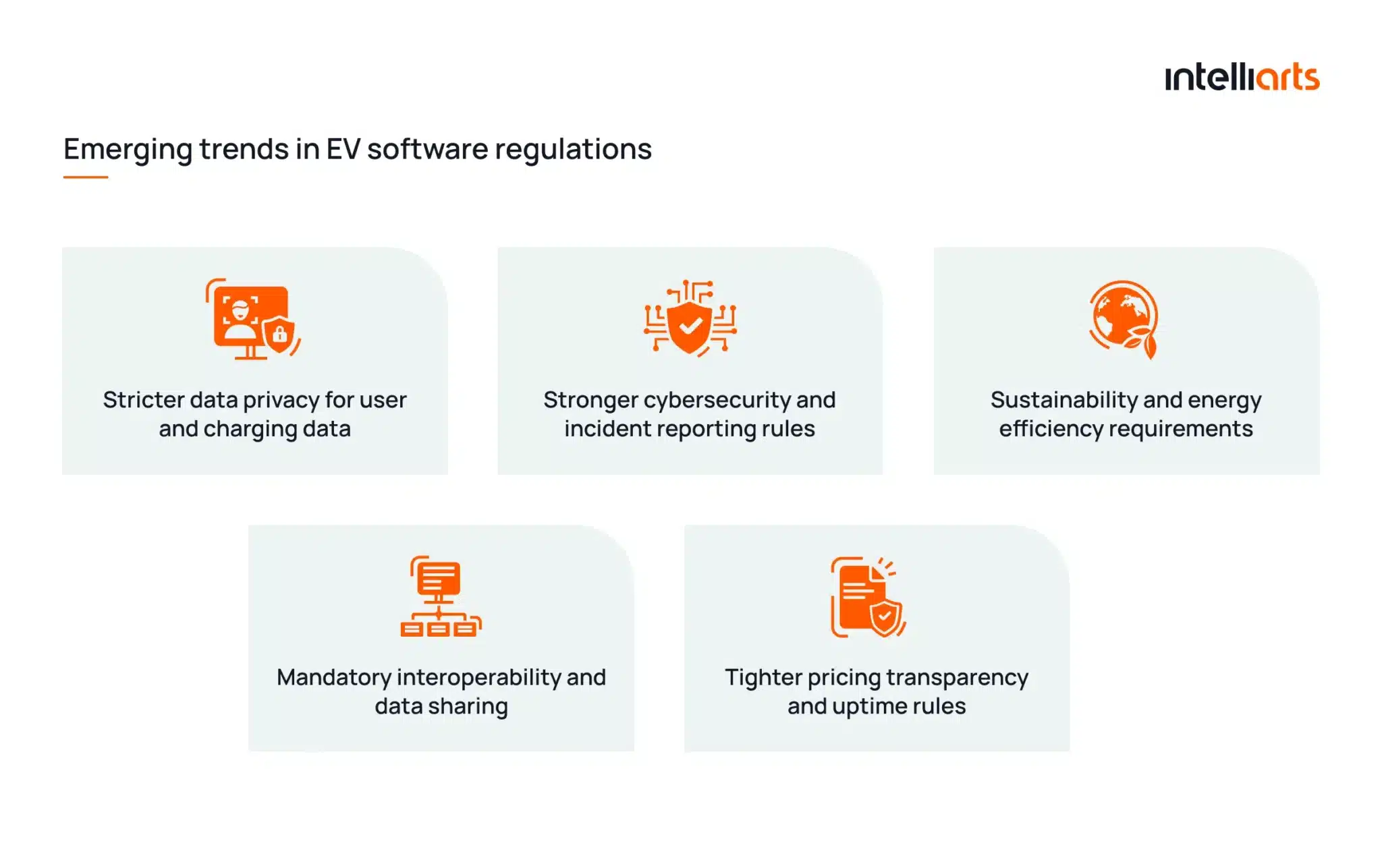
Emerging regulatory trends:
- Data privacy protections are expanding, requiring stronger safeguards around user information and charging session data, influenced by broader laws such as the GDPR and national privacy regimes.
- Cybersecurity requirements are becoming more detailed and well-articulated, with initiatives like the EU Cyber Resilience Act proposing lifecycle security and incident reporting.
- Sustainability and green compliance obligations are influencing infrastructure deployment, tying charging behavior and energy use to emissions and efficiency goals.
- Interoperability and data sharing expectations are increasing to support roaming and network coordination, as provided in the Eurelectric data interoperability study.
- Consumer protection rules are tightening around pricing visibility and uptime standards, which reflects regulatory movement toward transparency for users.
To prepare for evolving standards and stay ahead of the regulatory curve, businesses should embed regulation tracking into product planning. That means the following:
- Assigning clear responsibility for monitoring changes in key markets
- Adding compliance checkpoints into development workflows
- Aligning product roadmaps with upcoming regulatory timelines.
Technical teams should build modular compliance layers so that adjustments for new privacy, security, or interoperability rules do not require major system redesign.
Regular internal reviews, participation in industry forums, and engagement with legal and standards advisors help surface emerging obligations early. By structuring development processes around foreseeable regulatory shifts, businesses reduce risk and maintain deployment momentum as EV charging regulations mature.
Final Take
EV charging software now sits at the center of regulation, infrastructure, and user experience. Global standards define how systems should work, while regional regulations decide where and how they can operate. Companies that design EV software with compliance in mind reduce rollout risk and avoid costly rework. Choosing experienced partners is what helps businesses scale across markets while keeping EV platforms stable, secure, and ready for future requirements.
Here at Intelliarts, with a team of senior staff engineers and EV experts, we can support your EV project with both consulting and development. We focus on long-term partnerships, have 90% customer return rate, and 25+ years of experience in the development, AI, and EV market. Should you need a provider you can trust, don’t hesitate to reach out to Intelliarts.
Build a Future-Ready EV Platform with Senior Experts
Reduce rollout risk and avoid costly rework with our expertise in EV software and AI
Contact Us
FAQ
What are EV software regulations for different regions?
EV software regulations vary by region, covering cybersecurity, data privacy, interoperability, and grid integration. The EU emphasizes GDPR and standards like ISO 15118, while the US focuses on safety and grid compliance. Asia adds local certification layers. These EV software regulations directly shape product architecture.
How do regional regulations impact the development of EV charging infrastructure?
Regional rules influence hardware standards, grid connections, data exchange, and payment systems. Different connector types, energy regulations, and reporting requirements increase complexity and cost. These differences create EV charging infrastructure challenges, especially for cross-border scalability in the EV charging infrastructure market.
How can businesses ensure EV software complies with global and local standards?
Businesses should design modular architectures, follow international standards (OCPP, ISO 15118), and regularly audit systems against local laws. Partnering with experienced vendors and compliance experts reduces risk. Strong governance processes are essential for reliable EV software compliance in regulated markets.