
EV charging has become a practical requirement for drivers, businesses, and energy providers. More stations appear each year, and each one must work with different vehicles, software systems, and power conditions. In 2024 alone, more than 1.3 million public charging points were added globally, a growth of over 30% compared to the previous year. Clear standards help avoid confusion and technical mismatches, especially as countries use different connectors and communication rules.
In this post, you’ll explore the main EV charging standards and protocols. The guide will familiarize you with their provision, indicate the main benefits of complying with them, and show the future of EV charging standards development in 2026 and beyond.
Navigate EV Charging Standards with Ease
Understand how global EV charging standards connect to real regulatory requirements and what this means for scalable, compliant charging platforms.
Read our white paper
What are EV charging standards and protocols?
First, let’s get through the topic-related concepts:
EV Charging standards are technical guidelines created by international standards bodies that define requirements for charging electric cars.
Groups like ISO, IEC, SAE, and the European Commission define standards like connector types, safety rules, power levels, and more. Respectively, automakers and charging networks then have to adopt these requirements to keep vehicles and chargers fully compatible and their operation compliant.
At the same time:
EV Charging Protocols are communication rules that define how a charger and an electric vehicle exchange data during a charging session.
Unlike EV charging optimization standards, which focus on physical hardware and safety rules, protocols define the intelligence of the system. The standards are provided by ISO, IEC, SAE, OCA, and CharIN. They design these charging frameworks so that charging networks can coordinate thousands of chargers. Automated monitoring, integrated roaming, and consistent uptime are only a few of the goals of electric vehicle charging standards implementation.
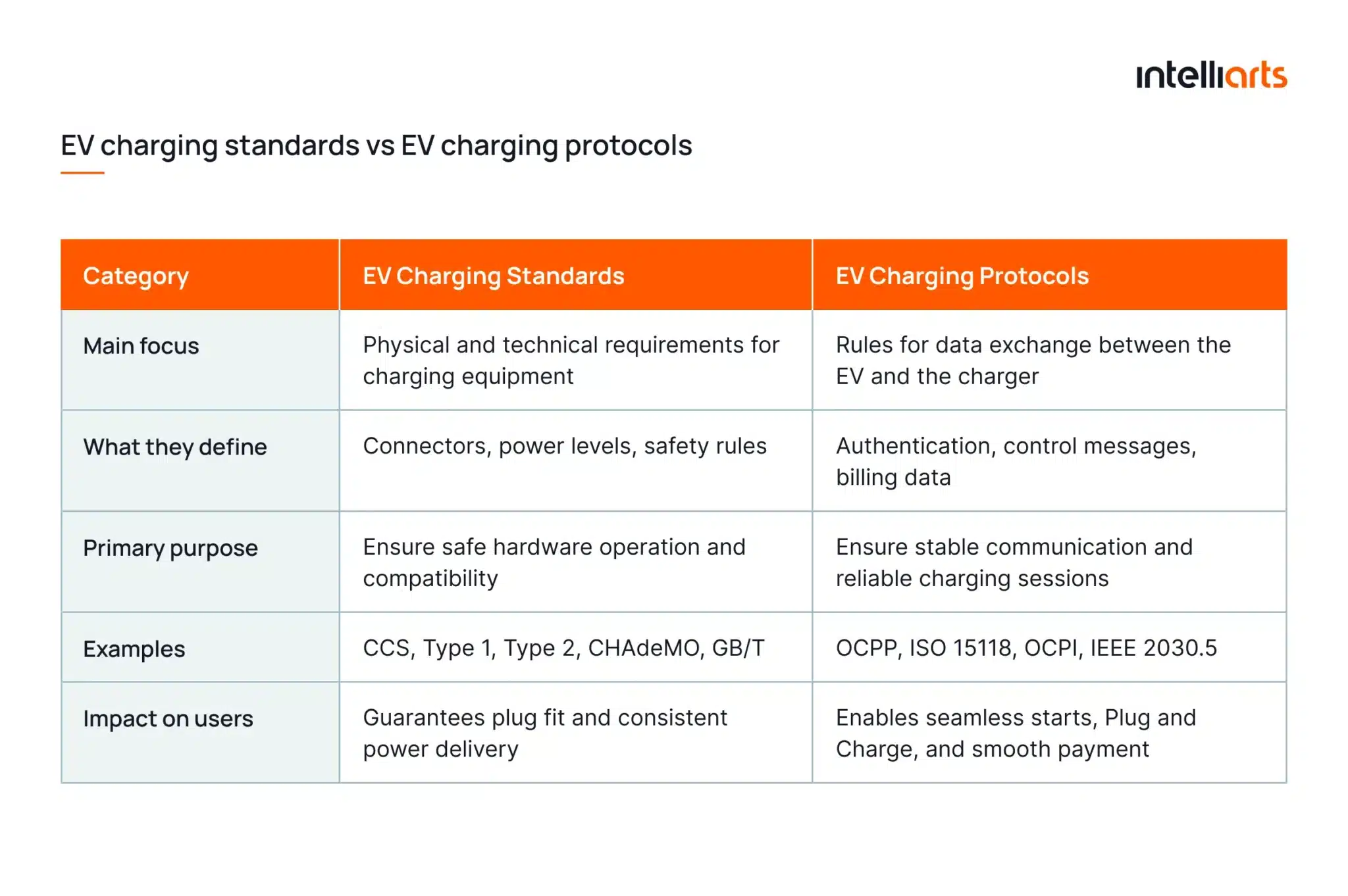
The table below shows the distinctions between EV charging standards for electric vehicles and EV charging protocols:
Key EV charging standards in the industry
When countries follow the same electric vehicle charging standards, networks grow faster, and users face fewer adaptation barriers. Here are the main industry standards, as well as details on governing organizations and their main provisions:
Combined Charging System (CCS)
Authority: https://www.ieee.org
Description: CCS is the dominant electric car charging standard in Europe and North America, combining AC and DC pins into one connector. It supports a broad power spectrum and relies on ISO 15118 as its main EV charger communication protocol, enabling features like Plug & Charge and smart-charging control. CCS is governed collectively through IEC, ISO, and SAE documents
Main provisions:
- Supports both AC (Type 1/2) and DC fast charging
- Power levels from 22 kW AC up to 350 kW DC
- Uses ISO 15118 for authentication and communication
- Adopted as the European EV charging standard
CHAdeMO charging standard
Authority: https://www.chademo.com/
Description: CHAdeMO is a Japanese-origin EV charging standard used by Nissan and several Asian automakers. It has historically led innovations such as vehicle-to-grid (V2G), though CCS is now more globally widespread.
Main provisions:
- DC charging up to 200 kW (current CHAdeMO 2.0)
- Native support for V2G bidirectional energy flow
- Widely deployed across Japan and parts of Asia
- Independent communication channel separate from AC circuits
Type 1 and Type 2 (AC Charging) standard
Authority: https://www.iec.ch
Description: These AC connectors define the baseline for EV charging station specifications. Type 1 is common in the U.S., while Type 2 dominates Europe thanks to EU regulations mandating it.
Main provisions:
- Type 1: single-phase AC up to ~7 kW
- Type 2: three-phase AC up to 22 kW (public AC up to 43 kW)
- Required interface for most European AC chargers
- Forms the AC component of CCS2
GB/T Standard (China)
Authority: http://www.sac.gov.cn/
Description: China’s electric car charging standards for electric vehicles operate under GB/T requirements with separate AC and DC connectors. A next-generation “ChaoJi” system is under co-development with CHAdeMO Association to unify high-power DC charging across Asia.
Main provisions:
- Government-mandated standard for all Chinese EVs
- AC up to 7–11 kW, DC up to 250 kW (higher in ChaoJi)
- Strong emphasis on grid-integrated smart charging
- Unique communication protocol not compatible with CCS
North American Charging Standard (NACS)
Authority: https://www.sae.org/standards
Description: Originally developed by Tesla and now standardized by SAE as US EV charging standards, NACS is compact, lightweight, and gaining adoption among major automakers in North America.
Main provisions:
- AC and DC in a single compact plug
- DC fast charging beyond 250 kW
- Backward compatibility across Tesla vehicles and networks
- Rapid growth among U.S. charge point operators
Clear standards shape how networks expand across regions and how EV smart charging regulations evolve. They also help operators avoid costly compatibility problems and ensure reliable charging access for users.
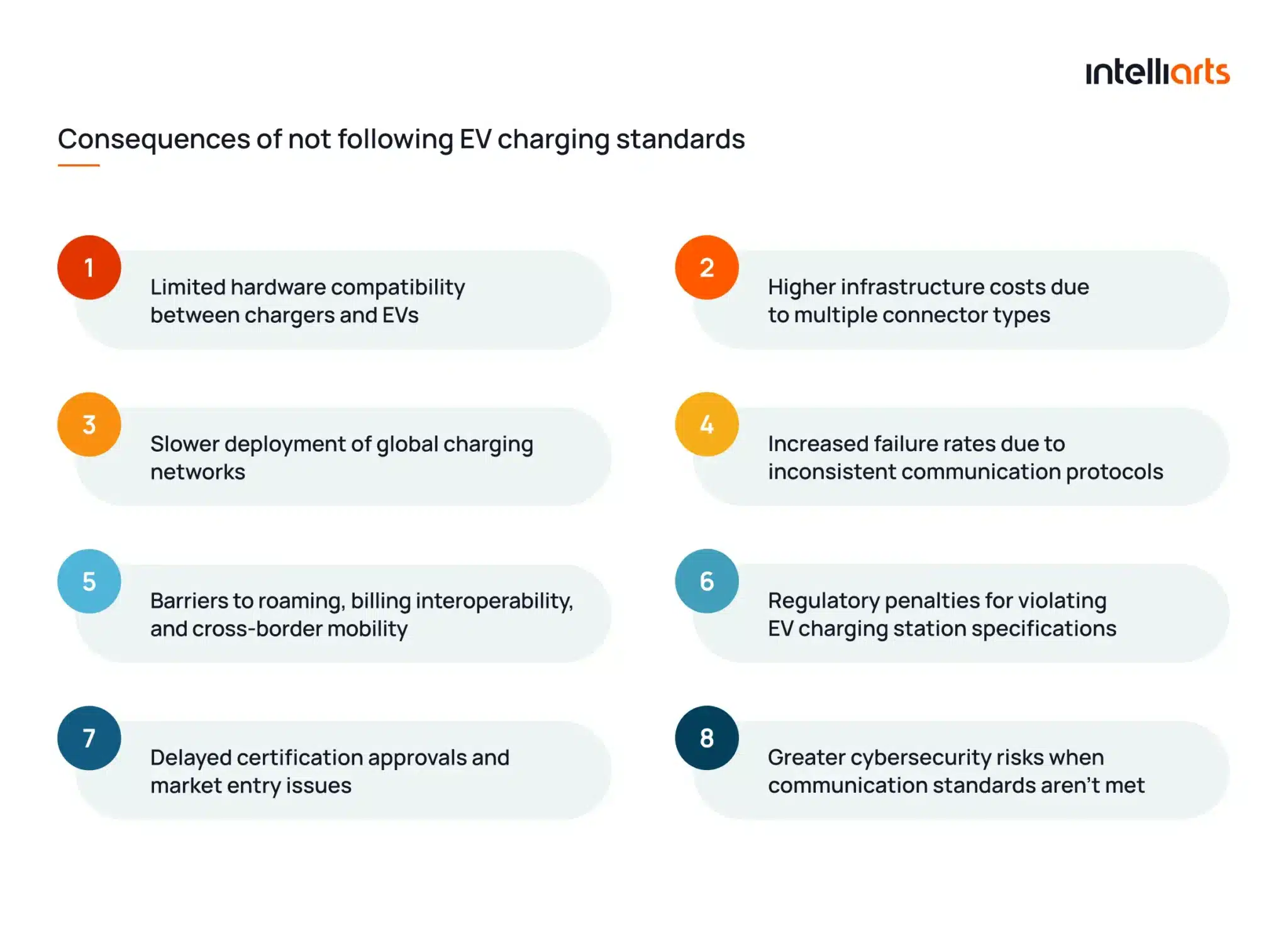
See the consequences of not following these EV charging station standards in the image below:
- Limited hardware compatibility between chargers and EVs
- Higher infrastructure costs due to multiple connector types
- Slower deployment of global charging networks
- Increased failure rates due to inconsistent EV charger communication protocols
- Barriers to roaming, billing interoperability, and cross-border mobility
- Regulatory penalties for violating EV charging station specifications
- Delayed certification approvals and market entry issues
- Greater cybersecurity risks when communication standards aren’t met
Key EV charging protocols in the industry
Clear EV charger communication protocol design protects users from failed charging sessions and supports global adoption of electric car charging standards. Here’s a list of the industry’s widely adopted protocols:
Open Charge Point Protocol (OCPP)
Authority: https://www.openchargealliance.org/
Description: OCPP is the most common communication system between a charging station and a central energy management platform. Operators use it to control chargers, update firmware, and monitor performance. OCPP is open and allows networks to mix hardware from different manufacturers. This supports the goals of modern electric vehicle charging standards and reduces vendor lock-in.
Main provisions:
- Open protocol for charger-to-platform communication
- Versions 1.6 and 2.0.1 supported by industry
- Tools for remote monitoring and fault handling
- Support for smart charging and tariff control
ISO 15118
Authority: https://www.iso.org/
Description: ISO 15118 defines secure communication between an electric vehicle and a charging station. One of its core features is Plug and Charge. This function identifies the vehicle automatically and starts charging without cards or mobile apps. ISO 15118 improves user comfort and supports future vehicle-to-grid functions that appear in EV smart charging regulations.
Main provisions:
- Automatic authentication through Plug and Charge
- Secure channel between vehicle and charger
- Structure for power control messages
- Preparation for V2G functions
These protocols operate around the charging ecosystem. They support roaming, grid coordination, and large infrastructure projects. They also help unify EV charging station specifications across regions.
Standardization feels like an engineering component only, but it’s actually a part of a business strategy. The more compliant your system is, the faster you can expand, certify, and form roaming partnerships. — Yurii Aulikh, Software Engineer at Intelliarts
IEC 61850
Authority: https://www.iec.ch/
Description: IEC 61850 defines communication rules for smart grids and substations. It is useful for large high-power charging sites. The protocol helps operators coordinate charging loads with local grid equipment.
Main provisions:
- Structured data exchange in grid systems
- Support for high-power infrastructure
- Tools for grid stability
- Integration with smart energy systems
These protocols are a valuable addition to global EV charging station standards. They are intended to help EV charging providers improve the reliability of their EV networks.
OCPI (Open Charge Point Interface)
Authority: https://ocpi-protocol.org/
Description: OCPI creates communication between different charging networks. It sends data about prices, availability, and session details. OCPI allows roaming, so users can charge across networks without separate accounts.
Main provisions:
- Roaming support between operators
- Data exchange for pricing and availability
- Session sharing for billing and settlement
- Simple integration across platforms
IEEE 2030.5
Authority: https://standards.ieee.org/
Description: IEEE 2030.5 controls communication between energy systems and distributed resources. It appears in home charging systems, grid-aware chargers, and utility control programs. It helps regions maintain stable power grids while supporting fast EV adoption.
Main provisions:
- Utility-to-device communication
- Support for demand-response programs
- Load control for residential and workplace charging
- Tools for grid-friendly operation
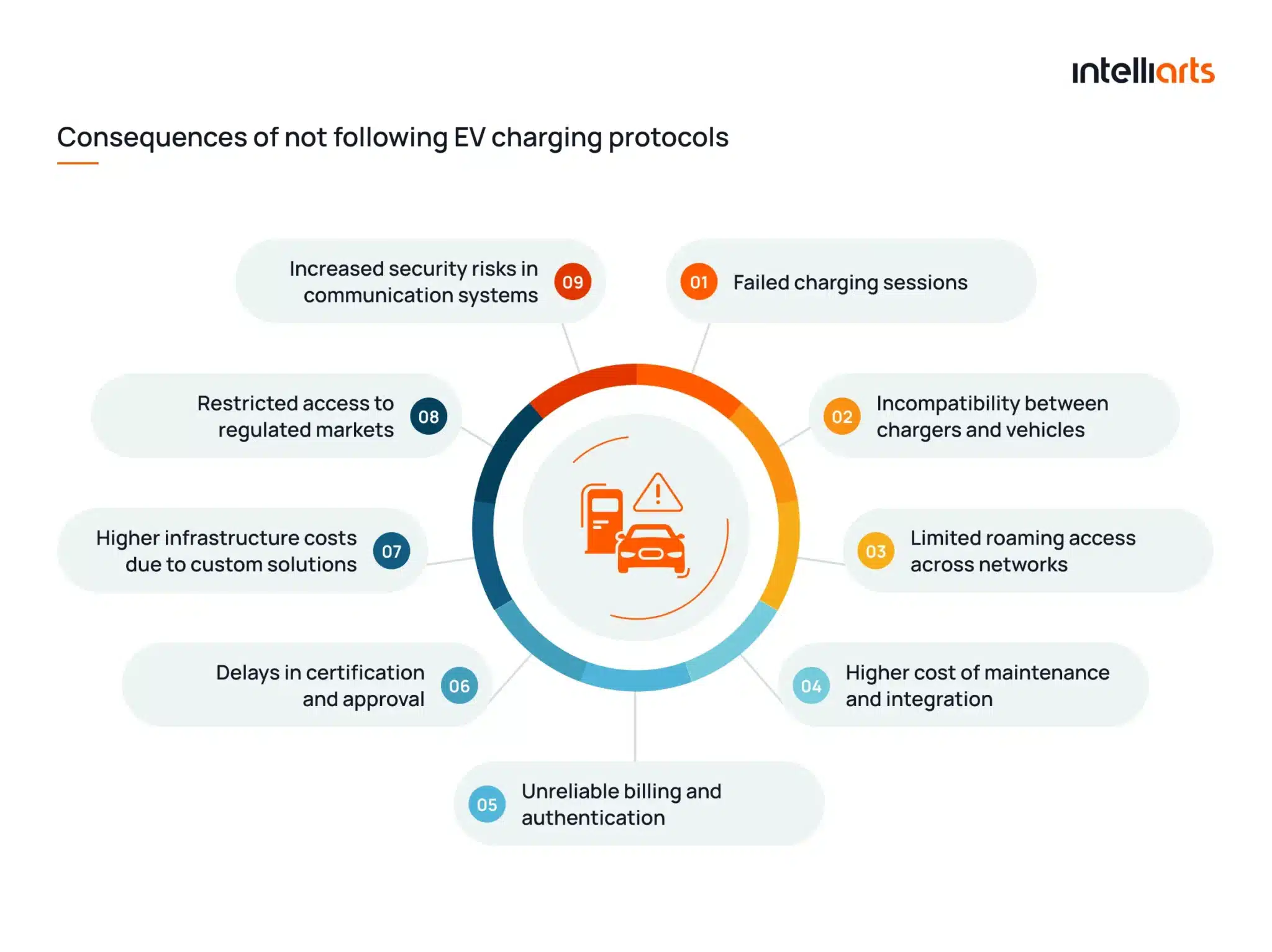
The consequences of not following these EV charging protocols are shown in the image below:
- Failed charging sessions
- Incompatibility between chargers and vehicles
- Limited roaming access across networks
- Higher cost of maintenance and integration
- Unreliable billing and authentication
- Delays in certification and approval
- Higher infrastructure costs due to custom solutions
- Restricted access to regulated markets
- Increased security risks in communication systems
Why Standardization Matters for the EV Ecosystem: Key Benefits
Standardization gives the EV ecosystem a stable foundation. Charging networks grow faster when every part of the system follows the same rules. It also helps operators avoid compatibility issues that slow adoption. Clear electric car charging standards and mature EV charging protocols create a predictable environment for manufacturers, utilities, and consumers.
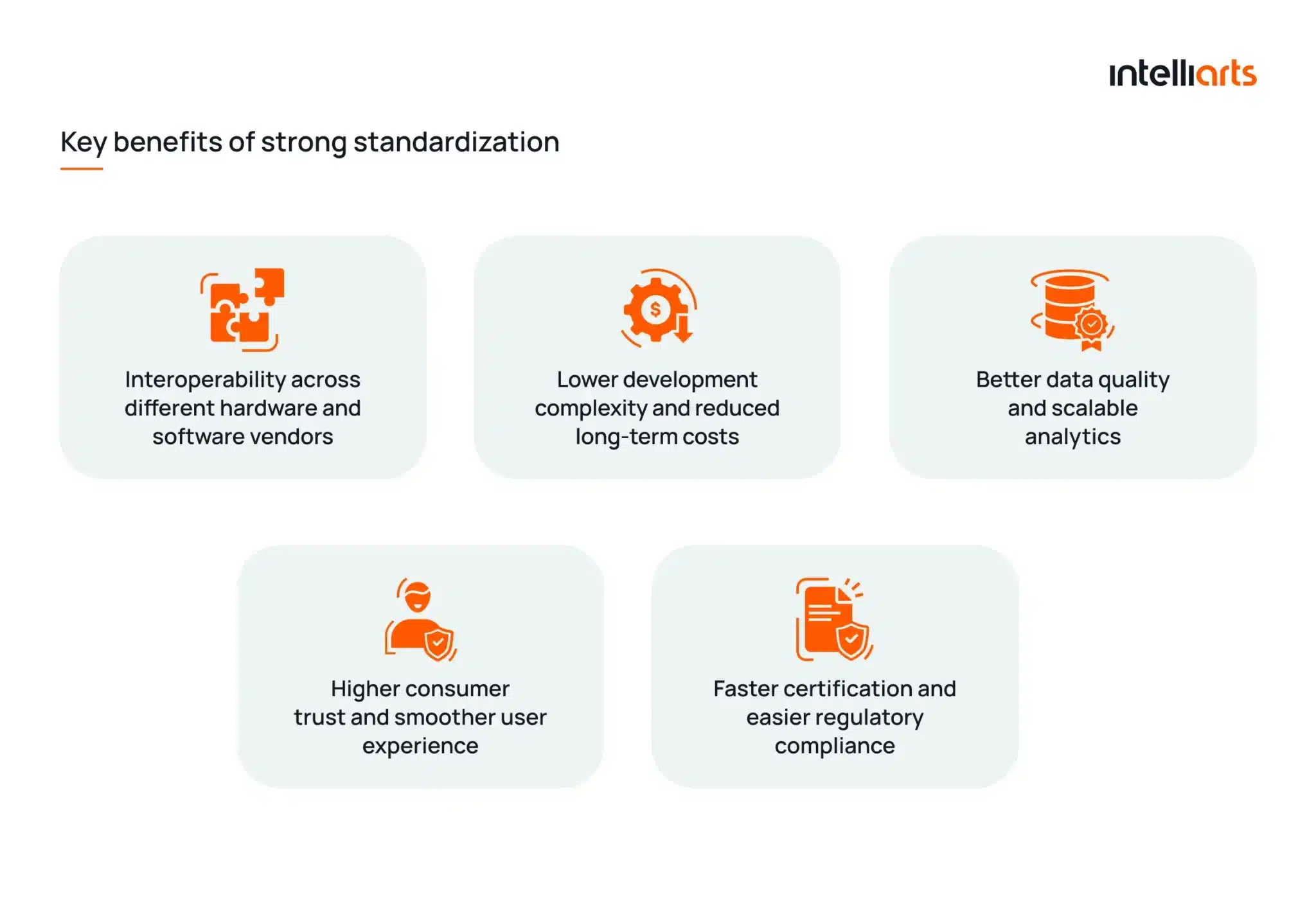
Key benefits of strong standardization:
- Interoperability across different hardware and software vendors. This reduces integration problems and keeps charging networks accessible to all EV models.
- Lower development complexity and reduced long-term costs. Companies do not need custom hardware for every market, which supports reliable global deployment.
- Better data quality and scalable analytics. Standard protocols make it easier to collect, analyze, and use data for predictive maintenance, grid coordination, and load balancing.
- Higher consumer trust and smoother user experience. Drivers can rely on roaming, simple billing, and consistent smart-charging behavior between networks.
- Faster certification and easier regulatory compliance. Standardized equipment enters the market more quickly and stays aligned with new policy updates.
In a nutshell, standardization helps every part of the EV ecosystem work more smoothly. It cuts unnecessary complexity, keeps networks reliable, and gives users a consistent experience wherever they charge. When companies follow the same rules, it becomes easier for every party involved to expand infrastructure and support new technologies without disruptions.
Looking for an experienced tech partner who has worked with lots of EV projects? Explore the EV charging management platform success story by Intelliarts.
The future of EV charging standards
EV smart charging regulations progress as infrastructure expands and regulatory pressure increases. The next stage depends on handling identity, energy coordination, and EV charging data analytics at scale. These four trends signal where the industry is heading and what constraints it must address.
#1 Growing adoption of Plug and Charge (ISO 15118)
Plug and Charge moves the authentication step into the vehicle. Chargers must read certificates and confirm identity without apps or cards. Networks that do not support ISO 15118 will struggle to connect newer EV models.
Indications:
- Adoption noted in the GAC European EV charging report.
- More EV models scheduled to support ISO 15118 in 2025–2026.
You may be additionally interested to explore EV charging management software platform market trends in another blog post by Intelliarts.
#2 Convergence toward global standards
The rise of large charging networks makes fragmented regional rules harder to maintain. Manufacturers want fewer connector formats, and regulators want simpler cross-border compatibility. The industry is moving toward shared technical baselines.
Indications:
- The IEA’s Global EV Outlook 2025 shows growth levels that intensify convergence needs.
- Cross-region alignment discussions continue in major industry groups.
#3 AI-based optimization and data-driven management
Large charging networks rely on forecasting and automated decisions. AI tools need clean, consistent data from chargers. This pushes future standards to define clearer data structures and communication rules.
Indications:
- An MDPI study shows how AI is reshaping load management.
- Providers invest in real-time data systems instead of static backends.
These trends show a shift in what actually limits the growth of charging networks. Hardware is no longer the main obstacle. The real challenge is software that can process new rules, handle grid signals, and work with large amounts of data. Standards will keep changing, so the networks that adjust their software fastest will shape how the next stage of EV charging develops.
Over the past couple of years, we have seen that getting new chargers isn’t the biggest bottleneck. Data management and grid coordination are. Future standards will be written with AI-driven load balancing in mind. — Alexander Barinov, Managing Partner at Intelliarts
#4 Integration with smart grids and renewable energy
Charging is now tied to grid stability. Operators expect chargers to react to grid load, frequency, and renewable output. Standards must adapt so chargers can follow live grid signals and handle new forms of energy exchange.
Explore the renewable energy software development expertise of Intelliarts.
Indications:
- A 2025 study, Grid-Aware Scheduling and Control of Electric Vehicle Charging Stations, demonstrates how chargers follow day-ahead grid plans and adapt in real time to support network stability.
- Utilities continue testing programs that link EV charging with solar and wind output.
Final take
EV charging depends on more than compatible hardware. Modern networks rely on shared standards, stable EV charger communication protocols, and software that adapts to new technical rules. Plug and Charge adoption, growing alignment between regions, and the shift toward grid-aware operation all point in the same direction. At the same time, companies that follow recognized standards now place themselves in a stronger position for the next stage of the EV industry.
Should you need an EV charging solution, make sure to partner only with experienced software vendors. Here at Intelliarts, with 24+ years of providing tech services to customers worldwide, we can help you with EV protocols and standards-compliant development. Don’t hesitate to reach out to our team of senior engineers to have your challenges covered and find out why we have a 90% customer return rate.
FAQ
Which EV charging protocols are most widely used today?
The most common EV charging protocols include CCS, NACS, and CHAdeMO. These electric vehicle charging standards dominate because they support fast charging and broad interoperability. CCS remains the primary European EV charging standard, while NACS is becoming central under updated US EV charging standards.
What challenges do businesses face when deploying EV charging infrastructure internationally?
Companies expanding globally must navigate different EV charging station standards and regional regulations. Hardware often conflicts with foreign charging standards for electric vehicles, increasing deployment time. Compliance with evolving EV smart charging regulations adds complexity, especially when balancing grid loads and ensuring consistent performance across markets.
Can a single software platform manage multiple EV charging protocols?
Yes, one system can support various EV charging protocols through adaptive integrations. Because it supports every major EV charger communication protocol, the platform remains interoperable with CCS, NACS, and OCPP. When built around recognized electric car charging standards, the software manages devices from multiple vendors reliably.