
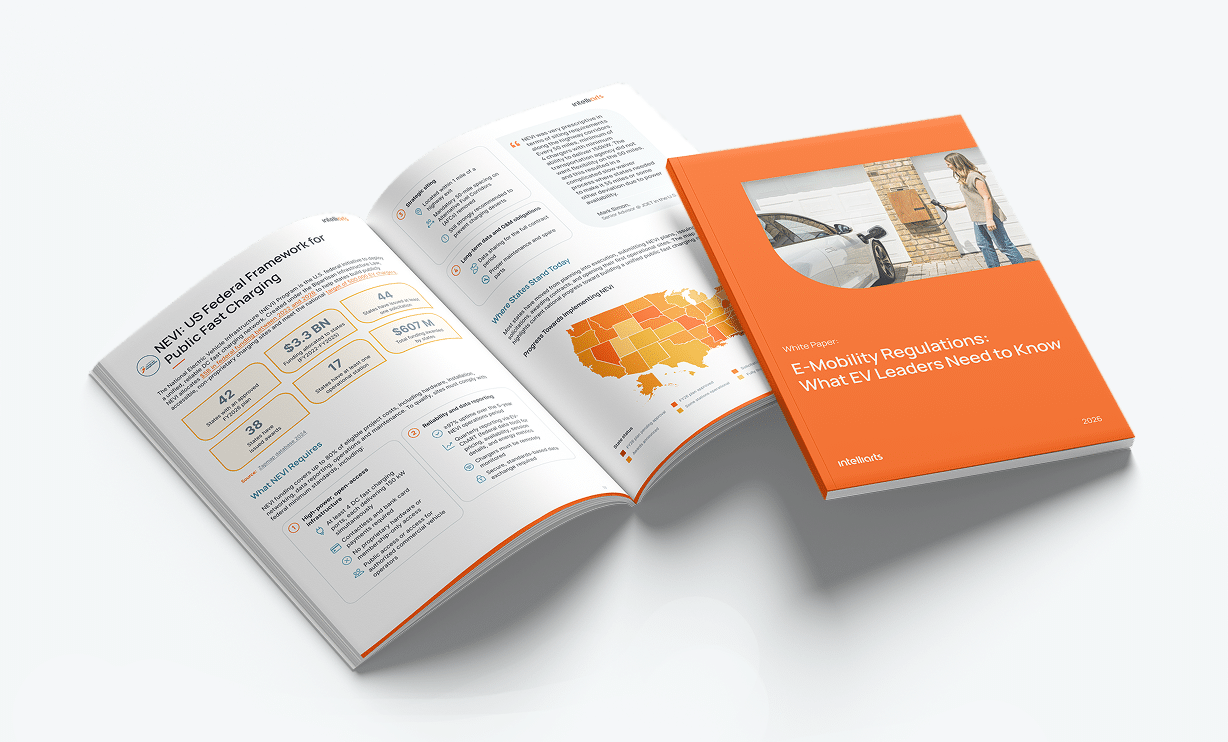

eMobility Regulations: What EV Leaders Need to Know

In the first half of 2025 alone, 5.9 million EVs were sold worldwide, a 29% year-over-year growth. This scale is transforming EV charging from a growth experiment into a highly regulated digital infrastructure.
Download our comprehensive guide to navigating the five global frameworks reshaping the industry, built on Intelliarts’ 9+ years of experience delivering future-ready emobility software for global leaders like EV Connect, Schneider Electric, Greenlane, and EVIQ.
What’s Inside?
- 5 Global Frameworks – Detailed technical and operational breakdowns of AFIR (EU), NEVI (US), UK Smart Charging, Eichrecht (Germany), and Chinese EV Charging Standards
- 36-Month Strategic Roadmap – A priority guide for building protocol-first architectures and automated reporting pipelines to prepare for evolving global compliance
- Exclusive Expert Insights – Direct strategic advice from specialists at Zaptec, Pionix, Laborelec, and Intelliarts
- Strategic Risk vs. Opportunity Analysis: How to avoid the material risks of vendor lock-in and technical debt
Who It’s For

Charge Point Operators

eMobility Service Providers

Charger OEMs

Risk Neutralization

Revenue Opportunities

Future-proofing Tech Stack


Grid Readiness

Funding Eligibility
Meet the Authors

With over 9 years of experience, she specializes in driving growth for emobility companies through tailored software solutions for V2G, EV fleet management, and power systems.
With over 9 years of experience, she specializes in driving growth for emobility companies through tailored software solutions for V2G, EV fleet management, and power systems.

eMobility expert with 13 years in software engineering. He has deep expertise in implementing OCPP (1.6/2.0.1), OCPI, and OpenADR to solve complex station lifecycle management and payment integration challenges.
eMobility expert with 13 years in software engineering. He has deep expertise in implementing OCPP (1.6/2.0.1), OCPI, and OpenADR to solve complex station lifecycle management and payment integration challenges.

Leads Intelliarts’ strategic direction across emobility. He has nearly 20 years of experience helping businesses design scalable, regulation-ready software platforms for networks of 10,000+ chargers.
Leads Intelliarts’ strategic direction across emobility. He has nearly 20 years of experience helping businesses design scalable, regulation-ready software platforms for networks of 10,000+ chargers.


FAQ
What is the EU regulation for EVs?
The EU’s main law governing public EV infrastructure is the AFIR regulation EV charging. This law sets binding rules for deployment, payments, data transparency, and uptime across all Member States.
What are the most important EV charging regulations in 2025–2030?
The most important EV regulations focus on interoperability, reliability, and grid integration, including AFIR in the EU, NEVI in the U.S., UK charger reliability and pricing rules, and Germany’s Eichrecht metering law. China EV regulations also matter, driving electrification through production mandates and nationally enforced standards for vehicles and chargers.
Can Intelliarts help with EV charging regulatory compliance?
Yes. We help EV charging operators, charger OEMs, and e-mobility platforms design and implement software that aligns with current and upcoming EV charging regulatory requirements. This includes AFIR, NEVI, UK smart charging, Eichrecht, as well as interoperability standards such as OCPP, OCPI, ISO 15118, and grid-integration workflows.