
Over the past decade, EV adoption has surged, forcing an expansion of charging infrastructure. In 2024 alone, over 1.3 million public charging points were added globally, resulting in a 30% year-on-year growth. Yet, rapid scale-up brings operational and grid challenges, including peak demand, charger downtime, and billing complexity.
EV charging management software is regarded as a critical enabler to tame niche complexities. Owners, network operators, fleet managers, and enterprises all stand to benefit from using such software.
In this post, you’ll explore how EV charging management software works in great detail. Besides, you’ll find out why exactly businesses need EV solutions based on niche-specific use cases, and discover what the future will likely bring for companies in the industry.
What Is EV Charging Management Software?
EV charging management software is a digital platform that enables operators to monitor, control, and optimize electric vehicle charging stations.
Basically, EV management software is a centralized tool that offers automated and semi-automated capabilities to manage energy distribution, user access, billing, maintenance, analytics, and other functionalities that a company considers aggregating and using.
Without further ado, we continue delving into the technicalities of EV charging optimization software by reviewing features of such tools and their expected impact on ROI.
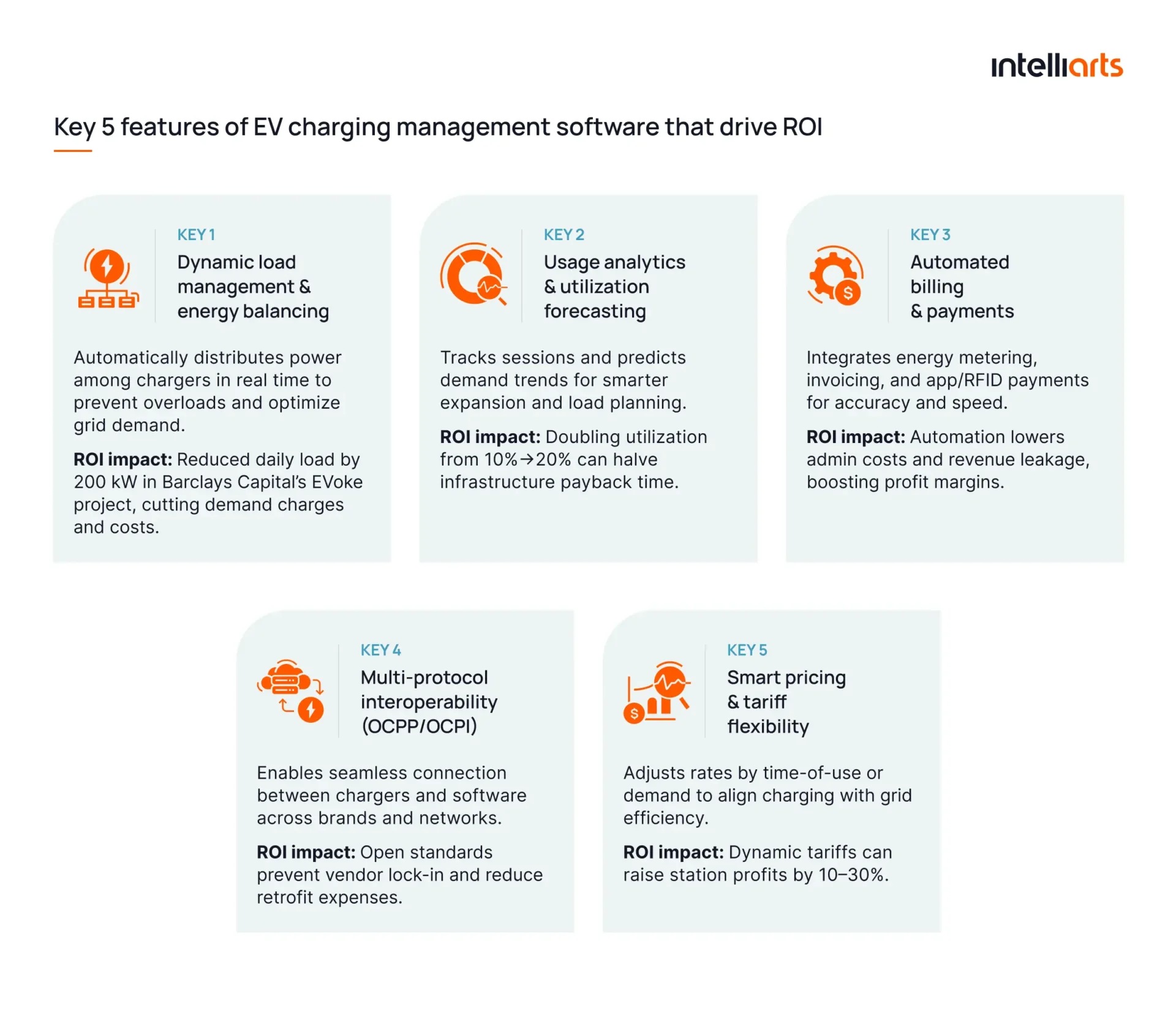
Why do owners and operators need EV charging management software: Key 5 features
It may be a bit tricky to assess the positive impact of utilizing EV fleet management software in digital transformation. However, certain research and case studies indicate the high impact of corresponding EV platform features on ROI:
#1 Dynamic load management and smart energy balancing
This feature automatically distributes available power among connected chargers in real time, ensuring optimal energy use and preventing overloads. It’s a key element of energy management for EVs, helping balance grid demand and station performance.
ROI impact: Barclays Capital, using EVoke’s smart charging APIs, reduced its daily charging load by 200 kW through advanced load scheduling. The project demonstrated how energy management for EVs can prevent grid overloads, lower demand charges, and significantly reduce operating costs.
#2 Usage analytics & utilization forecasting
Built-in analytics tools within EV charging optimization software track charging sessions, identify idle periods, and predict demand trends. This helps operators understand when, where, and how customers charge their vehicles.
ROI impact: The International ZEV Alliance report found that increasing average charger utilization from 10% to 20% can halve the payback period for EV infrastructure investments. This highlights how EV charging optimization software directly improves ROI by supporting data-driven expansion and load planning.
#3 Automated billing & payment system
Automated billing focuses on energy metering, accurate invoicing, and flexible payment options through apps or RFID at smart EV charging stations.
ROI impact: Industry ROI benchmarks emphasize that automating billing, metering, and payment processes significantly reduces administrative overhead and revenue leakage. CPOs implementing smart EV charging station platforms typically see measurable improvements in accuracy, cost efficiency, and overall profit margins.
Learn more about cost-effective EV charging optimization in our blog article.
#4 Multi-protocol interoperability (OCPP / OCPI, etc.)
Open Charge Point Protocol (OCPP) is an essential component of any EV smart charging system. The interoperability that this technology offers is intended to drive seamless communication between chargers and management software, regardless of brand or network.
ROI impact: For example, in a paper on OCPP interoperability, it’s noted that open protocols reduce complexity and cut costs by avoiding vendor lock-in and enabling the use of diverse hardware. By avoiding stranded assets and enabling hardware flexibility, interoperability can reduce replacement or retrofit costs.
#5 Smart pricing & tariff flexibility
Smart pricing approaches allow CPOs to dynamically adjust tariffs based on energy demand, time-of-use, or user type. It encourages off-peak charging and better grid alignment.
ROI impact: According to Solidstudio’s 2025 analysis, optimized pricing models and demand-based tariffs increase station profit margins by 10–30%, depending on utilization and energy costs. These smart charging solutions help operators balance grid loads while maximizing revenue through adaptive tariffs.
How does EV charging management software work?
EV charging management software is not exactly a standalone application, but rather a multiple-component platform with several logic layers and connections with external devices and third parties. Companies often use product roadmap software alongside the platform to plan feature development, prioritize updates, and ensure smooth integration of new charging functionalities.
Here’s how it works in a regular EV vehicle charging flow:
Step 1: IoT and sensor data сollection: The hardware–software bridge
Each EV charger acts as a smart IoT device equipped with meters, controllers, and sensors. Additional sensors may be installed in an electric vehicle. Altogether, they gather and send the following types of data:
- Energy delivered, voltage, and current
- Connector and charger status (available, charging, faulted)
- Temperature and load for safety control
- User or vehicle identification (via RFID, mobile app, or Plug & Charge)
This data is securely transmitted via OCPP or API to the cloud platform, where it’s aggregated from all connected chargers. The cloud layer forms the backbone for real-time monitoring, diagnostics, and data sharing across the network.
What really makes EV charging networks efficient isn’t just the hardware. It’s how well the energy is managed. Smart software keeps demand balanced and makes sure every kilowatt is used with purpose. — Ihor Rudnyk, an e-Mobility Solution Expert at Intelliarts
Step 2: Cloud platform and AI analytics: Intelligence layer
Within the cloud, collected data is processed by AI-powered analytics engines that continuously evaluate station performance and grid demand. Intelligence layer covers the following responsibilities:
- Predictive maintenance: Identifies anomalies such as overheating or voltage drops before they lead to outages.
- Load balancing: Automatically distributes power across active chargers to prevent overloads.
- Energy forecasting: Learns from historical use to predict future charging demand.
If, for instance, multiple chargers start simultaneously, the cloud engine automatically regulates current distribution to avoid exceeding facility limits. This is the stage where operational efficiency is achieved — less downtime, fewer technician visits, and optimized use of every kilowatt delivered.
Step 3: Integration with IT/OT systems and the energy grid
EV charging software doesn’t work in isolation. It integrates with IT systems, including billing, CRM, reporting, and OT systems, which form the bridge between the digital platform and real-world energy operations.
Above the cloud layer, the system connects with operational management modules such as:
- Energy management: Communicates with utilities, grid operators, and building systems to optimize power flow, balance demand, and integrate renewables.
- Charging management: Controls the real-time operation of chargers, manages queues, and coordinates sessions across sites.
- Vehicle management: Monitors EV status, battery levels, and fleet readiness, prioritizing vehicles that must depart soon.
This upper OT layer uses insights from the cloud’s AI and analytics to coordinate physical infrastructure. In turn, it sends back live operational data, creating a two-way feedback loop between the digital platform and the grid.
Step 4: Billing, authentication, and smart pricing: Business logic layer
The business logic layer connects the technical and financial sides of operation, including:
- Authentication: RFID, or Plug & Charge authentication.
- Billing and payments: Automatically generated invoices, prepaid accounts, and fleet settlements.
- Dynamic pricing: Tariffs adjusted by energy cost, time of day, or user group to balance demand.
All financial data flows through the same cloud infrastructure, ensuring that users are billed accurately and operators maintain transparent, real-time revenue control. The result — simplified workflows, minimal errors, and stronger monetization through adaptive pricing.
Step 5: Continuous monitoring and control loop
The described system often operates as a closed feedback loop to ensure continuous updates. Here’s how it may work:
- The IoT layer sends live charger data to the cloud.
- Analytical software processes and visualizes data for operators.
- Commands and updates (like restarting chargers, throttling power, or changing tariffs) flow back down through the same path.
This loop ensures fast responses to faults, dynamic energy control, and a consistent user experience.
Take a look at the infographic, including all the components of the charging procedure with an EV charging management software, and data flows:
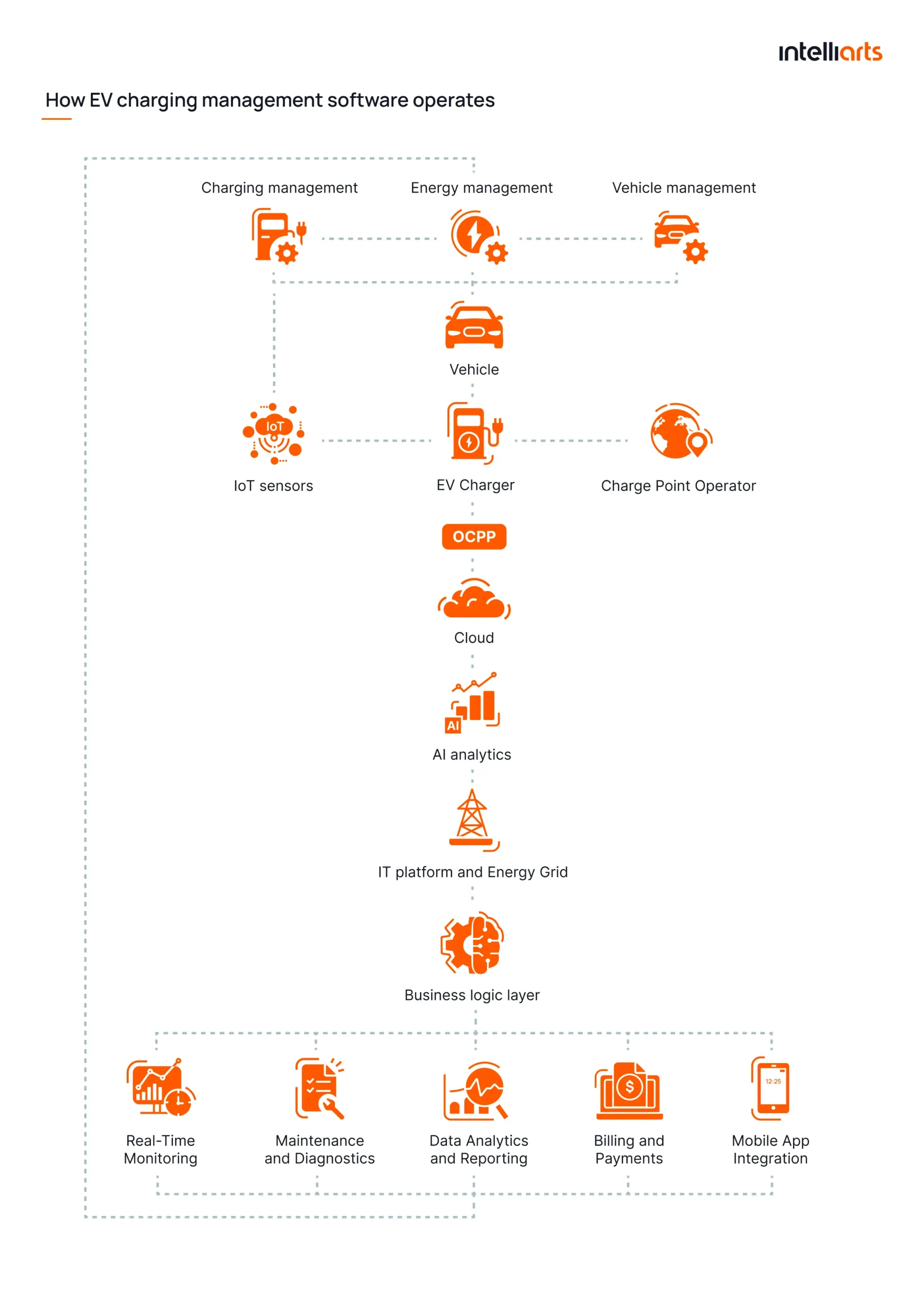
Note: The infographic and the instructions illustrate one of many possible approaches to structuring a flow of data with an EV charging management software in place. In certain scenarios, some components like mobile app integration or vehicle management may be absent, while others, like regulatory compliance, may be added.
Why do business owners and operators need EV charging management software?
Now, let’s focus more on the potential concerns of EV businesses and find out how exactly smart EV charging solutions address them. Information is available via the following infographics:
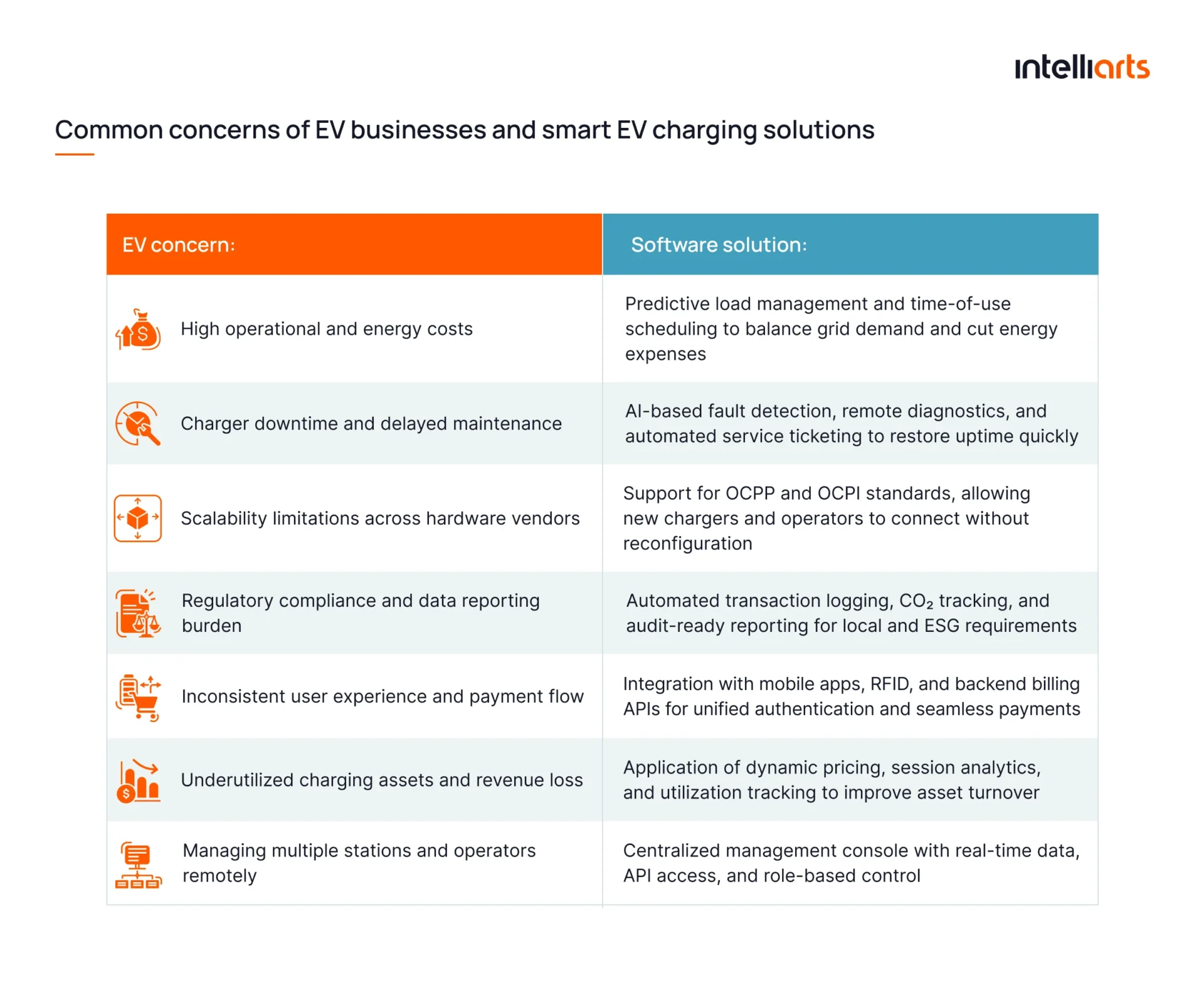
While indicated solutions already cover most of the EV and energy concerns, the actual usefulness of EV charging optimization software extends far beyond.
Niche-specific use cases of EV charging management software in business
While searching for a practical business solution, it’s best to leverage others’ experience. The following several cases reveal how exactly EV charging management software is used in practice:
Creating next-gen EV fleet management software: Success story by Intelliarts
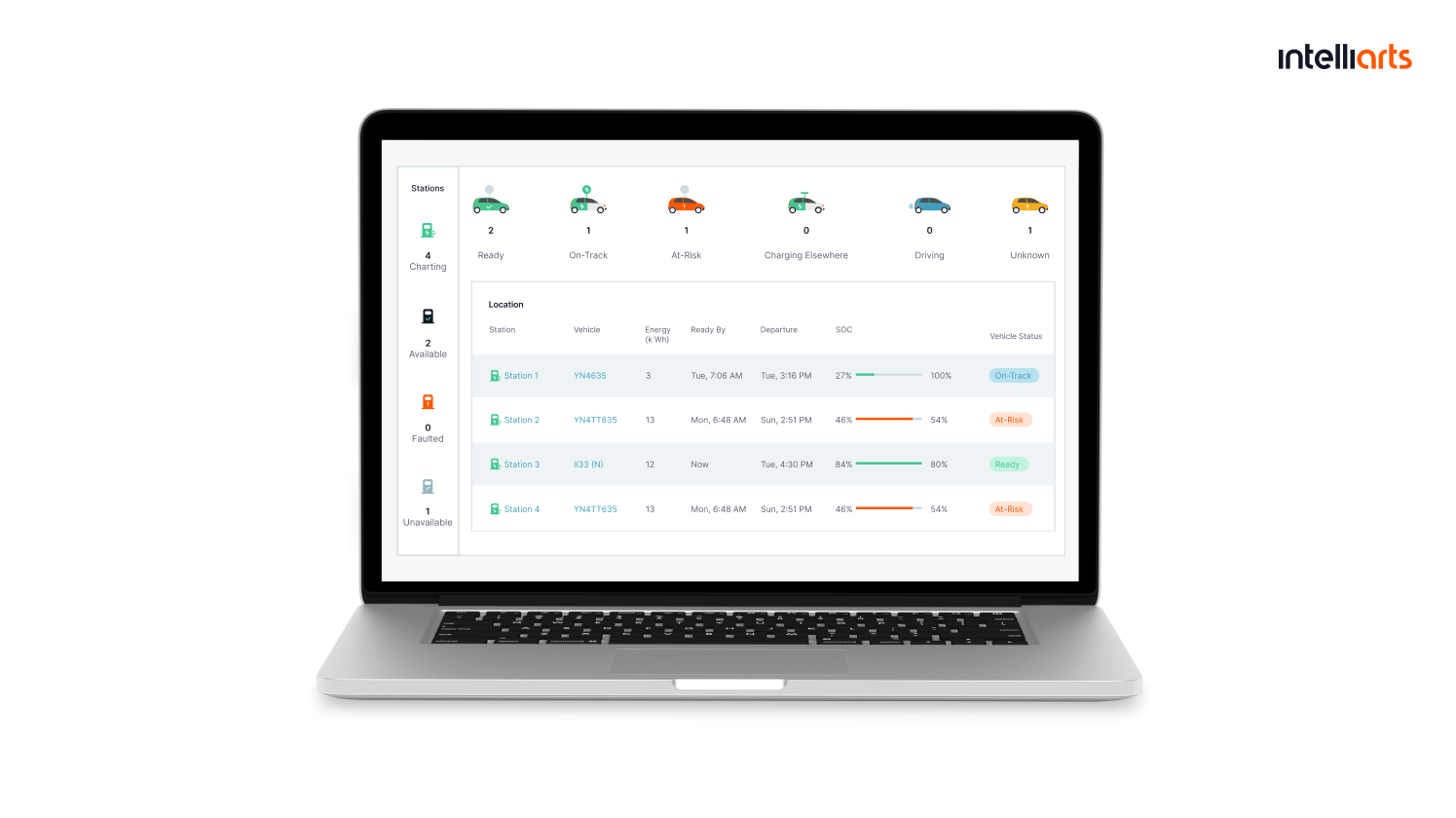
Challenge: The client sought to expand into the EV fleet management market but lacked software to efficiently control and optimize vehicle charging across diverse locations — depots, routes, and drivers’ homes.
Solution: Intelliarts built a next-gen EV charging management system integrating telematics, smart energy scheduling, and predictive analytics. The platform tracks EV status, charging sessions, and energy consumption in real time while prioritizing vehicles based on routes, schedules, and battery levels.
Results: The solution enhanced fleet efficiency, minimized charging downtime, optimized electricity use, enabled automated compensation for at-home charging, and provided analytics-driven insights for cost-effective, data-informed decision-making.
EV charging management platform for EVIQ: Success story by Intelliarts
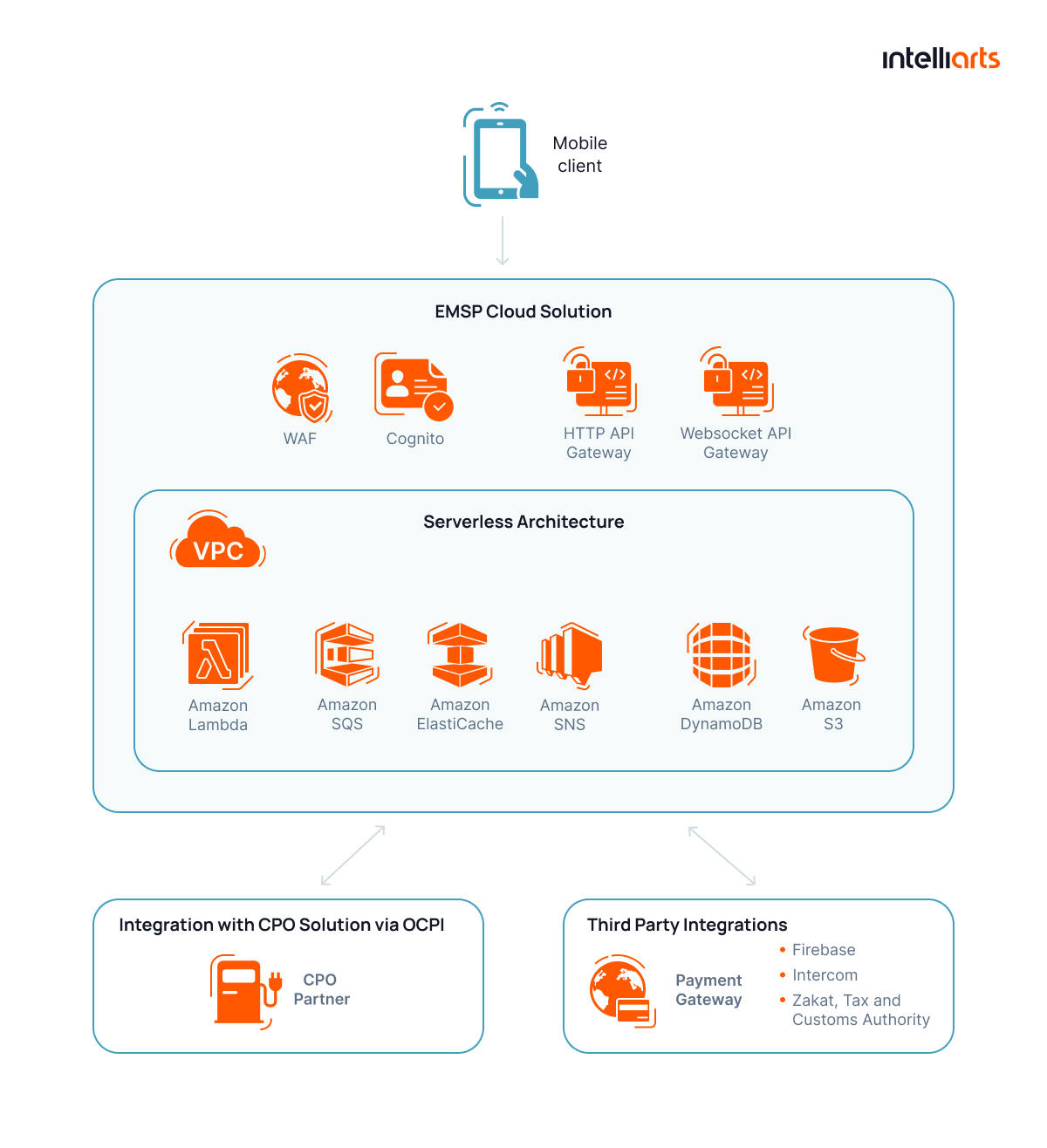
EVIQ Solution Architecture
Challenge: EVIQ, a leading Saudi e-mobility company, needed a custom EV charging management platform to oversee station performance, enable payments, and ensure ZATCA-compliant invoicing — all within a tight 6-month deadline. The solution had to scale with their growing nationwide charging network and meet local regulations and user experience standards.
Solution: Intelliarts designed and developed a serverless AWS-based EV charging management system, integrating local payment gateways, ZATCA e-invoicing, and OCPI protocol for future roaming. The platform enables real-time station monitoring, lifecycle management, and seamless charger onboarding/offboarding, paired with a bilingual mobile app in Arabic and English.
Results: Our team delivered the platform’s core modules faster than industry standards. More than that, we ensured full compliance, scalability, and smooth user experience. EVIQ now operates a robust, future-ready e-mobility ecosystem that supports rapid network expansion and long-term operational efficiency across Saudi Arabia.
Amazon & PowerFlex: Smart overnight fleet charging for a logistics business

Challenge: Amazon sought to electrify its delivery fleet while controlling depot energy use. The company needed a scalable solution to optimize overnight EV charging across hundreds of sites without overloading local grids.
Solution: PowerFlex implemented a smart load management system for 20,000+ chargers, using adaptive scheduling and real-time monitoring to balance charging demand and energy costs while ensuring all vans are ready by morning.
Results: Reduced peak demand, improved fleet reliability, and enabled cost-efficient overnight charging across 150+ logistics depots.
Barnet Council & Trojan Energy: Municipal charging hubs
Challenge: Barnet Council aimed to expand EV access for residents without home chargers by creating municipal charging hubs through public-private collaboration.
Solution: Partnering with Trojan Energy, the council deployed 500 streetlights and 793 ground-level chargers under a £5.19M OZEV-funded program, ensuring inclusive, on-street charging access.
Results: Enabled broad EV adoption, strengthened public-private infrastructure cooperation, and made sustainable mobility accessible to thousands of urban residents.
Choosing the right EV charging management software
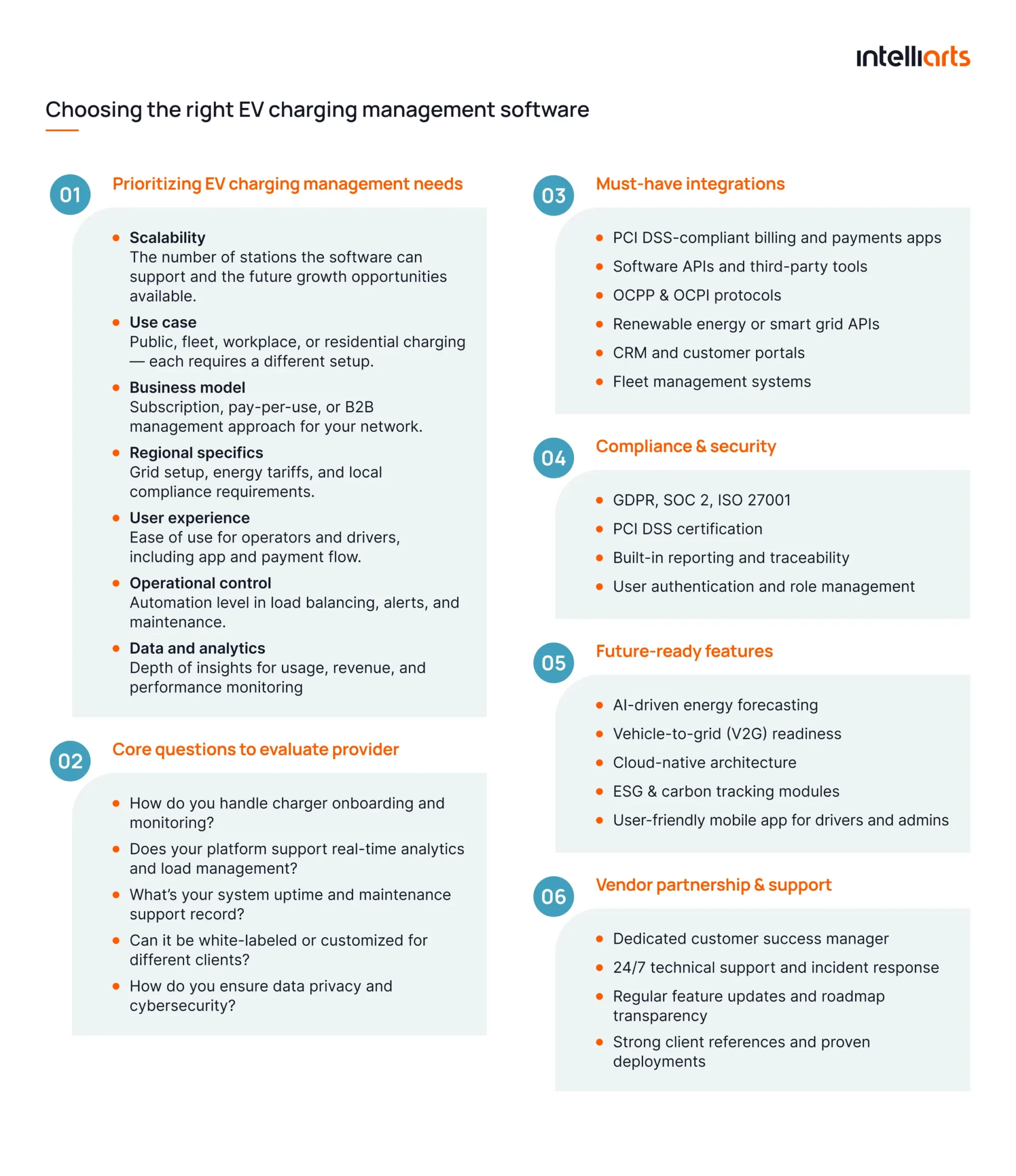
Since you are already well-versed with EV smart charging systems, the time is just right to explore how to choose such a software solution for your business. Using our vast experience, the Intelliarts team has gathered essential properties and features that a sufficient EV software should have, as well as tips for selecting software strategically.
#1 Define your EV charging management needs
Software usually differs in its monetization approaches, advantages, and weaknesses. Selecting your priorities correctly can help filter the least suitable options at the very beginning.
- Scalability. The number of stations the software can support and the future growth opportunities available.
- Use case. Public, fleet, workplace, or residential charging — each requires a different setup.
- Business model. Subscription, pay-per-use, or B2B management approach for your network.
- Regional specifics. Grid setup, energy tariffs, and local compliance requirements.
- User experience. Ease of use for operators and drivers, including app and payment flow.
- Operational control. Automation level in load balancing, alerts, and maintenance.
- Data and analytics. Depth of insights for usage, revenue, and performance monitoring
A platform built for public networks won’t necessarily fit fleet operations or depot charging. Realizing that the development should be purposeful and address core needs early can save months of rework. — Jurij Aulikh, an e-Mobility Software Engineer at Intelliarts.
#2 Core evaluation criteria
Ask vendors these questions:
- How do you handle charger onboarding and monitoring?
- Does your platform support real-time analytics and load management?
- What’s your system uptime and maintenance support record?
- Can it be white-labeled or customized for different clients?
- How do you ensure data privacy and cybersecurity?
#3 Must-have integrations
Your software should be able to connect with or have support for the following:
- PCI DSS-compliant billing and payments apps
- Software APIs and third-party tool
- OCPP & OCPI protocols
- Renewable energy or smart grid APIs
- CRM and customer portals
- Fleet management systems
#4 Compliance & security
Here are some non-negotiable aspects concerning the cybersecurity of an EV charging management software:
- Data protection. GDPR, SOC 2, ISO 27001
- Payment security. PCI DSS certification
- Audit readiness. Built-in reporting and traceability
- Access control. User authentication and role management
#5 Future-ready features
Ideally, your solution should support, or have in its development roadmap plans for the support of the following:
- AI-driven energy forecasting
- Vehicle-to-grid (V2G) readiness
- Cloud-native architecture
- ESG & carbon tracking modules
- User-friendly mobile app for drivers and admins
#6 Vendor partnership & support
Ensure that your provider has the following:
- Dedicated customer success manager
- 24/7 technical support and incident response
- Regular feature updates and roadmap transparency
- Strong client references and proven deployments
Important: Off-the-shelf EV charging management software may lack some functionalities you are looking for, while charging your business for features you may not even use. Not to mention that an external tool still requires custom software integration with your platform. That’s why it’s often recommended to strategize for having a custom EV charging management solution.
Future Trends in EV Charging Management Software
The EV industry is evolving rapidly. As of the end of 2025, we can note predominant digitalization, centralization, and attentiveness to Earth sustainability. Here are the main trends in the industry that are shaping the future decade:
- AI-driven energy forecasting. This trend focuses on using artificial intelligence to predict charging demand, electricity prices, and grid loads in advance. It helps optimize charging schedules, reduce costs, and prevent overloads.
- Vehicle-to-grid (V2G) integration. V2G technology allows electric vehicles to return stored energy to the grid or buildings. It turns EVs into mobile energy resources that support grid stability and efficiency.
- Cloud-native charging management platforms. Such systems are built entirely in the cloud. They are needed to enable real-time monitoring, scalability, faster updates, and easier integration with third-party services.
- Cybersecurity and user authentication. Here, the technology is applied to ensure the protection of charging infrastructure and user data. It relies on encryption, identity verification, and compliance with cybersecurity standards.
- EV fleet electrification and ESG reporting. Electrification is another approach to digitalization. It focuses on transitioning to electric fleets while simultaneously tracking carbon savings and energy use. This way, the technology can support sustainability metrics and reporting on environmental, social, and governance (ESG) goals.
Additional information on e-mobility technology trends is available in a white paper by Intelliarts.

Final take
EV charging management software centralizes control over energy use, billing, analytics, and integrations, this way making charging networks smarter and more profitable. Key ROI drivers include load balancing, predictive analytics, automation, interoperability, and dynamic pricing. The technology relies on IoT, AI, and cloud platforms to ensure seamless grid interaction.
Here at Intelliarts, we have over 25 years of experience delivering custom AI-powered solutions, including EV smart charging systems. With a focus on long-term partnerships — some lasting more than 15 years, and a team composed of 54% senior engineers, we’re well-qualified to take on your next project.
FAQ
What is EV charging management software and how does it work?
EV charging management software is a centralized platform that monitors, controls, and optimizes charging stations, helping operators manage operations, billing, and user access from a single dashboard.
What are the biggest challenges faced by Charge Point Operators (CPOs) in managing EV charging stations?
CPOs face challenges such as network reliability, interoperability between chargers, high maintenance costs, and complex billing management for public and private users.
How can EV charging management software improve the efficiency of station management across multiple hardware brands?
The software improves efficiency by unifying data from multiple hardware brands, enabling remote control, performance monitoring, and streamlined operations across all connected stations.